
How to Run Job Satisfaction Surveys That Actually Work
Learn how to run job satisfaction surveys that drive real change, from question design to action planning, with tips for frontline and distributed teams.
Dan Robin

You know the drill. Someone in leadership wants a read on morale, HR sends out a survey, the dashboard comes back with a neat set of numbers, and then everyone goes back to work as if the answers were the finish line. That's the part that drives me nuts. A job satisfaction survey is not a trophy. It's the start of a conversation, and if you stop at the score, you've mostly trained people to ignore the next survey.
I've seen this play out in offices, warehouses, clinics, and field teams. The pattern is always the same. People give you honest input when they think it will matter, and they go quiet when they learn nothing changes. The survey itself isn't the problem. The dead end after it is.
The Survey Nobody Asked For
Most bad survey programs begin with good intentions and lazy follow-through. A leader asks for a quick read on morale, HR sends a link, people click through it because they're polite, and the results land in a slide deck that nobody opens twice. That's not feedback. That's paperwork with better branding.
The sharper problem is trust. When people answer and then never hear back, they don't conclude that leadership is busy. They conclude that leadership didn't care enough to act. Once that happens, every future survey gets weaker. The signal drops because people start giving you safe answers, or no answers at all.
Practical rule: if the survey doesn't lead to a visible decision, a named owner, or a follow-up date, it shouldn't go out.
That's why I treat surveys as a loop, not a document. The point isn't to produce a clean report. The point is to find what's working, what's broken, and what needs attention next. A good program makes that path obvious before the first question is even written.
The rest of this comes down to discipline. Ask the right questions. Reach the right people. Separate mood from diagnosis. Then close the loop fast enough that people can see the difference. If you can't do that, save everyone the trouble and don't survey yet.
What Job Satisfaction Surveys Actually Measure
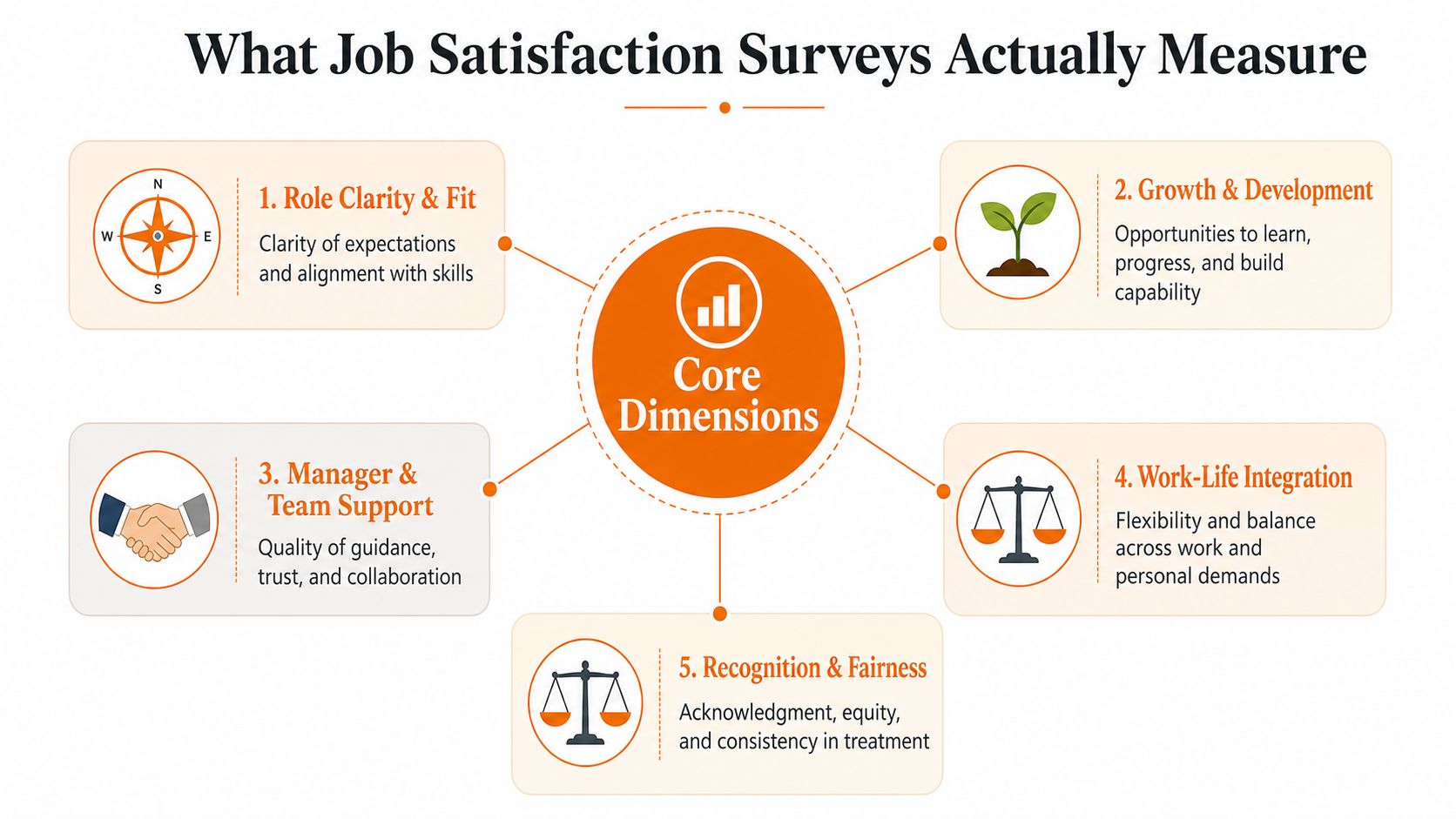
A job satisfaction survey is a way to measure how people feel about their work, but that definition is too blunt to be useful on its own. The value comes from splitting one broad feeling into the parts that create it. That's the difference between a mood check and a diagnosis.
Pew's 2024 benchmark is a good reference point because it shows both the headline sentiment and the details underneath it. 50% of U.S. workers were extremely or very satisfied with their job overall, 38% were somewhat satisfied, and 12% were not too or not at all satisfied, while 64% were satisfied with their coworkers, 59% with their manager or supervisor, and 58% with their commute among those who have one, according to Pew Research. That spread matters. People don't experience work as one feeling. They experience pay, people, process, and friction.
Global score versus facet score
The old mistake is to ask one question and call it insight. A global question tells you whether people are broadly happy or unhappy. A facet question tells you why. The National Longitudinal Surveys job satisfaction guide makes that split plain, and it's the right way to think about it.
Established instruments do this well. The Job Satisfaction Survey covers pay, promotion, supervision, benefits, contingent rewards, operating conditions, coworkers, nature of work, and communication, while the Job Diagnostic Survey also breaks the experience into multiple work dimensions. That design works because leadership can't fix “low satisfaction” in the abstract. They can fix a manager problem, a workload problem, or a clarity problem.
If you want to go deeper on the qualitative side, research methods with Kohru is a useful complement to survey data because it helps you hear the reasons behind the numbers without pretending the numbers explain themselves.
The practical test is simple. If your survey only tells you the mood, it's incomplete. If it also tells you where the friction lives, you can do something with it. That's the whole game.
Designing Questions People Will Actually Answer Honestly
Question design is where most survey programs go off the rails. People ask too much, word questions badly, and then act surprised when the answers are mushy. If you want honest input, the survey has to feel fair, short enough to finish, and specific enough to matter.
A strong survey uses multidimensional scales instead of one generic happiness question. That means you ask about pay, manager support, recognition, workload, growth, and day-to-day conditions as separate items. If you jam all of that into one question, you get a vague feeling. If you split it out, you can see where the pain is.
Keep the wording clean and the length human
I lean on plain guardrails. Avoid leading language. Don't write questions that push people toward approval. Give people a way to say “no emotion,” “no knowledge,” or “no certainty” when they're not sure. Forced precision is fake precision.
Indeed recommends keeping employee satisfaction surveys to 30 to 60 questions or roughly 20 to 30 minutes, using both multiple-choice and open-ended items, and offering no-emotion or no-knowledge options so people aren't forced into answers they don't have, as laid out in its survey guidance. That's not a random range. It's the difference between a survey people finish carefully and one they rush through while checking email.
A practical question bank usually includes one broad satisfaction item, then facet items that follow the actual work experience:
Pay and fairness: “I understand how my pay compares with the work I do.”
Manager support: “My manager gives me clear feedback.”
Workload: “My workload is manageable most weeks.”
Growth: “I can see a path to grow here.”
Recognition: “Good work gets noticed.”
Wellbeing: “My schedule gives me enough room to recover.”
Open-ended questions matter most when the score is either very high or very low, because that's where the reason usually hides.
If you want examples that are already structured for employee feedback, employee engagement survey questions examples is worth a look. For a separate writing aid, sample career statements for 2026 can help shape the kinds of growth prompts employees understand.
The rule is simple. Ask fewer questions, but make each one earn its place. That's how you get signal instead of noise.
Pulse Surveys Versus Full Diagnostic Surveys
Cadence is where smart programs separate themselves from sloppy ones. A pulse survey and a full diagnostic survey are not rivals. They do different jobs. If you use only one, you miss something important.
Here's the cleanest way to think about it. A pulse survey catches movement early. A deeper diagnostic survey tells you what caused it. One watches the weather. The other checks the roof.
Dimension | Pulse survey | Full diagnostic survey |
|---|---|---|
Length | Short | Longer |
Frequency | Monthly or quarterly | Quarterly or biannually |
Best use | Spotting trend shifts | Finding root causes |
Risk | Too shallow if used alone | Too slow if used alone |
A technically sound job satisfaction program uses a two-layer design with short monthly or quarterly pulses and deeper diagnostic surveys every 10 to 20 items quarterly or biannually, while treating groups with fewer than 8 to 10 responses as directional rather than statistically stable, according to MIHCM's guidance on employee satisfaction metrics. That threshold matters. Small groups can produce dramatic-looking scores that are just noise.
The danger with a pulse-only program is obvious. You'll know the mood moved, but you won't know why. The danger with a deep survey only is slower reaction time. By the time you notice a problem, people may already have adapted by leaving, disengaging, or checking out.
If the cadence is making your head spin, ways to calm an overactive mind is a useful reminder not to confuse more data with better judgment. The trick is restraint. Use the pulse for movement, the diagnostic for explanation.
For a practical breakdown of the lightweight version, what are pulse surveys and how do they work is a solid reference.
Reaching Frontline and Distributed Workers
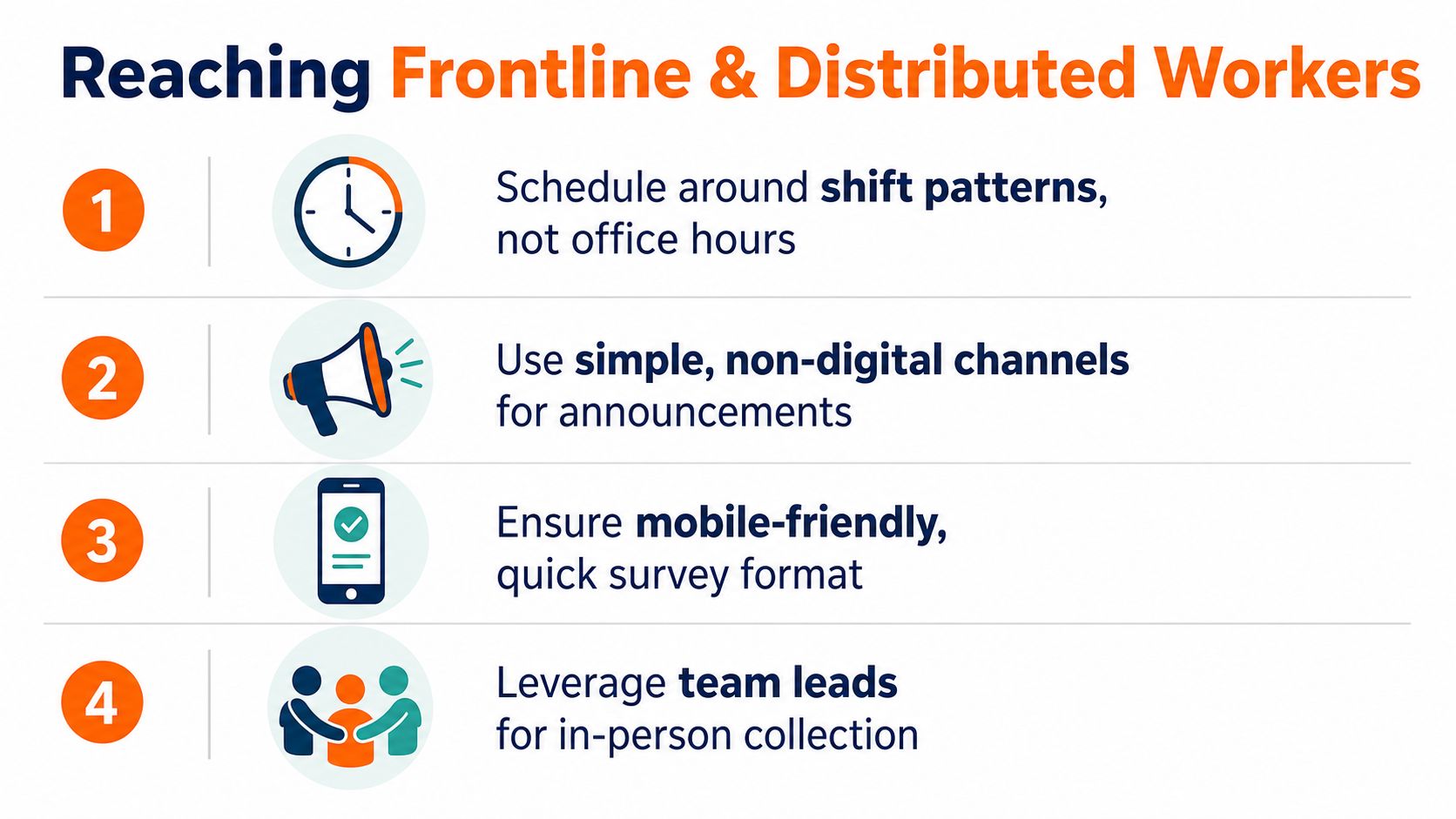
A lot of survey advice still assumes everyone sits at a desk, checks email all day, and has time for a tidy follow-up reminder. That's not how many teams work. If you want honest feedback from frontline staff, you have to meet them where they are, not where your survey tool prefers them to be.
The first rule is obvious, but it gets ignored all the time. Make the survey mobile-friendly. If someone is on a shift, in a store, on a ward, or out in the field, they're not opening a long form on a laptop. Give them a short link, a QR code, or a kiosk option on shared devices. Make the path short enough that they can complete it between tasks.
Segment by job reality, not just by org chart
Newer guidance recommends segmenting employees into targeted groups and tailoring survey blocks to role clarity, manager effectiveness, day-to-day operations, and working conditions, while warning that anonymity can break down in small teams unless managers only see results above minimum response thresholds, as noted by Spectra360's survey guidance. That's the right instinct. Different jobs create different friction, and one generic survey often misses it.
I'd be blunt about anonymity too. If a team is tiny, don't pretend the responses are fully anonymous in practice unless your reporting rules protect people. If a manager can guess who said what, trust gets damaged fast. Demographic questions can cause the same problem, so only ask what you need.
Practical rule: if you wouldn't show a report to a team without explaining how privacy is protected, the survey design needs more work.
Frontline programs fail most often. They collect responses from office staff, then assume the rest of the company is represented. It's a mistake. The people closest to the work are usually the ones whose experience is hardest to see from headquarters, and they're often the ones with the most useful insight.
Turning Scores Into Signal
A score by itself is decoration. The work starts when you ask what changed, where it changed, and for whom it changed. That's where segmentation and trend lines earn their keep.
The Conference Board reported in 2026 that overall job satisfaction reached 68.9%, the highest level in its 39-year survey history, edging up from 68.3% in 2025, according to its job satisfaction release. The useful part isn't just the record high. It's the small year-over-year movement. That's how you read a mature survey series, with attention to direction, not just the headline.
Read the score with context
A low score in one small team is not the same thing as a modestly low score across a large department. Size changes how much confidence you should put in the result. So does tenure, location, function, and manager. If you don't segment, you flatten real differences and miss the pockets that need help most.
I also care about the split between overall satisfaction and facet scores. If people say they're broadly fine but the manager or flexibility items are weak, that tells you exactly where to work. Established job satisfaction instruments split the overall view from facets like pay, promotion, supervision, benefits, coworkers, nature of work, and communication, and U.S. data show high satisfaction with coworkers at 64% and managers at 59% but much lower satisfaction with remote-work flexibility at 37%, as summarized in PositivePsychology's survey overview. That's the kind of contrast leaders need to see.
The honest move is to report three things together. The overall score, the key drivers, and the segments that are most at risk. Anything less is too flat to guide action.
Closing the Loop So People Trust the Next Survey
This is the part most companies skip, and it's the part employees notice first. A survey that disappears into a folder teaches people that their input has no consequence. A survey that comes back with a short, plain response builds trust.
Recent guidance recommends sharing survey results within two weeks, using a short action summary, and then checking whether employees saw improvements in the areas the company promised to change, paired with annual deep surveys and quarterly pulses for continuous tracking, according to TalentHR's survey guidance. That cadence is sensible because it keeps the conversation alive without turning every week into a project.

What to tell people after the survey
Don't overcomplicate it. Share the themes, name the top priorities, assign owners, and set a date to revisit them. If something won't be acted on, say so plainly and explain why. People can handle bad news. What they don't handle well is silence.
The worst version of this is the fake promise. Leaders say they'll fix everything, then fix nothing. That's worse than being honest about limits. A narrow, real action plan beats a broad, forgettable one every time.
Tell people what changed, not just what was heard.
The follow-up check matters because it proves the survey wasn't just ceremonial. If the next pulse shows no movement, say that too and adjust. That's how you build a feedback culture that doesn't collapse under its own weight.
Putting It All Together Without Spinning Up Another Tool
Most survey failures are coordination failures. The questions were fine, but the results sat in one tool, the action items lived in another, and nobody owned the loop between them. That is where survey programs stall. A clean process makes the survey, the discussion, and the follow-up work live together, so the feedback turns into action instead of a report that gets filed away.
Pebb handles that by bringing communication, tasks, and analytics into one app. A survey can go out where people already work, the results can be shared quickly, and the follow-up items become tracked work instead of wishful thinking. For distributed teams, that setup matters. If employees have to jump across tools just to answer and then hear back, participation drops fast. For teams trying to reduce tool sprawl, internal communication platforms are worth a close look, because they keep the conversation and the next step in the same place.
The best survey programs do three things well. They measure the overall experience and the specific drivers behind it, they protect privacy for smaller or frontline groups, and they close the loop fast enough that people notice. They also separate two jobs that often get blurred together, measuring mood and finding what to fix. A survey can tell you where sentiment is slipping. It does not fix the root cause on its own.
That is the standard I use when I look at any survey stack. If the process depends on email threads, spreadsheets, and scattered follow-ups, it is too easy for good feedback to disappear before anyone acts on it. Keep the workflow tight, keep ownership visible, and make the next step easy to track. Then visit Pebb and see how one place for communication, tasks, and analytics can turn a survey into a real feedback loop.
