
How Do I Measure Employee Engagement?
Learn how do i measure employee engagement with a practical, human-centered approach that reveals what really drives your team's performance.
Dan Robin
For years, employee engagement felt like a corporate ritual. We’d get the big annual report, see a number tick up or down a few points, and then… nothing much would change. It was a sterile process, completely disconnected from the actual work.
The intention was good. The execution wasn't.
Stop Chasing Scores. Start Understanding People.
Chasing a single, abstract engagement score is like trying to understand a relationship by only looking at an anniversary on a calendar. It misses everything that matters: the daily interactions, the small gestures, the real conversations. This guide is about flipping that script. We’re going to walk through how to move from a disconnected annual event to a continuous, honest dialogue with your team.
Here’s the thing: the number is just the start of the conversation, not the end of it.
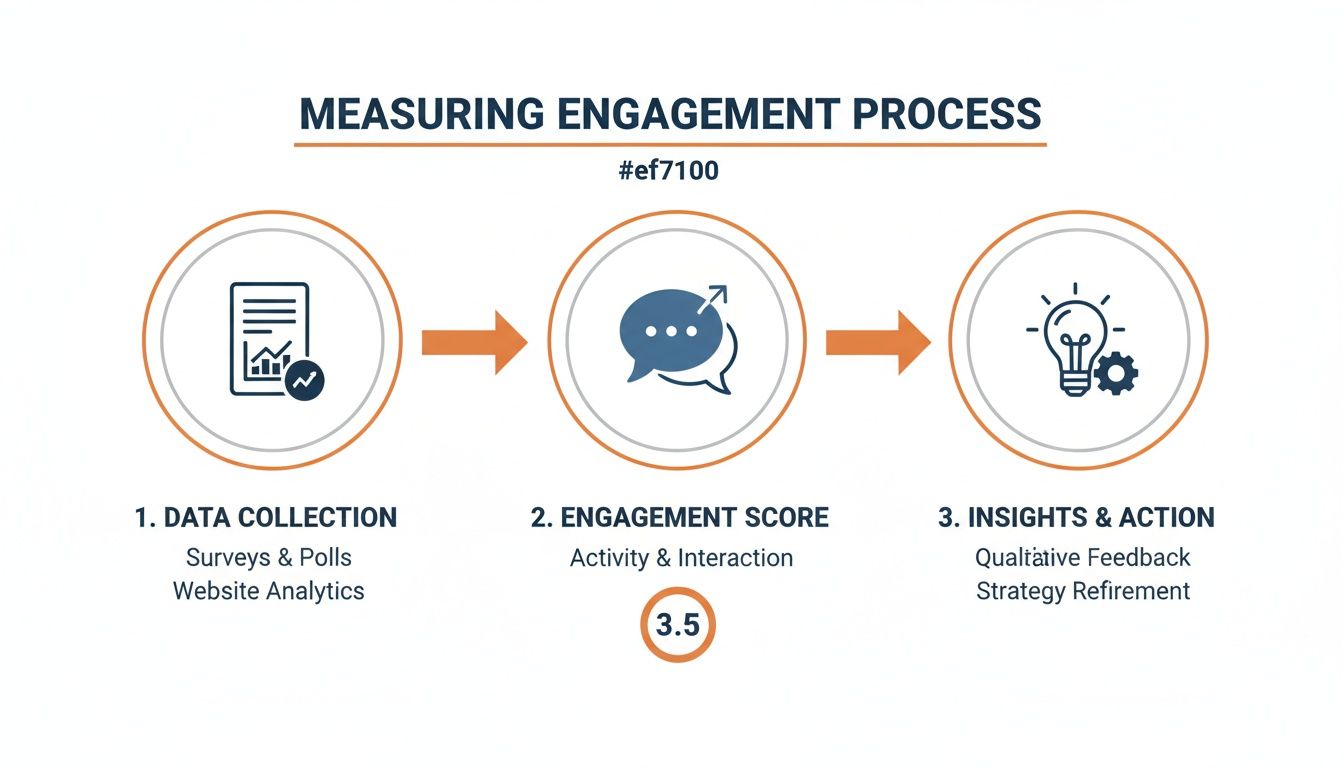
The score is just the beginning of the story, not the end.
What Really Matters
From my experience, real engagement isn't in a spreadsheet. It’s visible in the day-to-day rhythm of work, especially with the frontline teams who are the lifeblood of any business.
You see it when a manager checks in after a tough shift. You hear it when a team member celebrates a small win in a group chat, or when someone feels comfortable enough to ask for clarity on a company update.
Engagement is the texture of daily work, not just a metric on a dashboard. It’s about creating an environment where people feel seen, heard, and connected to the mission, even on the busiest days.
Beyond the numbers, genuine understanding comes from digging into what motivates people, like fostering a growth mindset. When people believe they can develop their abilities, their investment in their work deepens. It’s that simple. It comes back to seeing them as people, not data points.
So, how do you measure engagement in a way that feels human and sparks real change? You start by asking better questions and paying attention to what’s happening on the ground. You have to connect the what (the data) with the why (the human experience).
It requires a new playbook, one that prefers:
Continuous listening over infrequent, formal surveys.
Human context to explain the numbers.
Helping managers solve problems, instead of top-down directives.
This isn't about more work. It’s about making the work you’re already doing more meaningful. It's time to measure what matters.
Choosing Metrics That Actually Mean Something
Before you ask a single question, let’s be honest about what you’re trying to do. Are you fighting high turnover in your stores? Trying to figure out why customer satisfaction scores are dipping? Or maybe you just need to boost productivity on the warehouse floor.
“Engagement” itself is too vague. A ghost. You have to connect it to real business outcomes, or you’re just collecting numbers for the sake of it.
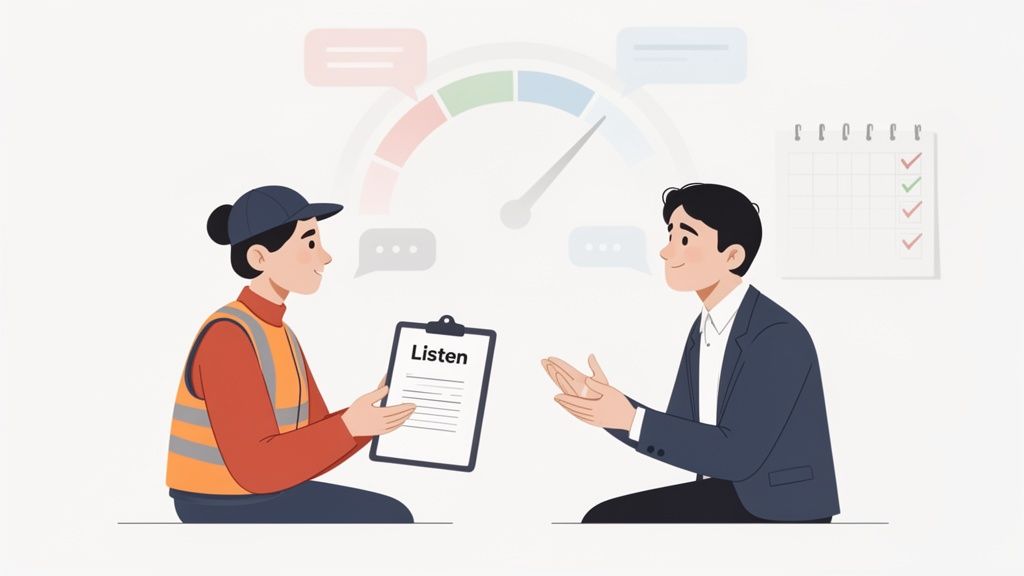
The real work is building a balanced view—one that combines what people feel with what they do.
Go Beyond The Survey
For years, we’ve leaned on surveys. They’re great for understanding sentiment—the why behind people’s actions. This is crucial, but it's only half the story.
The other half is behavioral data—the what.
This isn't about playing Big Brother. It’s about seeing the natural signals of a connected team. Modern tools let you see how work actually happens.
Communication Flow: How many people are reading critical company updates? Who is acknowledging them?
Team Collaboration: How actively are teams interacting in their digital workspaces? Is knowledge being shared?
Operational Consistency: How consistently are daily tasks or pre-shift checklists completed?
These signals tell a powerful story. They show you engagement in action, not just in theory. When you see that your most collaborative teams also have the lowest absenteeism, you've found something real. That's how you start to measure what matters.
Combining The "What" And The "Why"
So, how do you build a framework that gives you the whole story? You need a mix of metrics. One without the other is like navigating with half a map.
A high survey score from a team that never reads important safety updates is a warning sign, not a success story. Conversely, a team that completes every task but feels unheard is a flight risk.
Over the last decade, employee engagement became a core business indicator because we can now measure it. Gallup's research shows that engagement is fragile; their global data shows the rate fell to 21% in 2024, only the second decline in 12 years, costing the global economy trillions.
This drop underscores why smart measurement is so vital. The key is to connect these broad trends to your own operations. By blending different types of data, you create a richer picture of your organization's health.
A Modern Approach to Engagement Metrics
Let’s get practical. The old way was siloed and slow. A modern approach is integrated and continuous. It’s about the full picture, not just a snapshot.
Here’s a simple comparison of how to think about your measurement strategy.
Metric Category | The Old Way (Lagging Indicators) | The Modern Way (Leading & Lagging Indicators) |
|---|---|---|
Sentiment | Annual engagement survey scores | Frequent pulse surveys (e.g., weekly eNPS) and sentiment analysis from team chats. |
Productivity | Quarterly revenue per employee | Task completion rates, project cycle times, and customer satisfaction scores linked to specific teams. |
Retention | Annual turnover rate | Flight risk analysis based on sentiment, manager one-on-ones, and participation in growth opportunities. |
Communication | Manager-reported feedback | Read receipts on critical updates, interaction rates in team channels, and knowledge sharing frequency. |
This isn't about adding work; it’s about using the data you already have in a smarter way. Platforms like Pebb centralize this information, turning daily operational data into clear engagement signals without anyone filling out another form. You can dig deeper into which employee engagement metrics are most effective in our detailed guide.
Choosing the right metrics isn’t an HR checklist—it’s a business strategy. It’s about moving from guessing to knowing, and from reacting to turnover to predicting it. It’s how you start having the right conversations with the right people at the right time.
How to Design Surveys People Actually Want to Answer
Let's be honest: the 50-question annual survey is dead. It’s a chore for your team to fill out, and by the time you get the data, the problems you were trying to solve have already changed.
We’ve all been there—staring at a long form, trying to remember how we felt about a project six months ago. That’s not a conversation; it’s an exercise in compliance. The right way to do this is with a smart mix of light, regular check-ins and the occasional thoughtful deep dive.
So, let's talk about making surveys that work.
The Art of the Simple Question
The secret to a great survey isn't clever questions; it's clarity. Your only goal is to write simple, direct questions that encourage honest answers. Cut the jargon. Avoid multi-part questions. Ditch anything that makes people stop and wonder what you're really asking.
For instance, a question like, “How would you rate the synergistic alignment between departmental goals and overarching corporate strategy?” is a great way to get blank stares.
Instead, just ask: “Do you understand how your work contributes to the company’s goals?”
See the difference? One tries to sound smart. The other wants a real answer. Learning how to create a questionnaire built for clarity is the foundation for getting insights you can use.
Good questions feel easy to answer. They respect a person's time by getting straight to the point. The simpler the question, the more honest the answer.
The best strategy is to blend two types of surveys into a consistent rhythm: quick pulse checks and deeper dives.
Pulse Surveys for a Real-Time Signal
Think of a pulse survey as a quick check-in—usually two to five questions sent weekly or bi-weekly. Its job is to give you a real-time signal of your team’s morale and immediate challenges.
This is your early warning system. It helps you catch small issues before they snowball.
Here are a few examples:
On a scale of 1-10, how would you rate your week? (A classic that gives you a quick baseline.)
Did you get the support you needed from your manager this week? (A simple Yes/No.)
What’s one thing that would have made your week better? (An open-ended question that provides crucial context.)
They aren’t profound, and that’s the point. They're simple enough for someone to answer on their phone in 30 seconds between tasks.
Deep Dives for Deeper Understanding
While pulse surveys tell you what is happening, deeper surveys—sent maybe once or twice a year—help you understand the why. These are a bit longer, maybe 10-15 questions, and they explore topics like career growth, leadership, and company culture.
Even here, simplicity is your friend. Frame questions around concrete experiences.
For example, instead of asking, “Do you feel empowered?” which is abstract, try breaking it down:
Do you have the autonomy you need to do your job well?
Are you comfortable sharing your ideas with your manager?
Do you see clear opportunities for growth here in the next year?
Questions like these give you specific areas to work on. For more inspiration, we’ve put together a list of proven employee engagement survey questions and examples you can adapt for your own teams.
Meet People Where They Are
Here’s the thing that trips up so many engagement programs: delivery. You can design the world’s best survey, but if it’s buried in an email inbox that your frontline workers rarely check, it’s useless.
To get answers, you have to meet people where they work. For your desk-based teams, email might be fine. But for the 80% of the global workforce that doesn't sit at a desk—the nurses, retail associates, and warehouse staff—you need a mobile-first approach.
This means sending surveys to their phones, in their language, right inside the app they already use for work. A tool like Pebb makes this easy. A store manager can send a quick poll about a new inventory process and see the results in real-time.
They don't wait three months for a corporate report. They get instant feedback they can act on immediately. That’s how you turn measurement into a conversation, and a conversation into change.
Look Beyond Surveys to See the Full Picture
What people do often tells you more than what they say. This is where you find the real story of engagement, tucked away in the everyday rhythm of your business.
Engaged employees don’t just check a box on a survey; they show up differently. You can feel it. A high score is nice, but the real proof is in the small, consistent behaviors that signal a connected team. It’s about learning to see those signals.
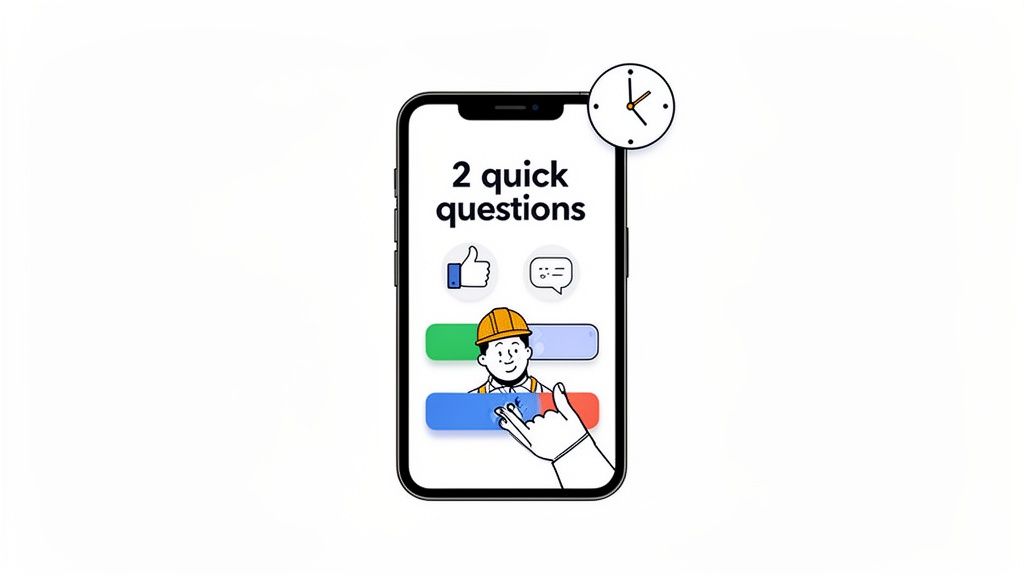
It’s time to tap into the behavioral data your operations are already generating.
Finding the Truth in Daily Actions
Think about the simple but powerful signals that exist right now in your company. These are tangible signs of a healthy team. You just have to know where to look.
We’re talking about things like:
Acknowledgment Speed: How quickly are important announcements seen by the team? A fast response isn't just about compliance; it’s about attention and respect for shared information.
Proactive Knowledge Sharing: Are people sharing helpful tips in team channels without being asked? That’s a sign of someone who cares about their colleagues' success.
Consistent Participation: Is there steady participation in daily huddles or shift check-ins? Consistency shows people are invested in the team’s rhythm, not just going through the motions.
When your team’s communication and tasks live in one place, like they do in a platform like Pebb, you start to see these patterns clearly. You might discover that the stores with the highest interaction in their team channels also have the lowest turnover.
That's not a coincidence. That's a direct line between behavior and a critical business outcome.
Why This Data Is More Honest
Let’s be real for a minute. People sometimes give the "right" answer on a survey. They might feel pressure to be positive, or they might not even realize how they truly feel until their actions show it.
Behavioral data cuts through that noise. It’s an unfiltered look at how work actually gets done and how people are truly connecting—or not. It’s the difference between someone saying they’re a team player and you seeing them consistently helping a new hire.
What people do in the flow of their work is the most honest feedback you'll ever get. It’s not an opinion; it’s evidence.
The financial case for this is undeniable. Gallup’s research shows that business units in the top 20% for engagement see 41% lower absenteeism and a 43% difference in turnover. They also report 23% higher profitability.
This makes engagement a P&L issue, not just an HR one.
How to Start Looking
You don't need a complex analytics team to start seeing these patterns. The first step is to simply start paying attention.
Begin with a few simple questions:
Where does our most important information get shared? Look at the read rates and acknowledgment times.
How do our teams solve problems together? Observe the back-and-forth in team channels. Are people asking for help and getting it?
Are operational basics being met consistently? Track task completion. Are there teams that are always on top of it?
By shifting your focus from just asking people how they feel to also observing what they do, you get a much more complete and honest answer to "how do I measure employee engagement?" We’ve written more about real engagement tactics that go beyond surveys if you're ready to dig deeper.
This isn’t about surveillance. It’s about understanding the health of your company through the most reliable data you have—the actions of your people. It’s about seeing the full picture.
Now What? How to Turn Data into Action.
Alright, let's get this data working for you. You’ve gathered the surveys, pulled the numbers, and now you’re staring at a dashboard. This is where so many engagement efforts fizzle out.
Honestly, a dashboard by itself is useless. Data without action is just an expensive hobby.
This last part of the process is everything. It’s where you translate information into real conversations and, more importantly, real change.
Find the Story on the Ground
First things first: ignore the company-wide average. I'm serious. It’s a vanity metric that smooths over all the important bumps. An overall score of 75% might sound decent, but it tells you nothing about what's really happening.
The real gold is always local. It’s hidden within specific teams, shifts, and locations. Your mission is to dig in and find those stories.
An insight like, "The night shift at the Chicago warehouse feels out of the loop," is a hundred times more valuable than, "Company communication scores are down 2%." One is a problem you can solve. The other is just a number.
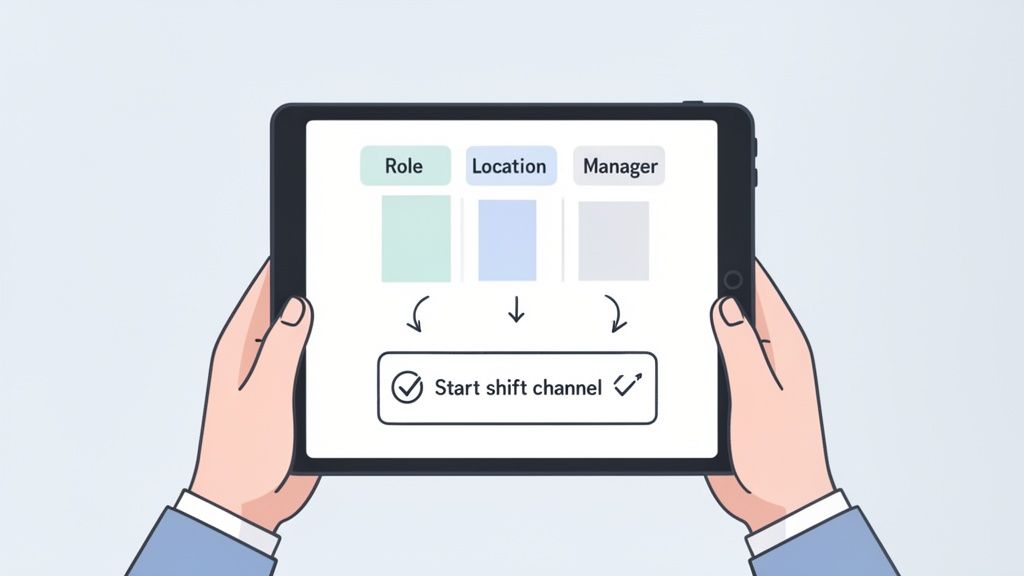
Start slicing your data right away. Don’t stop at the department level. Break it down by:
Manager: Engagement is overwhelmingly a team sport, and the manager is the coach. This is often the most revealing filter.
Location: Are your city teams having a different experience than your rural ones?
Role: How do your delivery drivers feel compared to the folks in the store?
Shift: Is there a difference between the opening crew and the closing team?
This is how you get past the averages and find the real issues. You might discover that one manager’s team has an eNPS of +50 while another team in the same building is struggling at -20. Now that's a place to start.
From Insight to Action
Once you pinpoint a problem, resist the urge to launch a big corporate program. The best approach is to get the information to the person who can fix it: the frontline manager.
Let’s stick with our Chicago warehouse example. The data shows the night shift feels disconnected. A top-down "communication initiative" from HQ is probably doomed. It’s too slow and generic.
Instead, a better move is to sit down with the night shift manager. Show them the specific, anonymous feedback and work together to brainstorm a few simple actions they can try this week.
It could be something as small as:
Starting a dedicated channel in your team app just for end-of-shift updates.
Blocking off 15 minutes at the start of every shift for a quick huddle.
Making a personal commitment to answer every question in the team chat within a few hours.
See how small and specific those are? We're looking for the smallest possible change that could make the biggest difference. The goal is tangible improvement, not a perfect presentation.
Set a New Baseline and Track Progress
After you've turned an insight into a local action, you need to close the loop. How will you know if it's working?
Don't wait for the next big survey. Send a quick pulse survey to that specific team in a few weeks. Ask a simple question like, "On a scale of 1-5, do you feel more connected to the team than you did a month ago?"
You can also look at your behavioral data. Has interaction in that team’s digital workspace picked up? These are the real-time clues that tell you if your small change is having a big impact.
This constant rhythm of Listen -> Understand -> Act -> Measure is the true engine of engagement. It’s not a project; it’s just the way a healthy company operates. You'll quickly move from asking “how do I measure employee engagement?” to truly improving it, one team at a time. The goal isn't just to hit a score—it's to make work a little bit better, every day.
Got Questions? We’ve Got Answers.
Even when you're all-in on measuring engagement, a few practical questions almost always come up. It's normal. Shifting from the old way of doing things to a more human approach feels different. Here are a few of the most common questions we hear.
How Often Should We Be Measuring Engagement?
There’s no magic number here, but what matters is a consistent rhythm. Think less "big annual event" and more "continuous conversation." The old way trained people to give feedback once a year; we want to make it feel natural to share it anytime.
We've seen great success with lightweight pulse surveys—just two to five simple questions—sent weekly or bi-weekly. This gives you a real-time finger on the pulse without causing survey fatigue.
Then, pair those with a more comprehensive survey once or twice a year to dig into bigger topics like career growth and company culture. The goal is to build a reliable feedback loop, not just run another corporate initiative.
What's the Real Difference Between Engagement and Happiness?
This is a crucial distinction. Happiness is a person's feeling of contentment. It’s important, but it can be temporary and isn't always linked to performance.
Engagement, on the other hand, is an emotional commitment to the company's mission and a desire to help it succeed.
A happy employee might be content doing the bare minimum. An engaged employee is invested and actively looking for ways to help the team win.
Your goal isn’t to measure happiness; it’s to measure engagement. Why? Because engagement is what fuels better work, lowers turnover, and drives a healthier bottom line.
How Do We Get Managers to Actually Use This Data?
This is everything. Data is useless if it sits in a dashboard. The secret is to make it simple and immediately relevant for your frontline managers.
Here’s our playbook for that:
Keep it local. Don’t bury managers in a 50-page report. Give them a simple snapshot showing data only for their team.
Frame it as a tool, not a test. Presenting data as a judgment is a surefire way to get them to ignore it. Position it as a tool to help them solve their biggest headaches, like reducing shift turnover.
Suggest concrete actions. Never just show a manager a low score and walk away. Suggest two or three simple things they can try, like starting a weekly recognition thread or using a poll for the next team meeting.
When you make the data simple, relevant, and actionable, managers will use it. Not because they have to, but because it makes their jobs easier.
Ready to stop chasing scores and start a real conversation with your team? Pebb unifies communication, operations, and engagement in one simple app, giving you the tools to measure what matters and take meaningful action. See how Pebb can help your teams connect and thrive.
