
Revolutionize Work: Top Employer Engagement Activities 2026
Discover 10 real employer engagement activities for 2026 that build a strong culture. From recognition to feedback, find what your team truly values.
Dan Robin

Most advice about employer engagement activities is junk food. It looks fun. It feels easy. And it fades fast.
Pizza parties, office games, and one-off happy hours aren't useless. They're just not the thing. Engagement isn't a party. It's a practice. It lives in the daily rhythm of work, in whether people know what's going on, whether their manager follows through, whether good work gets noticed, and whether the job feels organized instead of chaotic.
That matters even more if your people don't sit at desks all day. A warehouse picker, a nurse on a night shift, a restaurant supervisor, a field tech. They don't need another perk designed around office hours. They need clarity, access, and respect. They need systems that fit the specific work they do.
Gallup's long-running engagement tracking has made this plain for years. In 2017, Gallup reported that 85% of workers worldwide were not engaged or were actively disengaged, and by early 2022 Gallup reported 32% engagement among full- and part-time employees in the U.S., versus about 20% globally, as summarized in this review of Gallup engagement benchmarks. Engagement has never been a fluffy side topic. It sits right in the middle of communication, trust, recognition, and safety.
I've seen this up close on office teams, distributed teams, and operational teams. The activities that work aren't flashy. They're consistent. Some are simple. None are accidental. If you want a lighter morale boost too, fine. You can even discover how coffee boosts team energy. Just don't confuse that with the core work.
1. Employee Recognition and Rewards Programs
Recognition does not fail because companies care too little. It fails because they make it too slow, too vague, and too office-centric.
Frontline teams feel this first. A warehouse lead who stays late to fix a picking issue, a nurse who helps stabilize a rough shift, a store associate who trains a new starter on the fly. That work rarely shows up in a quarterly award cycle. If your recognition system depends on desk time, formal nominations, or HR chasing managers for submissions, a big part of your workforce gets ignored.

Build recognition into daily operations
Good recognition is immediate, specific, and easy to give from a phone. It should fit the pace of real work, especially in healthcare, hospitality, logistics, retail, and field teams where people are moving all day and may never open a laptop.
That means your system should let managers and peers post praise in the moment, attach it to a clear action, and share it where the team can see it. A public feed matters because it reinforces standards. People learn what the company values by watching what gets recognized.
Use a simple setup:
Name the action: Praise the extra shift covered, the customer issue resolved, the clean handoff, the safety step, or the help given to a new hire.
Make it visible: Shared recognition creates a running record of what good work looks like across locations and shifts.
Let peers contribute: Coworkers catch effort and reliability that managers miss.
Reward consistency, not just heroics: Daily dependability holds operations together.
If you need practical formats, messages, and reward ideas, this list of employee recognition program ideas is useful.
One rule matters more than the rest. If recognition takes more than a minute to send, usage drops.
This is also where unified employee tools matter. A platform like Pebb makes recognition easier to run across frontline and office teams because updates, shout-outs, chats, and team spaces sit in one place instead of being split across email, paper notices, and whatever app a manager happens to prefer. That matters at scale. Recognition only helps culture if everyone can access it, not just headquarters.
Done well, recognition improves more than morale. It strengthens retention, raises standards, and gives employees proof that good work gets noticed here. That is why it belongs near the top of any serious employer engagement plan.
2. Onboarding and New Hire Integration Programs
Most onboarding is a document dump with a cheerful welcome message attached. New hires sit through policy slides, sign forms, and then spend the next few weeks guessing how the place works.
That first stretch matters more than people admit. A new employee decides quickly whether the company is organized, whether managers are available, and whether asking for help is safe. You don't need an elaborate program. You need a clear path.
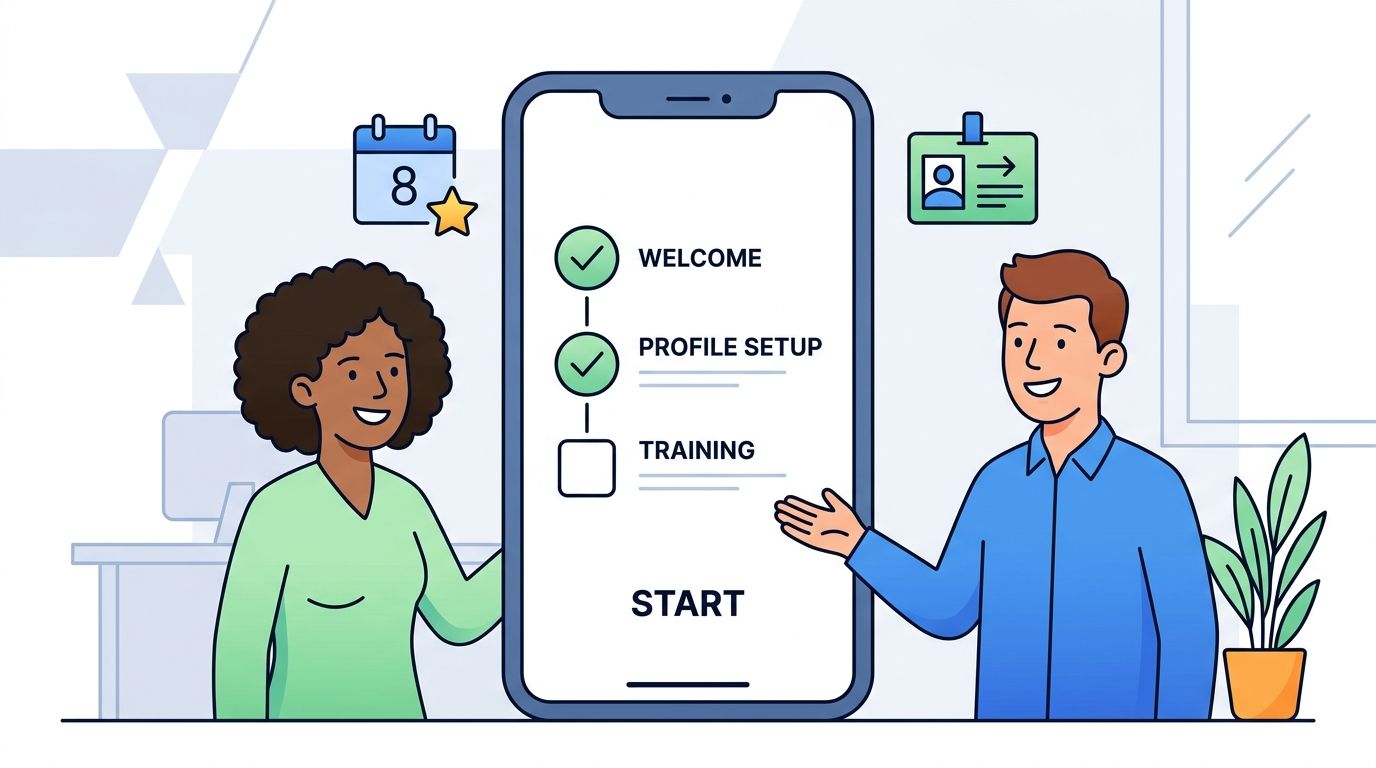
Give people a map, not a maze
Good onboarding has three parts. First, job basics. Second, relationship basics. Third, rhythm.
That means role-specific training, a real human buddy, and a short sequence of check-ins. It also means putting everything in one place. Policies, training videos, shift instructions, team contacts, escalation paths. Don't make a new hire hunt through email, chat, binders, and memory.
I've seen teams do this well with a mobile-first hub that includes Spaces for each function, a searchable people directory, and a knowledge library. That's especially useful in healthcare, hospitality, logistics, and retail, where people may start on a shift before they ever sit at a laptop.
A few habits make the difference:
Assign one owner: Someone should be responsible for the new hire's first weeks.
Write the basics down: "Ask Sarah if you're stuck" is not a system.
Schedule short check-ins: Day one, end of week one, and then regularly after that.
Ask for friction points: New hires spot broken processes fast.
New people don't need more information. They need the next right thing.
Google and Zappos are often cited for structured onboarding because they combine culture, guidance, and support instead of treating onboarding as paperwork. That's the bar. Not fancy. Clear.
3. Team Building and Collaborative Experiences
Most team building dies because it tries too hard. Forced fun is still forced.
The better approach is lighter and more regular. Give people chances to work together, talk outside the immediate task list, and solve something side by side. That can be a virtual session, a cross-team working group, a short in-person activity, or a simple shared project. It doesn't have to be expensive to be useful.

Keep it inclusive and low-pressure
What works for an office team on a Thursday afternoon often fails for a shift-based team spread across locations. That's where a lot of employer engagement activities fall apart. They were designed for the head office, then awkwardly pushed onto everyone else.
A better pattern:
Offer more than one format: In-person if local, virtual if not.
Design around schedules: Don't assume everyone is free at the same time.
Make participation easy: No long setup. No extra admin.
Prefer repeatable activities: A quarterly offsite is nice. A steady team ritual is better.
If your team is remote or mixed, these virtual team building activities can help you avoid the usual cringe.
Research on employer participation in broader engagement settings points to a simple truth: participation has to be user-friendly, broad, and not overwhelming, as noted in this employer engagement activity guide. That's just as true inside a company. If joining feels like work, people skip it.
4. Internal Communications and Company-Wide Announcements
If people learn important news through rumors, your engagement problem isn't cultural. It's operational.
Internal communication should be boring in the best way. Reliable. Predictable. Easy to find. Every employee should know where updates live, what counts as official, and how to ask follow-up questions. When that doesn't happen, people fill the gaps themselves.
Stop broadcasting. Start clarifying.
I've seen companies send polished leadership updates that answer none of the practical questions employees have. People don't just want the announcement. They want context. What changed, why it changed, what happens next, and whether it affects their schedule, pay, tools, or team.
The tools matter here. A central news feed, announcement channels, recorded all-hands, and comment-enabled posts beat scattered email threads every time. That's why so many companies now want communication inside the same place where work and operations already happen.
There's a larger shift behind this. One market estimate values employee engagement software at USD 3.2 billion in 2024 and projects it to reach USD 6.1 billion by 2030, with cloud-based platforms representing 72% of the market in 2024, according to this employee engagement software market estimate. The reason is straightforward. Companies don't want engagement trapped in annual surveys and disconnected tools. They want always-on communication and faster feedback loops.
A good announcement answers the follow-up question before people have to ask it.
5. Professional Development and Learning Opportunities
People don't stay engaged when the job feels like a dead end. They might stay employed. That's different.
Professional development doesn't need to mean expensive courses for a small group of high potentials. In practice, the strongest programs are usually broader and more ordinary. Better training for current work. Clear paths into the next role. Access to mentors. A place to store what the team has already learned.
Make growth visible
Amazon's Career Choice and Starbucks' College Achievement Plan get attention because they show a real commitment to employee growth. But the useful lesson isn't "copy the brand-name benefit." The lesson is to connect learning to a next step employees can see.
That can look like supervisor training for team leads, cross-training between departments, lunch-and-learns, certification prep, or a library of short mobile lessons for shift workers. If your organization uses a unified app, create dedicated spaces for training, keep policies and guides in a knowledge library, and let managers recognize progress publicly.
Three rules keep this grounded:
Teach for the current job and the next one
Make learning mobile-friendly
Link training to opportunity, not theater
A forklift operator who wants lead responsibilities, a medical assistant who wants scheduling authority, a store associate who wants to move into inventory control. Those are the pathways that keep learning real.
6. Wellness and Work-Life Balance Initiatives
A wellness program that adds more tasks to people's lives isn't helping. It's another obligation wearing a friendly face.
The best wellness moves are often structural. More predictable schedules. Cleaner handoffs. Clearer expectations after hours. Easier access to support. Less chaos. People don't need a meditation challenge if the weekly schedule changes at the last minute and nobody tells them why.
Remove pressure before you add perks
Office-centric wellness advice misses a lot of workers. Frontline teams usually need practical support more than symbolic support. That means making time-off rules easy to understand, sharing mental health resources in one clear place, and giving employees access from their phones instead of hiding support behind an HR portal they never open.
I've seen companies get more traction from small changes like these than from branded wellness campaigns:
Publish support resources clearly: No digging through policy folders.
Normalize using them: Managers should mention them without awkwardness.
Protect recovery time: Don't praise burnout as commitment.
Respect shift realities: A night crew needs different support than a daytime office.
Wellness is one of the most misunderstood employer engagement activities because leaders often treat it as a perk category. It isn't. It's a signal. It tells people whether the company sees them as humans or just output.
7. Shift Scheduling and Operations Transparency
For frontline teams, scheduling is engagement. You can talk all day about culture, but if people can't trust the roster, none of it lands.
Office-based advice typically falls short when applied to shift work. A desk team can survive some communication mess. A shift-based team can't. Late schedule changes, unclear coverage, awkward swap requests, and hidden staffing decisions create resentment fast.
Fix the operational friction first
In many companies, the highest-value engagement work isn't a campaign. It's making the workday easier to manage.
That means schedules posted early when possible, a clean way to request swaps, visible staffing updates, and one place to see shift details, clock-ins, and time-off status. Tools like Toast, 7shifts, UKG, and all-in-one apps that combine communication with scheduling work well because they reduce handoffs between systems.
The broader trend is clear. In the EU27, 51% of establishments report using data analytics in business operations, and among companies with remote workers, 60% say they use monitoring software to track employee activity and productivity, according to workplace technology research from the UC Berkeley Labor Center. My take is simple. If companies are already investing this heavily in operational visibility, they should use that visibility to reduce friction and improve fairness, not just to watch people more closely.
If a frontline worker has to ask three people when they're working next week, the system is broken.
8. Feedback and Continuous Improvement Systems
Asking for feedback without acting on it does more harm than not asking at all.
Employees notice the pattern fast. Survey goes out. People answer. Leadership says thanks. Nothing changes. By the second or third round, participation drops and comments get shorter. Not because people stopped caring. Because they learned the ritual.
Close the loop in public
Good feedback systems are small and frequent. A short pulse survey. A suggestion channel. A comment thread after an announcement. A manager check-in with one real question. These are the employer engagement activities that keep you close to the work if you read them and respond.
If you're rethinking surveys, this guide to a better employee survey format is worth using.
The deeper issue is measurement. Most public advice explains how to engage employers and employees, but much less explains which activities move outcomes and how to compare light-touch efforts with deeper, repeatable ones. JFF's employer-engagement continuum and New Ways to Work both point toward measurable goals, effectiveness tracking, and customer-satisfaction style feedback, as discussed in JFF's employer engagement resource guide. That's the right instinct. More activity isn't automatically better. Better loops are better.
A simple rhythm works:
Ask small questions often
Share what you heard
Name what changed
Drop what nobody uses
9. Diversity, Equity, and Inclusion Programs
A DEI program that lives in a slide deck won't help anyone. It has to show up in who gets heard, who gets developed, and who feels safe participating.
The best work here is usually less performative and more structural. Employee resource groups with actual support. Fair access to information. Diverse voices in internal stories. Managers trained to run meetings, reviews, and promotions with basic consistency. None of that is flashy. All of it matters.
Build belonging into everyday systems
I like ERGs when they have a real home, a clear purpose, and a way to feed insight back into the company. A dedicated group space helps. So does a searchable directory that lets people connect across functions, not just through org charts.
This also belongs in recognition, onboarding, development, and leadership communication. If the same people are always visible, always chosen, always invited, employees notice. Inclusion isn't a campaign. It's repetition.
Practical examples include shared channels for cultural events, spotlight posts featuring employees from different teams and backgrounds, mentorship circles, and manager prompts that make room for quieter voices. That's slower work than a single awareness month event. It also lasts longer.
10. Leadership Visibility and Manager Engagement Programs
Leadership visibility gets overrated in the wrong way. Employees do not need polished town halls or executive branding. They need proof that leaders and managers are present, reachable, and paying attention to the work people are doing.
This is less about charisma and more about operating discipline. A weak manager can cancel out a strong culture fast. If updates are inconsistent, questions go unanswered, and problems disappear into a chain of command, engagement drops. People stop raising issues. They stop trusting announcements. Then leadership wonders why frontline teams feel disconnected.
Put leaders into the real flow of work
Leadership should show up where employees already communicate, not only in scheduled events that suit office staff. For shift-based and distributed teams, that means mobile-friendly updates, short recorded messages, open Q&A threads, skip-level check-ins, and manager follow-up that happens in the same system people use every day.
That matters because access is the true test. If the warehouse team, field crew, retail staff, or night shift only hears from leaders after the fact, they are not included. They are being informed late.
The practical fix is simple. Build a repeatable cadence and make managers accountable for it. Weekly team check-ins. Monthly leadership updates with plain-language answers. Escalation channels that do not disappear after one post. Public follow-through on common questions. Pebb helps here because leaders, managers, and frontline employees can use one place for updates, chat, and feedback instead of splitting communication across email, noticeboards, and apps half the team never opens.
Employees judge leadership by access, response time, and follow-through. Not by how polished the message sounds.
The companies that do this well treat manager engagement as infrastructure. They train managers to communicate clearly, share context early, and close the loop after concerns are raised. That is what scales engagement across every location and every shift. Not another all-hands meeting that misses the people doing the actual work.
Top 10 Employer Engagement Activities Comparison
A lot of engagement advice falls apart the moment you leave headquarters. Free lunches do nothing for a night shift. A one-off team event will not fix bad onboarding, weak scheduling, or scattered communication. The activities below matter because they change how work feels across every location, every role, and every shift.
Use this table to decide where to invest first. If you run a frontline-heavy business, start with the systems that affect daily work, then layer on programs that reinforce culture.
Initiative | Implementation Complexity 🔄 | Resource Requirements 💡 | Expected Outcomes ⭐📊 | Ideal Use Cases ⚡ | Key Advantages |
|---|---|---|---|---|---|
Employee Recognition and Rewards Programs | Medium, ongoing coordination and clear rules 🔄 | Moderate, platform, admin time, reward budget 💡 | Higher morale, better retention, more visible appreciation ⭐⭐⭐ 📊 | Distributed teams, frequent wins, peer recognition ⚡ | Fast morale boost; reinforces behaviors worth repeating |
Onboarding and New Hire Integration Programs | Medium to High, upfront design and regular updates 🔄 | High, HR coordination, training content, mentors 💡 | Faster ramp-up, fewer early mistakes, stronger first-year retention ⭐⭐⭐ 📊 | High hiring volume, frontline onboarding, multi-location teams ⚡ | Creates consistency; reduces confusion in the first weeks |
Team Building and Collaborative Experiences | Medium, planning and facilitation required 🔄 | Moderate, event budget, coordination, virtual tools 💡 | Better trust, stronger collaboration, short-term morale gains ⭐⭐ 📊 | Remote teams, distributed groups, cross-functional work ⚡ | Improves working relationships; helps teams solve problems faster |
Internal Communications and Company-Wide Announcements | Low to Medium, depends on cadence and message discipline 🔄 | Low to Moderate, communication platform, content owners, analytics 💡 | Better alignment, fewer rumors, clearer company context ⭐⭐⭐ 📊 | Change communication, company-wide updates, distributed workforces ⚡ | Broad reach; easier to measure and improve |
Professional Development and Learning Opportunities | Medium to High, requires structure and follow-through 🔄 | High, courses, mentors, platform, ongoing budget 💡 | Better retention, stronger internal mobility, deeper bench strength ⭐⭐⭐ 📊 | Career pathing, succession planning, skills growth ⚡ | Builds capability inside the business; supports promotion from within |
Wellness and Work-Life Balance Initiatives | Medium, needs practical design and privacy safeguards 🔄 | Moderate, vendors, benefits budget, promotion 💡 | Lower burnout, better attendance, improved wellbeing ⭐⭐ 📊 | High-stress roles, retention-focused teams, demanding operations ⚡ | Shows practical support; can reduce avoidable fatigue-related issues |
Shift Scheduling and Operations Transparency | Medium, rules setup, manager training, clear ownership 🔄 | Moderate, scheduling technology, training, operations oversight 💡 | Fewer schedule errors, better coverage, more fairness and predictability ⭐⭐⭐ 📊 | Frontline and shift-based operations ⚡ | Transparent schedules; gives employees more control over their time |
Feedback and Continuous Improvement Systems | Medium, requires cadence and action tracking 🔄 | Moderate, survey tools, analysis time, follow-up resources 💡 | Better issue detection, stronger follow-through, engagement gains when acted on ⭐⭐ 📊 | Culture improvement, process fixes, recurring problem areas ⚡ | Surfaces friction early; turns employee input into visible changes |
Diversity, Equity, and Inclusion Programs | High, requires system changes and sustained leadership effort 🔄 | High, training, ERG support, tracking, leadership buy-in 💡 | Stronger retention, broader hiring reach, healthier team culture over time ⭐⭐ 📊 | Growing organizations, multi-site teams, equity goals ⚡ | Expands talent pool; improves fairness and belonging |
Leadership Visibility and Manager Engagement Programs | Medium, depends on manager discipline and leader time 🔄 | Moderate, leader time, coaching, communication channels 💡 | Higher trust, better issue escalation, stronger local engagement ⭐⭐⭐ 📊 | Frontline leadership, manager improvement, multi-location teams ⚡ | Improves manager-employee relationships; increases trust in decisions |
The pattern is simple. The highest-value activities are the ones employees feel in their actual workday. Clear onboarding. Reliable communication. Fair schedules. Useful feedback loops. Manager follow-through.
That is also why unified tools matter. Pebb makes these activities easier to run at scale because communication, recognition, knowledge, feedback, and frontline access can sit in one system instead of being split across email, paper schedules, chat apps, and disconnected HR tools.
It All Comes Back to Connection
When I look at the employer engagement activities that hold up, they all point back to the same thing. Connection.
Recognition connects effort to appreciation. Onboarding connects a new person to the job and the team. Communication connects people to what the company is doing. Development connects today's role to tomorrow's opportunity. Scheduling connects operations to trust. Feedback connects voice to change. Leadership visibility connects the people making decisions to the people living with them.
That's why the office-perk version of engagement feels so thin. It skips the hard part. It tries to manufacture a feeling without building the conditions that create it. Real engagement is quieter than that. It's a manager who follows up. A schedule people can trust. A place to find the truth. A system that includes the night shift, the weekend team, and the field crew, not just headquarters.
If you're deciding where to start, don't launch ten initiatives at once. Pick the friction that's making people feel ignored or disconnected and fix that first. If recognition is random, make it regular. If onboarding is messy, make it clear. If communication is scattered, centralize it. If managers are the weak link, train them and give them better tools.
That last part matters. Tools won't create intent, but they do shape whether your intent survives contact with real work. A unified app like Pebb can help because communication, spaces, knowledge, events, directory access, analytics, and frontline operations live in one place instead of being split across five systems. For distributed teams, that kind of setup isn't a luxury. It makes consistent practice possible.
You don't need a grand engagement strategy to make progress this week. You need one useful change that employees can feel. Something they notice without being told to notice it. That's usually the right signal.
If you're trying to run employer engagement activities without juggling separate tools for chat, updates, onboarding, scheduling, and feedback, Pebb is worth a look. It gives frontline and office teams one place to communicate, organize work, and stay connected across shifts and locations.
