
What is Employee Engagement Software? (And Why Most of it is Junk)
Tired of disconnected tools? Learn what employee engagement software really is, why it's essential, and how to find the right platform for your team.
Dan Robin
We need to talk about employee engagement software. For years, it’s been sold as a digital cure-all for morale, a way to measure happiness with endless surveys and dashboards. But let's be honest. Most of it feels like another complicated HR tool designed for a corporate office that’s completely out of touch with the people doing the actual work.
It's time for a different conversation. This isn't about measuring engagement. It's about creating it. It’s about building a single, calm, digital home where work, culture, and communication finally come together—especially when your team isn't all in the same room.
Beyond Ping-Pong Tables and Pizza Parties
For too long, "employee engagement" has been confused with superficial perks. We’ve all seen the office ping-pong tables and the Friday pizza parties. We’ve all gotten the company-branded swag. While many organizations still lean on these kinds of incentives, as you'll see in various guides to promotional products, they miss the entire point.
Those things aren’t bad, but they don't fix the real problems. Genuine engagement isn't about free food. It's about feeling connected to your work and the people you do it with. It's about having clarity, feeling respected, and believing you belong to something that matters.
It’s about feeling seen, heard, and in sync with the team. That's it.
The Growing Disconnect
This problem isn’t theoretical. It’s painfully real for companies with hybrid, remote, or frontline teams. When your people are scattered across locations and shifts, communication breaks. It just does. Critical updates sent by email never reach the person on the factory floor. The "why" behind a big decision never makes it past the corporate office.
Slowly, people start to feel like they’re on an island. They show up, do their jobs, but the connection to the company’s mission frays. Soon, you have a collection of individuals, not a cohesive team. And the old way of catching this—the dreaded annual survey—is a joke. It gives you a six-month-old snapshot of problems you should have fixed yesterday.
The silent collapse of employee engagement is impacting the workforce on a large scale. It's the slow erosion from accumulated burnout, hybrid work isolation, and economic anxiety.
To help leaders spot the difference, here's a quick look at the subtle signs of a disengaged workforce versus the clear hallmarks of a team that's all in.
Signs of Disengagement vs Hallmarks of Engagement
What Disengagement Looks Like | What True Engagement Looks Like |
|---|---|
Communication is top-down and one-way. | Information flows freely in all directions. |
People work in silos, unaware of other teams' goals. | Cross-functional collaboration is the norm. |
There's high turnover and frequent absenteeism. | Employees are loyal and show up consistently. |
Feedback is rare and often negative. | Recognition and constructive feedback are frequent. |
Employees do the bare minimum to get by. | People are proactive and take ownership. |
Morale is visibly low; cynicism is common. | There's a palpable sense of energy and optimism. |
Spotting these signs is the first step. The next is building a system to fix the root cause.
A Central Nervous System for Your Company
This is where we need to shift our thinking. What if you had one central place for your company to live online? A digital home base that keeps every single person in the loop, whether they’re at a desk in Denver or on a delivery route in Dallas.
That's the real idea behind modern employee engagement software. It’s not another item on an HR checklist. It’s the central nervous system for your organization—a calm, organized, and accessible hub for communication, operations, and culture.
The goal isn't to add another tool to the tech stack. It's to replace the chaos with clarity. It’s about turning a scattered group of individuals into a resilient, informed, and truly connected team. It’s about building a workplace where people feel like they’re part of the story, not just a line on a spreadsheet.
What Is Employee Engagement Software Anyway?
Let’s cut through the marketing nonsense. For years, vendors have sold complicated, buzzword-filled “solutions” that promise to magically fix engagement. At its core, good employee engagement software is much simpler than that. It’s a single, digital space where your entire company can come together.
Think of it less like another app you have to check and more like your company’s digital town square. It's the one calm, central home for everything work-related. No more hunting for information across a dozen different tools.
The goal isn't to add more tech to the pile. It’s to replace the chaos of scattered email chains, disconnected chat apps, and outdated intranet pages with one reliable source of truth.
It's a Conversation, Not a Megaphone
For way too long, internal communication was a one-way street. A top-down announcement from corporate was the best most employees could hope for. This model is completely broken, especially for frontline teams who are often the last to get the message—if they get it at all.
Modern employee engagement software flips that script. It isn't just a megaphone for leadership; it’s a genuine, two-way communication hub.
A news feed gives everyone the same real-time view of what’s happening, from the CEO to the newest hire. Direct and group messaging keeps conversations organized and easy to find. Dedicated project spaces give teams a focused place to collaborate without creating noise for everyone else.
This shift from broadcasting to communicating is huge. When information flows freely and everyone has a voice, you build real trust. People feel less like cogs in a machine and more like valued members of a team.
This is all about moving past superficial perks and addressing the real, human needs that drive lasting engagement.
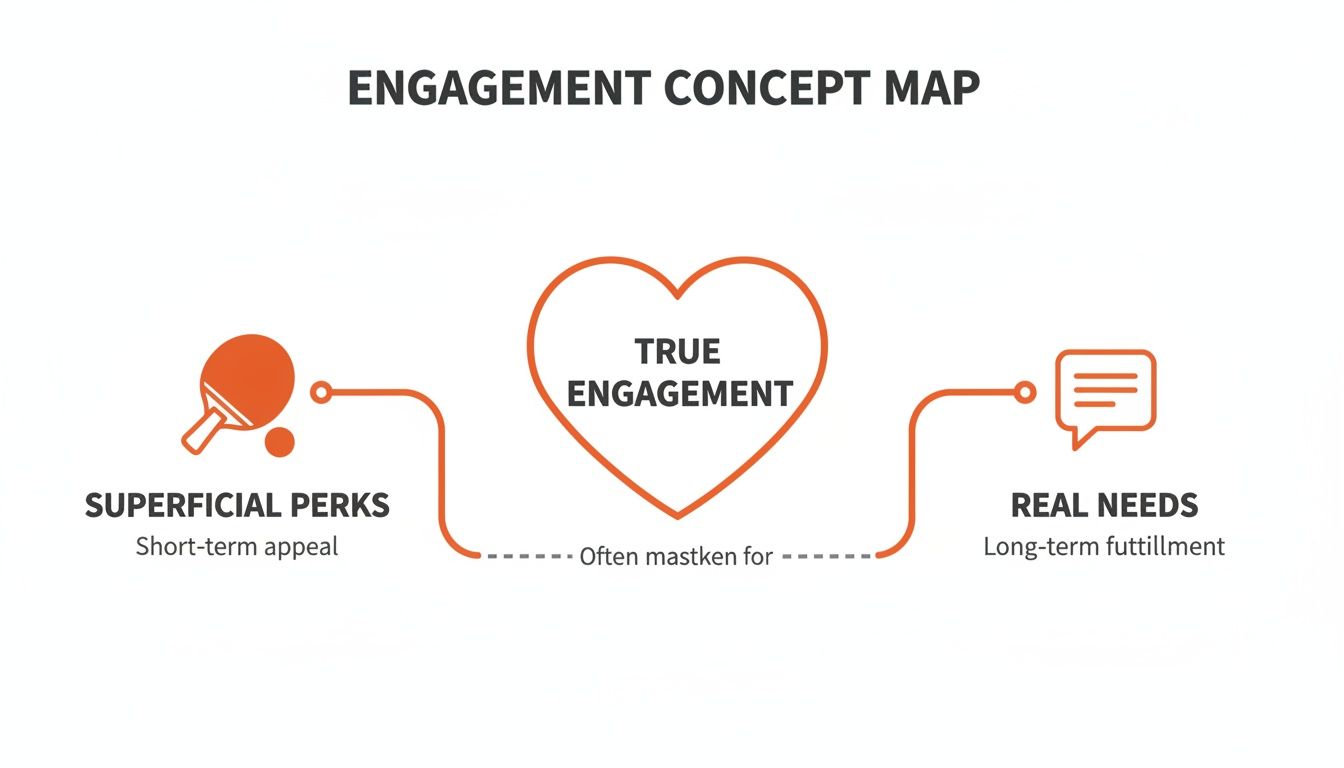
As the image shows, perks are often just temporary distractions. True engagement is built on meeting core needs like clear communication and a sense of belonging.
The Engine Room of Your Company
But good communication is only half the story. The best platforms go beyond just talking and weave in the tools people need to actually do their jobs. This is especially critical for frontline teams who aren’t sitting at a desk all day.
Instead of one app for schedules, another for training manuals, and a third for clocking in, a truly integrated platform puts everything in one place. A retail associate should be able to check their shift, complete a required training, and message their manager—all from one app on their phone.
This isn’t just about convenience; it’s about respecting people’s time and energy. It makes the work itself simpler.
The real purpose of this software is to get out of the way. It should make work simpler and calmer, not add another layer of complexity. When done right, it becomes the invisible infrastructure that helps people do their best work.
The rapid growth of these tools shows a major shift in how companies are thinking. The global market for employee engagement software was valued at around US$150 million in 2020 and is projected to hit US$370 million by 2026. This isn’t a passing trend; it’s a response to the urgent need for connection in the modern workplace. You can explore more data on this market growth and what’s driving it.
The Features That Actually Move the Needle
I’ve seen countless software demos packed with a dizzying array of bells and whistles. Tools that look impressive on a sales call but end up gathering digital dust. When it comes to employee engagement software, many platforms are bloated with features you’ll simply never use.
It’s time to get opinionated about what actually works.
The best tools are simple, focused, and solve real-world problems. They aren't about tracking vanity metrics; they're about making work calmer and more connected for every single person. After years of seeing what sticks and what gets ignored, I've found that a handful of core functions deliver almost all of the value.
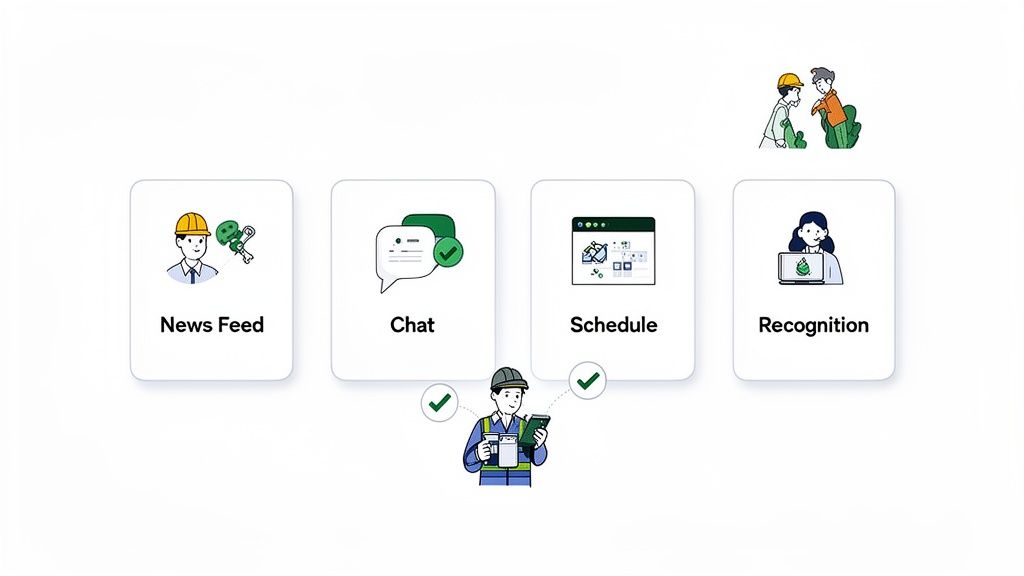
A Single Source of Truth
Let’s start with the most fundamental problem: the information gap. In most companies, official communication is a mess. Important updates get lost in overflowing inboxes, pinned to a bulletin board no one sees, or passed down through a game of telephone.
A central, company-wide news feed solves this instantly. It becomes the official source of truth, giving everyone—from the C-suite to the part-time warehouse associate—the same information at the same time. This isn’t just about efficiency; it's about fairness. When everyone is in the loop, you eliminate the "us vs. them" feeling that poisons company culture.
But a news feed is just the start. Integrated chat and dedicated project spaces are crucial for organizing conversations. Instead of chaotic, company-wide channels where everything gets lost, teams can have focused discussions in their own private areas. This cuts down the noise.
Tools for Connection and Recognition
Here’s the thing about company culture—it’s not built during the annual all-hands meeting. It’s built in the small, everyday moments. That's why simple recognition tools have such a massive impact on morale.
The ability for anyone to give a public "kudos" to a colleague does more than just make someone’s day. It makes good work visible. A Gallup study even found that employees who receive regular recognition are significantly less likely to look for other jobs.
When you make it easy for people to celebrate each other’s wins, you create a powerful, self-sustaining loop of positivity and motivation. It’s a simple feature with profound effects.
A searchable people directory that goes beyond a basic org chart helps people connect on a personal level, strengthening the bonds that make a company resilient. For a deeper dive, our guide covers the top 10 features every employee communication app should have, expanding on these core ideas.
Operational Tools That Simplify Work
Finally, the best employee engagement software understands that engagement isn't separate from the work itself. For frontline teams, work is often a frustrating mix of disconnected systems. One app for schedules, another for training, and a binder for company policies. It's a recipe for confusion.
Bringing these operational tools into the same app is a game-changer. Integrated scheduling lets people see their shifts and request time off without logging into a clunky, separate system. Task lists give managers a simple way to assign and track daily work, so everyone is clear on priorities. A knowledge library puts important documents like training manuals and safety protocols right in everyone’s pocket, accessible anytime.
When you remove these daily points of friction, you’re not just making work more efficient. You’re showing your employees you respect their time. You're making their jobs easier, and that’s one of the most powerful forms of engagement there is. It’s not about having the most features. It’s about having the right ones.
Why This Is No Longer a "Nice to Have"
For years, “engagement” felt like a soft metric. It was a feel-good number on an HR dashboard that rarely broke into a serious boardroom conversation about the bottom line. It was something to aim for, sure, but it felt fuzzy, hard to connect to the cold, hard numbers that drive a business.
That way of thinking is officially obsolete.
The truth is, employee engagement has a direct, measurable, and sometimes brutal impact on your company's health. This isn't a soft metric anymore. It's a leading indicator of your financial stability and long-term resilience. The cost of ignoring it is simply too high.
The Real Cost of a Revolving Door
The most immediate cost of disengagement is turnover. When good people leave, they walk out the door with institutional knowledge, customer relationships, and team morale. The cost to replace them isn't just a line item for recruiters; it's a massive drain on productivity.
Think about it. Every hour your managers spend interviewing and onboarding is an hour they aren't coaching their team. Then, consider the months it takes for a new person to get fully up to speed. A study from SHRM found that replacing an employee can cost anywhere from 50% to 200% of their annual salary. That’s not a soft cost—that's a direct hit to your profitability.
This is where employee engagement software stops being a perk and starts being a core business tool. By creating a hub for clear communication and a culture of recognition, it directly tackles the root causes of why people leave. Remember, people don't quit jobs; they quit cultures where they feel disconnected and unheard.
Investing in a tool that keeps people connected isn’t a cost center. It’s an investment in stability. You're not just buying an app; you're buying yourself time, consistency, and a team that wants to stick around.
From Disconnected to Efficient
But keeping people is only half the story. A connected team is also a more productive one. When information flows freely through a central channel, everyone from the frontline to the back office knows what the priorities are.
Mistakes get caught faster. Decisions are made with better context. Your entire operation just runs smoother because you’ve eliminated the friction that comes from siloed communication. Suddenly, frontline staff aren’t guessing what the new promotion is—they see it on the company news feed. A manager doesn’t have to chase down three people for an update because the conversation is neatly organized.
This isn’t just a theory; the market is proving it out. The market for employee engagement software is projected to rocket from USD 1.22 billion in 2025 to USD 4.47 billion by 2034. The analytics built into these platforms show that even a small 5-10% lift in engagement can increase profitability by 1.4 times. You can discover more insights about the market's trajectory and see the financial impact for yourself.
A well-engaged team weathers storms better, innovates faster, and delivers a superior experience to your customers. That’s something you can absolutely take to the bank. This isn't about feelings; it's about building a more resilient, profitable business.
How to Choose the Right Tool Without the Headache
The market for employee engagement software is incredibly noisy. Every day there's a new platform promising to be the perfect "solution," complete with a dizzying list of features and buzzwords. It’s enough to give anyone a headache.
Let’s be honest. Most of that noise doesn’t matter.
When you're trying to find the right tool for your company, the fancy dashboards are just distractions. I believe you should ignore almost all of it and focus on a few brutally simple questions instead.
Filter Out the Noise with Simple Questions
Start by asking: Does this tool solve our biggest, most immediate problems? If your frontline teams are out of the loop on company news, a tool with a hundred survey templates is useless. Focus on what will make a tangible difference in the day-to-day work of your people.
Next, ask: Is this simple enough for every single person to use? I mean truly simple. Can the person on your warehouse floor who only has a phone and five minutes between shifts open it up and know exactly what to do? If a tool requires a training manual, it's already failed.
Finally, the most important question: Can this tool replace multiple other things we're already paying for? The goal is to simplify, not to add another app to the pile. A great platform should consolidate your communication, scheduling, and recognition tools. For a more detailed look at what to look for, our 2025 enterprise employee experience platform buyer's guide offers a comprehensive checklist.
Why a Unified, Mobile-First Platform Wins
We’ve seen it time and again: companies try to stitch together a patchwork of specialized apps. One for chat, another for schedules, a third for kudos. It never works.
This approach creates more confusion and forces employees to jump between different systems just to get through their day. It’s complexity disguised as choice.
A unified platform isn't just about convenience; it's a statement about how you value your employees' time and attention. It’s about creating one calm, central home for work, not a dozen chaotic digital rooms.
This is especially true for your frontline and hybrid teams. Their work happens on their feet, on the road, and on their phones. A mobile-first design isn’t a nice-to-have; it's the only thing that matters. Easy onboarding via a single link and intuitive navigation—that’s the standard.
The demand for these integrated tools is growing for a reason. Research forecasts a USD 325.9 million market growth spurt between 2023 and 2028, as companies work to curb high turnover. Modern tools help retain talent by making work simpler and more connected. You can read the full analysis on this market trend to see why this has become a business necessity.
When evaluating potential platforms, it's beneficial to explore various options and compare features, much like reviewing the Top Employee Relations Management Tools can give you a broader perspective.
But always bring it back to that core idea. Does this simplify work? Or does it just add another layer of complexity? Your answer to that question will tell you everything you need to know.
The Real Goal Is Not the Software
After all this talk about features and platforms, it’s easy to forget what really matters. Let’s be clear: the goal isn’t the software. It’s not about hitting some arbitrary engagement score on a dashboard or checking a box on an HR to-do list.
The real goal is to build a calm, productive, and resilient company. A place where people actually want to show up and do their best work.
A Tool That Gets Out of the Way
We've always believed the best employee engagement software is the kind that just gets out of the way. It shouldn't be another clunky system your team has to fight with. Its job is to fade into the background, quietly making it easier to have better conversations, share clearer direction, and build stronger relationships.
It’s all about creating an environment of trust where information flows freely. A place where everyone, especially your frontline folks, feels seen, heard, and respected. When you get that right, the scores and metrics have a funny way of taking care of themselves.
The ultimate measure of success isn't software adoption; it's a feeling. It's that tangible sense of clarity and connection you can feel in the air when people are truly in sync.
That’s why our approach has always been a little different. We aren't just selling a list of features; we’re championing a simpler way to work. By removing the friction and giving work a single, calm home, you help people focus on what they do best.
Don't Just Shop for Features
So, here’s my final thought for you. As you look at different platforms, try not to get dazzled by a long list of bells and whistles. Look for a partner and a tool that aligns with your philosophy on what a great workplace should feel like. The journey of building a culture of engagement in the modern workplace goes way beyond technology.
Look for a tool that simplifies, not complicates. One that connects people, not just systems.
In the end, it was never about the software. It’s about the people. Choose the tool that helps you serve them best.
Got Questions? We’ve Got Answers.
We get it. Diving into a new kind of software brings up questions. Over the years, we've heard some recurring ones from leaders trying to figure out if an employee engagement platform is the right move. Here are our honest, no-fluff answers.
How Is This Different From Slack or Teams?
This is the number one question we hear, and it’s a great one. While tools like Slack and Microsoft Teams are fantastic for real-time chat among desk workers, they often create more noise than signal. More importantly, they were never designed for an entire workforce.
Think about it. Is your frontline staff—the people on the factory floor, in the store, or out in the field—living in Slack all day? Of course not.
Employee engagement software is built from the ground up to be an all-in-one home for everyone, especially your non-desk employees. It purposely combines calm, asynchronous communication (like a news feed) with the practical tools people need to do their jobs—think schedules, task lists, and a knowledge library.
The real goal here is to create a single source of truth for the whole company. It’s about ditching the chaotic patchwork of different apps and giving everyone one calm, organized place for everything work-related.
How Long Does It Take to Get This Up and Running?
The honest answer? It depends entirely on the tool you pick. We’ve seen clunky systems that require months of painful IT projects and endless training. That’s an old-school model that simply doesn't fly anymore.
A modern, mobile-first platform should be the exact opposite.
The right tool should be so intuitive that it requires almost no formal training. With a simple process, like sending out a single invite link, you should be able to get your entire organization set up and running in a matter of hours, not weeks. The goal is value from day one, not a long, drawn-out implementation that saps everyone's energy. If it feels complicated, it probably is.
How Do We Know if It’s Actually Working?
Success isn't just a number on a dashboard, though the numbers definitely matter. We believe you should measure it through a mix of tangible data and the real-world vibe of your company.
On the tangible side, you can absolutely track hard metrics. Keep an eye on things like lower employee turnover, higher software adoption rates, and faster internal communication.
But that’s only half the story. The qualitative side is just as critical. You should feel a real shift in the company culture. Is information flowing freely? Do managers feel more connected to their teams? Are people generally less stressed, confused, or out of the loop?
Ultimately, the true measure of success is a workforce that feels more informed, aligned, and connected. When you nail that, you end up with a calmer, more productive, and more resilient company. That’s the real ROI.
Ready to see how a single, calm app can bring your whole team together? Pebb unifies communication, operations, and engagement for frontline and office teams in one simple, modern app. Learn more and see Pebb in action.
