
The Difference Between "Congrats" and a Real Congratulation
Stop sending generic notes. Get 8 authentic examples for a congratulation message for new job that builds real connection with colleagues, friends, and peers.
Dan Robin
We’ve all sent them. The quick, one-line ‘congrats on the new job!’ It’s a nice gesture, I guess. But let’s be honest, it’s forgettable. It's the conversational equivalent of a stock photo. It checks a box but doesn't build a real connection.
After spending years building teams and watching people grow, I’ve learned that how you say congratulations matters. A good message isn't about flattery; it's about acknowledgment. It’s about seeing someone’s hard work and reflecting it back to them. It’s a small act that strengthens relationships and makes people feel genuinely seen.
Most of us want to do this well, but we get stuck. We fall back on clichés because we’re busy or unsure what to say. Here’s the thing: a thoughtful message doesn’t have to be a novel. It just needs to be specific, honest, and human.
In this piece, we’ll move beyond the generic. We'll look at eight distinct ways to craft a congratulation message for new job, each built for a different relationship and context. This isn’t about templates you copy and paste. It’s a guide to finding the right words for the right moment, so your message actually means something. We’ll break down what works, why it works, and how you can apply these ideas yourself.
1. Formal Corporate Congratulations Message
When an internal promotion happens or a key hire joins, the announcement is more than news. It's a statement about your company's direction. A formal corporate message, delivered through official channels, sets a professional tone and solidifies the role's importance. It's a structured, respectful way to share the news, ensuring everyone is informed consistently. This isn't just about saying "congrats"; it's about managing change with clarity.
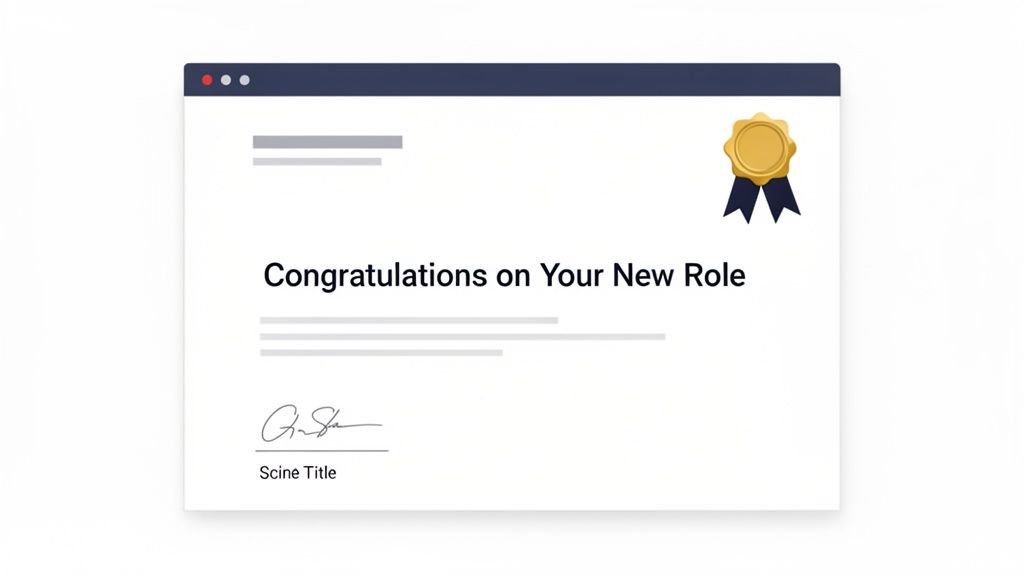
This approach is for official announcements that need to be documented and broadcast widely, especially in companies with multiple locations or remote workers. Sending it through a central tool like Pebb’s News Feed ensures the message reaches everyone at once. No more information silos from scattered emails or team chats. It creates a single source of truth.
Why It Works
Let's look at two common examples for a formal congratulation message and break down why they work.
Example 1: Executive to New Leader
"Dear [Name], Please accept my sincere congratulations on your appointment as [Position] at [Company]. Your dedication, expertise, and proven track record make you an excellent fit for this role. I am confident you will make significant contributions to our team. I wish you great success in this exciting new chapter of your career. Warm regards, [Sender Name, Title]"
The Breakdown: This message is direct, personal, and authoritative. It validates the decision by highlighting specific qualities ("dedication, expertise") and expresses confidence, which publicly endorses the new leader. It's efficient and respects a leader's time.
Example 2: Company-Wide Announcement
"On behalf of [Department], we are delighted to announce that [Employee Name] has accepted the position of [Job Title]. We are confident in their ability to excel in this role and look forward to their valuable contributions to our organization."
The Breakdown: This version is broader and speaks for a collective. It's focused on clarity: who was hired, for what role, and the company's positive outlook. It’s perfect for a company-wide broadcast where the goal is clear, concise information.
How to Use This
Use a Central Channel: Post announcements in a company-wide tool. This ensures everyone, including non-desk and remote staff, gets the same message at the same time.
Be Specific and Concise: Clearly state the person's name, new title, and department. Keep it short. Two or three paragraphs is plenty.
Tag Relevant Teams: If your tool allows, tag specific teams or departments to draw their attention directly to the announcement.
Proofread. A formal announcement represents your company. Typos undermine its professionalism.
2. Casual and Friendly Congratulations Message
Formal announcements have their place, but a team's real pulse beats in its informal interactions. A casual congratulations is where genuine connection happens. This is the peer-to-peer high-five, the digital "we're so excited for you" that makes someone feel truly seen. It's less about broadcasting news and more about sharing authentic excitement. It’s the glue that holds great teams together.
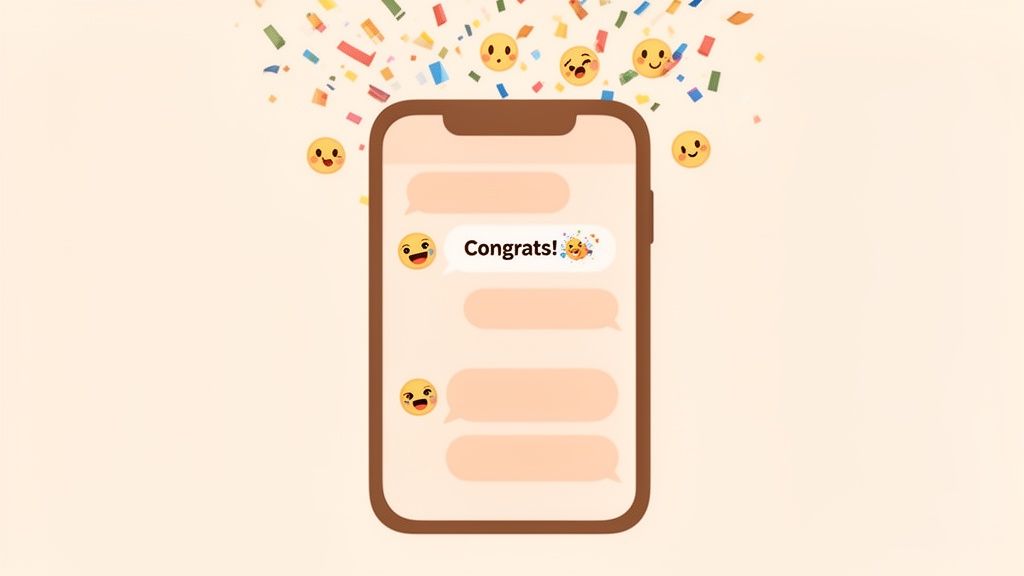
This style thrives in group chats or private messages. With a tool like Pebb, you can post in a team’s dedicated Space, letting the whole crew join the celebration with GIFs and emojis. It's the modern equivalent of gathering around a desk to offer well-wishes, but it works even when your team is spread across different time zones. It’s about creating a moment of shared joy, quickly and sincerely.
Why It Works
Let's break down a few casual messages. They might seem simple, but their power is in their authenticity and warmth.
Example 1: The Team Goodbye
"Yo! Congrats on landing that new gig! 🎉 We're gonna miss you on the team, but seriously, they're lucky to have you. Go crush it!"
The Breakdown: This perfectly balances camaraderie and support. "We're gonna miss you" validates their contribution, but it immediately pivots to genuine excitement for their future. The informal language ("Yo!", "Go crush it!") feels personal and real.
Example 2: The Personal Celebration
"OMG I'm so excited for you!! New job, new adventures—this is going to be AMAZING! Let's celebrate soon! 🙌"
The Breakdown: This is pure, unfiltered excitement. The focus is entirely on the person. It frames the new job as an "adventure," which adds positive energy. The invitation to "celebrate soon" extends the connection beyond the digital message into a real-world relationship.
Example 3: The Well-Deserved Recognition
"Dude, you absolutely deserve this! Can't wait to hear all about the new role. Drinks on us to celebrate? 🍻"
The Breakdown: Leading with "you absolutely deserve this" is powerful. It reinforces the person's hard work and talent, making the praise specific and meaningful. Like the last one, it includes an offer to celebrate, turning congratulations into a shared experience.
How to Use This
Use Team Channels: Post these messages in a group chat so the whole team can join in with replies and reactions.
Keep it Brief and Authentic: Two or three sentences are perfect. The goal is genuine warmth, not a formal essay.
Add a Personal Touch: Reference a specific reason you're excited for them. It shows you're paying attention.
Use Emojis: One or two relevant emojis add personality. A well-placed 🎉 or 🙌 can say a lot.
Consider Timing: For teams with varied shifts, send the message when the recipient is likely to be online. A private message first is a nice touch.
3. Professional LinkedIn-Style Congratulations Message
In professional networking, your words are currency. A well-crafted message on a platform like LinkedIn, or a professional channel like Pebb, is more than good manners. It’s a strategic move that strengthens your network and keeps doors open. This polished, yet personal message balances professionalism with genuine warmth. It's perfect for acknowledging peers, former colleagues, or industry connections.
This approach is for situations where you want to maintain a professional yet approachable tone. It’s not as stiff as a formal announcement but carries more weight than a quick "congrats!" It shows you're paying attention to your network and celebrating their wins. Sending it through a company space or directly on a professional profile makes the praise public and amplifies its impact.
Why It Works
Let's break down a couple of examples and see why they're so effective.
Example 1: Specific & Forward-Looking
"Congratulations on your new role as [Position] at [Company]! Your strategic approach to [specific achievement] and proven leadership make you the perfect fit for this opportunity. I'm excited to see the impact you'll make on your new team. Wishing you continued success!"
The Breakdown: This message is powerful because it’s specific. Mentioning a past "specific achievement" proves you've actually followed their career. It connects their past success to their future potential, which is highly validating.
Example 2: Warm & Confident
"Thrilled to see you step into this exciting new chapter! Your expertise in [field] will be invaluable, and I'm confident you'll drive meaningful change. Looking forward to following your journey. Let's connect soon!"
The Breakdown: "Thrilled" sets a genuinely enthusiastic tone. It highlights their "expertise" and expresses confidence in their future. The closing, "Let's connect soon," is a soft, open-ended invitation that strengthens the relationship without pressure.
How to Use This
Reference a Specific Strength: Before writing, do a quick search on their profile. Mentioning a specific skill or past project ("your work on the Alpha project") makes your message stand out.
Keep It Concise: Aim for three to four sentences. Your message needs to be easily readable on a phone.
Include a Call to Connect: Use phrases like "Let's stay connected" or "Hope our paths cross again soon." This keeps the door open for future collaboration.
Tag Thoughtfully: When posting in a shared space, tag the person and their new company. This increases visibility.
Proofread. This message is a reflection of your own professionalism. A typo can undermine sincerity. Read it over twice before you send.
4. Short SMS/Text Message Congratulations
In a world of scheduled emails, a quick text message cuts through the noise. It’s the digital equivalent of a high-five, delivered with speed and genuine excitement. This short message is perfect for reaching people on the move, celebrating with peers instantly, or just sending good vibes the moment you hear the news. It’s about immediacy and warmth. It makes someone feel seen right away.
This is best for peer-to-peer recognition where a formal message isn't needed. For distributed teams, especially those with non-desk workers, an instant message on a platform like Pebb is the fastest way to share a win. It keeps the connection personal and ensures the celebration isn't delayed.
Why It Works
Let's break down a few examples and see what makes them effective.
Example 1: Pure Enthusiasm
"Congrats on the new job! So proud of you. You're gonna crush it! 🎉"
The Breakdown: This message is a shot of pure energy. It’s informal, positive, and uses an emoji to add warmth. The phrase "gonna crush it" is a modern, powerful vote of confidence that feels authentic between peers.
Example 2: The Action-Oriented Congrats
"Heard the great news! Well deserved. Let's celebrate soon! 🎊"
The Breakdown: This version is warm, validates their success ("Well deserved"), and introduces a next step. "Let's celebrate soon" turns a simple message into a social invitation, strengthening the personal connection.
Example 3: The Team-Player Message
"YES! Congrats!! This is awesome! 🙌"
The Breakdown: Minimalist but effective. This text feels like a real-time, spontaneous reaction. The use of "YES!" and multiple exclamation points conveys genuine excitement. It’s a perfect, quick-fire message for a coworker you’re genuinely happy for.
How to Use This
Be Immediate: Send your message within hours of hearing the news. The value of a text is its speed.
Keep It Brief: Stick to one or two short sentences. The goal is a quick, heartfelt acknowledgment.
Use Emojis: One or two relevant emojis (like 🎉, 🙌, 💪) can add personality.
Use an App for Frontline Teams: For workers not at a desk, a tool like Pebb's instant messaging is ideal for sending immediate peer-to-peer recognition that won't get lost in email.
5. Colleague-to-Colleague Congratulations Message
When a coworker you genuinely respect gets a new job, the message you send is different. It’s a personal note that bridges the professional and the personal. This kind of message comes from a place of shared experience—acknowledging the daily grind, project wins, and mutual support that define a good working relationship. It's a powerful way to build a strong, collaborative culture.
This approach is perfect for strengthening your professional network and showing genuine support. Sending a private message first shows personal respect. A follow-up in a group chat amplifies the positive sentiment for the whole team. In Pebb, you can easily send a direct message and then post in a relevant team Space, creating both a private moment and a public celebration.
Why It Works
Let's break down three effective messages to see what makes them work.
Example 1: Acknowledging a Shared Project
"Hey [Name], I wanted to reach out and congratulate you on your new position! I've really enjoyed working with you on [specific project], and I think [New Company] is lucky to have you. I'd love to grab coffee and hear more about what you're excited about in this role. Let's stay in touch!"
The Breakdown: This message is effective because it’s specific. Mentioning a shared project instantly grounds the message in a real, positive memory. The offer to "grab coffee" is a concrete, low-pressure way to transition the relationship from coworkers to long-term network contacts.
Example 2: Highlighting a Specific Quality
"Congrats on the new gig! You've always been the person who [specific quality, e.g., 'stays calm under pressure'], and I know you're going to bring that same energy to this role. We're going to miss working with you, but you totally deserve this. Hit me up anytime!"
The Breakdown: Calling out a specific, admirable quality shows you've been paying attention. It makes the compliment feel authentic, not generic. Phrases like "totally deserve this" and "hit me up anytime" create a warm, supportive tone that reinforces camaraderie.
Example 3: Focusing on Team Contribution
"Just heard the news—amazing! Your attention to detail and collaborative approach have made such a difference on our team. Really excited to see what you accomplish in this new role. Let's definitely stay connected!"
The Breakdown: This highlights the colleague’s impact on the team ("made such a difference"), which validates their contribution. It's forward-looking ("excited to see what you accomplish"), which focuses on their future success and shows you’ll be cheering them on.
How to Use This
Be Specific: Mention a shared project, a memorable moment, or a quality you admire. Generic praise falls flat.
Offer to Connect: Suggest a concrete next step like coffee, lunch, or a promise to stay in touch. This keeps the relationship alive.
Use Both Private and Group Channels: Send a direct message for a personal touch, then post in a team chat to celebrate them publicly.
Keep it Timely: Send your congratulations within a day or two of the official announcement. Promptness shows you care.
6. Friend-to-Friend Congratulations Message
When a work friend lands a new job, the message isn't about corporate-speak. It's about genuine, human connection. A friend-to-friend message is a personal and authentic note that celebrates their achievement on a deeper level. It bridges the gap between professional success and personal growth, strengthening the friendships that make work more than just a job. This is the message that says, "I see you, I'm proud of you, and I'm celebrating with you."
This approach is for celebrating someone you have a real bond with. It’s for the coworker you grab coffee with, the one who knows your struggles, and the one you've cheered on from day one. Sending this kind of message via a private channel first, like a direct message in Pebb, makes the moment feel intimate and sincere. It’s a private cheer before the public celebration. It shows your friendship comes first.
Why It Works
Let's break down a couple of examples to see what makes them so effective.
Example 1: The Emotional Cheerleader
"OMG I'm SO proud of you!! I knew this was coming—you've been prepared for this forever. I'm literally tearing up thinking about how far you've come since [shared memory]. You deserve every bit of success coming your way. Let's celebrate ASAP! I'm buying! 🎉❤️"
The Breakdown: This message leads with pure, unfiltered emotion ("OMG," "SO proud"). Referencing a specific "shared memory" makes it deeply personal and shows you’ve been paying attention to their journey. The immediate offer to celebrate with a concrete action ("I'm buying!") turns words into a tangible promise of support.
Example 2: The "I Knew It All Along" Friend
"You did it!! I remember when you were scared to apply and I had to push you to go for it. Look at you now! I'm literally so proud of the person you've become. This job is going to love you as much as I do. Let's celebrate this weekend!"
The Breakdown: This message works because it highlights the friend's personal growth ("scared to apply... Look at you now!"). It frames you as a supportive figure who was there from the beginning, reinforcing the strength of your bond. It's a powerful way to say "I believed in you even when you didn't believe in yourself."
How to Use This
Send Privately First: Use a direct message or a text to share your personal congratulations before you join a public group chat. This prioritizes your friendship.
Reference a Shared Past: Mention an inside joke, a tough project, or a conversation where they shared their dreams. This makes the message uniquely yours.
Use Your Real Voice: Don't be formal. Use the emojis, nicknames, and language you actually use with this friend. Authenticity is everything.
Make Concrete Plans: Don’t just say "let's celebrate." Suggest a specific plan, like "Drinks this Friday?" or "Let's grab lunch next week." This shows you’re serious.
7. Mentor-to-Mentee Congratulations Message
When a mentee gets a new job, the congratulation message is more than a formality. It’s a capstone on a shared journey. This message reinforces the bond, acknowledges their hard work, and celebrates a milestone that both of you worked toward. It’s a proud, personal, and encouraging note that validates their effort and signals your continued support. This isn't just about saying "congrats"; it's about honoring their progress.
A mentor’s message carries weight. It confirms that the mentee’s skills are seen and valued by someone they respect. Sending this message promptly turns a professional achievement into a powerful moment of personal recognition. In a company that values growth, this kind of interaction showcases a healthy mentorship culture in action.
Why It Works
Let's look at a few examples and break down what makes them effective.
Example 1: The Proud Reflection
"I am so incredibly proud to congratulate you on landing this new role! Watching your growth from [starting point] to now has been one of the greatest privileges of my career. Your willingness to learn, your integrity, and your determination are exactly what made you perfect for this position. I'm always here if you need guidance-let's stay connected. You've got this! 🌟"
The Breakdown: This message is full of genuine pride. It opens with strong personal feeling ("incredibly proud") and references the journey ("from [starting point] to now"), making the praise specific and earned. Highlighting key traits ("integrity, determination") connects the mentee's character directly to their success. The offer of continued support is warm and open-ended.
Example 2: Acknowledging the Hard Work
"Congratulations on your well-deserved promotion! When we started working together, I saw the potential in you, but watching you develop into such a capable, confident professional has been inspiring. You took every piece of feedback, grew from it, and came out stronger. That's true leadership. Excited to see where this next chapter takes you!"
The Breakdown: This focuses on the mentee's agency. It emphasizes how they took action on the guidance ("You took every piece of feedback...and came out stronger"). By framing their receptiveness as "true leadership," the mentor gives a powerful compliment that builds confidence for the new role. The focus is squarely on the mentee's effort, not the mentor's guidance.
How to Use This
Reference a Specific Growth Moment: Mention a breakthrough or challenge they overcame. It shows you were paying attention.
Focus on Their Achievement: Frame the success as a result of their hard work. Your role was to guide; their role was to do the work.
Be Genuinely Proud: Empty compliments fall flat. Use sincere, heartfelt language. Your authentic pride is the most valuable part of the message.
Offer Continued Support: Instead of a generic "I'm here for you," try "I'm always a phone call away" or "Let's grab coffee next month to celebrate."
Encourage Them to Pay It Forward: A great way to close is by encouraging them to mentor others as they grow. This reinforces a cycle of positive development.
8. Multi-Level Recognition Message (Team Celebration)
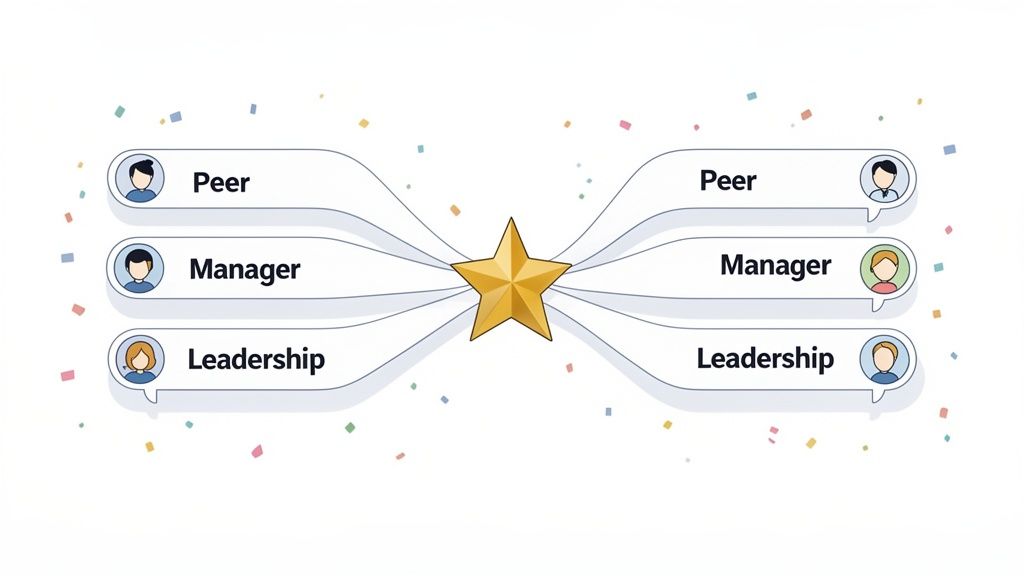
A single "congrats" is nice. A chorus is powerful. A multi-level recognition message turns a new job into a genuine team celebration. It’s a coordinated effort where peers, managers, and leaders all share their congratulations in a visible, public way. This isn't just about sending multiple notes; it's about building a wave of support that shows the whole organization values individual growth.
This approach is especially effective for remote or shift-based teams where spontaneous celebrations are difficult. By using a central tool like Pebb's News Feed, you can create a single, powerful moment of recognition that everyone can participate in, no matter their location. It makes appreciation a shared, cultural experience, not a private email.
A Coordinated Celebration
Let's break down how to sequence these messages to build momentum. The key is to layer authentic messages from different perspectives.
Peer Message: "So excited to celebrate my teammate [Name]! Your collaboration on the [Project Name] was amazing, and I'm thrilled for your new opportunity. You totally earned this!"
Supervisor Message: "Congratulations on your promotion, [Name]. Your leadership and dedication have made a significant impact on our team's performance, especially with [Specific Contribution]. Well deserved."
Mentor Message: "I've had the privilege of watching your growth over the past year. This achievement is a direct reflection of your commitment to excellence and learning. I'm incredibly proud."
Leadership Message: "Congratulations from our entire leadership team. Your success exemplifies our organizational values of innovation and integrity. We are excited to see the impact you'll make in your new role."
The Breakdown: This sequence tells a story. It starts with a peer's personal connection, builds with a supervisor's performance view, adds depth with a mentor's perspective, and culminates with an authoritative endorsement from leadership. Each message reinforces the others, creating a complete picture of why the person is valued. It feels authentic because it is—each message comes from a genuine relationship.
How to Use This
Coordinate the Timing: Don't post all at once. Stagger them over 24 hours to build momentum. Start with peers, then the manager, and end with senior leadership for maximum impact.
Create a Central Hub: Use a dedicated channel, like a thread in a Pebb Space, to gather all the good wishes in one place.
Be Authentic: Coach participants to share a specific, genuine memory. A personal detail ("Your work on the Q3 report was a game-changer") is far more meaningful than a generic "congrats."
Tag Everyone: Tag the individual, their old team, their new team, and relevant department heads. This widens the audience and reinforces a culture of celebration.
Comparison of 8 Styles
Message Type | Implementation Complexity 🔄 | Resource Requirements ⚡ | Expected Outcomes 📊 | Ideal Use Cases 💡 | Key Advantages ⭐ |
|---|---|---|---|---|---|
Formal Corporate Congratulations Message | Medium 🔄 — requires formal tone, approvals | Moderate ⚡ — drafting, HR/lead sign-off, distribution | 📊 Official documented recognition; consistent branding | Executive appointments, company-wide announcements, HR communications | ⭐ Creates formal record; broad organizational visibility |
Casual and Friendly Congratulations Message | Low 🔄 — quick, informal delivery | Low ⚡ — minimal time, mobile-ready | 📊 Boosts morale and peer camaraderie | Peer-to-peer, team celebrations, informal cultures | ⭐ Feels genuine and immediate; easy to send |
Professional LinkedIn-Style Congratulations Message | Medium 🔄 — polished and personalized | Moderate ⚡ — research and tailored wording | 📊 Enhances professional visibility and networking | Industry peers, professional networking, career milestones | ⭐ Balances professionalism with warmth; shareable |
Short SMS/Text Message Congratulations | Low 🔄 — concise, character-limited | Very Low ⚡ — instant send via mobile/IM | 📊 Immediate acknowledgment; limited context | Shift-based teams, frontline workers, urgent recognition | ⭐ Fast delivery; high accessibility |
Colleague-to-Colleague Congratulations Message | Low–Medium 🔄 — peer tone with professionalism | Low ⚡ — personal note, possible group post | 📊 Strengthens peer trust and collaboration | Peer-level recognition, team transitions, cross-department | ⭐ Genuine peer validation; fosters ongoing relationships |
Friend-to-Friend Congratulations Message | Low 🔄 — highly personal and informal | Low ⚡ — private messaging, emotive language | 📊 Deepens personal bonds; memorable emotional support | Close workplace friendships, intimate celebrations | ⭐ Highly authentic and heartfelt; very memorable |
Mentor-to-Mentee Congratulations Message | Medium 🔄 — reflective, supportive tone | Moderate ⚡ — thoughtful examples, offer of guidance | 📊 Reinforces development culture and leadership growth | Mentee promotions, career milestones, succession planning | ⭐ Encourages continued growth; documents mentorship impact |
Multi-Level Recognition Message (Team Celebration) | High 🔄🔄 — coordinated across roles and timing | High ⚡⚡ — multiple contributors, scheduling, channels | 📊 Powerful, memorable recognition; culture reinforcement | Major promotions, organization-wide celebrations, high-impact wins | ⭐ Comprehensive support and visibility; strong cultural signal |
A Message Is a Start, Not an End
We’ve walked through eight ways to say congrats. But if you take away just one idea, let it be this: a congratulation message for new job is a conversation starter, not a box to be checked.
The goal isn't just to say "congrats." It's to reinforce relationships and make someone feel seen. The difference between a message that gets a polite "Thanks" and one that truly lands is specificity. It’s the gap between "Great news on the new role!" and "I'll never forget how you single-handedly saved the Q3 launch. They are so lucky to have your calm, problem-solving mind on their team." One is a pleasantry; the other is a genuine acknowledgment of their value.
After breaking down all those examples, a few core principles stand out.
Be a detective. Your message should prove you've been paying attention. Reference a specific skill, a past project, or a personal quality that makes them a perfect fit. This turns a generic compliment into evidence that you truly see their strengths.
Match the medium. A heartfelt paragraph is perfect for an email. A short, punchy message with a well-chosen GIF is right at home in a group chat. The channel dictates the format, but it doesn't have to dilute the sincerity.
The personal touch matters most. Even in a formal setting, the best messages have a spark of humanity. It’s the one sentence that departs from the script, like "On a personal note, we're really going to miss your energy in our weekly meetings." That's the part people remember.
These aren't complicated rules. They're simple. They just require a moment of thought before you hit send. The most effective congratulations aren't about finding the perfect words. They're about reflecting on the person's journey and connecting it to their future. You're not just celebrating the outcome; you're honoring the process that got them there.
Sometimes, the message is just the beginning. For major career milestones, your words can be a prelude to a more tangible celebration. A thoughtful congratulation is just the beginning. To mark a significant milestone, consider following up with a celebration or a meaningful gift. For instance, when someone is retiring, you might look into these thoughtful retirement gift ideas.
Mastering this small art makes you a better colleague, leader, and friend. It’s a small investment of your time that pays huge dividends. It shows you're not just a passive observer in your network; you're an active participant in celebrating others' wins.
So, the next time you hear about a promotion, pause. Resist the default. Ask yourself: What's one specific thing I admire about how they got here?
The answer to that question is your message. That's the one they'll save.
Ready to make recognition a core part of your team's culture? Pebb brings all your frontline communication, including shout-outs and celebrations, into one simple app. See how you can connect your team and make sure no one’s milestones get missed by trying Pebb today.
