
7 Practical Communication Tips for Leaders
Ditch the corporate jargon. Here are 7 practical communication tips for leaders of frontline and distributed teams. Learn to be clear, consistent, and human.
Dan Robin

Communication is a tool, not an announcement. We've all sat through the all-hands where a leader reads from a script and calls it communication. It isn't. It's broadcasting.
That gap gets expensive fast, especially when your team works the floor, the ward, the warehouse, or a spread of time zones. In an Interact/Harris Poll of 1,000 employees, 91% said their leaders lack critical communication skills, and 31% said poor communication caused them to miss important work goals, as summarized by Becoming Your Best on communication breakdowns at work. I don't find that surprising. Most leaders talk too soon, say too much, and assume one announcement equals alignment.
The problem gets worse in real operating environments. Frontline workers deal with fragmented shifts, noise, handoffs, and limited access to polished office channels. That gap is often ignored in mainstream advice, which is why I keep pointing leaders toward practical training like Baz Porter's executive communication guidance instead of generic “be more transparent” fluff.
Real communication creates understanding. It travels through repetition, context, feedback, and follow-through. It's slower than sending a memo and far more useful. We've managed, built for, and talked to leaders doing this work in hospitals, retail stores, logistics hubs, and distributed teams. Here's what holds up.
1. Listen More Than You Speak

Most leaders think communication starts when they open their mouth. It starts earlier than that. It starts when they ask a decent question and stay quiet long enough to hear the answer.
One of the simplest communication tips for leaders is also the one people resist most. In effective leadership communication, leaders should do 80% of the listening and only 20% of the talking, according to CCL's guidance on communication habits for leaders. That ratio feels unnatural when you're under pressure. It works anyway.
A retail manager covering multiple stores can't fix what she never hears. A hospital supervisor won't catch a broken handoff process if every huddle turns into a speech. Listening is how you find the small problems before they turn into schedule blowups, safety issues, or quiet resentment.
Ask questions that open things up
The difference between “Any issues?” and “What's slowing you down this week?” is huge. The first gets you a shrug. The second gets you something you can use.
I've found that frontline teams usually tell you the truth when the question is concrete and the setting is safe. Not performative safe. Actually safe. That often means small groups, one-on-ones, or an async channel where people can speak without a room staring at them.
Practical rule: If you ask for input, close the loop. Otherwise you're training people to stay quiet.
A good rhythm is simple:
Ask about friction: “What made your shift harder than it needed to be?”
Ask about workarounds: “What are people doing manually that we should fix?”
Ask about support: “What do you need from me that you're not getting?”
If you want a practical way to make this visible, build regular listening moments into the places your team already uses. A good starting point is this guide on how to make employees feel heard.
Listening across shifts matters more than polished town halls
For distributed and shift-based teams, listening can't be limited to direct reports who work your hours. Night shift often knows things day shift never sees. Float staff hear failure points permanent staff normalize. Part-time workers notice confusion fast because they live at the edge of your systems.
That's why the best leaders don't just listen upward and inward. They listen sideways and down to the work itself.
2. Be Clear About What Matters and Why

At 6:45 a.m., the day shift walks in, the night shift wants to go home, and someone says, “Leadership wants us to improve efficiency.” Nobody on the floor knows what to do with that. One supervisor pushes for speed. Another slows the line to cut errors. A third starts asking for cleaner reporting. By noon, people are working hard in three different directions.
That is what unclear priorities look like in real life.
A leader is not clear because an update got sent. A leader is clear when people on different shifts can answer three questions without guessing: What matters right now? Why does it matter? What should I do differently today? The gap between those two standards is wider than many leaders think, as noted earlier in the article.
Translate the priority into the job in front of people
Broad goals rarely survive first contact with frontline work. “Improve efficiency” means one thing in a warehouse, another in a clinic, and something else entirely to a field service crew working from vans and phones.
The job is to make the goal local.
“Cut picking errors before the 5 p.m. truck” gives a warehouse team a target they can use. “Answer call lights faster during shift change” gives a care team a concrete focus. “Log customer issues before leaving the site” helps a distributed service team avoid losing details between jobs.
If the team cannot repeat the priority in plain language, it is still too fuzzy.
I usually test this with one simple question: “What trade-off should you make if things get busy?” That gets to the heart of clarity fast. If people give you five different answers, the message was too broad or too polished to survive real work.
Repetition matters, but it has to be useful
Leaders often hear that messages need repeating, and that part is true. What fails is repeating the slogan instead of repeating the meaning.
Argosy Capital's article on leadership communication habits points out the old rule that people often need to hear a message multiple times before they act. On frontline and distributed teams, I've found the better standard is this: repeat the same priority through the channels people use, and tie it to the decisions they face during the day.
That might look like this:
Pre-shift huddle: “Accuracy first this week. We have too many preventable returns.”
Team chat: “If you hit a volume spike, slow down before final scan. Rework is costing us tomorrow's capacity.”
One-on-one with a lead: “Coach for fewer shortcuts at handoff. That is where the misses are starting.”
Same priority. Different moments. Clear action.
Give people the reason, not just the instruction
The why is not decoration. It helps people make sound calls when you are not there.
A nurse manager might say, “We're tightening handoff notes because one missing detail at 7 a.m. can create risk for the rest of the shift.” A warehouse lead might say, “Shipping accuracy comes first because returns create extra work on the next shift and damage customer trust.” A regional operations leader with distributed crews might say, “Close jobs in the app before driving off site because dispatch is making the next assignment from that information.”
Now the team can make better decisions under pressure.
That is also where tone matters. Business Training Experts' advice on clear leadership instructions lines up with what works on the ground: explain the task, explain why it matters, leave room for judgment, and treat the exchange like a conversation. Orders without context might get short-term compliance. They rarely get good judgment.
A practical script helps:
“Here's the priority. Here's why we're focusing on it this week. Here's what that means for your decisions today. If something conflicts with it, raise it early.”
Simple language travels well across shifts, job sites, and noisy environments. That is the standard to aim for.
3. Show Up Consistently, Even When It's Awkward
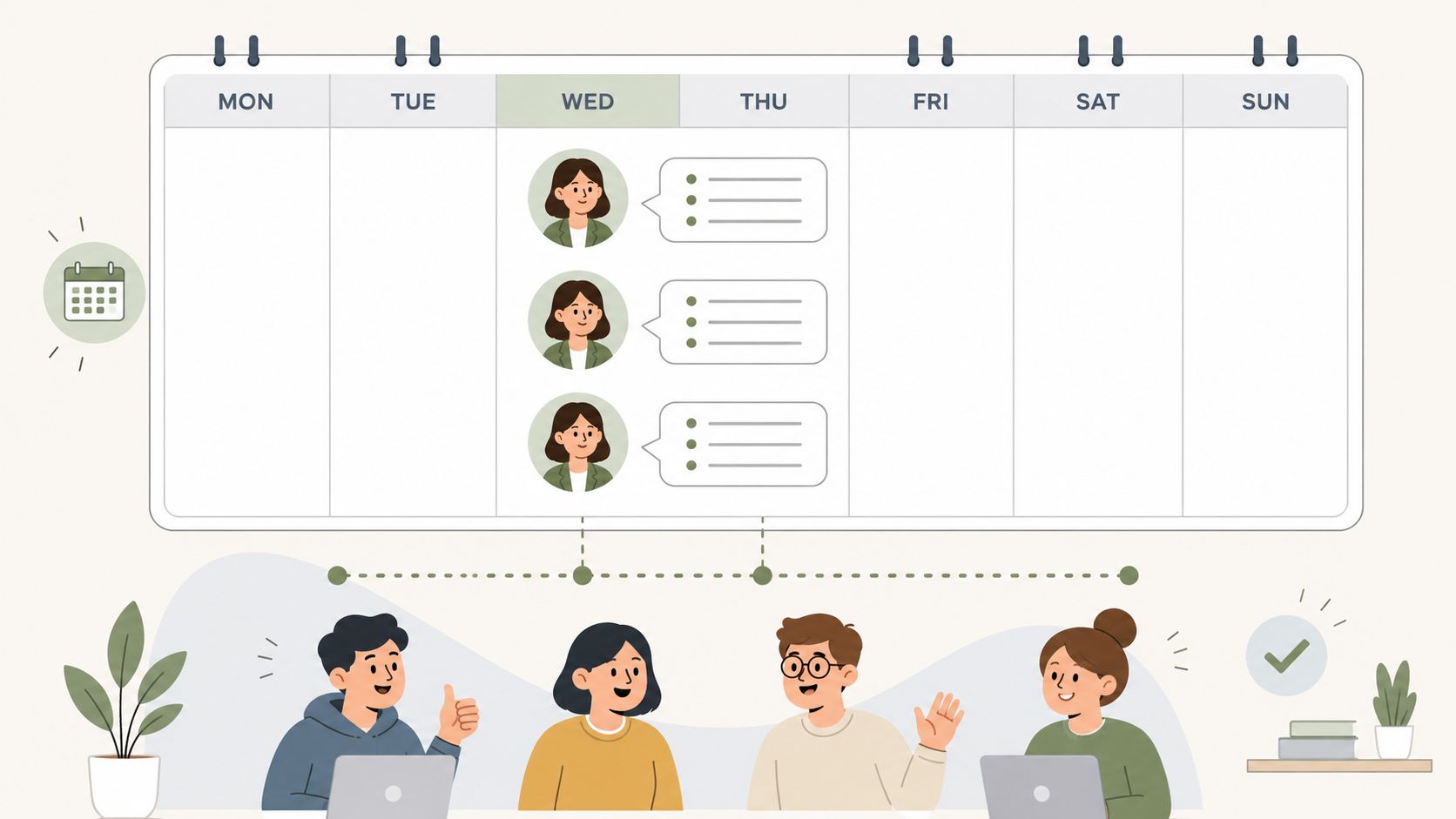
Nothing spooks a team like a leader who disappears for weeks and reappears with an announcement. Sporadic visibility makes every message feel suspicious.
Consistency beats charisma. A plain Monday update every week is more useful than a brilliant town hall once a quarter. People relax when they know where they'll hear from you and when.
This matters even more when your team isn't in one office. Research indicates that 96% of leaders agree effective communication channels are essential for remote work success, according to Sociabble's write-up on employee communication statistics. I'd add that the same principle holds on the frontline. If your people work different shifts, your communication channel is part of the job design.
Presence is a habit, not a campaign
A district manager I know does the same thing every Monday before 9 a.m. He posts three sentences to store leads. What changed last week, what matters this week, and what he's watching. That's it.
It works because it's predictable. The note is never dramatic. It doesn't need to be.
Pick one rhythm: Weekly beats random.
Pick one home base: A huddle, a team chat, or a standing office hour.
Keep it short: Three useful sentences beat twelve fluffy ones.
Direct supervisor communication remains the most trusted source for leadership updates, with 45% of employees naming it as their top channel in Zoom's workplace communication statistics article. That's a useful reminder. People trust the person closest to the work more than the polished company-wide blast.
Show up where work happens
If the team lives in chat, don't hide in email. If they start every shift with a huddle, be part of that rhythm. If they're mobile-first, don't depend on desktop-only updates.
And when things feel awkward, show up anyway. Especially then.
4. Adapt Your Message to Your Audience, Not Every Team Hears the Same Way

The same message can land as strategy, threat, or nonsense depending on who hears it.
Tell a finance team you need to reduce labor costs and they'll think margin. Tell a shift supervisor the same thing and they may hear, “Cuts are coming.” That's not oversensitivity. That's context.
A lot of communication tips for leaders fail because they assume one clean message should work for everyone. It won't. Effective leaders translate. They don't change the truth. They change the framing, examples, and level of detail so people understand what the truth means in their part of the work.
Translation beats relay
I like the word translation better than cascade. Cascade sounds like dropping information downhill. Translation means making meaning.
That's especially important for frontline teams, because broad communication advice often ignores their environment. The Diversity Movement notes that frontline communication is often underserved in leadership guidance, even though these teams deal with fragmented shifts, noisy settings, and limited access to office-style tools.
So adapt the message:
For clinicians: Focus on patient flow, safety, and handoff risk.
For warehouse staff: Focus on station flow, error reduction, and end-of-shift pain.
For store teams: Focus on customer impact, staffing reality, and what changes today.
Good leaders don't just pass along the memo. They interpret it for the people who have to live with it.
Choose the channel that fits the audience
Urgent coordination belongs in instant messaging. A sensitive policy change may need a manager huddle first. A process update for distributed teams may work best as a short written note plus a follow-up Q&A.
The point is simple. Don't confuse “everyone received it” with “everyone understood it.”
5. Embrace Transparency About What You Don't Know
Leaders often think certainty builds trust. Fake certainty destroys it.
People can tell when something is still shifting. They can hear it in your voice, see it in the revised timelines, and feel it in the hedging. If you pretend everything is settled when it isn't, they stop trusting both your words and your judgment.
The better move is plain honesty. Staffbase puts it well in its piece on leadership communication: leaders should deliver as much bad news at once as possible and be honest about what they do not know or what they will implement, rather than downplaying problems or shifting blame in Staffbase's article on trust and leadership communication.
A simple script works better than polished spin
In practice, I've seen one format work again and again:
What we know now
What we don't know yet
What we're doing next
When you'll hear from me again
That script works in a hospital rolling out a new protocol, a logistics team dealing with route changes, or a remote team sorting out a reorg. It lowers speculation because people can place the uncertainty somewhere real.
“Here's what we know today” is stronger than “Everything's under control” when everyone can see it isn't.
Don't perform calm. Be steady instead
Steady is believable. Performative calm usually isn't. If a decision is still being debated, say that. If you're waiting on information from legal, finance, or operations, say that. If you made a call that didn't work, say that too.
Teams don't expect omniscience. They do expect honesty. There's a difference.
6. Create Space for Two-Way Communication, Not Just Broadcasting
One-way communication is efficient right up until it fails. Then it gets expensive.
A leader sends an update. Nobody asks questions. Leadership assumes alignment. Meanwhile the night team interpreted the policy one way, day shift another way, and supervisors are inventing workarounds because the details don't fit reality. That's how “we communicated it” turns into “why is everyone doing this differently?”
The answer isn't more messages. It's better loops.
Build feedback into the system
Organizations winning in 2025 are prioritizing reinforced communication habits measured by sustained adoption at 90-plus days, not just immediate training satisfaction, according to Better with Oli's communication training statistics for 2025. That same piece notes that 25% of leaders say breaking through information overload is the main barrier to effective communication. I agree with the diagnosis. More channels don't fix overload. Better listening infrastructure does.
That can be simple:
A standing Q&A space: One place where anyone can raise an issue.
Pulse prompts: Ask one useful question after a shift or at week's end.
Visible responses: Let people see what changed, what won't, and why.
If you want a practical model, this article on rethinking internal communication as conversation instead of broadcast gets the principle right.
Respond in public when you can
When one person asks a useful question, many others are usually wondering the same thing. So answer where others can benefit, unless privacy makes that inappropriate.
That's how you teach a team that speaking up is worth the effort. It also helps people see that communication is part of operating the team, not a side project HR remembers every quarter.
7. Master the Difficult Conversation, Especially in Distributed Teams
Hard conversations go bad faster in distributed teams because text strips out tone and delay adds friction. A corrective note in chat can read harsher than you meant. A group message can embarrass someone before you even realize what happened.
So set one rule and keep it. If the issue touches performance, conflict, trust, or emotion, don't handle it in group chat or email. Use a live conversation.
That applies whether the team is in retail, healthcare, logistics, or tech. The channel matters because the conversation matters.
Use specifics, not labels
“You're disengaged” is a label. “You missed two handoff updates and the next shift started without the right information” is specific. Specific behavior gives you something to discuss and improve. Labels only invite defense.
Research on communication strategy also points to a common trust problem after recent years of upheaval, and practical trust-rebuilding tactics are often missing from mainstream advice, as discussed in FranklinCovey's article on communication strategies. That tracks with what I've seen. Teams with low trust don't need softer slogans. They need follow-through.
A simple opening line works well: “I've noticed X. Help me understand what's going on.” That keeps the door open long enough to learn whether the issue is skill, clarity, workload, conflict, or something outside work.
Follow up, or don't bother pretending it mattered
A hard conversation without follow-up is just an uncomfortable moment. A hard conversation with clear expectations, support, and a date to revisit it becomes management.
If conflict is part of the issue, this guide on conflict resolution in teams is worth keeping in your back pocket. And if the situation turns into a broader team issue or public disruption, it helps to think through essential crisis communication strategies before you improvise under stress.
Private conversation first. Written summary second. Public clarity only when the team actually needs it.
7-Point Leadership Communication Comparison
Approach | 🔄 Implementation Complexity | ⚡ Resource Requirements | 📊 Expected Outcomes | 💡 Ideal Use Cases | ⭐ Key Advantages |
|---|---|---|---|---|---|
Listen More Than You Speak | 🔄🔄 Habit and skill development; requires genuine curiosity | Moderate, regular one‑on‑ones, time to listen, feedback channels | 📊 Higher engagement (~+40%), early issue detection, stronger trust | Frontline, multi‑store or shift‑based teams | ⭐ Builds trust, improves retention, uncovers frontline insights |
Be Clear About What Matters and Why | 🔄🔄 Discipline to simplify and repeat messaging | Low–moderate, time to craft messages and multi‑channel repeats | 📊 Better alignment and decision‑making; measurable performance gains | Goal‑driven operations (warehouses, stores, customer‑facing teams) | ⭐ Reduces wasted work, increases ownership and accountability |
Show Up Consistently, Even When It's Awkward | 🔄 Low–moderate; habit formation more than complexity | Low, regular brief updates, scheduled presence (huddles/chat) | 📊 Increased predictability, accessibility, and team calm | Hybrid/distributed teams needing visible leadership | ⭐ Strengthens presence, reduces anxiety, boosts morale |
Adapt Your Message to Your Audience | 🔄🔄🔄 High, requires audience knowledge and translation skill | Moderate–high, segmentation, tailored channels, leader time | 📊 Faster adoption, fewer misunderstandings, higher engagement | Diverse orgs with different roles (clinicians, frontline, corporate) | ⭐ Ensures relevance, reduces rumors, improves buy‑in |
Embrace Transparency About What You Don't Know | 🔄🔄 Moderate; requires vulnerability and disciplined follow‑up | Low–moderate, regular updates, commitment to timelines | 📊 Greater credibility, reduced rumor mills, increased team input | Crises, rapid change, uncertain or evolving situations | ⭐ Builds trust, invites collaboration, eases anxiety |
Create Space for Two‑Way Communication, Not Just Broadcasting | 🔄🔄🔄 High, systems and follow‑through required at scale | High, platforms, time to respond, analytics, moderation | 📊 Better information flow, higher retention, faster problem resolution | Large distributed teams needing feedback loops | ⭐ Improves decisions, fosters agency, surfaces hidden issues |
Master the Difficult Conversation, Especially in Distributed Teams | 🔄🔄🔄 High emotional and logistical complexity | Moderate, synchronous time, training, documentation | 📊 Faster issue resolution, protected culture, clearer accountability | Performance management, conflict resolution in remote teams | ⭐ Preserves trust, prevents escalation, ensures fairness |
It's Not Complicated, It's Just Hard
There's no secret playbook hiding behind better communication. The mechanics are pretty plain. Listen before you talk. Explain what matters and why. Show up on a predictable rhythm. Translate the message for the people doing the work. Say what you know, say what you don't, and stop pretending a broadcast equals understanding.
What makes this hard isn't complexity. It's discipline. It's easier to send one polished message than to answer twenty messy questions. It's easier to sound certain than to admit you're still figuring something out. It's easier to talk to the team than to listen to what the team has been trying to tell you.
But the leaders people trust usually aren't the slickest presenters. They're the steady ones. They make time for the awkward conversation. They repeat themselves without sounding irritated. They explain decisions in local terms. They follow up after the meeting instead of acting like the meeting solved it.
That matters even more on the frontline and across distributed teams, where people often miss the informal context office workers take for granted. A nurse coming off a long shift, a warehouse picker moving between stations, a store associate catching updates between customers, or a remote teammate waking up six time zones later doesn't need more corporate polish. They need a clear signal. They need context. They need a channel where they can ask, push back, and get an answer.
Good communication is a craft. It's built in habits, not slogans.
So if you want this to get better, don't start with a grand reset. Start smaller. Pick one habit. Hold one listening session that isn't really a status meeting. Replace one vague update with a clear message about what matters this week. Turn one announcement into a question and response loop. Have one difficult conversation live instead of hiding behind text.
That's how teams start to trust what you say.
What's one habit you'll start this week?
If you want one place to put these habits into practice, Pebb is built for it. It gives leaders a single app for chat, voice and video calls, updates, a heartbeat-style news feed, Spaces for team collaboration, tasks, files, scheduling, clock-in, PTO, and analytics. For HR teams, internal comms leaders, and frontline operators trying to keep people aligned across shifts and locations, Pebb is a practical digital home that helps communication become part of the work instead of another tool sitting beside it.
