
Branding and Reputation Management: Drive Business Value In
Learn how branding and reputation management drive business value. Access 2026 frameworks, KPIs, and playbooks for HR & frontline operations.
Dan Robin

A lot of teams think their brand breaks in public. It usually breaks in the back office first.
A store gets slammed on a Thursday evening. A scheduling mix-up leaves two new hires on the floor with almost no context. One cashier gives the wrong return guidance. A customer waits too long for help, gets irritated, posts about it before getting home, and tags the company. By the next morning, the complaint has picked up comments from people with their own bad stories. Marketing didn't cause that. PR didn't cause that. Operations did. Internal communication did. Leadership did.
I've seen this pattern too many times to pretend branding is mostly about logos, taglines, and polished campaign decks. Your brand is the promise. Your reputation is the receipt. One is what you say you'll be. The other is what people experience when your systems are under pressure.
That gap matters more than most leaders want to admit. About 63% of a company's market valuation is tied to reputation, and a one-star increase in Yelp rating can boost revenue by up to 9%, according to Blue Ocean Global Technology's 2024 reputation management statistics roundup. If you're still treating branding as a creative exercise and reputation as a cleanup job, you're protecting the wrong end of the problem.
The hard lesson is simple. Every shift handoff, every missed update, every manager who assumes "someone probably told them" is shaping public perception. Branding and reputation management live in the daily habits of the company, not just in the external voice of it.
Opening with a frontline scenario
The warning signs are rarely dramatic.
A hospitality team starts a weekend short-staffed. The supervisor posts an update in one channel, the schedule changes in another, and two people never see either one. Guests feel the confusion immediately. Check-in slows down. A room issue sits unresolved. One frustrated customer leaves a review that isn't even especially angry. It's worse than that. It's specific.
Specific complaints travel.
They feel credible because they usually are. Nobody reading that review sees the messy handoff behind it, the missed message, or the manager who thought the policy had already been explained. They just see a brand that didn't keep its word. That's how branding and reputation management collide in real life. Not in a boardroom. On a shift.
The mistake most teams make
Most companies split this work into separate boxes. Marketing owns the brand. PR owns reputation. HR owns culture. Operations owns execution. Then everyone acts surprised when customers experience the company as one thing and employees experience it as another.
That split is the problem.
Practical rule: If your frontline team can't explain your brand promise in plain language, customers will eventually define it for you.
I've worked with teams that spent months refining external messaging while leaving store leads, charge nurses, and shift supervisors to improvise. That never ends well. The customer doesn't care which department dropped the ball. They only care that the promise and the experience didn't match.
What the floor teaches you fast
Frontline environments are ruthless truth-tellers. Retail, healthcare, logistics, hospitality. They expose weak systems within days.
A brand promise only holds if the people delivering it have clear guidance, easy access to policy, and a simple way to raise issues early. If they don't, reputation damage starts as operational drift. Then it becomes customer distrust. Then leadership finally notices when the internet does.
That's why I don't separate branding from reputation management anymore. I see them as one operating discipline with two outputs. Internal clarity and external trust.
Understanding branding and reputation management
Branding gets romanticized. Reputation management gets reduced to damage control. Both views are shallow.
Branding is your company's stated intent. It's the promise you make through your language, design, behavior, values, and decisions. Reputation management is the discipline of tracking whether people believe that promise, and correcting course when they don't. One sets expectations. The other tests them against reality.

Branding is a promise, not a paint job
A lot of leaders still talk about brand as if it's mostly visual. Fonts. Colors. Website polish. That stuff matters, but only after the harder work is done.
Fundamental brand questions are plain:
What do we want people to expect from us
What do we refuse to be
Can employees explain that without reading a slide
If the answer to the last question is no, your brand isn't clear enough. It's decoration.
Reputation is proof
Reputation management is what happens after your company meets reality. Reviews, comments, search results, employee chatter, hiring sentiment, customer stories, public responses. All of that forms the reputation people carry around in their heads.
And trust sits right in the middle of it. 81% of consumers say they need to trust a brand before buying, and 64% stop buying if employer reputation falters, which directly ties internal culture to external sales. I don't think that should surprise anyone, but plenty of companies still run as if customers and employees never compare notes.
They do. Constantly.
A weak employer reputation doesn't stay inside the hiring funnel. It leaks into customer perception fast.
Where teams confuse the two
The confusion usually shows up in three ways:
Area | Branding mistake | Reputation mistake |
|---|---|---|
Messaging | Teams obsess over the slogan | Teams ignore how staff actually explain the work |
Ownership | Marketing carries the whole burden | PR gets called only after something blows up |
Measurement | Leaders track awareness only | Leaders ignore operational signals until reviews drop |
This is why fragmented programs fail. If HR, ops, and marketing aren't working from the same basic story, employees create their own version. Customers then react to that version, not the one in the brand guide.
Why employees are the first channel
Most companies still act as if external channels matter most. I think that's backward. Employees are the first publishing platform your brand has.
They answer questions. They clarify policies. They deliver care. They solve mistakes. Or don't. Each interaction either confirms the brand or contradicts it.
That also explains why consistency matters. It takes 5 to 7 impressions for a consumer to remember a brand for the first time, and Tenet's branding statistics summary notes the same pattern in the stricter phrasing of 6 to 7 impressions for memorability. A scattered company can't create those impressions cleanly. It just creates noise.
Branding and reputation management work when the inside story and the outside story match. That's the whole game.
How branding influences reputation and vice versa
Branding shapes the standards people bring to the interaction. Reputation decides whether those standards rise, hold, or collapse.
That loop is constant. You say you're reliable, premium, caring, simple, local, fast, human. Then customers test every one of those words in moments that don't feel strategic at all. A delayed response. A confusing return. A rude handoff. A manager who sounds indifferent. That's where the brand either earns belief or loses it.
The brand sets the bar
A polished brand can help. It creates clarity and recognition. But it also raises expectations. The nicer your promise sounds, the harsher the reaction when reality falls short.
That's why I don't admire branding that asks operations to perform miracles. If your website says effortless and your staff are wrestling with six disconnected systems, you've built a reputation problem into the brand itself.
Reputation pushes the brand back into shape
This part matters just as much. Reputation isn't only an outcome. It's feedback.
If the same complaint keeps showing up, the right response isn't better wording from the social team. It's a change to the operation, the policy, the training, or the staffing model. Public perception should influence brand decisions because it tells you where your story stops being believable.
A practical example is employee advocacy. Not the fluffy version where people are told to post approved content. I mean genuine advocacy, where employees understand the company well enough to speak clearly and positively about it because their daily experience backs it up. That kind of advocacy doesn't come from a campaign. It comes from alignment.
When branding teams and reputation teams don't talk, customers become the integration layer.
What good companies do differently
The companies that get this right treat customer feedback and employee feedback as one shared signal, not two separate streams.
They usually do three things well:
They adjust the promise when needed. If the company can't reliably deliver "white glove" service, they stop pretending that's the standard.
They fix the root cause. A rise in negative reviews often points back to staffing gaps, broken handoffs, or unclear policy.
They treat internal friction as brand risk. Slow approvals, missing information, and messy scheduling aren't just efficiency issues. They change how the brand feels in public.
The AI layer is now part of reputation
There's a newer wrinkle here. AI tools are now part of how people discover and assess brands. That means your reputation isn't just what appears in search or reviews. It's also what large language models surface when users ask for recommendations.
According to Soar's analysis of brand reputation in AI search, review platforms with 8+ structured entity attributes are cited by AI assistants at about 4.3x the rate of brands that lack them. That's not a branding footnote. It's a visibility issue with direct reputation consequences.
So yes, branding influences reputation. But reputation also edits the brand in real time. Smart teams listen when that happens.
Building frameworks and KPIs to measure success
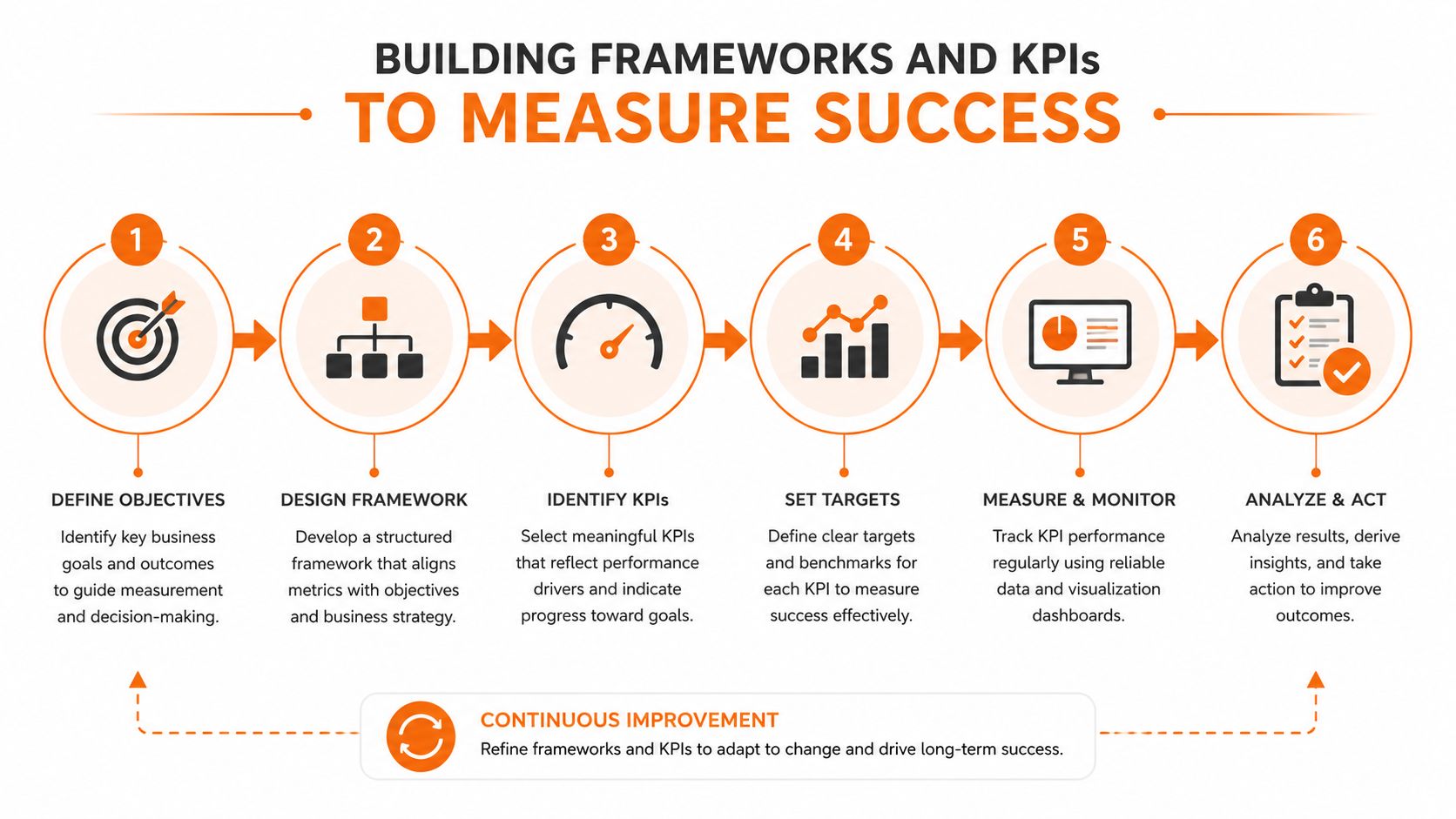
If branding and reputation management only live in presentations, they won't survive contact with the business. You need a working framework. Not a mural on a strategy wall. A system people can use weekly.
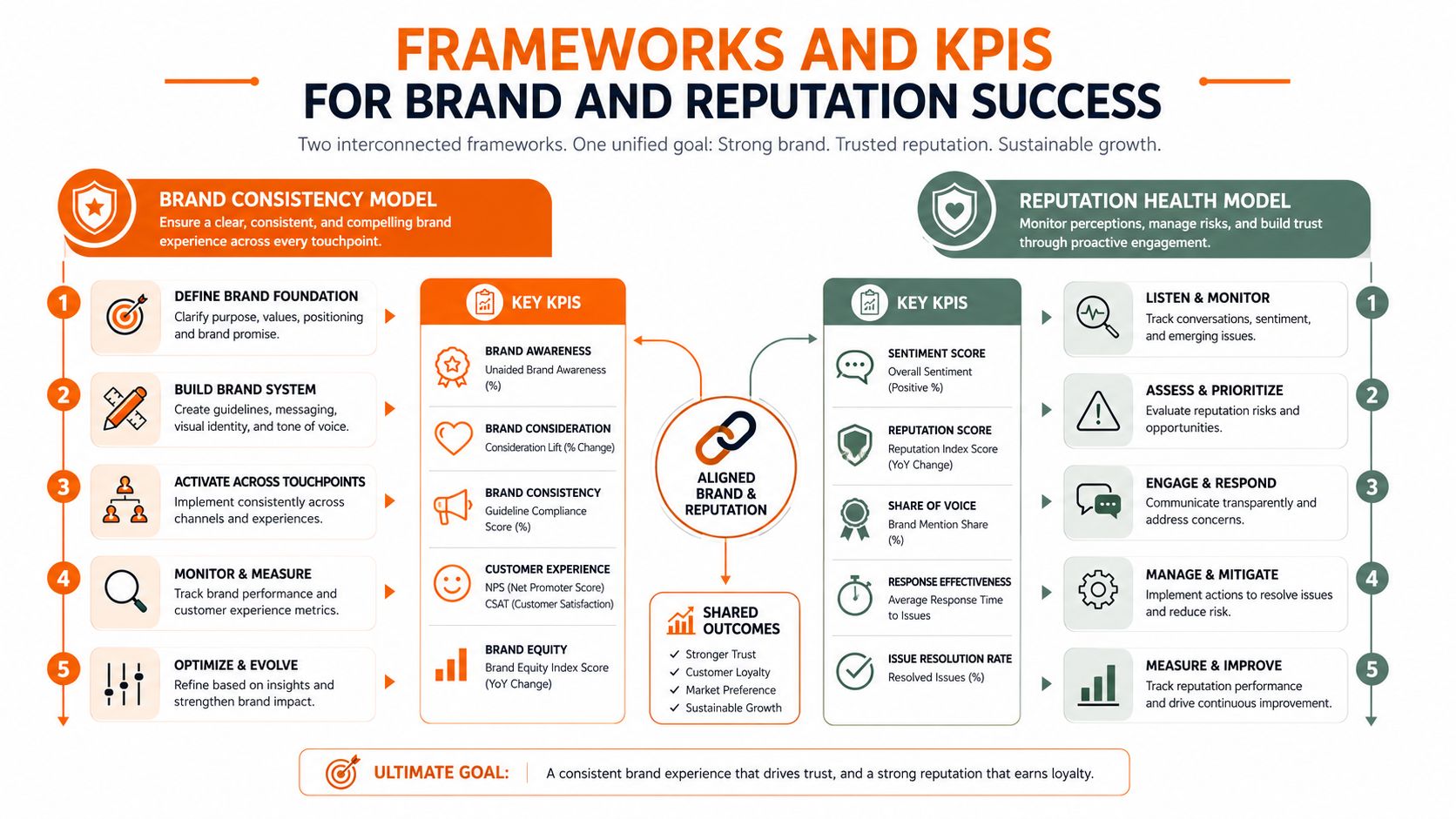
I prefer two linked frameworks. One tracks brand consistency. The other tracks reputation health. Keep them separate enough to stay clear, but close enough that one informs the other.
Framework one for brand consistency
This framework answers a simple question. Are we showing up the same way across leadership, managers, frontline staff, and public channels?
I look at four inputs:
Message clarity. Can people explain the company promise in plain English.
Behavior alignment. Do policies, manager behavior, and customer interactions support that promise.
Content consistency. Do internal and external updates sound like they came from the same company.
Access to truth. Can employees quickly find the latest policy, guidance, and context.
If one of those breaks, the brand gets fuzzy fast.
Framework two for reputation health
This one is more dynamic. It tells you how the market is reacting, where the friction is coming from, and whether your response habits are helping or hurting.
A practical dashboard might include:
Sentiment ranking using a 1 to 10 scale
Review volume
Response time
Average star rating trend
Negative mention themes
Audience segment patterns
Geographic hotspots
Virality risk
That isn't theory. Sprout Social's corporate reputation management guidance notes that implementing a 1 to 10 ranking system for sentiment analysis and tracking review volumes and response times correlates with measurable improvements in star ratings and public sentiment.
Watch for this: If your sentiment score drops before your review average does, you still have time to fix the operation before the public record hardens.
What to measure weekly and what to review monthly
Not every metric deserves the same rhythm. Teams drown when leaders ask for daily updates on things that barely move, then miss urgent signals that changed yesterday.
Cadence | What to track | Why it matters |
|---|---|---|
Weekly | Response times, negative mention themes, unresolved issues | Shows where trust is leaking now |
Monthly | Star rating trend, sentiment movement, recurring internal friction | Reveals pattern, not noise |
Quarterly | Message consistency across leaders and teams | Tells you whether the brand is drifting |
For internal teams trying to tighten their discipline, this guide on how to measure communication effectiveness is a useful complement to the broader reputation work. Internal clarity is easier to improve when you're measuring actual comprehension, not just message output.
Build the alert system before the crisis
Teams often wait too long to operationalize alerts. By the time a leader asks for monitoring, the issue has already become social.
Set alerts for a same-day response to negative reviews. Segment your sentiment scoring by audience type, geography, and issue category. And assign owners in advance. The point isn't more dashboards. It's faster judgment.
The best KPI setup does one thing well. It tells you where the story you're telling about the company no longer matches the story people are living with it.
Tactical playbook for HR and internal communications
HR and internal comms teams often get pulled into reputation work only after a public flare-up. That's backward. They should be in the room from the start.
Employees don't create trust through intention. They create it through clarity, repetition, and confidence. If your people are unsure how to explain a policy, how to respond to frustration, or what the company stands for when something goes wrong, they will improvise. Improvisation is expensive.
Start with the employee version of the brand
Most brand manuals are written for marketers, not employees. That's a mistake.
The frontline version should answer practical questions. What do we promise customers in plain language. What does that look like on a rushed day. Which phrases should we avoid. When do we escalate. What matters more, speed or accuracy, warmth or strict policy, local flexibility or central consistency. If you don't define those tensions internally, managers will define them for themselves.
Use small training, often
Nobody wants another bloated learning module. People need short, useful guidance they can absorb between tasks.
A simple internal comms rhythm works better:
Weekly micro-briefs that explain one policy or behavior clearly
Manager talking points for shift huddles and team meetings
Peer recognition that highlights brand-aligned behavior in real situations
Pulse checks that ask where employees feel confused, blocked, or unheard
This isn't soft work. It's core operating discipline.
According to Gray Group's brand reputation management analysis, companies with high frontline engagement scores see 3.5x fewer negative social mentions, yet fewer than 15% of frameworks include internal comms metrics. That gap tells you exactly where many reputation programs are weak. They monitor the public consequence and ignore the internal cause.
Good internal comms doesn't make people cheerful. It makes people consistent.
Put internal metrics beside external ones
I want HR and internal comms leaders to stop accepting vanity metrics. Open rates and post views aren't enough.
Track whether employees understood the update. Track where policy confusion keeps recurring. Track whether managers are using the same language across sites. If you're reworking your approach, this practical guide to an internal communications strategy is a strong starting point because it treats communication as an operating system, not a content calendar.
Give managers fewer words and better ones
Middle managers carry more of the brand than most executives do. They translate priorities into behavior. So help them do that.
Don't bury them in talking points. Give them short explanations, likely questions, and clear escalation paths. Then listen when they tell you where the script doesn't fit reality. That's not resistance. That's field intelligence.
HR and internal comms sit closer to reputation risk than many companies realize. They hear the confusion first. They see the morale shifts first. They know when the internal story is starting to fracture. Use that vantage point.
Tactical playbook for operations and frontline teams
Operations teams don't need a lecture on brand values. They need habits that hold up during a busy shift.
That's why I prefer operational guardrails over motivational language. A supervisor under pressure won't remember a brand manifesto. They will remember a checklist, a simple escalation rule, and a shared place to flag a recurring issue before it turns into a customer-facing problem.
Treat low-visibility signals as serious
Public complaints are late signals. The earlier warnings usually show up in private messages, shift notes, handoff gaps, and hallway comments.
Gray Group's social media reputation management analysis found that 68% of reputation risks emerge in low-visibility channels like private chats and shift logs, leading to 41% of downgrades from internal failures unnoticed by public monitoring. That tracks with what many operators already know. By the time customers start posting, the team has often been living the problem for days.
Build a frontline rhythm that catches problems early
A practical operating rhythm can be simple:
Pre-shift clarity with one source for tasks, changes, and service notes
Mid-shift issue capture so small failures get logged while they are fresh
Post-shift review that flags repeat friction, not just one-off mistakes
Supervisor escalation rules that define when a local issue becomes a cross-site issue
That structure matters more than polished language. It gives people a place to put problems before customers do.
Use equipment, policy, and presentation as part of the brand
Frontline reputation isn't only about words. It's also physical. Uniforms, signage, checkout flow, cleanliness, tools, and workwear all affect how competent the company feels to a customer.
In food service, retail, and hospitality, presentation shapes trust before anyone speaks. If you're rethinking what practical frontline standards look like, even something as basic as durable, fit-for-purpose workwear matters. For teams comparing functional options, Explore our apron collection offers a useful example of how operational gear can support a cleaner, more consistent customer-facing experience.
Give supervisors a short list, not a philosophy
The best operations playbooks are blunt:
Situation | What the supervisor should do |
|---|---|
Policy confusion | Confirm the current rule, post the update in the team channel, note where the confusion started |
Repeated customer complaint | Log the pattern, not just the incident, and escalate if it repeats across shifts |
Staffing shortfall | Reset service expectations early and communicate the tradeoff clearly |
Broken handoff | Fix the process, not only the person |
Operations teams protect the brand by reducing avoidable inconsistency. That's the work. Quiet, repetitive, unglamorous, and worth more than most companies admit.
Roadmap for implementation with Pebb
Most companies don't fail at branding and reputation management because they lack ideas. They fail because they try to do everything at once, in every location, with no shared operating rhythm. Then the launch becomes the plan.
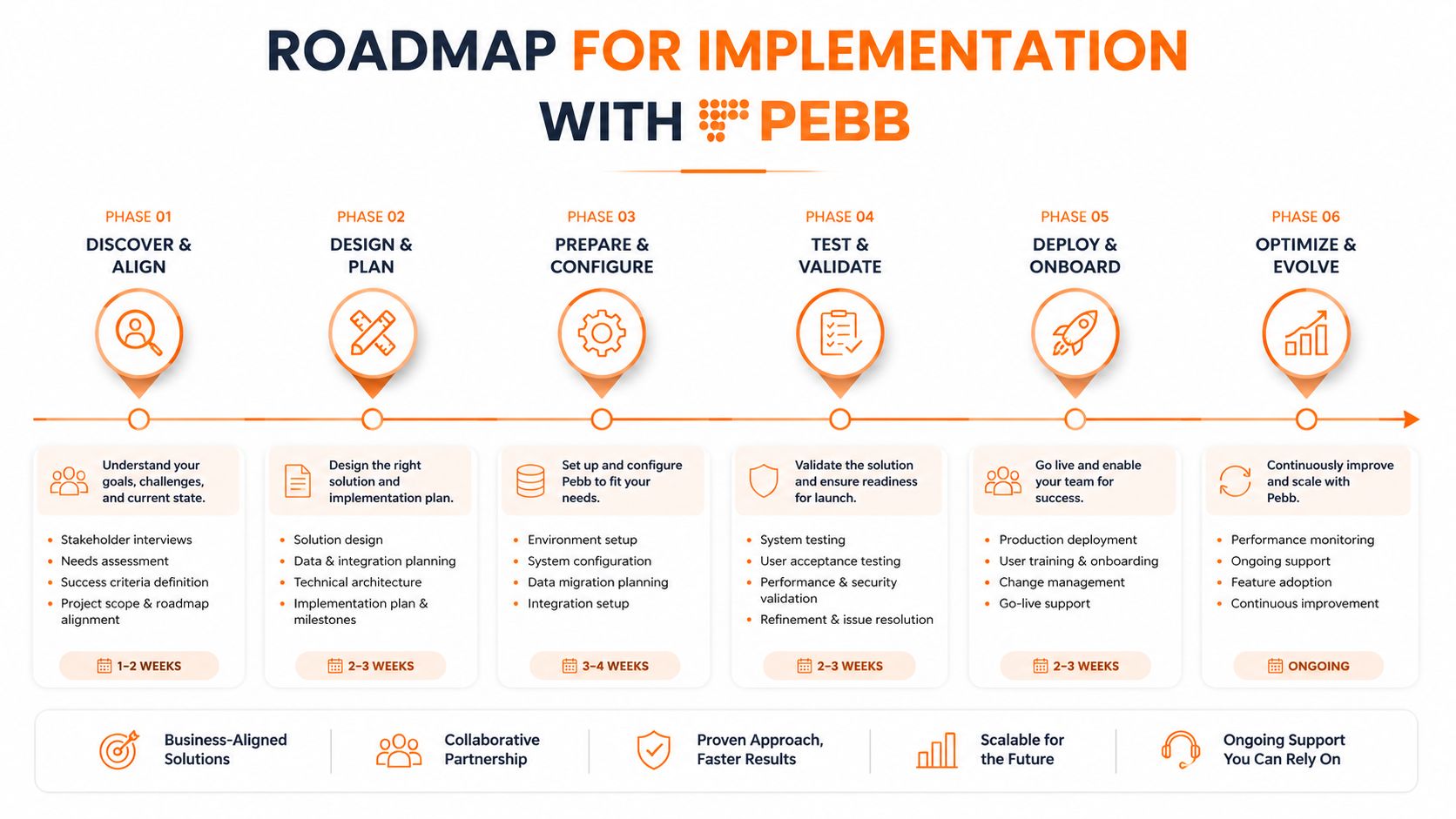
A better approach is phased. Six months is usually enough to build momentum without exhausting people. The point isn't to "roll out culture." It's to create one place where communication, execution, and feedback stop fighting each other.
Month one and two with one pilot and one promise
Start with a contained pilot. One region, one business unit, or one cluster of locations. Pick a team where frontline complexity is real enough to expose friction, but leadership support is strong enough to sustain adoption.
The first promise should be modest. Not transformation. Clarity.
Use Spaces to create distinct team hubs for managers, frontline staff, and cross-functional leads. That gives people a clear home for updates, files, tasks, and practical discussion. If your current state is scattered across chat apps, notice boards, email threads, and one supervisor's memory, this alone is a major improvement.
In this phase, focus on a few basics:
current policies in one place
daily and weekly updates in a consistent format
task assignment with visible ownership
a clean onboarding flow through a single invite link
That's enough to reduce confusion fast.
Month three with manager habits before broad rollout
The middle layer decides whether the tool becomes useful or decorative. So train managers first on behavior, not features.
Show them how to run a shift handoff inside a dedicated Space. Show them how to pin an update, assign a follow-up task, and close the loop publicly so the next shift sees the answer. Show them how to replace scattered screenshots and side-channel guessing with a searchable record.
This is also the right point to use pulse surveys. Keep them short. Ask where policy is unclear, where handoffs are breaking, and which issues keep repeating. The answers give you operational signal before customer complaints do.
A platform earns trust when employees can find the answer faster than they can ask around for it.
Month four with shared visibility across functions
By month four, the goal shifts from local order to cross-functional visibility.
Internal comms can use the heartbeat-style news feed for company-wide updates that need reach and consistency. Operations can use Tasks and Space-based coordination for execution. HR can use the Knowledge Library for policies, onboarding material, and manager guidance. Leaders can finally stop asking three departments for three different versions of the same story.
Unified tools begin to close the hidden gaps in reputation frameworks. The problem was never only that information existed in different places. The problem was that no one could see how internal confusion connected to external fallout.
Pebb's analytics help here. They give leaders visibility into engagement and activity trends so they can spot where adoption is weak, where communication is landing, and where attention is needed. That matters because silence in one team often predicts inconsistency in front of customers later.
Month five with frontline operations built into the same system
By month five, expand the operating layer.
For shift-based teams, at this point the value becomes hard to ignore. Scheduling, clock-in, PTO tracking, files, policy access, and team communication belong closer together than most legacy systems allow. When the person doing the work has to jump between too many tools, the company pays in delays, confusion, and avoidable mistakes.
Bringing scheduling and communication into the same daily environment helps supervisors catch the simple failures that often damage reputation. Missing coverage. Unclear handoffs. Policy changes that didn't reach everyone. Repeated customer issues that one location notices before the others do.
Use configurable Spaces for site-level rituals. A morning brief. Incident follow-up. Customer issue review. Recognition posts. Quick polls. None of this is flashy. That's why it works.
Month six with refinement, not sprawl
By month six, resist the urge to keep adding channels and complexity. The right move is refinement.
Review which Spaces are active and which are cluttered. Remove duplicate workflows. Tighten permissions and governance so information stays secure without making access painful. Use analytics to compare engagement across teams and ask a sharper question than "Are people using it?" Ask "Are the teams with better communication showing fewer operational surprises?"
That's the reputation connection. Not a vanity dashboard. A clearer line between internal clarity and external consistency.
A practical six-month roadmap might look like this:
Phase | Focus | What success looks like |
|---|---|---|
1 | Pilot setup | One region working from shared Spaces and a single onboarding flow |
2 | Core communication | Policies, updates, and files moved into one mobile-friendly home |
3 | Manager adoption | Supervisors using tasks, handoffs, and pulse checks consistently |
4 | Cross-functional alignment | HR, internal comms, and ops working from the same operating layer |
5 | Frontline integration | Scheduling, tasks, and communication supporting daily execution |
6 | Optimization | Cleaner governance, stronger adoption, clearer engagement patterns |
What I like about this approach is that it respects how people work. Frontline teams need speed and simplicity. Office teams need visibility and structure. Leadership needs signal without waiting for a crisis report. A unified app only matters if it reduces friction for all three.
That is the true implementation test. Not whether the software can do a lot, but whether it helps the company keep its promises more consistently under pressure.
Reflecting on the journey ahead
Most reputation advice is too public-facing. It assumes the danger begins when the complaint appears, the review lands, or the post spreads. I don't buy that anymore.
The actual risk starts earlier, in ordinary moments that look operational instead of strategic. A shift swap nobody confirmed. A manager who explains the policy three different ways in one week. A missed internal update that leaves employees guessing in front of customers. Those moments don't feel like branding work. They are.
That's why branding and reputation management deserve more respect than they usually get. This isn't a layer you add after the primary business is done. It is the core business itself, expressed through language, systems, and behavior. Every company has blind spots. The dangerous ones are the gaps between what leaders think is obvious and what frontline teams truly know.
So I think the better question isn't "How do we protect our brand?" It's "Where are we making it too hard for our own people to deliver the experience we keep promising?"
If your reputation is one of your biggest assets, then internal confusion is one of your most expensive liabilities.
I'd start there. Not with a giant initiative. With a few honest conversations. Where are handoffs weak. Which teams are improvising. Which policies still live in screenshots and memory. Which customer complaints are really internal design failures wearing a public face.
That kind of reflection usually leads to better systems, better habits, and fewer surprises. It also creates a healthier company. One where HR, operations, internal comms, and leadership stop treating reputation as someone else's job.
If you're trying to bring communication, operations, and engagement into one place, Pebb is worth a serious look. It gives frontline and office teams a shared digital home for chat, updates, Spaces, tasks, files, scheduling, and analytics, without forcing people to juggle a pile of disconnected tools. That's the kind of structure that helps brands stay consistent when work gets messy, which is usually when reputation is being decided.
