
What's the best employee engagement software? Let's be honest, it's a mess out there.
Discover the best employee engagement software of 2025 with honest reviews, features, pricing, and real user insights to help you decide.
Dan Robin
Trying to find the right employee engagement tool feels like walking into a labyrinth. Dozens of apps, all promising to solve the same problem: a disconnected workforce. One flashes AI-driven insights, another boasts about a slick user experience, and a third claims it’s built just for frontline teams. How do you pick the one that will actually help your people, not just look good in a demo?
I’ve been there. I’ve seen the right tool change a company's entire vibe, and I’ve watched the wrong one become another ghost app on everyone's phone. Here’s the thing: the difference isn’t about who has the most features. It's about who has the right ones, wrapped in a design that feels natural to use. A tool is only useful if people use it.
This guide is my attempt to cut through that noise. I've spent countless hours with these platforms to give you an honest, no-fluff breakdown. We’ll look at the big names like Culture Amp and Microsoft, but also smart, unified tools like our own, Pebb. I’ll show you where each one shines and where it falls short. We’ll talk about remote vs. frontline teams, pricing, integrations, and the little quirks you only discover after you’ve signed the contract.
This isn’t just another list. It's a practical guide to help you find a tool to build a more connected, motivated team. Because when your people are dealing with real challenges like recognizing job burnout, the last thing you need is another piece of software no one uses. You need something that works.
Let’s find it.
1. Pebb
When you're trying to connect a workforce split between desks, storefronts, and warehouses, the last thing you need is another app. What you really need is one app that does the important things well. We built Pebb on this exact principle: unification. It combines communication, operations, and culture into a single, mobile-first tool that feels as intuitive as a social media app. It's our top choice because it solves the fragmentation problem from the ground up.

Pebb’s design bridges the gap between frontline and office teams. Everyone gets the same real-time news feed, direct and group chat, knowledge library, and tools for shifts and time-off requests. This isn’t just for making announcements; it’s for creating a shared digital space where your company culture can actually grow. For a deeper look at how it compares to other mobile-focused tools, check out our own honest, hands-on comparison of top employee engagement apps.
Why Pebb Stands Out
Pebb’s strength is its ability to replace a messy stack of separate tools. Instead of one app for chat, another for schedules, and a third for company news, you get one clean home for everything.
The onboarding is ridiculously simple. You can invite your entire organization with a single link, skipping the painful process of uploading spreadsheets. We’ve had teams move their entire company over in a single day. That kind of speed is critical for seeing value right away.
It also comes packed with over 50 integrations for leading HR and payroll systems, solid admin controls, and analytics that show you exactly where engagement is happening.
Best for: Companies of all sizes, especially those with both desk-based and frontline workers, who want to consolidate their tech and build a cohesive culture.
Pros:
Truly All-in-One: Merges chat, news, knowledge, and operational tools to reduce app fatigue.
Fast & Easy Onboarding: A single invite link gets your whole team on board quickly.
Mobile-First Design: A genuinely good experience for frontline and dispersed teams.
Strong Integrations: Connects with over 50 HR and payroll systems.
Cons:
Pricing Isn't Public: You need to talk to us for detailed enterprise pricing.
Migration Planning: If you're coming from multiple legacy systems, you'll need a thoughtful plan to migrate.
Website: pebb.io
2. Microsoft Viva Glint
If your company runs on Microsoft 365, adding another standalone tool can feel like a step backward. This is where Microsoft Viva Glint makes its case. It's not another tool; it’s a fully integrated layer within the Microsoft world you already use. It’s one of the best employee engagement software options for M365-native organizations because it focuses on enterprise-grade surveys and AI-powered insights, turning feedback into action plans right inside Teams.
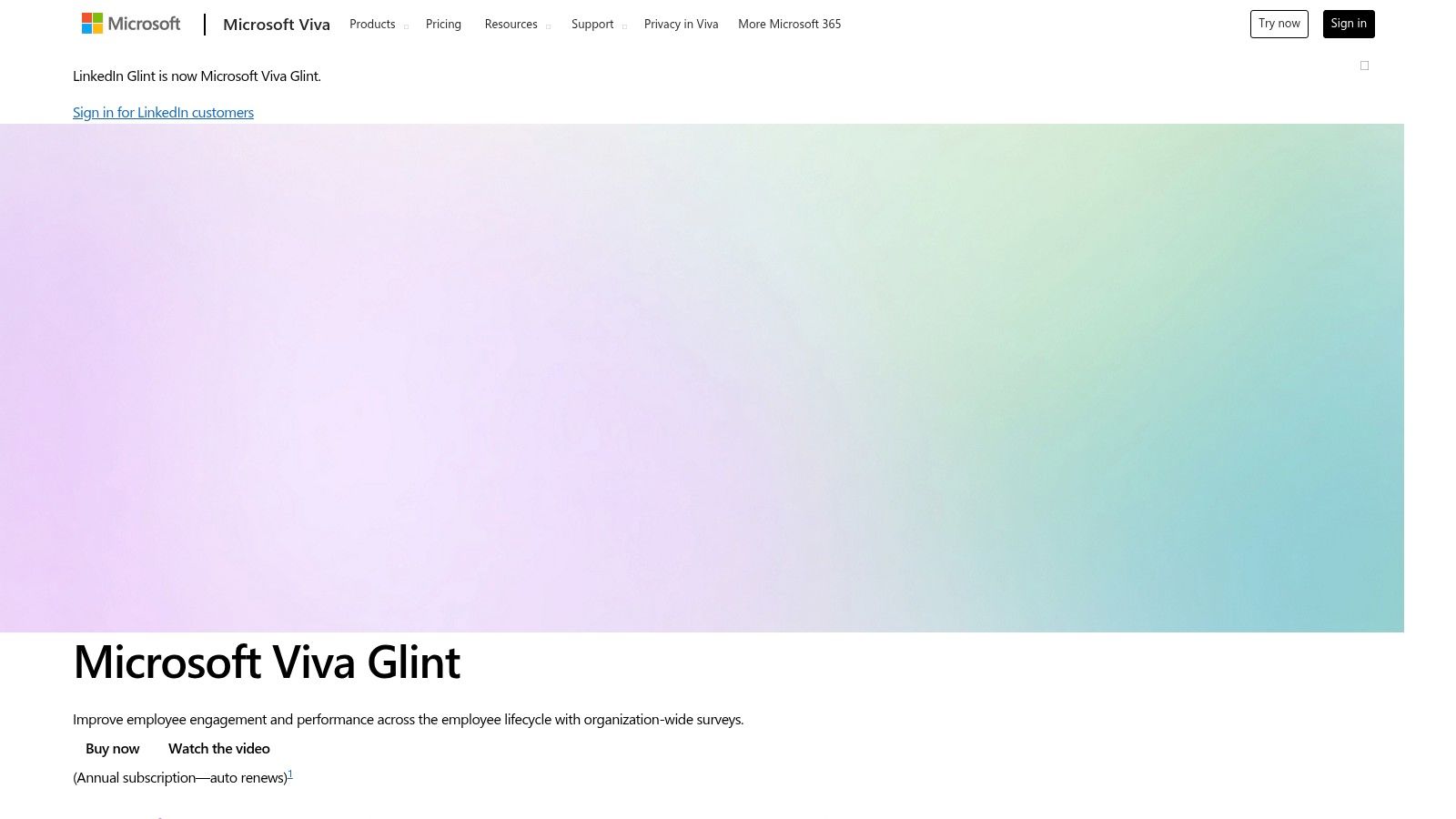
Its real magic is that native integration. Imagine running a pulse survey and seeing AI-driven recommendations pop up for managers inside their Teams channels. It removes the friction of logging into another platform, which is often half the battle.
Key Features and Pricing
Always-On Surveys: Deploys recurring pulse and engagement surveys with AI-driven action recommendations.
Leader Dashboards: Provides clear dashboards with industry benchmarks to put your data in context.
Deep M365 Integration: Lives inside the tools your team already uses daily, mainly Teams.
Microsoft is transparent with its entry-level pricing as part of the Viva suite bundles, though custom enterprise plans require a conversation with their sales team.
Pros and Cons
Pros:
Seamless Integration: Its home within Microsoft 365 is its biggest strength, offering top-tier security and a familiar feel.
Transparent Pricing: Entry-level pricing is public, which is a breath of fresh air in the enterprise space.
Cons:
Microsoft-Centric: If your organization doesn't run on Microsoft, Glint loses almost all of its appeal.
Focused Scope: It's a survey and insights tool. For community or recognition features, you'll need other Viva modules or a different tool entirely.
3. Culture Amp (Engage)
For organizations that want to ground their engagement strategy in deep people science, Culture Amp is a heavyweight. Instead of just giving you tools to ask questions, it gives you the right questions to ask. It’s built on research-backed survey templates, robust industry benchmarks, and powerful analytics, making it one of the best employee engagement software choices for data-driven HR teams. It excels at turning complex feedback into clear, actionable insights for leaders.
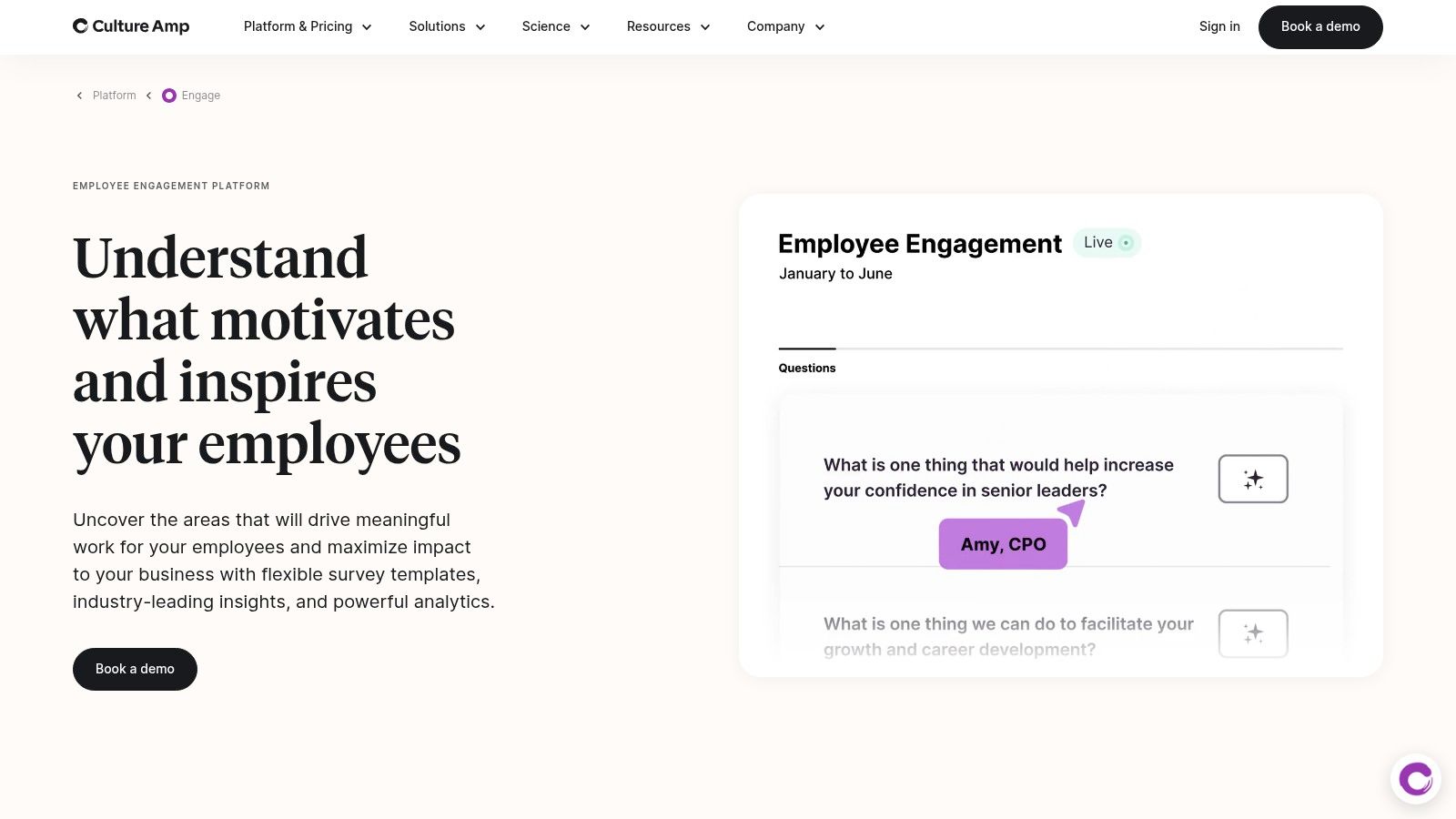
The platform’s strength is its blend of science and simplicity. Features like AI-assisted comment summaries help managers make sense of qualitative data without needing a Ph.D. in statistics. This focus on helping managers is key, as it helps translate company-wide data into local action. We've seen it work wonders in large, global organizations, and you can learn more about how it fits into the broader landscape of top employee engagement platforms.
Key Features and Pricing
Research-Backed Surveys: Over 40 templates for engagement, lifecycle, DEI, and more, all validated by organizational psychologists.
AI-Powered Insights: Features like an "AI Coach" and comment summaries help managers interpret feedback and recommend actions.
Industry Benchmarks: Compare your engagement data against companies in your industry, size, or region.
Pricing is quote-based and tailored to your company's size and the specific modules you need. You'll have to talk to their sales team for a proposal.
Pros and Cons
Pros:
Deep People Science: Its biggest advantage is the robust, research-backed content and analytics.
Mature Analytics: Exceptionally well-suited for large, global organizations that need to slice data across complex demographics.
Cons:
Quote-Based Pricing: The lack of transparent pricing can be a hurdle for smaller teams or those with tight budgets.
Potential for High Cost: The comprehensive feature set often comes with a premium price tag.
4. Lattice (Engagement)
For companies that want to connect the dots between how people feel and how they perform, Lattice offers a compelling, integrated system. It’s not just an engagement tool; it’s a people management platform where engagement, performance, and development are all part of the same story. This makes it one of the best employee engagement software choices for companies that want to turn feedback directly into performance conversations and growth plans.
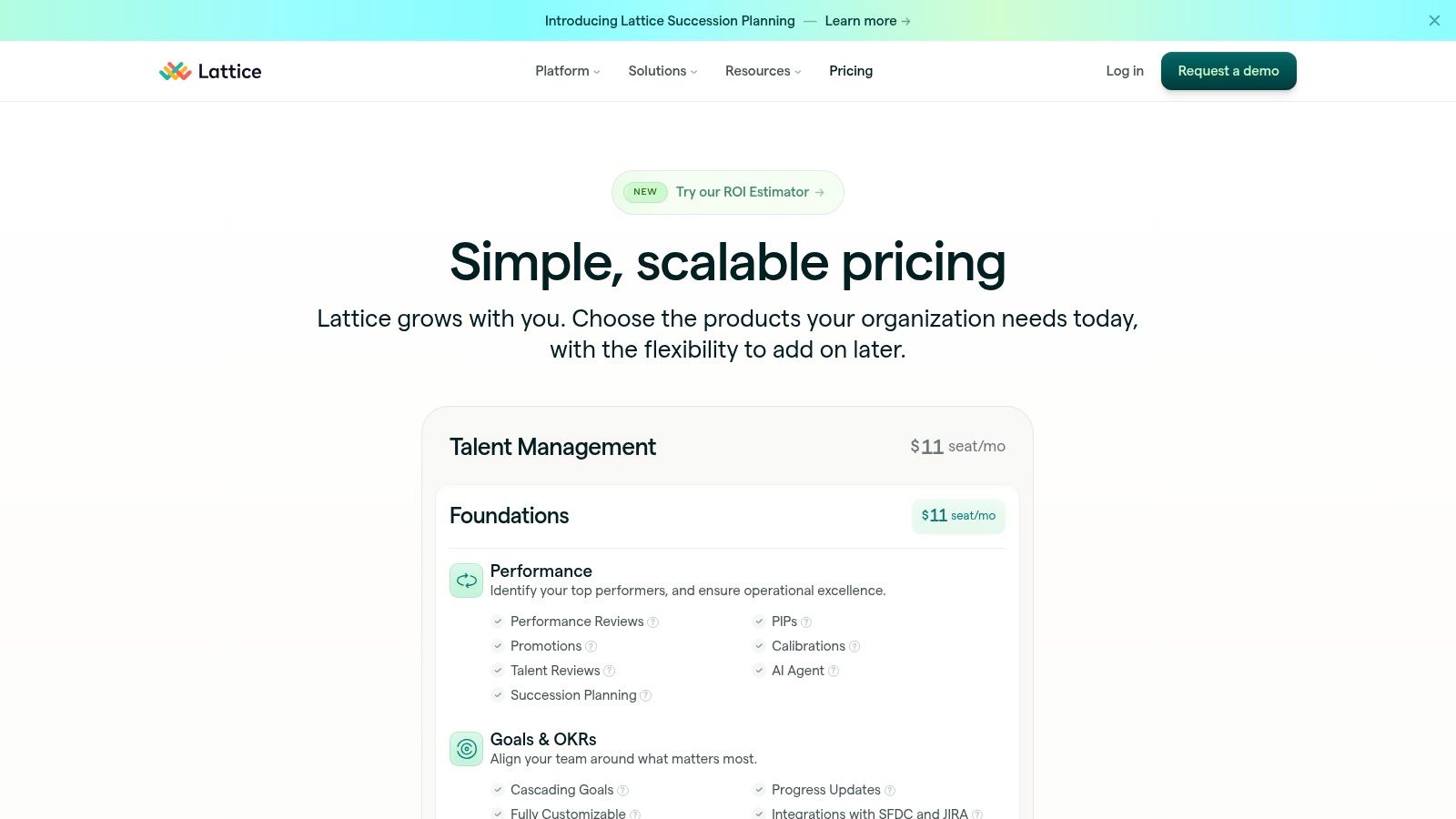
The platform shines by making the feedback loop tangible. An engagement survey insight doesn't just sit in a dashboard; it can directly inform a manager’s 1:1 agenda or highlight a team-wide goal that needs attention. This tight integration helps managers move from insight to action without switching systems, which is where progress often stalls.
Key Features and Pricing
Holistic Surveys: Runs engagement, pulse, onboarding, and exit surveys with powerful analytics and heatmaps.
Integrated Performance Tools: Seamlessly connects engagement data with performance reviews, goals/OKRs, and 1:1 meeting agendas.
Manager Action Plans: Equips managers with specific, data-driven action plans to address team feedback.
Lattice's pricing is modular—you buy the suites you need. It requires an annual contract and typically has a minimum spend, making it a better fit for established teams rather than startups.
Pros and Cons
Pros:
Cohesive Workflow: The tight link between engagement feedback and performance management tools creates a powerful, unified flow.
Strong Manager Tooling: Provides excellent, intuitive dashboards and action plans that genuinely help managers.
Cons:
Commitment Required: The annual billing and minimum spend can be a barrier for smaller companies.
Bundle-Based Cost: Pricing can add up quickly as you add more modules to get the full platform experience.
5. 15Five (Engage)
15Five was built on the idea that managers are the key to engagement. Their tool is less about a single annual survey and more about creating a continuous feedback loop. It combines psychometrically validated surveys with powerful analytics, but the real difference is how it ties that data back to manager development. For companies looking to not just measure engagement but actively improve it through better leadership, it's one of the best employee engagement software options out there.
The platform feels built for action. Instead of just showing you a heatmap of problem areas, it pushes insights to managers and offers optional add-ons like coaching to help them develop the specific skills needed. This moves the conversation from "what's wrong" to "what can we do about it."
Key Features and Pricing
Validated Surveys: Deploys scientifically-backed engagement surveys and eNPS to get an accurate pulse.
Dynamic Heatmaps & AI Insights: Visualizes data across the organization and uses AI to synthesize qualitative feedback.
Manager Enablement Tools: Offers add-on coaching, content, and performance management modules.
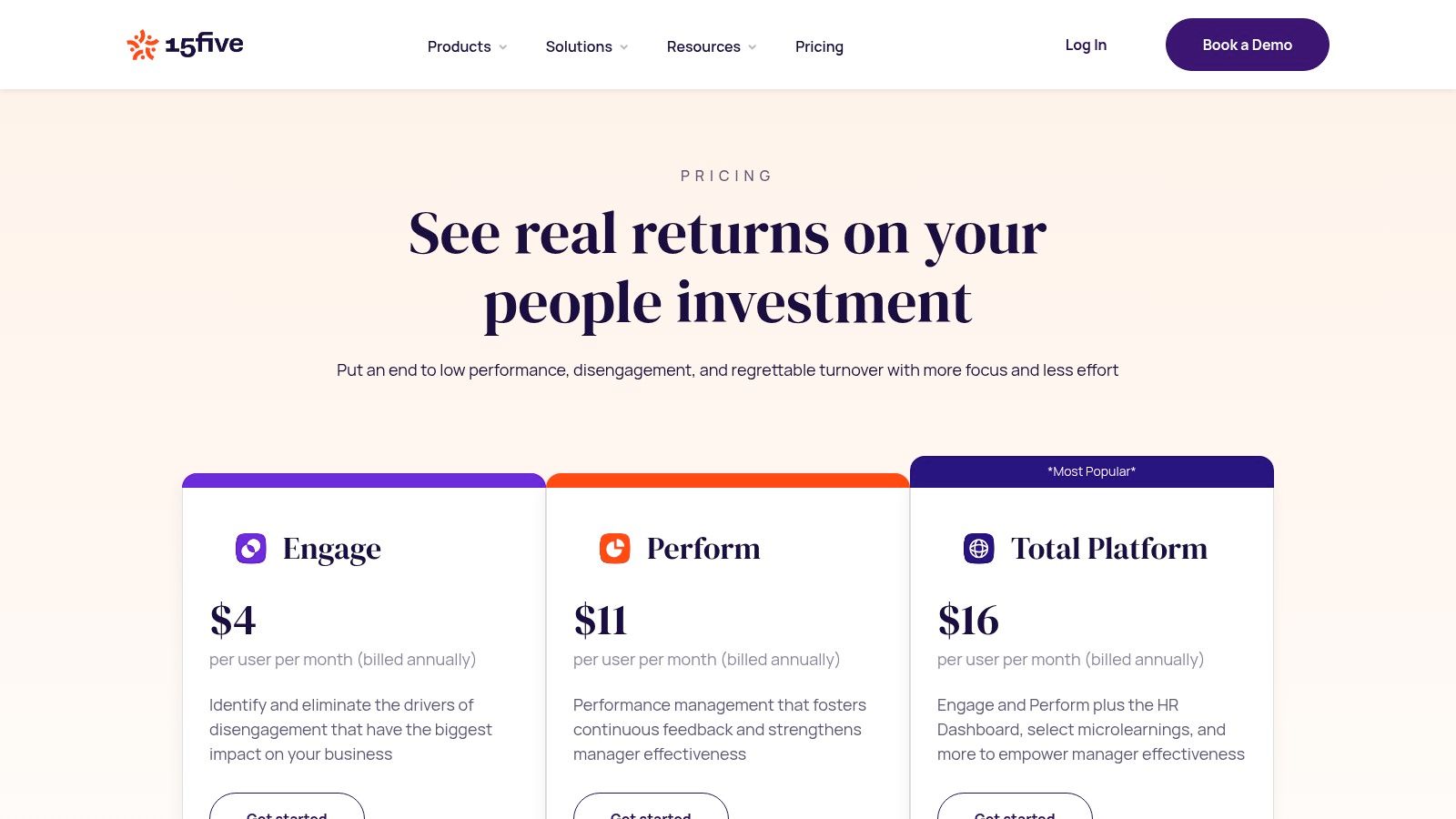
15Five is wonderfully transparent with its pricing. The Engage plan has a clear per-user cost, with other features available as bundles or à la carte add-ons. A huge plus.
Pros and Cons
Pros:
Transparent Pricing: You can see costs directly on their website without a sales call.
Focus on Manager Enablement: Goes beyond just data, offering tools to help managers improve.
Cons:
Cost Can Add Up: The à la carte model is flexible, but the total cost can increase significantly as you add modules.
Tiered Features: Some of the most powerful analytics are reserved for their higher-priced plans.
6. Workday Peakon Employee Voice
For large enterprises already in the Workday ecosystem, Peakon Employee Voice is less of a choice and more of a natural extension. This isn't just a survey tool; it's an enterprise-grade listening engine designed to plug directly into your existing HR data. Its strength is transforming continuous employee feedback into predictive insights about retention and diversity, making it one of the best employee engagement software choices for data-heavy, enterprise-scale organizations.

The real power here is its predictive analytics. Peakon doesn't just tell you how employees feel now; it uses that data to forecast potential turnover risks. For a Chief People Officer, this means moving from reactive problem-solving to proactive talent strategy, all within a familiar environment.
Key Features and Pricing
Continuous Listening: Deploys always-on engagement, DEI, and lifecycle surveys to capture real-time sentiment.
Predictive Analytics: Uses data to forecast turnover risks and identify drivers of attrition.
AI-Powered Comment Analysis: Its "Illuminate" feature automatically surfaces themes from thousands of open-ended comments.
Pricing is tailored for enterprise clients and requires a direct conversation with the Workday sales team. It’s positioned as a premium tool.
Pros and Cons
Pros:
Powerful Analytics: Its ability to benchmark data and predict turnover is a major differentiator for large companies.
Deep Workday Integration: For companies using Workday for HR, the integration provides a seamless, holistic view.
Cons:
Enterprise-Focused: The platform is built and priced for large companies, making it less accessible for smaller businesses.
Opaque Pricing: You won't find a pricing page; getting a quote is a mandatory step.
Visit Workday Peakon Employee Voice
7. Qualtrics EmployeeXM
If you view employee experience as a science, Qualtrics EmployeeXM is the enterprise-grade laboratory. It's less of a simple tool and more of a comprehensive research platform, designed for deep listening and complex analysis across the entire employee lifecycle. If you're managing a global workforce and need sophisticated analytics, Qualtrics is arguably one of the most powerful options available. It’s built for complexity and scale.
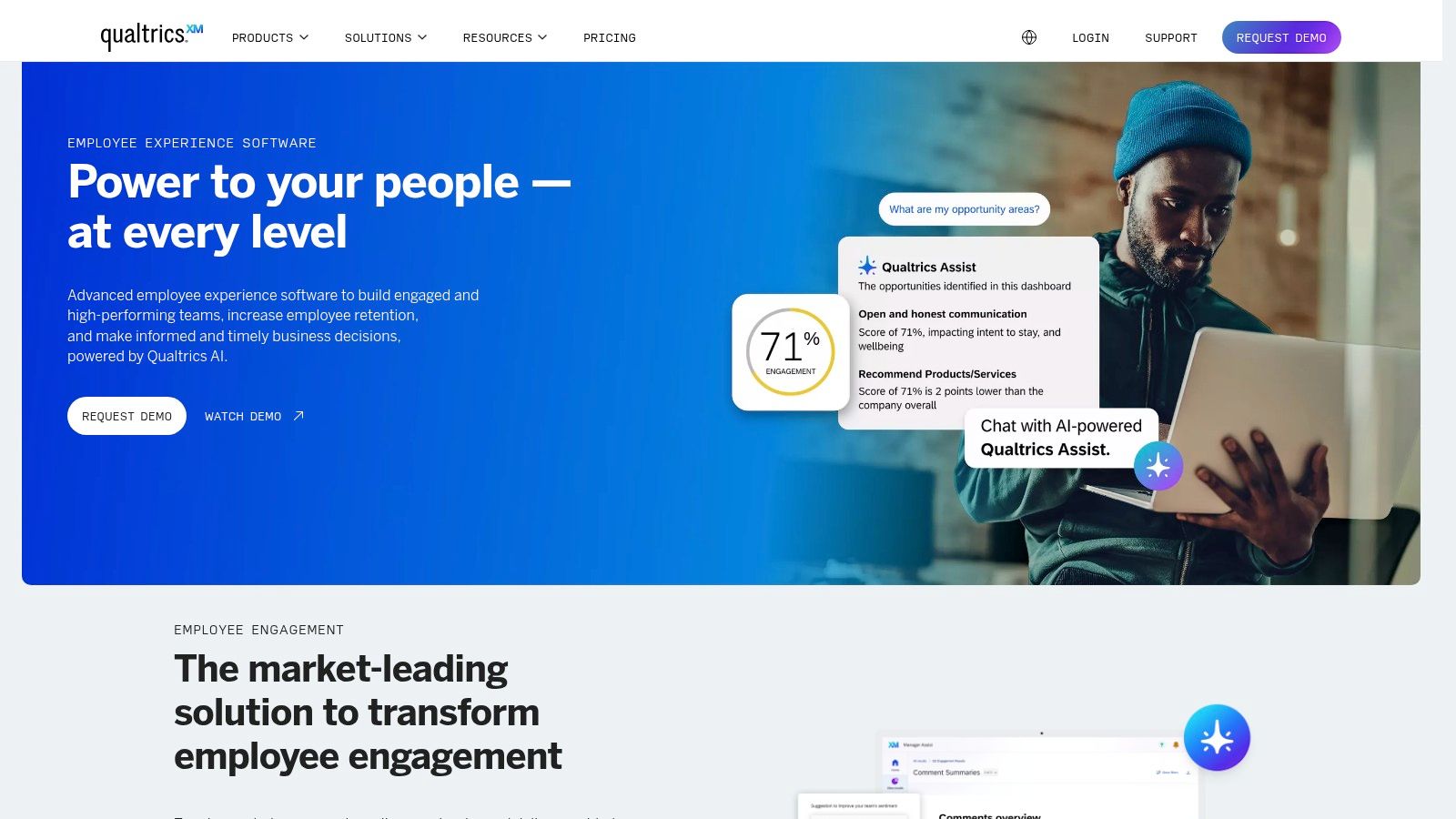
The platform truly shines in its ability to slice and dice data, giving leaders prescriptive insights and clear dashboards. It moves beyond just collecting feedback; it’s about understanding the why behind the numbers and empowering managers to act. Its flexible packaging allows companies to build the listening program they need.
Key Features and Pricing
Employee Experience Dashboards: Delivers tailored insights for managers and senior leaders.
AI-Powered Analytics: Uses AI to uncover trends, sentiment, and key drivers of engagement.
Scalable Governance: Built for large, complex organizations with robust controls and integrations.
Qualtrics uses a quote-based pricing model, so you’ll need to connect with their sales team for a custom plan. This platform is an investment. If you need some ideas for what to ask, explore these employee engagement survey questions examples.
Pros and Cons
Pros:
Powerful Analytics: Its survey and analytics capabilities are among the best in the market.
Enterprise-Ready: Mature governance, security, and integration features are built for global companies.
Cons:
Costly: The quote-based pricing can be a significant investment, making it inaccessible for some.
Complexity: Its power can be overkill for smaller businesses that just need a simple feedback tool.
8. Officevibe by Workleap
Sometimes you don't need an enterprise battleship; a speedboat gets the job done faster. Officevibe is that speedboat. It’s a refreshingly straightforward and lightweight tool designed for teams that need to start gathering feedback and boosting morale now, not next quarter. It focuses on the essentials: quick-to-launch pulse surveys, genuine peer recognition, and actionable manager feedback, making it one of the best employee engagement software choices for small and mid-sized companies.
The platform’s real charm is its simplicity and speed. You can get it running in a day, not a month, and its Slack and Teams integrations mean it fits into existing workflows with almost no friction. It's built to feel less like a corporate mandate and more like a helpful teammate.
Key Features and Pricing
Automated Pulse Surveys: Delivers regular, easy-to-answer surveys to keep a finger on the team’s pulse.
Peer Recognition ("Good Vibes"): A simple, effective feature for employees to celebrate each other.
Anonymous Feedback: Creates a safe channel for honest, two-way communication.
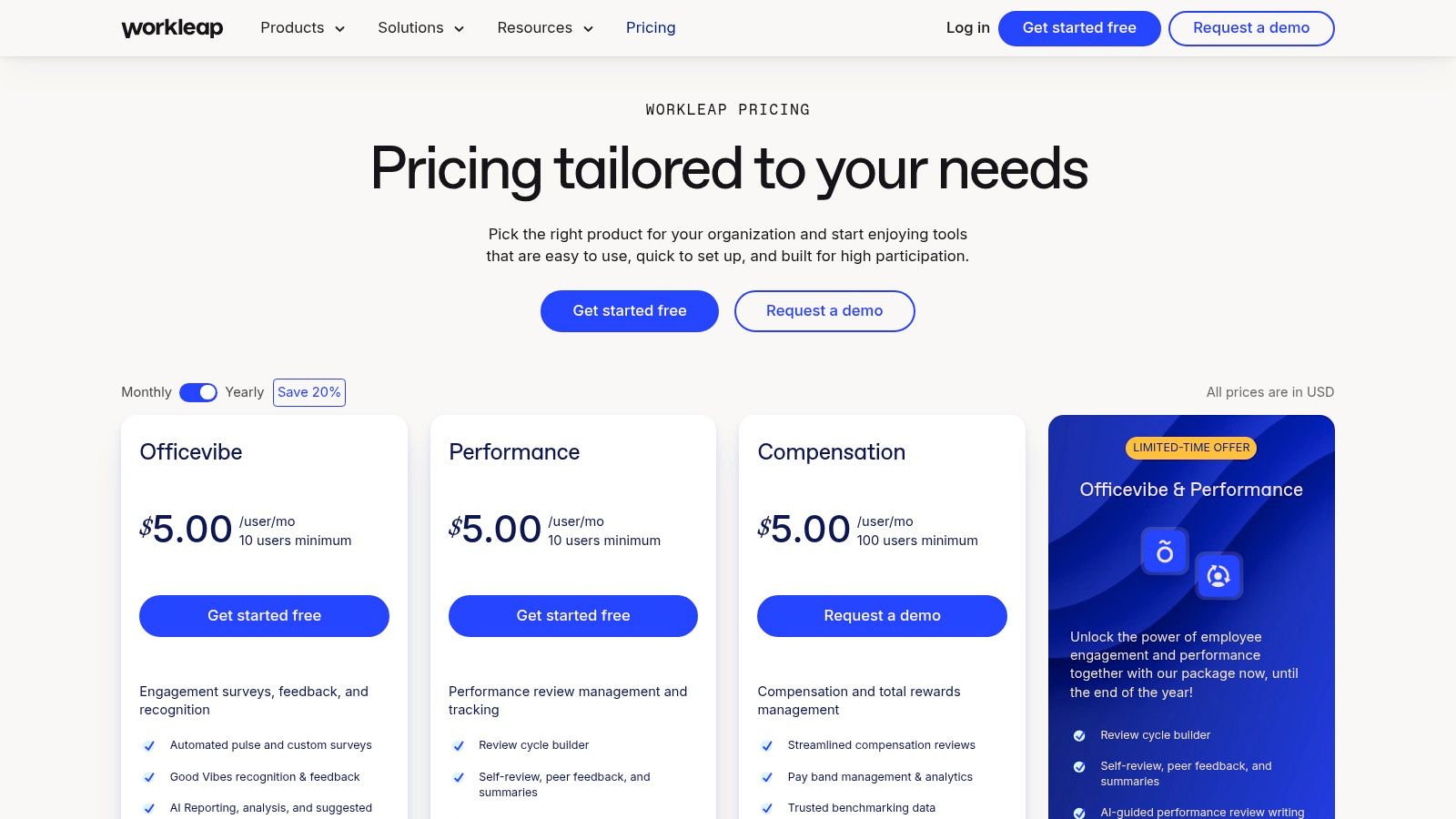
Officevibe offers transparent, per-user pricing that’s publicly listed on their website, including a free plan for small teams. This approach removes the guesswork from buying HR software.
Pros and Cons
Pros:
Transparent Pricing: Offers a free trial and clear, affordable monthly plans, which is great for budget-conscious teams.
Fast & Simple: Incredibly easy to set up and use, encouraging high adoption rates without extensive training.
Cons:
Limited Scope: It excels at surveys and recognition but lacks the deeper performance management or analytics of a full suite.
Basic Reporting: The analytics are insightful but may not satisfy data-heavy HR teams in larger enterprises.
9. Leapsome (Engagement module)
Leapsome is an all-in-one people platform, but its strength lies in its modular approach. You can start with just its engagement module and expand later. This makes it a flexible choice for businesses that want to grow into a more comprehensive system without paying for everything upfront, and one of the best employee engagement software options for companies looking to unify their people processes one step at a time.
The platform is designed to connect the dots between how employees feel (engagement surveys), what they do (performance reviews), and how they grow (learning). This integration is where it really works. You can run a pulse survey, identify a skill gap, and then assign a relevant learning path, all within the same tool.
Key Features and Pricing
Engagement and Pulse Surveys: Features robust analytics, heatmaps, and industry benchmarks.
Connected Modules: Natively links engagement data to performance reviews, goals, and learning modules.
Enterprise-Ready: Offers SSO, ISO 27001 certification, and GDPR compliance.
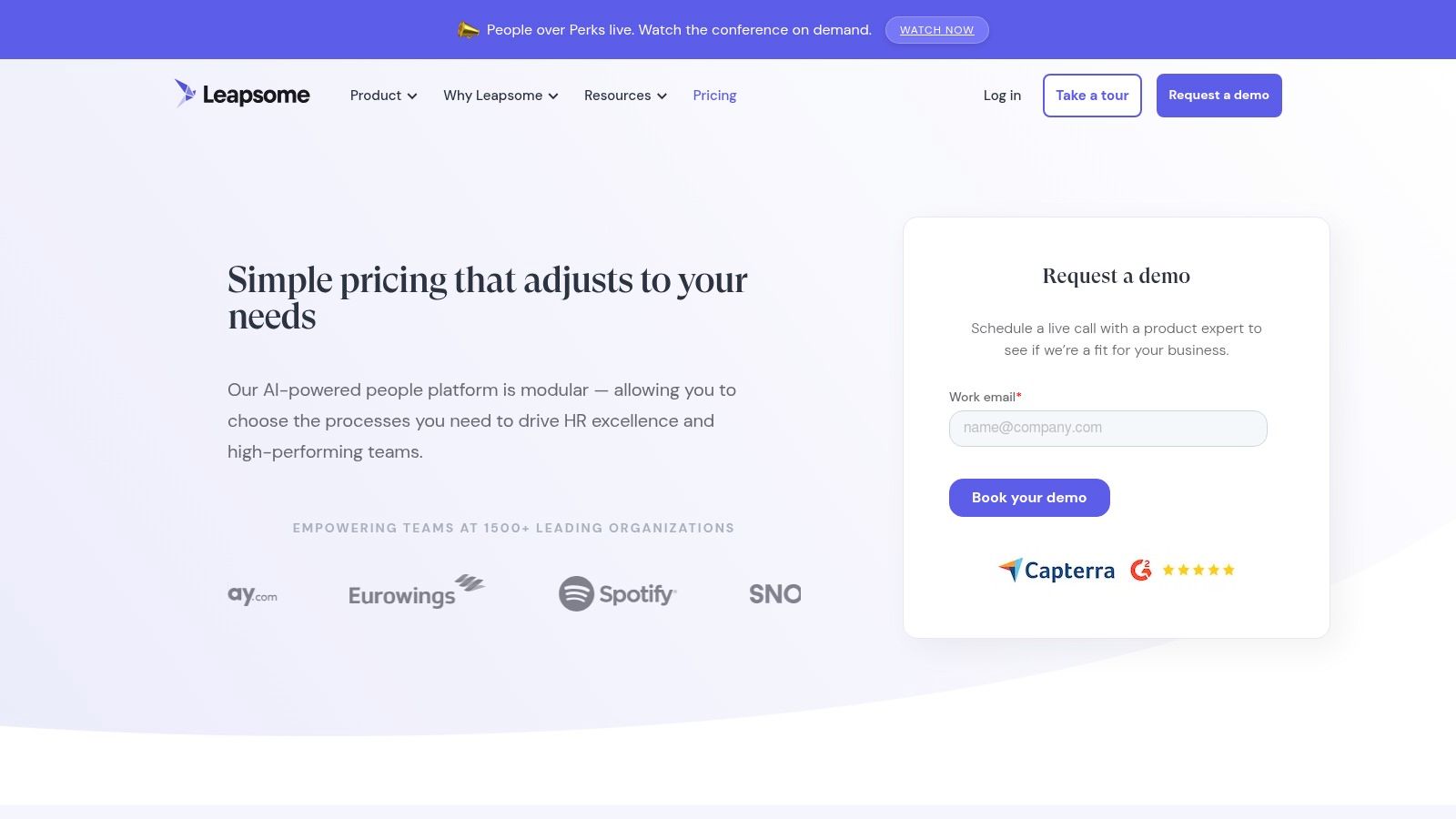
Leapsome’s pricing is entirely quote-based and requires an annual contract. You can start with a 14-day free trial, but you’ll need to connect with their sales team for a custom plan.
Pros and Cons
Pros:
Modular by Design: Allows you to start with engagement and add other modules as your needs evolve.
Holistic People Management: Balances usability with deep functionality across its interconnected modules.
Cons:
Opaque Pricing: You have to get a custom quote; there's no public pricing available.
Gated Customer Success: Dedicated customer support is only included for contracts over $6,000 per year.
10. Quantum Workplace
For organizations looking to move beyond simple surveys into a more holistic engagement and performance strategy, Quantum Workplace is a serious contender. It’s an enterprise-ready platform that combines robust feedback mechanisms with performance management. It’s one of the best employee engagement software choices for companies that want deep, interconnected data, with a strong emphasis on service and training to ensure you know what to do with it.
What makes Quantum Workplace stand out is its commitment to partnership. They don't just sell you software; they offer dedicated customer success to help you build a culture of feedback. The platform’s extensive benchmarks, sourced from over 10,000 organizations, also give your survey results invaluable context.
Key Features and Pricing
Unlimited Surveys: Deploy engagement, pulse, and lifecycle surveys without restrictions.
AI-Driven Insights: Uses AI to analyze feedback and provides tools to help managers take action.
Extensive Benchmarking: Compare your organization's engagement data against a massive dataset.
Dedicated Support: Offers tiered customer success packages to guide implementation.
Quantum Workplace is transparent about its entry point, with a minimum package starting at $15,000 per year and no implementation fees. More advanced, quote-based packages are available for larger enterprises.
Pros and Cons
Pros:
Transparent Entry Point: Knowing the minimum annual cost upfront helps with initial budget planning.
Robust Support: A strong focus on customer success ensures you get the most out of the platform.
Cons:
High Entry Cost: The $15,000 minimum can be a significant barrier for smaller businesses.
Complex for Simple Needs: Its breadth of features might be overkill if you just need a basic survey tool.
11. G2 – Employee Engagement Software (category)
Sometimes, the best first step isn't picking a tool, but understanding the entire landscape. That's where G2 comes in. It's a massive peer review marketplace, your reconnaissance mission before committing to a demo. It’s an invaluable resource in the search for the best employee engagement software because it aggregates hundreds of verified user reviews, letting you see what real people think about a platform’s promises versus its reality.
The platform’s strength is its granular filtering. You can sift through options based on company size, industry, and specific features, then create side-by-side comparisons. This process helps you quickly build a shortlist of vendors who genuinely fit your needs, saving you from countless wasted sales calls.
Key Features and Pricing
Verified User Reviews: Access detailed pros, cons, and ratings from people who have actually used the software.
Side-by-Side Comparisons: Create custom comparison grids to see how different platforms stack up.
Segment Filtering: Easily narrow down the market for SMBs, mid-market, or enterprise companies.
G2 is entirely free for buyers to use. Vendors pay for sponsored placements, but the core review data is accessible to everyone.
Pros and Cons
Pros:
Real-World Vetting: The large review base is perfect for validating vendor claims before you buy.
Free to Use: Provides a comprehensive market overview at no cost, helping you build a data-backed shortlist.
Cons:
Sponsored Placements: Be mindful that sponsored listings can influence which vendors appear at the top.
Information Overload: The sheer volume of options can be overwhelming if you don’t use the filters effectively.
Visit G2 – Employee Engagement Software
12. Capterra – Employee Engagement Software (directory)
Much like G2, Capterra isn't a tool itself but a comprehensive directory that lets you survey the market, compare features, and read user reviews. Think of it as the starting line for your research, offering a bird's-eye view of the industry before you dive into demos. It's a necessary first stop for anyone trying to find their way.
Its real value lies in the powerful filters. You can sort platforms by rating, number of reviews, or specific features, helping you quickly narrow down a massive list to a manageable shortlist. It’s an essential, unbiased resource for finding the best employee engagement software for your team's specific needs.
Key Features and Pricing
Comprehensive Vendor Listings: An extensive catalog of software with detailed profiles and feature breakdowns.
User Reviews and Ratings: Authentic feedback from real users to help gauge a platform’s strengths and weaknesses.
Comparison Tools: Side-by-side comparisons and buyer's guides to help you make an informed decision.
Capterra is a free resource for buyers; its revenue comes from software vendors who pay for placement.
Pros and Cons
Pros:
Free and Accessible: It costs nothing to browse, compare, and read reviews, making it a risk-free research tool.
Broad Market Overview: Offers one of the most complete pictures of the available software options in one place.
Cons:
Sponsored Placements: The default sorting can be influenced by paid listings, so use filters to get a more objective view.
Information can be Outdated: Always double-check pricing and features on the vendor’s official website.
Visit Capterra – Employee Engagement Software
Top 12 Employee Engagement Software Comparison
Platform | Core features | UX / Quality (★) | Value & Pricing (💰) | Target audience (👥) | Unique selling points (✨) |
|---|---|---|---|---|---|
Pebb 🏆 | Chat, news feed, kudos, shifts, PTO, tasks, knowledge lib, analytics | ★★★★☆ fast adoption, social feel | 💰 Free start; contact sales for full plans | 👥 Frontline + desk teams, SMB–mid-market | ✨ One‑link onboarding, 50+ integrations, unified ops+engagement |
Microsoft Viva Glint | Always‑on surveys, AI insights, leader dashboards, Teams/M365 integration | ★★★★☆ enterprise-grade, secure | 💰 Public entry price; sales trials available | 👥 Organizations standardized on Microsoft 365 | ✨ Deep Teams/M365 integration, strong security |
Culture Amp (Engage) | Research-backed templates, benchmarks, AI summaries, lifecycle surveys | ★★★★☆ people‑science depth | 💰 Quote-based; can be costly | 👥 Mid-market → enterprise people/HR teams | ✨ Benchmarks, DEI & retention insights |
Lattice (Engagement) | Engagement + pulse, heatmaps, manager action plans, OKRs, 1:1s | ★★★★☆ cohesive manager tooling | 💰 Annual billing; minimum spend | 👥 Growing companies wanting unified people platform | ✨ Engagement → performance workflow integration |
15Five (Engage) | Validated surveys, eNPS, heatmaps, AI insights, manager enablement | ★★★★☆ manager-focused UX | 💰 Public pricing for core; add-ons raise cost | 👥 SMBs & mid-market managers | ✨ Manager enablement, Kona AI, coaching add-ons |
Workday Peakon Employee Voice | Continuous listening, turnover prediction, AI comment analysis, benchmarks | ★★★★☆ enterprise analytics & scale | 💰 Quote-based; enterprise-level pricing | 👥 Large enterprises on Workday HCM | ✨ Predictive analytics, tight Workday alignment |
Qualtrics EmployeeXM | EX dashboards, prescriptive insights, mobile access, AI analytics | ★★★★☆ deep analytics for complex programs | 💰 Quote-based; premium enterprise pricing | 👥 Complex, multi‑geo enterprises | ✨ Flexible packaging, advanced analytics & governance |
Officevibe (Workleap) | Pulse & custom surveys, anonymous feedback, peer recognition, integrations | ★★★☆☆ simple, fast to deploy | 💰 Transparent, low pricing + free trial | 👥 SMBs & mid-market teams | ✨ Lightweight, quick setup, peer recognition |
Leapsome (Engagement) | Engagement pulses, reviews, goals/OKRs, learning, multi‑language support | ★★★★☆ modular and user-friendly | 💰 Quote-based; modular pricing; 14‑day trial | 👥 Companies wanting modular expandability | ✨ Modules (engagement → performance), ISO/GDPR, SSO |
Quantum Workplace | Unlimited surveys, AI insights, benchmarks, dedicated CS & training | ★★★★☆ robust support & insights | 💰 Minimum ~$15k/yr entry; tiered pricing | 👥 Enterprises & large organizations | ✨ Extensive benchmarks, strong customer success |
G2 – Employee Engagement (category) | Reviews, side‑by‑side comparisons, filters, vendor links | ★★★☆☆ helpful for shortlist validation | 💰 Free to use | 👥 Buyers shortlisting vendors | ✨ Verified user reviews, comparison grids |
Capterra – Employee Engagement (directory) | Category guides, vendor profiles, filters, pricing context | ★★★☆☆ broad discovery & filtering | 💰 Free to use | 👥 Buyers scanning many options quickly | ✨ Wide vendor catalog, buyer guides and shortlists |
Final Thoughts
We’ve walked through a dozen different paths to the same place: a more connected and effective team. We've seen heavy-hitters like Microsoft, specialized survey tools like Culture Amp, and all-in-one platforms like Lattice.
If there’s one thing to take away, it’s this: there is no single "best employee engagement software" for everyone. The best tool is the one that fits the unique shape of your organization. The one your people will actually use. A platform can have a thousand features, but if it feels like another corporate chore, it’s already failed.
It's Not About the Software, It's About the System
Let’s be honest. Buying software is the easy part. The real work is building a system of communication and feedback that your team trusts. The tool is just the vehicle; you still have to steer.
Think about the actual day-to-day of your employees. For a frontline worker in a busy retail store, a clunky, desktop-only portal is a non-starter. They need something mobile, intuitive, and immediate. For a distributed engineering team, the priority might be seamless integration with the project tools they already live in.
This is where so many engagement plans fall flat. We get excited about dashboards but forget the human on the other end of the screen. We measure sentiment but fail to create a space where genuine connection can happen.
From Measurement to Movement
The biggest shift happening now is the move from measuring engagement to enabling it. Old-school software was built around the annual survey. It gave you a snapshot, a lagging indicator of how things were a few months ago. That’s helpful, but it's not enough.
Modern tools are about creating a continuous loop. They facilitate daily check-ins, celebrate small wins in real-time, and make company-wide announcements feel personal. They connect people not just to management, but to each other. This is the difference between a tool that diagnoses problems and one that helps you build a healthier culture, day by day.
So, as you decide, don't just compare feature lists. Ask yourself these questions:
Who is this really for? Is it designed for HR admins, or is it truly built for the end-user, whether they’re at a desk or on their feet?
What problem does this solve right now? Are you trying to fix communication, improve recognition, or get a handle on sentiment? Start there.
Will this simplify our lives? Or will it just add another login for everyone to forget? The goal is consolidation, not more complexity.
Choosing the best employee engagement software is a huge step, but it’s just the first one. The real magic happens when you use it to listen, to connect, and to build a workplace where people feel seen and heard. That’s a goal worth investing in.
Tired of juggling multiple apps for communication, surveys, and recognition? Pebb was built to replace that chaos with a single, beautiful platform your frontline and office teams will actually love using. See how we bring everything together at Pebb.
