
Author: Ron Daniel
Onboarding Tools vs. Traditional Communication Methods
Compare mobile-first onboarding platforms with email-and-paper methods across speed, engagement, frontline access, automation, and security.
Have you ever started a new job and felt like you were drowning in forms, emails, and endless checklists? I’ve been there too. It’s like stepping into chaos when all you want is to hit the ground running. And here’s the kicker: only 12% of employees feel their company does a great job onboarding new hires. That’s not just a small problem - it’s a massive one.
At Pebb, we saw this firsthand. New hires were overwhelmed, HR teams were buried in manual work, and communication gaps were everywhere. It wasn’t working, especially for frontline or remote teams. So, we decided to fix it. But I’ll be honest, this wasn’t just about replacing paper with tech. It was about rethinking how onboarding should work to drive workplace engagement in today’s fast-paced, distributed workplaces.
In this article, I’ll break down how modern onboarding tools like Pebb compare to old-school methods. We’ll look at what’s slowing teams down, how digital tools are changing the game, and why the right system can make all the difference. Let’s dive in.
Traditional Onboarding Communication Methods
Common Traditional Methods
Back in the day, onboarding looked a lot different than it does now. New hires would walk into their first day and immediately be handed a stack of printed tax forms, emergency contact sheets, policy acknowledgments, and maybe a welcome packet. That packet might include an office map, an org chart, an employee handbook, and a few pieces of company swag - pretty standard stuff.
HR teams leaned heavily on email for the rest. Offer letters, benefits info, IT setup instructions, parking details - you name it, it landed in the new hire's inbox. The result? A cluttered inbox full of scattered details that made it tough for anyone to keep track of what was where.
Then came the in-person orientation sessions. Picture long PowerPoint presentations covering company history, compliance policies, and other essentials. Sure, they had their moments, but they weren’t exactly the most engaging way to kick things off.
Some companies tried to soften the experience by assigning a buddy or mentor - a seasoned employee who could answer questions and help the new hire navigate their early days. While these personal touches helped, they couldn’t fully make up for a process that often dragged on for weeks or even months. It was clear: these traditional methods weren't cutting it when it came to clarity or efficiency.
Problems with Traditional Methods
The cracks in the system became apparent pretty quickly. For starters, traditional onboarding was a slow grind, often stretching out over weeks or months. This left new hires feeling stuck, unable to hit the ground running. And when you consider that 55% of employees spend between 30 minutes and two hours daily just clarifying communication details, it’s easy to see how the confusion starts on day one. Important info would get buried in massive handbooks or lost in the shuffle of emails.
"Traditional paper-based onboarding isn't just more time-consuming than using a digital onboarding system, it can also be more expensive." - StaffCircle
For HR teams, the manual work was relentless. Every handwritten form had to be entered into the system by hand, creating a mountain of data entry that naturally increased the chances of errors. And let’s not forget the security risks - paper-based processes didn’t exactly excel at keeping sensitive personal information safe.
But here’s the kicker: these methods were built for desk jobs. They completely fell apart when applied to retail workers, warehouse staff, or remote employees. Many of these folks don’t have regular access to company email or a quiet place to sift through piles of paperwork. As a result, frontline workers often got left out of the loop. In industries like retail, hospitality, and healthcare - where decentralized teams need to be on the same page from day one - that’s a major problem. Companies must find better ways to engage and empower your frontline workforce effectively.
Modern Onboarding Tools: How They Work
Let me tell you, onboarding has come a long way. Tools like Pebb have completely transformed the process, making it smoother and more efficient for everyone involved. Imagine this: a single platform where new employees can access everything they need, whether they’re at a desk or on the floor of a bustling retail store. That’s the beauty of modern onboarding tools - they centralize everything and automate the heavy lifting for HR teams.
Here’s how it works. Over the first 30–45 days, these tools automatically deliver compliance documents, benefits details, and introductions to key stakeholders. No more drowning in paperwork or losing track of critical forms. Everything is streamlined, eliminating manual data entry and ensuring nothing important slips through the cracks.
What Pebb Offers

When we designed Pebb, we wanted to create something that worked for everyone - not just office workers with easy access to company emails. That’s why we made it mobile-first and packed it with features that make onboarding a breeze.
Here’s what makes Pebb stand out:
Work chat with unlimited history: Perfect for quick questions and real-time conversations.
News feed: Keeps everyone in the loop with company announcements and team updates.
Knowledge library: A searchable hub for policies, procedures, and training materials.
We didn’t stop there. Pebb also supports pre-boarding, so new hires can complete HR forms, explore company culture materials, and even connect with their assigned buddy before their first day. It’s a game-changer. By the time they officially start, they already feel like part of the team.
And that’s not all. Pebb integrates tasks, calendar events, shift schedules, and PTO management into one app. Whether you’re a retail worker, a warehouse employee, or part of an office team, you get the same seamless experience. Features like digital forms, group chats, and an employee directory ensure everyone stays connected, no matter where they are or what device they’re using.
Benefits of Using Modern Tools
The benefits of tools like Pebb are huge, both for companies and employees. First, they simplify the onboarding process, cutting down timelines from weeks to days. Automation handles the repetitive tasks, so HR teams can focus on what really matters - people.
Engagement is another big win. Instead of just reading through a pile of documents, new hires can dive into interactive features like news feed updates, polls, and real-time chats. They can even share instant feedback through polls and digital forms, giving HR teams valuable insights into what’s working and what needs tweaking. Considering only 12% of employees think their company does a great job with onboarding, tools like this are a much-needed improvement.
For frontline workers, the impact is even more noticeable. They’re no longer stuck chasing down managers or sifting through irrelevant information. Everything they need is right in their pocket, accessible 24/7. And the best part? Pebb makes it affordable. Companies can start for free for up to 15 employees, with the Premium plan costing just $4 per user per month. That means businesses of any size can onboard the right way.
Here’s a stat that blew my mind: employees waste an average of 3.5 hours a week searching for information they don’t need. Modern tools like Pebb cut through the clutter, organizing everything logically and making it easy to find. That way, new hires can focus on what they’re really here to do - learn their role and start contributing.
Onboarding Tools vs. Traditional Methods: Direct Comparison
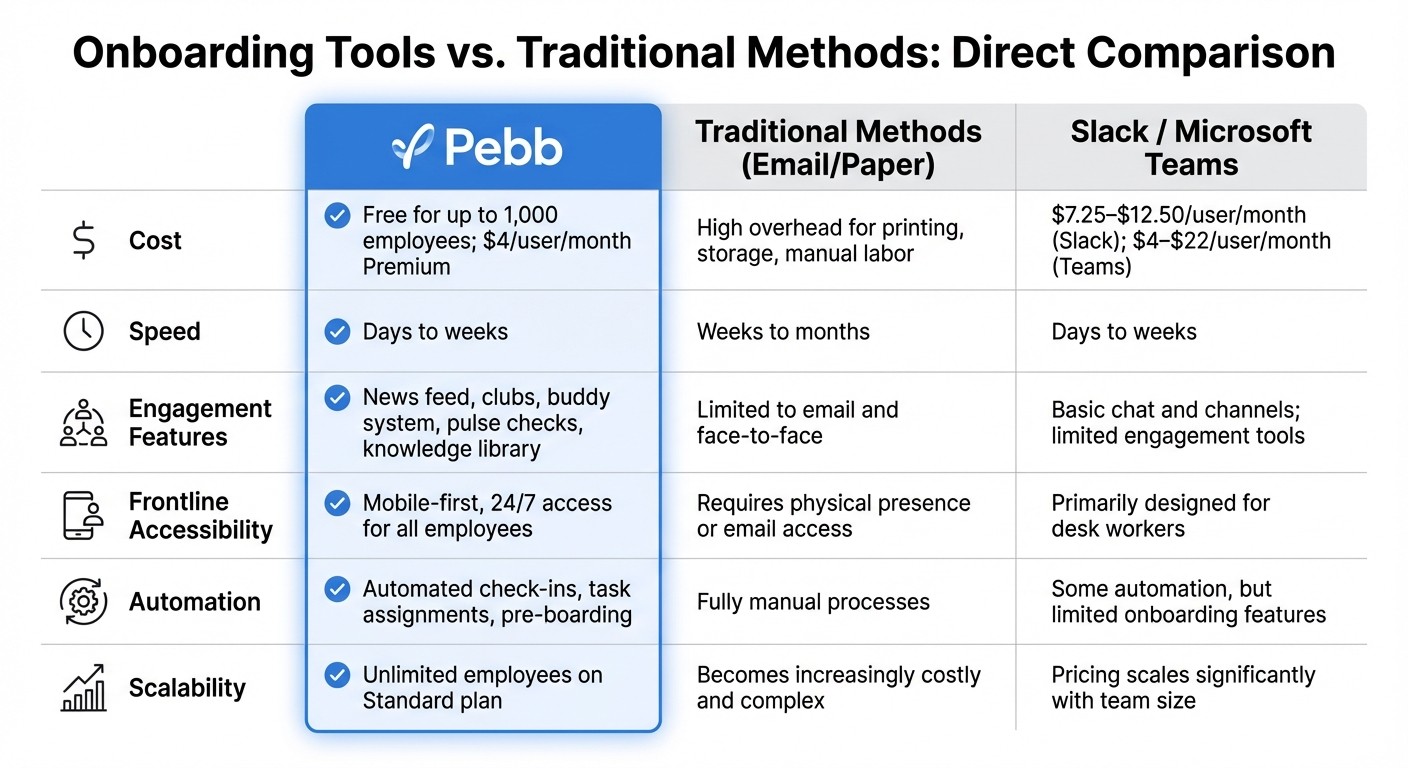
Pebb vs Traditional Onboarding Methods Comparison
Let me break this down for you - when people ask, “What’s the real difference here?” the answer is simple: time and efficiency.
Traditional onboarding - think endless email chains, stacks of printed handbooks, and marathon in-person sessions - can drag on for weeks or even months. It’s a slow grind, leaving new hires feeling like they’re wandering in circles before they even find their footing. But with digital systems like Pebb, onboarding shrinks to just days or weeks. That means your new team members aren’t stuck in limbo - they’re up and running from day one.
Here’s why this matters: effective onboarding programs can boost employee retention by 82% and increase productivity by over 70%. Yet, shockingly, only 12% of employees feel their company nails the onboarding process. That’s a massive gap, and outdated methods are a big part of the problem. Traditional systems are bogged down by manual tasks and paper-based workflows, while low engagement levels are costing businesses a staggering $8.9 trillion globally. The takeaway? Sticking to old-school methods isn’t just inefficient - it’s expensive.
Comparison Table: Pebb vs. Traditional Methods
Let’s get into the specifics. Here’s how Pebb stacks up against traditional methods and other tools like Slack or Microsoft Teams:
Factor | Pebb | Traditional Methods (Email/Paper) | Slack / Microsoft Teams |
|---|---|---|---|
Cost | Free for up to 15 employees; $4/user/month Premium | High overhead for printing, storage, manual labor | $7.25–$12.50/user/month (Slack); $4–$22/user/month (Teams) |
Speed | Days to weeks | Weeks to months | Days to weeks |
Engagement Features | News feed, groups, polls, knowledge library | Limited to email and face-to-face | Basic chat and channels; limited engagement tools |
Frontline Accessibility | Mobile-first, 24/7 access for all employees | Requires physical presence or email access | Primarily designed for desk workers |
Automation | Automated check-ins, task assignments, pre-boarding | Fully manual processes | Some automation, but limited onboarding features |
Scalability | Up to 15 employees on Standard plan | Becomes increasingly costly and complex | Pricing scales significantly with team size |
The differences here are crystal clear. Traditional methods are clunky and resource-heavy, while tools like Slack or Teams, though useful, aren’t tailored for onboarding. Pebb, on the other hand, is purpose-built to make the process seamless, accessible, and scalable.
Here’s the thing: when employees are wasting 3.5 hours a week hunting for information they shouldn’t need to, and 55% lose 30 minutes to two hours daily just clarifying details, it’s a no-brainer to invest in a system that organizes everything efficiently. That’s exactly why we created Pebb - to cut through the chaos and give people the tools they need to succeed right out of the gate.
Pebb in Action: Practical Examples
When it comes to onboarding, the gap between theory and actual execution can make or break how quickly new hires settle into their roles. Let me walk you through two real-world examples that show how Pebb simplifies the process and delivers results.
Example 1: Onboarding Retail Frontline Teams
Picture this: a typical U.S. retail store brings on 10–20 new associates each month. The onboarding process? A mess of paper tax forms, outdated training videos, and rushed floor tours. New hires leave with a handbook they’ll likely never open again, and crucial information ends up scattered across binders, random emails, or locked away in someone's memory.
Now, here's how we flipped the script with Pebb. New associates immediately join a "New Hire – Store Associate" group on their phones. This club houses everything they need: dress code details, time-off policies, safety procedures, POS guides, and even bite-sized how-to videos. We also set up a day-by-day task list for their first two weeks. Tasks like "Complete safety quiz", "Watch 3-minute POS intro", "Shadow opening checklist", and "Review returns policy" come with due dates and automatic reminders. No more guesswork.
When questions pop up - like during the chaos of a lunch rush - new hires don’t have to track down a manager. Instead, they hop into dedicated group chat channels like #frontline-qa or #store-101. Managers, on the other hand, can track progress through read receipts and automated checklists, ditching the need for messy spreadsheets or manual tracking. Unlike static paper handbooks, Pebb centralizes everything, making it easy to manage tasks, share updates, and communicate in real time.
And the impact? Research shows digital onboarding can boost new hire productivity by 54% and slash time-to-productivity by 62%. In retail, this means new associates can handle transactions and daily routines independently within days, not weeks. Plus, with standardized and trackable training, safety incidents drop, and new hires gain confidence right out of the gate.
Example 2: Onboarding Large Distributed Teams
Now let’s take it up a notch. Imagine onboarding hundreds of new hires across dozens of locations in industries like logistics or hospitality. Traditional methods struggle here - safety protocols vary by site, updates crawl through email chains, and HR has no clue who’s completed mandatory training at which location.
With Pebb, we tackle this challenge in layers. First, there’s a global onboarding space that ensures every new hire - whether they’re in Atlanta or Seattle - receives the same essential training. This covers core values, safety, compliance, and systems. Then, we layer in location-specific groups for details like site procedures, emergency plans, and property layouts.
To make it even smoother, we use role-based task templates - think "Warehouse Picker – First 30 Days" or "Housekeeping – First 14 Days." These templates auto-assign tasks based on the role, so nothing falls through the cracks.
When it’s time to roll out a new policy or standard operating procedure (SOP), HQ publishes it once in the news feed, and it reaches every location instantly. No more relying on regional managers to cascade updates. Leaders can immediately check completion analytics across sites, spotting which locations are excelling and which need extra support. For example, one hospitality brand we work with went from spending hours merging spreadsheets to having instant visibility into training completion rates by property, role, and start date.
This layered approach transforms onboarding for large, distributed teams into a seamless, efficient process. It’s no longer about patchwork fixes - it’s about delivering consistency and clarity, no matter the scale.
Why Pebb Works Best for Onboarding
Let me share something we’re pretty proud of at Pebb: we’ve cracked the code on onboarding chaos. You know the drill - outdated tools, endless emails, and a scattered process that leaves everyone frustrated. We built Pebb to fix all of that. Think of it as your mobile-first hub designed for how people actually communicate today. No fluff, just a straightforward way to streamline onboarding.
Here’s the deal: accessibility and speed are where Pebb shines. Traditional systems? They’re clunky and slow, especially for the 2.7 billion frontline workers worldwide who don’t have a corporate email or desk. That’s why we made sure Pebb works seamlessly on personal devices. New hires can connect in less than 24 hours - just one invitation link, and they’re in.
But onboarding is just the start. Pebb’s all-in-one design takes things further by combining everything you need in one place: work chat, a searchable Knowledge Library, task management, shift scheduling, and even a social news feed. New hires get access to every resource instantly, all through our centralized, searchable hub. It’s simple, fast, and effective. As Dan Robin from our team so perfectly said:
"The right tool doesn't add to the chaos; it quiets it".
And then there’s the cost. Let’s be real - price matters, especially when you’re scaling. Competitors like Workvivo start at over $20,000 per year, and Staffbase can go well beyond $30,000. Pebb? We offer a free plan for up to 15 users, and our Premium plan is just $4 per user per month. That’s a fraction of what you’d pay for Slack or Teams, making it budget-friendly for large, distributed teams.
With a 4.6/5 rating on G2 and pricing that’s hard to beat, Pebb delivers fast, hassle-free onboarding from day one. We’ve seen companies go from setup to full company-wide communication in a single day. And when only 12% of employees feel their company does a great job with onboarding, we’re here to change that narrative - no complexity, no sky-high costs, and no fragmented systems holding you back.
Wrapping It All Up
Let me paint you a picture: imagine starting a new job and being bombarded with endless emails, paper forms, and cluttered bulletin boards. It’s overwhelming, isn’t it? That’s exactly what traditional onboarding feels like - slow, disjointed, and impersonal. It’s no wonder these outdated methods struggle to engage new hires. They treat onboarding as a checklist, not as an opportunity to build connection and loyalty from day one.
That’s why we created Pebb. It’s a mobile-first, all-in-one platform designed to simplify everything. With Pebb, work chat, knowledge libraries, task management, and real-time updates all live in one place. No more digging through endless email threads or waiting for answers. New hires can hit the ground running, whether they’re on the frontlines or part of an office team. It’s about making sure everyone feels connected and supported right from the start.
Here’s the kicker: sticking with outdated methods comes with hidden costs - lost time, low engagement, and higher turnover. Pebb flips the script. We offer a free plan for up to 15 users, and our Premium plan is just $4 per user per month. That’s not just affordable; it’s a game-changer compared to what others charge. With Pebb, you’re not just onboarding faster - you’re building teams that thrive together.
This isn’t just about swapping one tool for another. It’s about rethinking how we welcome new hires and set them up for success. When you invest in the right tools from day one, you’re not only boosting efficiency - you’re creating an environment where people want to stay and grow. Ready to see the difference Pebb can make? Let’s transform your onboarding process together.
FAQs
How do tools like Pebb make onboarding more engaging compared to traditional methods?
Starting a new job can feel like being dropped into a maze, especially when traditional onboarding tools leave you sifting through countless emails or wrestling with clunky intranets. That’s where Pebb changes the game. It brings everything new hires need into one intuitive platform. Whether it’s group chats, task lists, or a searchable directory of teammates, it’s all right there - accessible anytime, even on your phone.
But here’s the real magic: Pebb doesn’t just organize tasks; it builds connections. New team members can jump into role-based or location-specific groups, ask questions in real time, and interact with coworkers through dynamic, engaging features. Onboarding shifts from being a box to check off to an experience that sparks collaboration and relationships from day one.
And the best part? It’s budget-friendly. With a free tier for up to 15 employees available and a premium plan at just $4 per user per month, Pebb ensures your team feels welcomed, supported, and ready to hit the ground running - without breaking the bank.
What makes Pebb an ideal communication tool for both frontline and office employees?
Pebb is like the ultimate gathering spot for teams, no matter where they’re working - on the shop floor, in the office, or anywhere in between. It’s an all-in-one communication hub that works effortlessly across devices. For frontline workers, it’s a game-changer. They can use their smartphones to access work chats, voice and video calls, and real-time news feeds, complete with handy push notifications and offline access. Meanwhile, office teams get the same seamless experience on their desktops and laptops.
Here’s the kicker: Pebb doesn’t just replace one tool - it combines several. Instead of juggling multiple apps, you get everything in one place: groups, task management, events, an employee directory, and even a knowledge library. This makes it so much easier for teams to collaborate and stay on the same page. And the best part? It’s budget-friendly. Pebb offers a free tier for up to 15 employees, and the premium plan is just $4 per user per month, making it a great fit for businesses big and small.
Whether you’re organizing shifts, sharing company updates, or running virtual meetings, Pebb keeps everyone connected and in sync, no matter where they’re working from. It’s all about making teamwork simple and effective.
How does Pebb keep onboarding data secure compared to traditional paper-based methods?
When it comes to security, Pebb takes things to a whole new level compared to old-school paper methods. Let me give you the lowdown. Pebb uses advanced encryption to safeguard sensitive data, whether it’s being sent across networks or just sitting in storage. This means your information is locked down tight, unlike paper forms that can easily get lost, misplaced, or land in the wrong hands. And here’s the best part: you can control exactly who has access to what with customizable permissions. No more worrying about unauthorized eyes on your data.
But that’s not all. Pebb includes permissions control, which lets you control access to onboarding data more precisely. It’s like having a security camera for your information - offering you both peace of mind and accountability. Let’s face it, paper systems just can’t hold a candle to this kind of protection. With Pebb, you’re not just getting a secure solution; you’re stepping into a smarter, more streamlined way to onboard your team.
