

Author: Ron Daniel
Managing remote team culture through virtual employee clubs
Build voluntary virtual clubs with clear goals, time limits, async options, and steady rhythms to boost belonging.
Most remote teams don’t have a communication problem. They have a connection problem.
I saw that play out on our team at Pebb.io. We had messages flying all day, calendars packed, and replies coming in fast. But the small moments that make people feel close were missing. The result was subtle at first, then hard to ignore: quieter chats, less energy, and more people feeling on their own even while “connected.”
The data lines up with what I’ve seen. Remote workers often say loneliness is one of the hardest parts of the job, and even 30 to 60 minutes a week of virtual team-building activities can make a clear difference in how people show up. What worked for us wasn’t adding more meetings. It was setting up simple virtual clubs people could join by choice, with a steady rhythm and clear time limits.
In this guide, I’ll walk through what helped us get these clubs off the ground, where we got it wrong, and how we kept the groups people cared about active without turning them into extra work. If you’re trying to make a remote team feel more human, this is the playbook I’d start with.
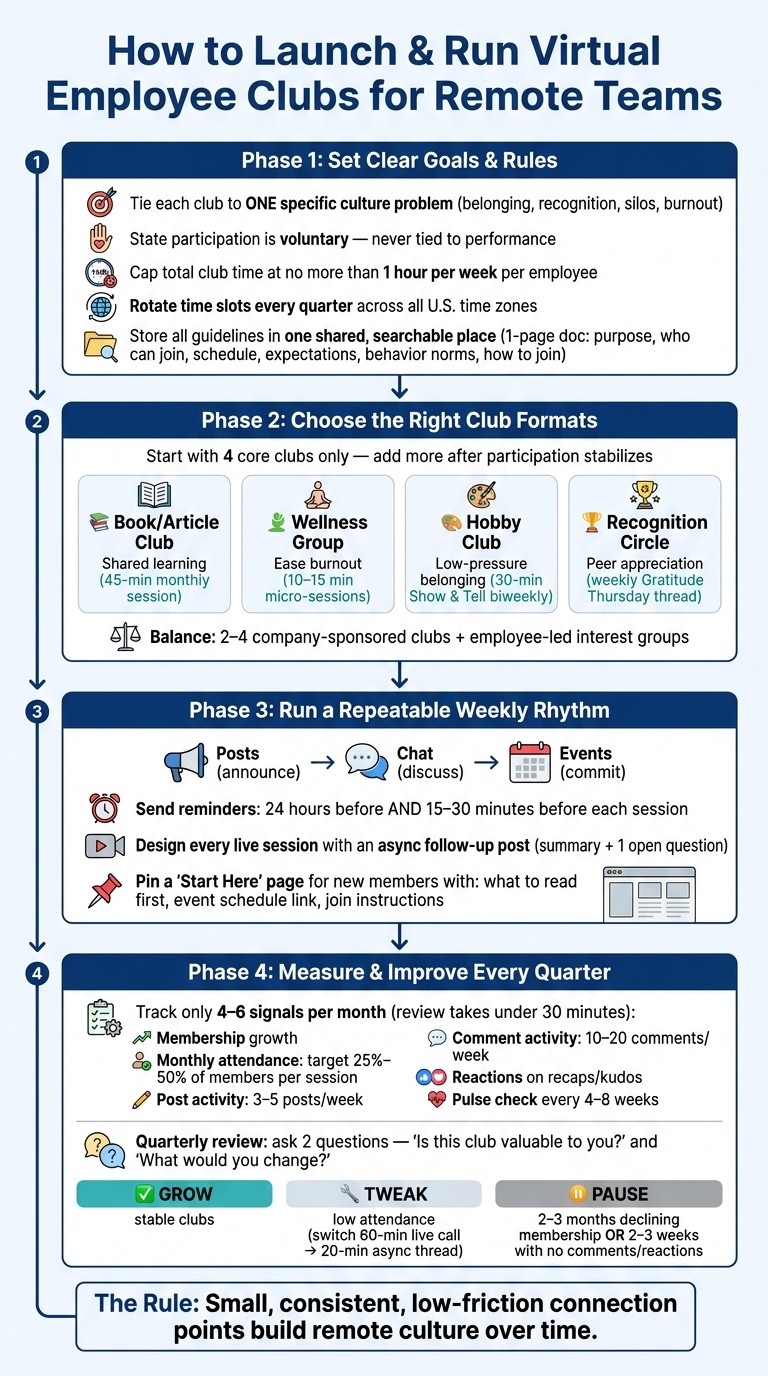
How to Launch & Run Virtual Employee Clubs for Remote Teams
Set clear goals and simple rules before you launch
I’ve seen this happen more than once at Pebb.io: a team starts a club with good energy, a fun name, and a Slack post that gets a bunch of emoji reactions. Two weeks later? Silence. The club didn’t fail because people didn’t care. It failed because the purpose was fuzzy.
A club without a clear reason fades fast. In remote teams, that usually turns into one more empty space instead of a place where people feel close. Here’s the thing: before we launch any club, we tie it to one specific culture problem. Once that part is clear, the format gets much easier to pick and keep running.
Pick culture goals that match your business needs
When we think about clubs, we don’t start with, “What sounds fun?” We start with the gap. We look at turnover, ramp time, engagement scores, and mobility data to figure out what kind of connection problem we’re trying to fix. Each club should solve one real issue.
Let me give you a simple way to think about it:
If belonging feels weak, hobby groups or coffee chats can help.
If recognition is low, recognition circles make more sense.
If teams work in silos, cross-functional clubs can bring people together.
That one-to-one match matters. Naming one or two main outcomes for each club makes it easier for people to get why it exists and how it helps them.
I’ve found that when employees can see the point right away, they’re far more likely to join without feeling like they’re being nudged into “just another program.”
Write down participation rules and time limits
This part sounds small, but it saves a lot of trouble later.
We always state up front that clubs are voluntary and never tied to performance or promotion. That line needs to be plain and hard to miss. Managers also need to stay away from wording that makes attendance sound expected, because optional activities can start feeling like homework pretty fast.
I’ve watched that shift happen in remote teams. Something starts as casual, then people begin wondering, “Will it look bad if I skip?” That’s when the fun drains out.
We also set recurring times and list all U.S. time zones so nobody has to do the math in their head. Then we rotate time slots every quarter, so the same group of people isn’t always stuck missing out. On top of that, we cap total club time at no more than 1 hour per week per employee across all clubs. That keeps participation inside normal work hours and stops club time from spilling into personal time.
Store club guidelines in one shared place
One lesson we learned early: if people have to ask around for the basics, they often won’t join at all.
That’s why we keep the purpose, schedule, expectations, and join-or-leave steps in one searchable place. In Pebb, the Knowledge Library gives employees a way to find what they need on their own, without asking a manager. It also helps new members join at their own speed. As clubs grow and new organizers step in, it keeps the rules the same for everyone.
Our club doc is pretty lean. It fits on one page and covers:
purpose
who can join
when it meets
participation expectations
behavior norms
how to join
That simple setup has saved us a ton of back-and-forth, and it makes clubs feel open instead of confusing.
With goals and rules in place, the next step is choosing club formats people will actually join.
Choose club formats that employees will actually join
I’ve seen this go sideways fast at Pebb.io.
We’d get excited, spin up a bunch of clubs at once, and then watch the energy spread out like peanut butter on too much toast. On paper, it looked fun. In practice, organizers got stretched thin, posts slowed down, and people quietly stopped showing up.
Here’s the thing: more clubs doesn’t mean more connection.
What worked better for us was starting small. We’d begin with four core clubs tied to the biggest culture gaps we were trying to fix. Then we’d add more only after participation stayed steady. That kept things simple and gave each group a fair shot.
The best club mix depends on the gap you’re trying to close: learning, burnout, belonging, or recognition.
Start with 4 reliable club types
At Pebb.io, I’ve found it helps to start with four club formats that each support one clear culture goal.
Book or article clubs are great for shared learning, especially for managers and knowledge workers. We keep sessions light on purpose. One short article or one podcast is usually enough. If the homework feels like homework, people bail.
Wellness groups can help ease burnout in always-on remote work. I’ve seen short 10–15 minute micro-sessions work far better than long wellness calls. Async challenges, like step counts, also fit better for people jumping in between shifts or meetings.
Hobby clubs - cooking, photography, gaming, and DIY - tend to create easy, low-pressure connection. These are often the groups where cross-functional bonds start to happen. They also give quieter employees a place to speak up without the stiffness of a formal meeting.
Recognition circles give peer appreciation a place to live. A weekly "Gratitude Thursday" thread or a short monthly wins huddle can help quieter contributors stay visible. It also gives teams a simple way to tie day-to-day stories back to company values.
Balance company-sponsored and employee-led groups
One setup I like is pretty simple: let HR or operations sponsor two to four core clubs tied to actual culture goals, then leave room for employees to pitch and run interest-based groups too.
That balance matters.
Company-sponsored clubs bring structure and focus. Employee-led clubs bring the kind of energy that never comes from a top-down plan alone. I’ve watched both sides play out, and the sweet spot is having both.
Let me tell you what happened next when we made the employee-led path easier: more people stepped up.
Not because we pushed them, but because they didn’t have to start from zero.
We gave them a simple one-page approval checklist with:
an inclusive purpose
clear time boundaries
a mobile-friendly format
alignment with company values
We also shared a starter template with a sample description and a few posting prompts. That small bit of structure made it much easier for someone to start an interest-based group without feeling stuck before day one.
Set up dedicated club spaces inside Pebb Groups
This part is easy to overlook, but it makes a big difference.
Each club should have its own Pebb Group with a clear name, a one-sentence purpose, pinned join instructions, and a short intro prompt. I always try to keep the copy mobile-friendly, because if joining feels clunky on a phone, people put it off and often never come back.
Once each club has a clear format and a clear home, it gets a lot easier to build a weekly rhythm through chat, posts, and events.
Run clubs with a repeatable weekly rhythm
At Pebb.io, I learned this the hard way: clubs don’t fade because people stop caring. They fade because the rhythm gets fuzzy.
We saw it happen more than once. A club would start with energy, the first meetup would go well, and then... silence. No one knew when the next session was, where to talk in between, or how to jump back in after missing one week. Once we gave each club a home inside Pebb Groups and built a steady weekly flow around it, things got a lot easier for everyone.
Here’s the thing: people join clubs when they know what to expect. And facilitators stick with them when the format is simple enough to repeat. That’s why we use chat, posts, and events together so each club stays in sight between meetings.
Use chat, posts, and events to keep clubs visible
We keep the pattern simple: use posts to announce, chat to discuss, and events to lock in commitment. That cadence works well across a few common club formats:
Book club: Kick things off with a post that shares the title and reading schedule, use chat for mid-month discussion prompts, and set a recurring 45-minute monthly discussion event.
Wellness group: Share a short weekly theme every Tuesday, use chat for quick check-ins between sessions, and run a recurring 15-minute wellness break at a fixed time listed in both ET and PT.
Hobby club: Announce the session theme in a post, keep chat active with photos and tips between meetups, and host a recurring 30-minute Show & Tell every other Thursday.
We also send reminders 24 hours before and 15 to 30 minutes before the event. That small step makes a bigger difference than most people expect. Let me tell you what happened next when we started doing this more consistently: fewer no-shows, fewer “Wait, is this today?” messages, and a lot less work for the person running the club.
After each live session, we post a short recap with takeaways, links, and one question or poll for anyone who missed it.
That rhythm works best when every live session also leaves an async follow-up.
Support both live and async participation
This part matters a lot for U.S. teams spread from Eastern to Pacific time zones. I’ve seen live-only clubs shut people out without anyone meaning to. Someone on a West Coast morning shift can’t always make a 12:00 PM ET wellness break. That’s not a motivation issue. It’s just scheduling.
So we design every live session with an async follow-up built in.
Right after each session, the facilitator posts a short summary with takeaways, links, and one open question that mirrors the live discussion. That gives people who missed it a simple way to jump back in. They can react, reply, and share their own ideas when their schedule opens up.
For async prompts, we keep them visual and easy to answer. A prompt like Post a photo of what you're reading this week works well because it’s specific, low effort, and flexible. Someone can reply with one image, one sentence, or both. No pressure, no giant wall of text.
Keep resources organized so new members can join easily
Once the cadence is in place, the next job is making it easy for new members to catch up fast. I’ve watched people drop off almost right away when they can’t find the basics. If joining a club feels like homework, most people won’t bother.
A pinned "Start Here" page inside each Pebb Group fixes that without adding extra onboarding work.
We use that page to cover three simple things: what to read or watch first, a link to the current event schedule, and join instructions. Then we keep club materials sorted into clearly labeled categories like Meeting Notes, Reading Lists, Challenge Rules, Recognition Templates, and Event Recaps.
Consistent naming helps more than you’d think. Labels like Book Club – Notes – 2026-03-20 or Wellness – Step Challenge Rules – Spring 2026 make it easy for new members to scan what’s there and join the same day.
I like this setup because it does two jobs at once. It helps people catch up in minutes, and it gives us a clean bridge to measuring what participation actually looks like.
Measure participation, improve what works, and wrap up
I learned this the hard way at Pebb.io: if we tracked too much, nobody looked at the data. If we tracked too little, we were flying blind.
So we kept it simple.
Track a few clear activity signals
Once clubs are live, I focus only on the signals that tell me whether people are actually connecting. Not vanity numbers. Not busywork. Just 4 to 6 signals each month. The whole review should take less than 30 minutes.
Here’s what we watch most closely at Pebb.io:
Membership growth
Monthly attendance - we aim for 25% to 50% of members joining at least one session each month
Post and comment activity - 3 to 5 posts and 10 to 20 comments per week usually tells me the club has a pulse
Reactions on recaps or recognition shout-outs
A 4- to 8-week pulse check
For recognition circles, kudos volume and whether kudos are spread across teams and levels
Here’s the thing: these signals matter because they show whether clubs are cutting isolation and building belonging. I’m not looking for motion for the sake of motion. I’m looking for signs that people feel closer to each other.
That changes how we read the numbers.
A club with lots of posts but no real back-and-forth? That may be noise. A smaller club with steady comments, decent attendance, and people showing up for each other? That’s usually a good sign.
We use those signals to decide if a club needs more support, a format change, or a pause.
Review clubs every quarter and adjust the mix
Every quarter, we review each club for three things: membership trend, average attendance, and chat activity.
Then we send a short pulse with two questions:
"Is this club valuable to you?"
"What would you change?"
That part has saved us more than once.
Let me tell you what happened next in one of our lower-performing groups. We had a club that looked fine on paper at first, but attendance kept slipping. When we asked those two questions, the answer was blunt: people liked the topic, but they didn’t want another 60-minute live call on their calendar. So we changed the format to a 20-minute async thread. Same theme, far less friction. Engagement picked back up.
In most cases, that’s the fix.
We usually handle clubs like this:
Grow stable clubs
Tweak low-attendance clubs
Pause declining ones
For low-attendance clubs, the most common move is switching from a 60-minute live call to a 20-minute async thread. For clubs with declining membership for two or three consecutive months, or 2 to 3 weeks with no comments or reactions, we send a pause notice and archive the resource folder so the content stays available.
That last part matters. Pausing a club doesn’t mean deleting its history. People may still want the guides, recaps, or old discussions later.
One reason this process is easy for us is that Pebb keeps RSVPs, posts, reactions, and polls in one place, so quarterly reviews take minutes. I don’t have to jump between tools or stitch together five reports just to see what’s going on.
After each quarterly review, we adjust fast and keep the strongest clubs visible.
Conclusion: build culture through small, consistent connection points
At Pebb.io, we’ve seen remote culture grow through repeated, low-friction connection points.
That’s the big lesson.
Define a clear purpose for each club. Start small. Give employees a dedicated home inside Pebb Groups with a steady weekly rhythm. Then design each live session with an async follow-up.
That’s how we build steady belonging - one small connection point at a time.
FAQs
How do I get remote employees to join clubs voluntarily?
I’ve seen this play out up close at Pebb.io: the fastest way to make work feel less flat isn’t another meeting. It’s giving people a place to connect over something they already care about.
That’s why we put real energy into interest-based clubs, like book groups, wellness circles, and hobby chats. Nothing forced. Nothing awkward. Just easy, low-pressure spaces where people can join at their own pace and take part because they want to, not because a manager told them to show up.
Here’s the thing: when someone joins a running group, a reading club, or even a casual weekend-photography chat, the upside goes way beyond small talk. Those groups help people build friendships, feel seen, and find common ground with teammates they might never meet in their day-to-day work.
We’ve learned to talk openly about those social and cultural benefits instead of treating them like a side note. They matter. A lot. When people feel connected, they tend to show up with more energy and a stronger sense of belonging.
We also make a point to recognize active members and group activity in public. A simple shout-out in the company feed, a quick mention after a team event, or a highlight around a club win can go a long way. Let me tell you what happened next when we started doing that more often: participation felt less like a private side activity and more like part of how we build community as a company.
And yes, the tool matters. With Pebb, it’s much easier to keep group participation, chat, and event planning simple. That lowers the barrier to entry, which is half the battle. If joining feels complicated, people put it off. If it feels easy, they jump in when the timing feels right for them.
What should I do if a virtual club loses momentum?
I’ve seen this happen more than once at Pebb.io: a virtual club starts with a burst of energy, everyone jumps in, and then a few weeks later it gets quiet. Not dead, exactly. Just... flat.
Here’s the thing: when a virtual club loses momentum, I don’t assume people stopped caring. Most of the time, there’s a reason under the surface. It could be low participation. It could be a disconnect between what the club offers and what members want. It could even be that people just aren’t sure how to join in without feeling awkward.
When that happens, we monitor engagement and ask for feedback. I like to look for small signals first. Are fewer people posting? Are event RSVPs dropping? Has the chat gone silent except for one or two regulars? Those clues usually point us in the right direction.
Then we refresh the club in simple ways that make it feel alive again:
Add regular activities so people know there’s always something happening
Make room for informal chat so it doesn’t feel stiff or forced
Set clear guidelines that help the space stay welcoming and easy to join
I’ve found that this works much better than trying to force energy back into the group with one big announcement. Small rhythms beat one-off pushes almost every time.
At Pebb.io, tools like Pebb help a lot here. We use groups to give each club its own home base, news feeds to keep updates visible, and event coordination to make meetups and recurring activities easier to plan. That way, members don’t have to hunt for information or guess what’s happening next.
One lesson I’ve learned the hard way: if you’re making changes, say so. Be open about what you’re trying to fix. Let members know you heard the feedback, what you’re changing, and why. People are much more likely to re-engage when they feel included instead of managed from a distance.
I also like to involve members in planning. Let me tell you what happened next in one case: once we invited members to help shape the next round of activities, participation picked back up because the club started to feel like theirs again, not just something they were added to.
And I never treat feedback like a one-time check-in. We keep reviewing it, watching what changes, and adjusting over time. That steady loop is what helps a virtual club stay welcoming instead of fading out quietly.
How can I include employees across different time zones?
I learned this one the hard way. Early on at Pebb.io, we’d plan team events that looked great on paper, then half the team couldn’t make it because the timing only worked for one region. It felt small at first, but over time, people noticed. If the same group always has to join late, wake up early, or miss out, it doesn’t feel fair.
So now we plan events during overlapping hours, and we always include time zone details right in the invite. That tiny step saves a lot of back-and-forth. We also rotate activity times, which helps spread the inconvenience instead of dumping it on the same people every time. In practice, setting core hours like 11:00 AM–2:00 PM EST has helped us a lot with live collaboration.
Here’s the thing: live time matters, but it can’t be the whole plan. Some of our best participation has come from async options too. We’ve shared recorded events, left room for flexible participation windows, and made it easier for people to join when their schedule allows instead of forcing everyone into one narrow slot.
That’s one reason I like how we use Pebb. It brings scheduling, chat, and knowledge sharing into one place, so it’s much easier for us to keep everyone in the loop without turning coordination into a full-time job.
