
What Is Diversity and Inclusion: Benefits & Best Practices
Confused about what is diversity and inclusion? Get clear answers, real benefits, and steps to build an inclusive workplace that works for everyone.
Dan Robin

The team photo looked great on the careers page. Different ages, backgrounds, accents, and job titles. Then one of our strongest people told me that she was tired of being invited into meetings where nobody expected her to shape the decision.
We Had a Diverse Team but Not an Inclusive One
I've seen this up close. A company can hire a visibly mixed team, celebrate that fact, and still build a place where some people edit themselves all day just to get through work.
On paper, we were doing a lot right. We had representation across departments. We had leaders who said the right things. We had policies, events, and a deck full of values. But in the day-to-day work, a pattern kept showing up. The same few people spoke first in meetings. Feedback landed differently depending on who gave it. Some employees were expected to be “culture adds,” but not trusted with the biggest calls.
That gap is where a lot of diversity work goes wrong.
What the room looked like versus how it felt
I remember exit interviews that sounded almost identical. People didn't say, “This place lacks diversity.” They said things like, “I stopped pushing my ideas,” or “I never knew if it was safe to disagree,” or “It felt like some people were allowed to be complicated and others had to be careful.”
That's the difference between counting people and including them.
You can hire for representation in a quarter. You build trust much more slowly.
A lot of leaders miss this because representation is easier to see. You can put it in a slide. Inclusion is messier. It shows up in who gets interrupted, who gets stretched assignments, whose mistakes get forgiven, and who has to prove competence over and over.
Why good intent isn't enough
Most exclusion at work doesn't look dramatic. It looks ordinary. A manager picking the same person for the client presentation because they “communicate well.” A team chat full of inside jokes that leave newer people out. A promotion discussion built on vague words like “executive presence” or “not quite ready.”
Nobody wakes up hoping to create that kind of culture. But plenty of decent teams do.
That's why when people ask me what is diversity and inclusion, I don't start with policy language. I start with the lived version. Who got in the door, and once they arrived, who got heard, trusted, backed, promoted, and kept.
Hiring diverse talent is important. It's also the easy part.
Diversity Is Who Is in the Room Inclusion Is How They Feel
I've sat in leadership reviews where someone points to a hiring chart and says, “We're doing well on diversity.” Then I ask a harder question. Who speaks in meetings without being cut off, who gets the high-visibility work, and who still has to translate themselves to be seen as credible?
That is the distinction.
Diversity is who is present. Inclusion is what happens to people after they arrive.
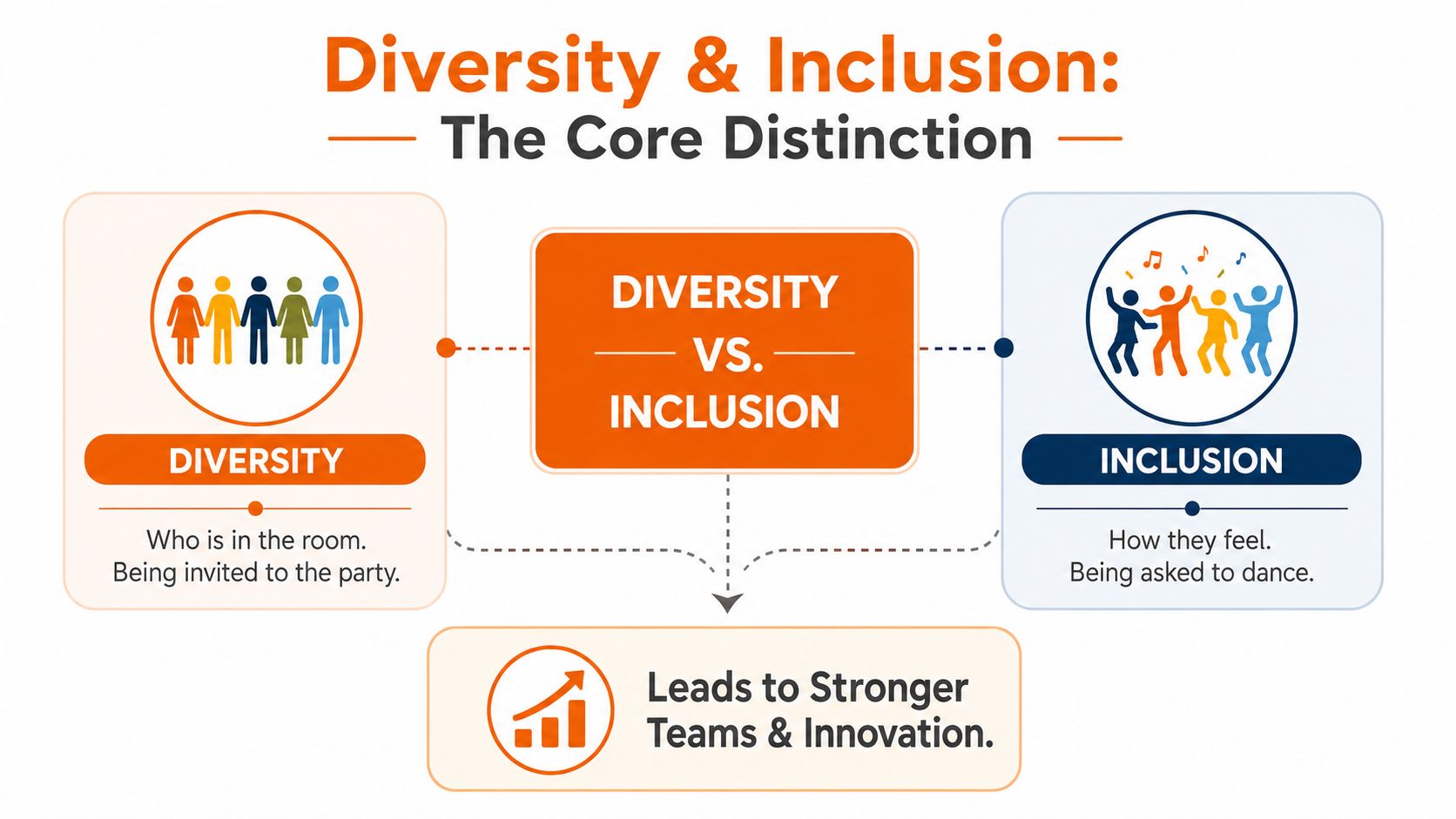
Diversity shows up in composition
At work, diversity is the mix of people across the company. It shows up by function, level, pay band, manager population, succession pipelines, and attrition patterns. A company can look balanced in early-career hiring and still be narrow where power sits. That gap matters more than many dashboards admit.
Good leaders examine where representation holds and where it falls off. They look at who gets hired, who gets promoted, who stays, and who exits after one difficult manager or one stalled review cycle.
Inclusion shows up in operating habits
Inclusion is less visible on a slide deck and more visible in the work itself. It shows up in whether people get context before decisions are made, whether feedback is specific instead of coded, whether norms are clear, and whether managers make room for different working styles without lowering standards.
That is why diversity and inclusion initiatives only work when they change daily practice. Policy matters. So do the tools people use every day, including the employee app, team chat, scheduling system, recognition feed, and performance platform. If those systems reward speed over fairness, private access over shared context, or manager instinct over clear criteria, inclusion breaks down fast.
A short comparison helps:
Term | What it answers | What it looks like in practice |
|---|---|---|
Diversity | Who is here | Different backgrounds, identities, ages, abilities, and experiences represented across frontline roles, management, leadership, and revenue-critical teams. Hiring slates are broad. Promotion pipelines do not narrow to the same profile every time. |
Inclusion | What it is like to work here | Meetings where quieter people are invited in without being put on the spot. Feedback tied to observable work, not vague language. Schedules, communication channels, and employee app updates designed so deskless and office staff get the same information. Conflicts addressed consistently. Credit, coaching, and stretch work distributed fairly. |
That table looks simple because the idea is simple. The execution is not.
I've seen companies recruit a more varied workforce and still run the place through unwritten rules. If success depends on sounding like the dominant group, joining the right side chats, or being available at the hours leadership prefers, inclusion is weak no matter what the headcount report says.
This starts long before employment. The setting is different, but the lesson in teaching diversity in the classroom carries over cleanly. People feel included when adults build an environment where participation, respect, and fairness are practiced every day.
Leaders often want a faster answer than that. There isn't one. Hiring can change representation relatively quickly. Trust takes repeated proof, role by role, system by system, manager by manager.
Why This Is More Than Just a Buzzword
A CEO once told me, "We already hired a diverse team. Why are people still unhappy?" That question gets to the problem faster than any slogan. Representation can change on a dashboard long before day-to-day work changes for the people doing it.
Diversity and inclusion shape operating results, extending beyond employer branding. Analysts at McKinsey, summarized by InStride's workplace diversity and inclusion statistics, found a clear link between more diverse leadership teams and stronger business performance. The same analysis ties inclusive, diverse organizations to stronger productivity, better cash flow per employee, and greater success entering new markets.
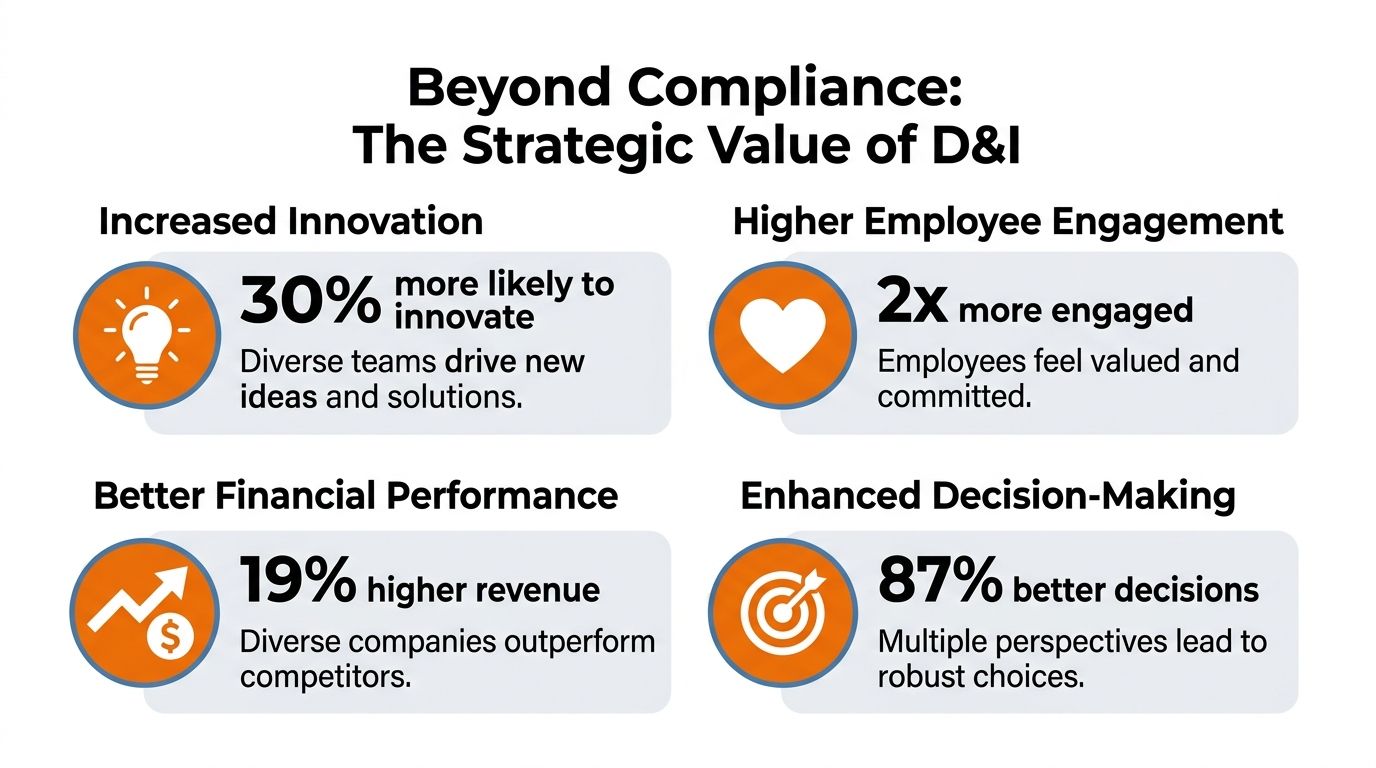
The image above includes figures beyond the research cited here. The point does not depend on every number. Companies get better outcomes when they widen who contributes, remove friction from how work gets done, and stop designing the culture around one default type of employee.
That is the gap between intent and impact.
A company can publish values, run heritage month events, and add DEI language to the careers page while still making exclusion the daily operating system. You see it in who gets the late notice for schedule changes, whose manager gives useful feedback, whose promotion case gets sponsorship, and whose questions in the employee app go unanswered. If the tools, routines, and decisions favor the same group every time, the culture is telling the truth even when leadership messaging says otherwise.
Employees notice that quickly. Job seekers do too. Built In's diversity and inclusion statistics roundup reports that many candidates want to work for companies that value DEI efforts, while confidence in whether employers live those values is far weaker. Leaders should take that gap seriously. It means the market is no longer reacting to statements. People are judging the evidence.
The evidence is operational.
Managers decide who gets stretch work. Recruiters decide who gets screened in. Finance decides whether parental leave, accommodations, and pay equity work are funded. Internal communications decides whether deskless teams receive the same information as headquarters. Product and IT teams decide whether core tools, including the employee app, support multiple languages, accessibility needs, and real two-way communication instead of top-down broadcasts. HR cannot carry all of that alone, and companies stall when they pretend it can.
I have seen the strongest progress come from leaders who stop asking, "What should we say?" and start asking harder questions. Where are we losing people? Which managers have the biggest engagement gaps? Which step in promotion review introduces the most subjectivity? Which teams still rely on backchannel access instead of clear process?
Those questions are less glamorous. They work better.
Handled seriously, this effort improves decision quality, retention, execution, and trust. Handled as theater, it creates cynicism faster than doing nothing at all.
The Real Challenges Nobody Likes to Talk About
Most diversity and inclusion efforts don't fail because leaders lack a slide deck. They fail because the work gets uncomfortable, political, slow, and personal.
That's normal. It's also where decisions begin.
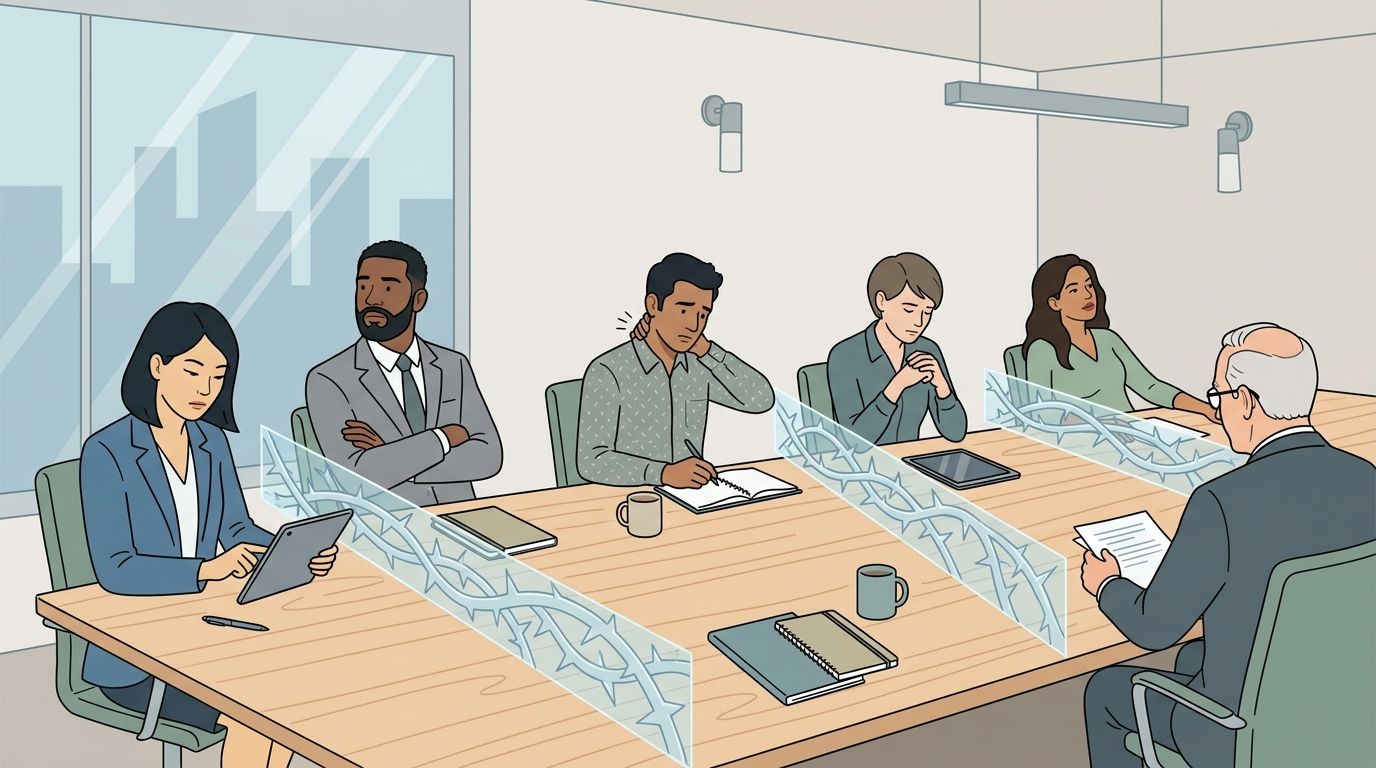
Backlash is real
Companies are operating in a tense environment. Consumer support for DEIB has surged to 56%, while brands also face rising backlash driven by political influence since 2024, according to Mintel's US diversity, equity, and inclusion market report.
That contradiction creates a leadership test. Some teams respond by going quiet. They rename programs, avoid clear language, and hope nobody notices. Employees always notice.
The steadier approach is to drop the performance and keep the substance. If your work is grounded in fair hiring, better management, accessibility, and clearer career paths, it's harder to dismiss as theater because it is tied to how the company runs.
Tokenism wastes everyone's time
One hire from an underrepresented group does not fix a culture. It often makes things worse if the company then expects that person to represent a whole community, absorb exclusion without complaint, and serve on every panel.
I've watched organizations celebrate a “first” while leaving that person with no real support, no peer network, and no power. That is not progress. That is optics with a human cost.
A useful reality check is to look at groups that are still pushed to the margins even when companies claim to care about inclusion. The latest data on autistic job outcomes is a good reminder that access and belonging are not solved by broad statements. Specific communities face specific barriers.
If your strategy depends on one visible hire proving the culture is fair, you do not have a strategy.
Managers often resist for predictable reasons
Most resistance doesn't sound openly hostile. It sounds practical.
A manager says structured interviews feel slow. Another says discussing bias makes the team defensive. Someone else says they just want to “hire the best person” as if the question is whether bias exists only in theory. Usually what they mean is they don't want to change how they work.
That's why HR can't own this alone. Inclusion rises or falls with line managers. They choose who gets airtime, who gets coaching, and who gets second chances.
A few hard truths tend to separate serious teams from performative ones:
Good intentions aren't evidence. If the experience is uneven, intent doesn't erase that.
Training doesn't replace accountability. People need standards, not just awareness.
Silence has a message. When leaders avoid the topic, employees fill in the blanks.
The challenge isn't whether this work is controversial. The challenge is whether leaders have enough discipline to keep doing the unglamorous parts when the applause disappears.
How to Measure What Actually Matters
I've seen companies celebrate a hiring milestone in the all-hands, then lose half that goodwill six months later because the same people kept getting the stretch assignments, the visibility, and the promotions. Headcount looked good on paper. Day-to-day experience told a different story.
That gap is what measurement needs to catch.
Representation still matters. It tells you who made it through the door. But if you want to know whether inclusion is real, track what happens after hiring: who gets developed, who gets heard, who gets promoted, and who leaves.
Measure the moments that shape a career
A useful D&I dashboard is usually smaller than leaders expect. The mistake is trying to track everything and ending up with a report nobody uses. Start with the points where manager judgment has the most impact.
Look at promotion rates by demographic group. Look at attrition the same way. Review performance ratings, access to high-visibility projects, and time-in-level before promotion. Those patterns show whether opportunity is being distributed fairly or informally handed to the same profile of employee again and again.
Company averages will not save you here.
An engagement score can look healthy while one group is consistently reporting lower trust, lower fairness, or less confidence in speaking up. Break survey results out by group, team, and manager where your population size allows it. If you only review the overall score, you are measuring comfort at the center and missing friction at the edges.
The metrics that usually reveal the real problem
The basics do the job if leaders review them and act on them.
Measure | What it can reveal |
|---|---|
Hiring rates versus applicant pools | Whether access is broad or narrowed early in the process |
Promotion rates by demographic | Whether advancement is consistent or manager-dependent |
Exit rates by demographic | Whether some groups are leaving faster, and where to look first |
Performance ratings by group | Whether evaluation standards are applied evenly |
Disaggregated survey responses | Whether belonging, trust, and safety vary across the company |
Numbers alone are not enough, though. Inclusion failures often show up in communication before they show up in retention. Meeting norms, manager feedback, recognition patterns, and internal updates all shape who feels informed and taken seriously. This guide on assessing inclusivity in workplace communication is a practical way to review those habits.
Ask questions that people can answer honestly
Generic engagement surveys produce generic answers. Ask about actual experience.
Do people feel safe disagreeing with their manager? Do they believe promotions are fair? Do they get the same access to information as everyone else? Can they be themselves without paying for it socially or professionally?
Those questions are harder for leaders to hear, which is exactly why they matter.
I also look for gaps between systems, not just scores. If one group has lower promotion rates, check calibration practices. If exits are concentrated under a few managers, inspect how those managers give feedback, assign work, and run team meetings. If survey comments keep mentioning confusion or exclusion, review the channels employees rely on every day, including your employee app, internal comms, and meeting cadence.
The riskiest number in inclusion work is the average, because it lets leaders feel satisfied while other employees absorb the cost.
Good measurement changes ownership. HR should build the scorecard, but managers should be expected to explain their numbers, department heads should review patterns in their own teams, and executives should decide which gaps get fixed first. Otherwise the data becomes decoration.
If the goal is inclusion, measure whether people have a fair shot at belonging and progress. Then tie those findings to the operating habits that shape work every day. That is where intent either becomes impact, or fails to materialize.
Practical Ways to Build an Inclusive Culture
I've seen companies hire a more varied team, publish the right values, and still lose trust because daily work felt uneven. The gap usually showed up in ordinary places. Who got the meeting notes. Who was asked for input before a decision. Who heard about an opening early. Who could use the tools without extra effort.
That is why inclusive culture has to show up in operations, not slogans. People judge fairness through hiring steps, manager habits, communication channels, promotion criteria, and the systems they touch every day.
What HR leaders should do
HR owns the design of the system. If the process is vague, personal preference usually takes over.
Start with the parts of the employee journey where inconsistency creates the most damage:
Tighten job descriptions. Remove inflated requirements, unclear language, and culture-fit phrasing that screens people out before the first conversation.
Use structured interviews. Ask the same core questions, define strong answers in advance, and score candidates against shared criteria.
Audit career paths. Employees should be able to see how progression works, what good performance looks like, and who makes the call.
Standardize onboarding and internal communication. New hires should not need a helpful manager to get basic context, policy access, or introductions.
The trade-off is real. Structure can feel slower to managers who are used to improvising. It is still better than a system where access depends on confidence, proximity, or guesswork.
Keep inclusion close to the tools employees already use. Pebb can support that work in practical ways. Teams can run employee resource groups in Spaces, make pronouns and profiles visible in the People Directory, share multilingual updates, and publish company news in one place instead of relying on scattered email threads.
For distributed teams, small recurring practices usually hold up better than one-off events. This list of DEI activities for remote teams is useful because it focuses on habits teams can repeat.
What managers should change this week
Managers shape inclusion faster than any policy does. They decide how work gets assigned, whose input counts, and whether feedback helps people grow or keeps them guessing.
Three changes have immediate impact:
Run meetings with more than one way to contribute. Share context early, ask for written input, and stop treating speed as proof of insight.
Give equally specific feedback. If one employee gets coaching and another gets vague reactions, you are creating different standards.
Distribute stretch work in the open. High-visibility assignments should follow clear criteria, not comfort, chemistry, or habit.
A quick test helps. Look at your last five meaningful opportunities. Promotions prep, client visibility, special projects, senior stakeholder exposure. Who got them, and what rule decided it?
That answer usually reveals more than a culture deck ever will.
What every employee can do
This work cannot sit with HR alone. It also goes wrong when everyone treats inclusion as personal style instead of shared practice.
Useful habits are small and repeatable:
Notice who gets interrupted, then bring them back in.
Credit ideas to the person who said them first.
Make room for colleagues who need context before speaking.
Learn enough about coworkers to work together thoughtfully, without turning curiosity into performance.
Do your own homework before asking someone affected to explain everything for you.
No single action fixes culture. Repeated actions do.
The tools matter more than leaders think
Intent breaks down in the handoff between values and workflow. A company says everyone belongs, but updates only reach headquarters. Policies sit in folders frontline staff cannot find during a shift. Video content has no captions. Team chat favors the loudest people and the same language every time.
Those are operating failures. Employees experience them as exclusion.
Leaders often treat the employee app, onboarding flow, internal comms, directory, and feedback channels as admin decisions. They are culture decisions. If the systems are hard to access, inconsistent, or built around one type of worker, the message is clear even if nobody says it out loud.
Inclusive culture gets built in those details. Clear information. Equal access. Predictable processes. Tools that help people participate fully, whether they sit at headquarters, work remotely, or spend the day on the floor.
This Work Is Never Really Finished
A company can mean well and still create a daily experience that wears people down.
That is why inclusion work does not stay solved. New managers bring old habits. Teams grow fast and stop explaining decisions. Communication tools change, and access gaps show up again for frontline staff, remote employees, new joiners, or people working in a second language. The standard has to be regular maintenance, not a one-time push.
I have never seen a company get this perfect. I have seen companies get better when leaders stop grading themselves on intent and start checking the employee experience at the point of use. Can people find the policy during a shift? Do managers know how to run a fair promotion process? Does the team app reach everyone, or just the people at a desk? That is where inclusion holds up or breaks down.
Progress usually looks ordinary from the outside.
It shows up in cleaner handoffs, clearer expectations, fewer backchannel decisions, and less guesswork about how to get information or raise a concern. It shows up when a store associate, warehouse lead, engineer, and office manager can all access the same updates without chasing someone down. People stop feeling like outsiders in their own job, and retention conversations get less defensive because the friction is already being addressed.
If you are trying to answer what is diversity and inclusion in a way that helps leaders act, the practical answer is simple. Diversity is representation. Inclusion is whether people can participate, contribute, and progress without unnecessary barriers. The work is to keep closing the gap between what the company says and what employees experience.
Start small, but start where the pain is obvious. Fix one uneven process. Give one manager group better guidance. Clean up one tool employees rely on every day.
That is how this work becomes credible.
If you want to make inclusion visible in daily operations, Pebb is one option to consider. It combines communication, team spaces, updates, files, scheduling, and employee profiles in one employee app, which can help companies create a more consistent experience across frontline and office teams.
