
Internal Communications Planning That Actually Works
Build an internal communications planning system that reaches every employee, drives action, and proves impact—without drowning your team in noise.
Dan Robin

You publish the update. The email goes out, the intranet post is live, and the company feed has a polished announcement. Then a supervisor asks where the latest policy is. A warehouse employee hears an older version from a colleague. A nurse sees the message after the shift it was meant to guide.
That gap is where internal communications planning either earns its keep or becomes a publishing calendar.
The job isn't producing more messages. It's creating a reliable path from information to understanding to action, especially for people who aren't sitting at a desk all day. That requires fewer assumptions, clearer ownership, better manager support, and measurement that follows what employees do after they receive a message.
Rethinking What Internal Communications Planning Actually Means
Internal communications planning is often treated as a distribution exercise. Someone writes an announcement, chooses a channel, schedules it, and checks the reach report. The work looks complete because the content exists.
Employees don't experience communication that way. They experience it as a search problem. Can I find the current answer? Do I understand what changed? Does it apply to my role? What do I do next, and who can help if the instructions don't fit the way I work?
A study of 150 administrative employees at the University of Cape Coast in Ghana found a strong positive relationship between effective organizational communication and employee engagement, with r = 0.71 and statistical significance at p < 0.01. Its regression model reported that communication clarity, feedback mechanisms, and management openness jointly explained 68% of the variation in engagement levels, with effects of β = 0.41, β = 0.36, and β = 0.29 respectively. The findings come from one institution, so they shouldn't be mechanically applied to every workforce, but they point to a useful planning principle: communication quality depends on more than publication. The study details and source context are available here.

Design the path, not just the message
A useful plan answers four practical questions:
Findability: Where will employees look first?
Clarity: Can they understand the message without decoding corporate language?
Action: What must they do, by when, and with what support?
Feedback: How can they question, correct, or challenge the information?
This is why a modern employee communication platform should be judged by the pathways it creates, not just the number of features it contains. A feed may publish an update, while a knowledge space preserves the current policy and a manager conversation explains how it affects a particular shift.
The planning standard should be simple: publication is an input, not an outcome. Measure whether people found the right information, understood it, used it, and completed the behavior the organization needed. That shift turns internal communications from a stream of announcements into operational infrastructure.
The Five-Stage Planning Cycle That Keeps You Honest
A good planning cycle starts with an uncomfortable audit. Don't begin by asking what you should publish next. Ask where employees currently lose the thread.
Stage one is audit. Map channels, audiences, owners, message reach, and employee needs. Talk to desk-based staff, frontline workers, managers, and people on different shifts. Look for duplicate policies, abandoned channels, unclear escalation routes, and information that exists but can't be found during work.
Stage two is goals. Define what should change. “Send a safety update” is an activity. “Help warehouse employees understand the revised process and follow it during the next shift” is an objective. Give each objective one leading indicator and one outcome indicator, such as message reach plus policy completion, or manager briefing completion plus process adoption.
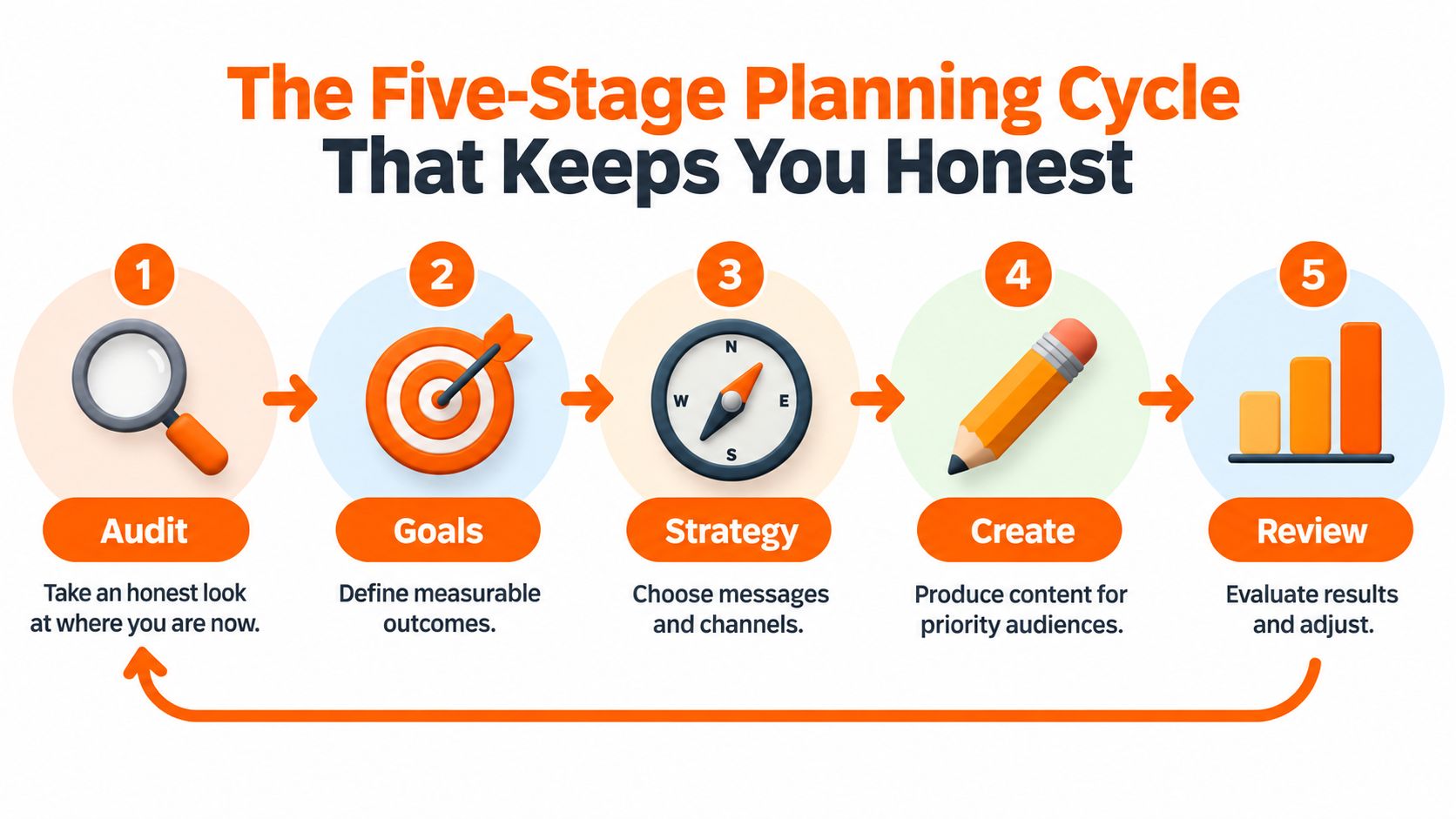
Stage three is strategy. Choose the channel mix, message owner, timing, fallback route, and escalation rules. Email may suit office staff, while a manager huddle, mobile post, printed notice, or SMS may be necessary for people who don't check email during a shift. Channel availability isn't proof of access.
Stage four is creation and delivery. Write the leadership narrative, manager briefing, employee action version, FAQ, and reference document as connected parts of one message. Keep version ownership visible. The difference between content operations and content production matters here. Production creates assets. Operations makes sure those assets have owners, rules, workflows, and a useful place to live.
Stage five is review. Establish a baseline before launch, then compare results afterward by location, role, shift, language, and employment type. If reach is low, investigate channel or timing. If reach is high but comprehension is weak, fix the message or manager briefing. If comprehension is strong but action is poor, look for workflow friction, missing authority, inadequate training, or an impractical process.
The cycle keeps a plan honest because every stage can challenge the assumption made in the stage before it.
Segmenting Audiences and Building Your Cascade
“All employees” is usually a category, not an audience. A retail associate using a phone between tasks, a warehouse employee working a fixed shift, and a finance specialist with constant desktop access may need the same core message, but they won't receive it under the same conditions.
Start with two dimensions: information need and access constraint. Then assign each audience a primary channel, fallback channel, message owner, and response time. A desk-based group might use email and a searchable reference page. A frontline group might need a mobile post reinforced by a supervisor huddle. A multilingual workforce may need translated instructions, visual guidance, or a local-language conversation route.
A simple operating map might look like this:
Audience | Primary route | Fallback | Owner | Required response |
|---|---|---|---|---|
Desk-based teams | Email and reference page | Manager discussion | Function leader | Read and confirm |
Mobile frontline teams | Mobile update and team space | Shift huddle | Site manager | Follow the action |
Shift-based operations | Supervisor briefing | Printed or posted notice | Shift lead | Apply by next shift |
Distributed teams | Team space and direct message | Scheduled call | Team manager | Ask questions and complete task |
The cascade keeps the message consistent without forcing every employee to consume the same format. Leadership establishes the decision narrative. Managers receive context, a concise briefing, likely questions, and the next step. Employees receive an action-oriented version with a deadline and feedback route.
That middle layer is where many plans break. Managers get a link and are expected to interpret it alone. The result is predictable: different teams hear different explanations, and employees aren't sure which version to trust.
Governance prevents that drift. Name one source of truth, assign version ownership, define approval thresholds, check accessibility, and document the crisis escalation path. A searchable people directory app can also help employees identify the right manager, subject expert, or support contact instead of sending every question to a general inbox.
Segmentation isn't about creating more content for its own sake. It's about removing the work employees shouldn't have to do.
Why More Channels and More Content Often Make It Worse
Many teams respond to weak reach by adding another channel. Then another. Soon the same update appears in email, chat, the intranet, a company feed, a team space, and a manager deck. Employees don't experience that as support. They experience it as uncertainty about which copy matters.
Gartner surveyed nearly 1,000 employees and managers and found that 38% of employees considered the volume of organizational communication excessive. Harvard Business Review discusses the information-overload problem here. The point isn't that communication should become sparse. Important information needs repetition. The point is that repetition without information architecture creates noise.

Give every lane a job
Treat each publishing environment as a distinct lane:
Company feed: Broad updates that most employees need to notice.
Team spaces: Local context, discussion, tasks, and follow-up.
Direct messages: Sensitive or targeted information that shouldn't become public noise.
Knowledge library: Stable policies, procedures, forms, and the current source document.
A team update news feed can support broad visibility, but it shouldn't become a warehouse for every document and question. Put the announcement where people will see it, then point to the controlled reference location where they can return later.
A unified workplace tool can help if it reduces duplication and clarifies where work belongs. This overview of the MEDIAL internal communication platform is useful for thinking about how communication and training environments can connect. The tool won't fix unclear ownership, stale content, or indiscriminate publishing.
The better question isn't, “Which channel haven't we tried?” It's, “What decision must the employee make before acting, and how can we remove unnecessary choices?” Fewer, clearly owned pathways often beat a larger calendar.
Managers as the Critical Relay Point
A policy announcement can be perfectly accurate and still fail at the team level. I've seen employees receive a change notice, then wait for the supervisor to explain what it means for today's workload, tomorrow's shift, or a customer conversation.
Gallup reports that managers account for 70% of the variance in team employee engagement. The 2024 State of the Global Workplace key insights make the planning implication hard to miss. Managers aren't just another audience. They are the relay point that turns organizational intent into a local conversation.
A strong manager pack doesn't need to be elaborate. It needs to arrive early and answer the questions people will ask:
What changed, and why?
Who is affected?
What should the team do today?
What should wait?
What should a manager escalate?
Where is the current source of truth?
Consider a healthcare team receiving a revised handoff process. A central post can explain the change, but a charge nurse still needs to discuss when the process applies, what happens during a busy shift, and where staff can report a problem. In logistics, a shift lead may need a short script and a visual reminder rather than a long policy document.
Measure the relay itself. Track whether managers received the briefing, whether they held the planned conversation, whether employees can explain the next step, and whether questions reach the assigned owner. Publication tells you that headquarters acted. Relay evidence tells you whether the message reached the team.
Managers also need communication practice, not just materials. Resources on how to improve manager communication skills can help teams build that capability without turning every supervisor into a communications specialist.
Preparation doesn't make managers sound robotic. It gives them enough context to speak naturally and consistently.
Measuring What Matters From Reach to Business Outcome
Reach metrics are easy to collect, so teams often stop there. Opens, clicks, views, and reactions create a tidy report, but they can't tell you whether an employee understood a new process or followed it correctly.
Research on internal-communications teams found that 60% are primarily responsible for reach metrics, while 60% use measurement data to build business cases. The benchmark source provides the underlying context. The planning problem is not a lack of activity data. It's the weak connection between activity and decisions about resources, behavior, and business performance.
Use a four-layer dashboard
Reach is the foundation. Record delivery, opens, views, clicks, and access by audience segment. Low reach usually points to the wrong channel, poor timing, missing credentials, or weak reinforcement from local leaders.
Comprehension asks whether people understood the message. Use a short knowledge check, acknowledgement quality, manager briefing completion, or employee questions that reveal confusion. High reach with low comprehension means the content or explanation needs work.
Action measures behavior. Did employees complete the policy task, use the new workflow, attend the required training, or acknowledge the procedure? High comprehension with low action often indicates friction, unclear authority, missing tools, or a process that doesn't fit the work.
Business outcome connects the behavior to an organizational result. Depending on the objective, that might include fewer incidents, faster operations, stronger retention, or higher engagement. Treat the connection as an evidence chain, not automatic proof of causation. Other factors may influence the result.
Practical rule: Every objective should have one delivery measure and one outcome measure.
That pairing changes the conversation. Instead of reporting that a message reached a workforce, you can ask whether the right group understood it, acted on it, and moved the operating result in the intended direction. Review the dashboard by location, role, shift, language, and employment type. Averages hide the people most likely to miss the message.
Making Internal Communications Planning Stick
Effective internal communications planning isn't a search for the perfect announcement format. It's a discipline of audit, ownership, audience judgment, manager support, and honest review.
The organizations that sustain it treat communication as part of how work operates. They give important information a home. They keep reference content current. They prepare managers before employees ask questions. They design fallback routes for people who can't access the primary channel. They also resist adding content when the problem is duplication.
The evidence supports taking this seriously. A survey-based source reports that 70% of employees intending to stay with their employer long term rated communication as excellent, compared with 24% among employees who rated it only good. The same source reports that 47% strongly agreed they knew what was expected of them, while 32% strongly agreed they felt connected to their organization's mission or purpose. The source provides the broader communication and retention context.
Those figures don't mean communication alone determines retention or engagement. They do show why clarity, connection, feedback, and access belong in the same planning conversation. An employee can't act confidently on information they can't find, and a manager can't reinforce a message they received too late.
Start with one important workflow. Audit how information moves today, define the behavior you need, equip the relay points, and measure what happens after publishing. Then revise the system based on evidence. That's how a communications plan becomes part of the workplace instead of another document in it.
Pebb brings team chat, updates, Spaces, tasks, schedules, and a Knowledge Library into one mobile and web work app for frontline and office teams. Use Pebb to give employees a clearer place to find information, managers a practical route to reinforce it, and leaders better visibility into what people engage with.
