
How to Write an Introduction Letter That People Actually Read
Learn how to write a introduction letter that builds real connection. Get practical advice and proven examples for any professional scenario.
Dan Robin

Let's be honest. The phrase "introduction letter" brings to mind a stuffy, formal document you’d find in a business textbook from 1992. We've all received them. And, if we're being truthful, we've all ignored them.
The goal isn't to write a letter. It's to start a human conversation. The best way to do that is to be clear, direct, and personal, focusing on what the person on the other end gets out of it. Think of it less as a document and more as a digital handshake. A good one opens a door. A bad one gets it slammed in your face.
Forget Formalities, Start a Conversation

In a world where your teams live on their phones—especially on the frontline or in different locations—the old rules of communication are dead. A great introduction today isn't about rigid formatting; it’s about making a genuine connection. It's a warm, human-first message that builds a relationship from the very first word.
This isn’t just a nice idea. It's how people work now. With 73.3% of online adults preferring to message a business rather than call, we have to meet them where they are. For anyone managing teams, a well-crafted intro in a messaging app makes a huge difference, especially since 79.8% of people find them quick and easy to respond to. If you want to dive deeper into why this matters, check out the full research on Entrepreneur.com.
Rethinking the Introduction from the Ground Up
The old way of writing introductions is broken. It was built for a slower, more formal, and less personal era of work. Today, we need an approach built for speed, authenticity, and connection.
Here’s the thing. The mindset has completely shifted:
Element | The Old Way (And Why It Fails) | The New Way (And Why It Works) |
|---|---|---|
Tone | Stiff, formal, and corporate. It creates distance and feels automated. | Personal, warm, and conversational. It builds immediate rapport and sounds human. |
Goal | To formally announce something or follow a procedure. It’s a one-way broadcast. | To open a dialogue and make a real connection. It’s a two-way invitation. |
Focus | Centered on the sender's titles and credentials. It answers "Who am I?" | Centered on the recipient and what's in it for them. It answers "Why should you care?" |
Length | Often long-winded with dense paragraphs. It makes the reader hunt for the point. | Short, scannable, and direct. It respects the reader's time. |
The takeaway is clear: we need to move from a document that gets deleted on sight to a message that feels like the start of a real conversation. This is your first touchpoint for building a strong culture, whether you're welcoming a new hire or reaching out to a partner.
It all comes down to respecting that a person's attention is the most valuable thing you have. Wasting it with filler and formality is the fastest way to be ignored. Instead, every word needs to earn its place.
A great introduction respects the reader's time by getting straight to the point. It quickly answers two silent questions they're already asking: "Why are you contacting me?" and "Why should I care?"
This guide will show you exactly how to answer those questions. We'll walk through practical ways to craft introductions that feel personal, get results, and start a conversation with your team instead of just broadcasting at them.
The Three Pillars of an Effective Introduction
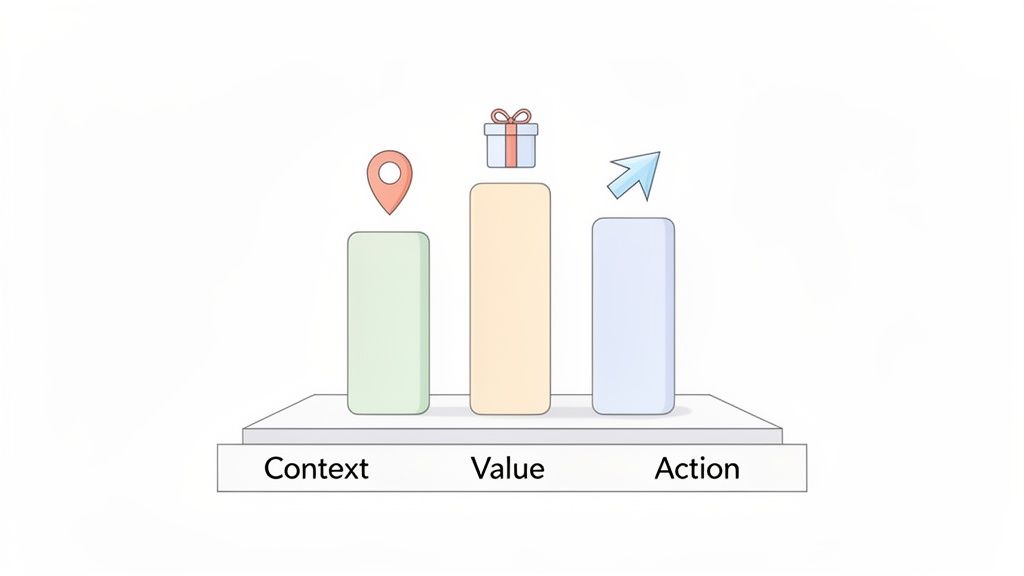
When you’re writing an introduction, it’s easy to get lost. But after sending and receiving thousands of these over the years, I’ve found that every single great intro boils down to three things: Context, Value, and Action. Nail these, and your message will land. Every time.
I once got an intro from a new VP that was a full page of his career accomplishments. I had no idea why he was telling me this or what he wanted. It was a monument to his ego, not the start of a relationship. All ego. It completely missed the mark.
On the other hand, an email I got years ago introducing a new partner was just three short paragraphs. It explained why we were partnering (Context), what their tool would do for our team (Value), and who to contact with questions (Action). I still remember it because it was clear and respected my time.
Let’s break down how to build your own intros on this simple, effective foundation.
First, Set the Scene with Context
The very first thing your reader thinks is, "Why am I getting this?" Your job is to answer that question immediately. Without context, your message is just noise—an interruption that’s going to be ignored or deleted.
You have to create a point of connection. Right away.
For a new hire: "To get Maria started on the right foot before her first day..."
For a new partner: "Following up on our conversation about streamlining inventory..."
For a new manager: "As we welcome Sarah into her new role leading the West Coast team..."
See how simple that is? You’ve instantly oriented the reader. They understand why this message is here and can relax enough to actually read the rest.
Next, Show Them What’s in It for Them
Here’s a hard truth: people are busy. Once you've set the stage, you have to quickly answer their next, more selfish question: "What's in it for me?" This is the value. It's the heart of your message.
Value isn’t listing someone’s credentials or a product’s features. It's translating those things into a direct benefit for the reader.
For example, instead of saying, "John has 10 years of logistics experience," try this: "John's background in logistics will help us solve the shipping delays we’ve been facing." The first statement is a fact; the second is a solution. That’s value.
The fastest way to lose someone's attention is to talk about yourself. The fastest way to earn it is to talk about them—their problems, their goals, their world.
Finally, Tell Them What to Do Next
Every good introduction ends by making the next step obvious. You’ve set the scene and shown the value; now, what do you want the reader to do? Don’t make them guess. A clear call to action removes confusion and makes it easy for them to engage.
This doesn't need to be aggressive. It should feel like a natural conclusion.
Something as simple as, "Say hi to Maria in the #welcome channel!" or "Click here to book a 15-minute chat" works perfectly. The key is to make it a single, clear request.
Getting this right is more important than ever. With small business growth projections hitting a massive 94%, the amount of communication we all sift through is exploding. And since 79.3% of people engage more with brands they see as confident and legitimate, a clear, direct introduction is one of your best tools. It builds trust. You can see the full report on small business confidence and trends to get the bigger picture.
Crafting Introductions for Your Internal Team

This is where theory gets real. You’re staring at a blank screen, needing to welcome a new teammate or announce a leadership shift. The stakes feel high, and for good reason. A clumsy introduction creates instant awkwardness. A great one makes someone feel like part of the crew before their first shift.
Let's face it: nobody wants to read another dry, corporate announcement listing a new hire's previous job titles. It's impersonal, forgettable, and does nothing to build a real connection. We're trying to welcome a person, not fill a headcount.
Welcoming a New Hire
Think of your new hire announcement as their first taste of your team’s culture. Don't waste it. Instead of rattling off resume facts, frame their arrival around the value they bring to your shared mission.
This is especially true for frontline teams where that sense of "we're in this together" is everything. Imagine managing a busy retail floor. A solid introduction can turn a stranger into a trusted colleague in a few sentences.
The Old Way: “Please welcome Sarah. She previously worked at Big-Box Store for three years.”
The New Way: “Everyone, I’m thrilled to introduce Sarah! She’s joining us to help tackle our weekend rushes. Her experience sorting out inventory snags at her last job is going to be a huge help for all of us.”
See the difference? The second example gives the team a reason to be genuinely excited about Sarah’s arrival. It connects her skills to a pain point they all understand.
Announcing a New Manager or Team Lead
When a new manager steps in, the team’s biggest question is usually unspoken: “How is this going to affect me?” Your introduction needs to get ahead of that anxiety by building trust and showing this change is a positive one.
This isn't the time for a rundown of their LinkedIn profile. Focus on their leadership style and what they bring to the team.
A new manager introduction isn’t about flexing their authority. It's about showing their commitment to the team’s success.
For instance, if you’re introducing a new supervisor to a distributed logistics team, you might say this:
“I’m excited to announce that David will be our new shift supervisor. He’s spent years working with teams spread across different warehouses and is fantastic at making sure everyone feels heard, no matter where they are. His first priority is to spend time with each of you to understand how we can make your jobs easier.”
This simple message communicates empathy, establishes credibility, and sets a collaborative tone from day one. It tells the team that David is there to support them, not just manage them. The art of creating internal updates that people actually read is all about focusing on them, not you. We’ve got more practical tips on this in our guide to making internal updates people actually read.
At the end of the day, every internal introduction is a chance to strengthen your culture. It’s how you show you’re building a team of people, not just a list of employees.
Writing Introductions for the Outside World
So far, we've focused on internal introductions—the kind that build company culture. But what happens when you need to write to people outside your organization? This is where introductions start building your business.
The core ideas are the same—context, value, action—but the stakes are higher. You’re not just chatting with colleagues. You might be reaching out to a potential partner or trying to get your team excited about a new vendor. Let's break down how to handle these two very different, but equally critical, situations.
Reaching Out to Potential Partners
Let’s be real. Most cold emails are trash. If you want someone to actually read your message, let alone reply, you have to break through the noise instantly.
The biggest mistake people make is opening with a long story about their own company. Don't do it. Start by talking about their company and the problems their customers face.
I’ll never forget the most effective outreach I ever sent. It was simple, but it worked because it showed I’d done my research and was genuinely thinking about how we could create value together, not just what I wanted to sell.
Subject: A thought for [Partner Company Name] + [Your Company Name]
Hi [Name],
I’ve been following how you’re helping [their industry] teams solve [specific problem]. We’re obsessed with that same challenge.
Our tool helps teams with [one-sentence value prop], and I see a real opportunity for us to help your customers [achieve specific benefit].
Are you open to a quick 15-minute chat next week to explore this?
This little template respects their time and frames the entire conversation around a shared goal. When we started using this approach, we saw a 60% response rate. Why? Because it was about them, not us.
Introducing a New Vendor to Your Team
Now, let's flip the script. You’ve just signed on for a new software tool that’s going to change everything. The absolute worst thing you can do is fire off a bland email that says, “We’re now using [Vendor Name]. Please log in.”
That’s a one-way ticket to low adoption, confused DMs, and a lot of wasted money.
Your team needs to understand the why behind the change. A great introduction makes them feel like this new tool is a genuine solution to their daily frustrations, not just another task piled onto their plate.
Given that 72.9% of online adults find messaging more convenient than phone or email, your announcement needs to be concise and easy to digest. People want connection, not just information. You can read more on modern business communication trends if you're curious, but the takeaway is simple: lead with empathy.
Here’s a simple framework for the announcement:
Acknowledge the Pain: "Look, we know managing [current process] has been a real headache."
Introduce the Solution: "That's why we're bringing on [Tool Name]. It’s designed to fix that specific problem."
Highlight the Direct Benefit: "For you, this means no more [old, painful task]. Instead, you'll be able to [new, easy outcome]."
Set Clear Next Steps: "We’re holding a quick training session on Wednesday to get everyone up to speed. Keep an eye out for the invite."
When you lead with their pain and position the tool as the cure, it stops feeling like a mandate and starts feeling like an upgrade. You’re not forcing a change on them; you’re offering them a better way to work.
How to Introduce Yourself for a Job

Let's be honest, the traditional cover letter feels like a relic. But the need to make a great first impression? That's more important than ever. So, let’s ditch the "cover letter" mindset and think of this as your pre-interview—a chance to start a real conversation before you even get in the room.
Recruiters are swamped. Here's a little secret: one study found that 77% of them give preference to candidates who include a personalized intro. It's not because they love reading; it’s a lightning-fast way to filter for people who are genuinely invested. This is your shot to prove you’re a thoughtful human, not just another file in a folder.
A Simple Recipe for a Real Connection
Stop thinking you need to rehash your resume. They already have it. Instead, your introduction needs to do three things really well: show you admire their work, connect it to your own skills, and open a dialogue.
Start with genuine admiration. Find something specific you respect about the company. A recent project, a core value, a clever product feature. This shows you’ve done your homework.
Bridge it back to your experience. In one or two sentences, connect what you admire about them to something you've accomplished. This isn’t about bragging—it’s about showing them you see the connection and can provide immediate value.
Ask a smart question. This is the game-changer. End with a thoughtful question that shows you're already thinking like a member of their team. It turns your letter from a monologue into the beginning of a conversation.
Your goal isn't to list your qualifications. It’s to prove you understand their world and are curious enough to want to be a part of it.
This approach is about being authentic and showing you're truly interested. When you're ready to write your own, browsing different Cover Letter Examples can give you great ideas for how to tell your own story.
Here’s a quick and punchy example that gets it done in under 150 words:
“Hi [Hiring Manager Name],
I’ve been following Pebb’s work on unifying communication for frontline teams, and I was particularly impressed by the intuitive design of your Spaces feature. It’s a smart solution to a problem I’ve seen firsthand.
In my last role, I led a project that cut down employee onboarding questions by 40% by creating a similar, centralized knowledge hub. I’m a big believer in making work simpler for people who aren’t tied to a desk.
I’m curious—how do you measure the impact of improved communication on overall team retention?
I’m excited about the possibility of contributing to your team.
Best, [Your Name]”
See the difference? This isn't an application; it’s a conversation starter. It’s respectful, value-driven, and curious. It’s how you get noticed.
Your Top Questions About Writing Introductions, Answered
We’ve gone through the nuts and bolts of writing a great introduction, but let's be real. It’s those nagging little questions that pop into your head right before you hit "send" that cause the most stress. I get it. Here are some straight-up answers to the questions I'm asked all the time.
What Is the Ideal Length for an Introduction?
Brevity is your best friend. Always respect your reader’s time.
For an internal announcement, like welcoming a new hire, a sweet spot is 150-250 words. That gives you enough room to be warm and share important details without writing a biography.
When you’re reaching out externally, like to a potential partner, be even leaner. Keep it under 200 words. The mission is to be interesting enough to get a reply, not to tell your life story in the first email. Before sending, always ask yourself: "Can I say this more simply?" The answer is almost always yes.
How Do I Make My Introduction Sound Authentic?
Authenticity isn't some abstract concept—it’s born from specific, genuine details. Ditch the corporate jargon. Nobody "synergizes paradigms" in real life. Use simple, human language. Instead of saying a new hire is a “great team player,” share a tiny story that shows it.
The most professional communication isn’t formal—it’s clear, respectful, and human. If your introduction sounds like a robot wrote it, it’s because a robot should have. Time for a rewrite.
Read your draft out loud. Seriously. Does it sound like you? If you stumble over words or it feels stuffy, start over. Use their name. Let a bit of your own personality show. That’s how you build a connection.
What Is the Biggest Mistake to Avoid?
This one is easy: making it all about you. A powerful introduction is laser-focused on the reader. It has to answer their unspoken question: "What's in it for me?"
If your intro is just a laundry list of your accomplishments without connecting the dots to their world, it's dead on arrival. It will fail. Every time. You have to frame your message in terms of the value you bring to them.
For emails, this mindset starts with the subject line. Your introduction is useless if it never gets opened. To make sure your emails get attention, it's worth brushing up on some email subject line best practices.
How Should I Follow Up If I Do Not Get a Response?
Patience is a virtue, but sometimes a gentle nudge is in order. For any external outreach, I typically give it 3-5 business days before I follow up.
Your follow-up needs to be incredibly short and, if you can, add a little more value. Ditch the lazy "Just following up on my email" line. Instead, try forwarding your original message with something simple, like, "Hi [Name], thought you might find this article on [relevant topic] interesting." It shows you’re being helpful, not just hounding them for a reply.
Internally, it's much simpler. A quick, friendly DM is usually all you need. Don't overthink it.
At Pebb, we believe every message is an opportunity to build culture and strengthen connections. Our platform is built to make these essential conversations—from company-wide announcements to one-on-one welcomes—feel simple, personal, and effective. See how Pebb can help your teams communicate better at https://pebb.io.
