

Author: Ron Daniel
Transparency vs. Secrecy: Communication in the Workplace
Balance openness and confidentiality at work: what to share, when to protect details, and how clear communication builds trust.
Most people think workplace communication is all about meetings, emails, and Slack messages. But let me ask you this: have you ever been in a meeting where the leader shared just enough to get you excited, but not enough to actually understand what’s going on? It’s frustrating, right? I’ve been there too, and I’ve seen how this gap between what leaders think they’re communicating and what employees actually hear can derail even the strongest teams.
Here’s the kicker: 86% of executives believe trust is high in their organizations, but only 67% of employees agree. That’s a huge disconnect. And when trust falters, productivity, morale, and even the bottom line take a hit. At Pebb, we’ve learned that the key to bridging this gap is finding the sweet spot between transparency and confidentiality. It’s not about spilling every secret or locking everything away - it’s about knowing what to share, when to share it, and how to make your team feel informed and valued.
In this article, I’ll share what we’ve learned about balancing openness and discretion, why both are important, and how you can build trust through smarter communication. Let’s dive in.
What Transparency Means in the Workplace
Transparency is about giving employees the full picture - sharing accurate, relevant information so they understand the "why" behind decisions. It’s not just about relaying facts; it’s about providing the context that makes those facts meaningful.
Here’s where transparency sets itself apart from basic information sharing: it’s a commitment to clarity. Employees shouldn’t be left guessing about what’s important or why decisions are made. For instance, if a budget cut is announced, transparency means explaining the reasoning behind it, the alternatives considered, and the impact it will have. This level of openness builds trust.
"Transparent communication is not the same as oversharing... It focuses on what employees need to do their best work, and it avoids burdening them with details that create noise rather than clarity."
It’s important to strike a balance. Sharing unrefined ideas or confidential data can backfire, creating confusion or unnecessary concern. Today’s workforce expects to be treated as partners in the business, not just passive recipients of information. They want to see how their efforts tie into the bigger picture and to feel confident that leadership isn’t withholding critical details. When done right, transparency doesn’t just inform - it empowers.
Let’s look at how this plays out in practice.
Examples of Transparent Communication
Transparency can take many forms: company-wide updates on financial goals, straightforward explanations when projects are canceled, or sharing quarterly results with the entire team rather than keeping them confined to the C-suite. These actions prevent misinformation and speculation from filling the gaps.
At Pebb, we’ve built systems that make transparency second nature. Our news feed, group chats, tasks, calendar events, digital forms, and knowledge libraries ensure everyone has immediate access to the context they need. Employees can revisit the "why" behind decisions without having to chase down their manager for answers. It’s all there - clear and accessible.
Consistency is also key. Regular communication rhythms, like weekly updates, monthly town halls, and quarterly reports, help eliminate the uncertainty of “when will we hear from leadership next?” Predictable updates reduce anxiety, while decision logs and shared knowledge bases let employees catch up on their terms, rather than relying on word-of-mouth or outdated information.
How Transparency Creates Trust
At its core, transparency fosters trust by keeping employees informed and aligned with the company’s goals. When people understand the reasoning behind decisions, even tough ones, they’re more likely to get on board. Matthew NeSmith, Senior Editor at BambooHR, sums it up perfectly:
"Transparency in business is more than simply keeping your employees informed - it's about building trust while encouraging feedback from your team."
Transparency also holds leaders accountable. When decisions are documented and visible, there’s no room for quiet reversals or forgotten promises. Employees feel respected because they’re treated like capable adults who can handle the truth. And when you invite feedback through Q&As, pulse surveys, or open forums, it becomes clear that transparency isn’t just a one-way street - it’s an ongoing dialogue.
The payoff? Teams that feel connected to the mission, leaders who earn genuine credibility, and a workplace where people are motivated to show up and give their best. That’s what happens when you get transparency right.
Next, we’ll dive into situations where keeping information confidential might be necessary.
When and Why Organizations Need Secrecy
I get it - transparency is the gold standard. It builds trust, fosters collaboration, and makes everyone feel like they're part of the bigger picture. But let’s be honest: there are times when keeping things under wraps isn’t just necessary - it’s critical. Whether it’s to protect your business, your team, or even your clients, there are moments when discretion isn’t optional.
Take intellectual property, for example. If your company has developed a proprietary technology or a unique process that sets you apart, broadcasting those details would be like handing your competitors a cheat sheet. Did you know that trade secret theft costs U.S. businesses anywhere between $225 billion and $600 billion every year? That’s not pocket change - it’s a massive risk. And it’s not just about patents or software; think strategic business plans, upcoming mergers, or product launches. Sharing those prematurely could derail months (or years) of effort.
Then there’s the legal side of things. Employee data - like salaries, health records, or performance reviews - has to stay confidential. It’s not just ethical; it’s the law. The same goes for client information if you’re in healthcare or legal fields. And let’s not forget industries like government or national security, where confidentiality is the backbone of the job. As researchers Michael Slepian, Eric Anicich, and Nir Halevy put it:
"The sustainability of these entities often hinges on the ability to keep sensitive information from prying eyes".
Here’s something I’ve noticed: being entrusted with confidential information can actually be empowering. When someone tells you, “This is confidential, and we’re trusting you with it,” it sends a powerful message. It says, “You’re important, and your role matters.” That sense of trust can boost job satisfaction and make the work feel more meaningful. But there’s a catch - people need to understand why the secrecy exists. Without that context, it doesn’t feel like trust; it feels like exclusion.
These examples show how confidentiality isn’t just about keeping secrets - it’s about protecting innovation, privacy, and even morale.
Situations That Require Confidentiality
Let’s break it down. There are a few key scenarios where secrecy isn’t just smart - it’s essential:
Trade secrets and intellectual property: Whether it’s a new product design, a patent application, or proprietary software, sharing this information too soon could give competitors an unfair advantage.
Competitive strategies: Planning to enter a new market? Acquiring another company? Launching a game-changing product? Keeping those plans under wraps until the right moment can make all the difference.
Legal and privacy obligations: Laws like HIPAA and GDPR aren’t just suggestions - they’re rules that protect individuals and keep companies out of legal trouble.
National security: For those working in defense, intelligence, or government, confidentiality isn’t just about business - it’s about safety. A single leak here could have serious consequences.
The key takeaway? Secrecy should always have a clear, legitimate purpose. When employees understand that confidentiality protects their jobs, their company’s future, or even their own safety, they’re far more likely to respect it. But if secrecy feels arbitrary or over-the-top, it can backfire.
Problems with Too Much Secrecy
Here’s where things get tricky. While secrecy can protect your business, it can also alienate your team. When employees are constantly left in the dark, they start to feel disconnected. They wonder what leadership is hiding, and that uncertainty breeds mistrust. Worse, when there’s no clear reason for withholding information, rumors can spiral out of control - and those rumors are often far more damaging than the truth.
"Keeping an organizational secret can affect employees in two key ways. On the one hand, it can negatively impact well-being. Employees often feel cut off from others... On the other hand, organizational secrecy can elevate well-being by instilling a sense of status and purpose."
It’s a double-edged sword. Sure, being trusted with a secret can feel empowering, but it can also be stressful. Imagine not being able to talk about significant parts of your job with anyone - not even friends or family. That kind of isolation takes a toll. Over time, too much secrecy leads to disengagement. People stop asking questions because they assume they won’t get answers. They stop sharing ideas because they don’t have enough context. And eventually, they stop caring.
So, what’s the fix? Explain the "why." When leaders take the time to clarify the rationale behind confidentiality - how it protects the team, the company, or the mission - it shifts the narrative. Employees feel less burdened and more trusted. Emphasizing team camaraderie also helps. When people know they’re not alone in carrying a responsibility, the stress lightens.
At Pebb, we’ve seen this balance in action. Our all-in-one employee app for communication and operations allows leadership to communicate around the secret. Using tools like our news feed, group chats, tasks, calendar events, digital forms, or knowledge library, leaders can share the context employees need - like the "what" and the "why" - without revealing the confidential details. It’s a way to keep people informed and included, even when certain information has to stay locked down.
Next, we’ll dive into how to strike the perfect balance between transparency and secrecy - because the smartest communication strategies don’t choose one over the other. They blend both.
Transparency vs. Secrecy: Finding the Right Balance
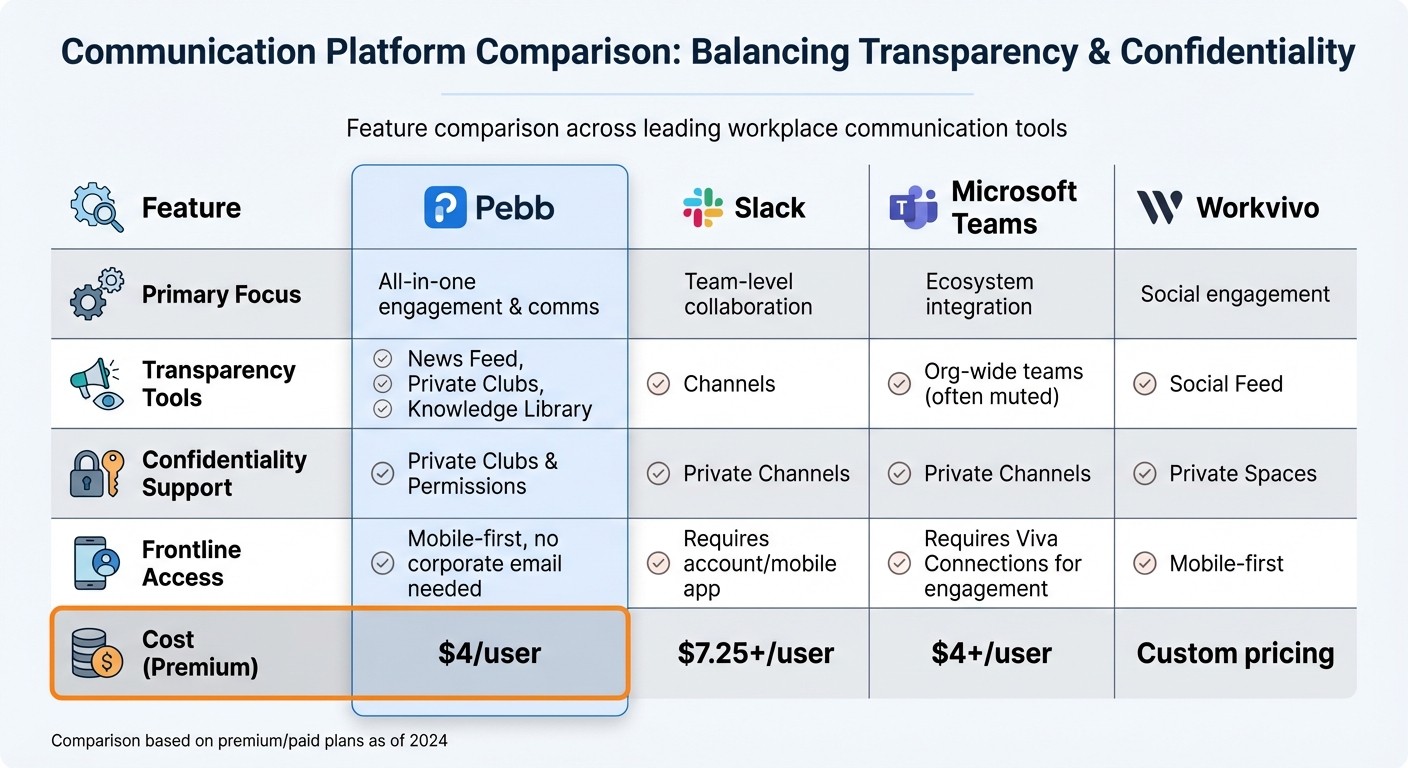
Workplace Communication Platform Comparison: Transparency and Confidentiality Features
Let’s be honest - navigating the line between transparency and secrecy can feel like walking a tightrope. But here’s the thing: you don’t have to pick one over the other. The most effective communication strategies use both, and the trick is knowing when to lean into openness and when to keep things under wraps. It’s not about extremes; it’s about balance. That’s where most leaders stumble because, let’s face it, there’s no universal playbook for this.
Here’s an eye-opener: while 86% of executives believe their organizations have high levels of trust, only 67% of employees feel the same way. That’s a pretty big disconnect. And it often boils down to this - leaders think they’re being transparent, but employees feel like they’re left in the dark.
So, how do you fix it? Start by defining what transparency actually looks like in your company. As Matthew NeSmith, Senior Editor at BambooHR, explains:
"Transparency doesn't mean you should open Pandora's box and bring up all the complaints from customers, investors, and former employees."
Instead, focus on sharing the essentials: where your company stands now, where it’s headed, and the steps you’re taking to get there. That’s your baseline. Everything else? It depends on timing, context, and whether sharing it adds value or just creates unnecessary noise.
How to Share Information Without Oversharing
Here’s a practical first step: create a formal disclosure policy. Define what’s considered “baseline information” that everyone needs to know and what qualifies as “sensitive information” that stays confidential. This isn’t about being secretive for the sake of it - it’s about consistency. When employees know where the boundaries are, they’re less likely to feel blindsided or excluded.
Another tip? Share the “why,” not just the “what.” Let’s say you’re assigning a task or setting a deadline. Don’t just hand it over - explain why it matters and why the person you chose is the right fit. This gives your team context without requiring you to spill every detail about budgets, client negotiations, or other sensitive topics. Context builds trust, plain and simple.
And one more thing: if you’re diving into sensitive topics during a meeting, start with a confidentiality reminder. It’s not about creating paranoia - it’s about setting clear expectations. Everyone leaves the room knowing what can and can’t be shared.
Once you’ve laid down these ground rules, the right tools can help you strike the perfect balance between transparency and discretion.
Communication Tools That Support Both Approaches
Here at Pebb, we’ve built our platform to reflect this balance because, let’s face it, no one-size-fits-all solution works for real-world communication. With clear boundaries in place, tools like ours can help you keep communication both open and secure.
News Feed: This is where we share company-wide updates, celebrate wins, and outline goals. But here’s the kicker - you can target posts to specific teams or roles. For example, if there’s a sales-only initiative, only the sales team sees it.
Groups: These are a game-changer. Think of them as secure, always-accessible conference rooms. Whether it’s leadership discussions, project-specific coordination, or sensitive HR matters, these spaces let the right people collaborate openly while keeping the conversation private.
Task Management: Assign tasks, set deadlines, and define success metrics - all visible to the people who need to know. If a task involves confidential details, you can limit access to just the contributors and managers.
Knowledge Library: This is your go-to hub for policies, procedures, and best practices. Role-based permissions ensure the right people see the right information. For example, HR teams can access employee handbook updates, while frontline staff get operational guidelines.
Here’s how Pebb stacks up against other platforms when it comes to balancing transparency and confidentiality:
Feature | Pebb | Slack | ||
|---|---|---|---|---|
Primary Focus | All-in-one engagement & comms | Team-level collaboration | Ecosystem integration | Social engagement |
Transparency Tools | News Feed, Groups, Knowledge Library, Tasks, Calendar, Digital forms | Channels | Org-wide teams (often muted) | Social Feed |
Confidentiality Support | Groups & Permissions control | Private Channels | Private Channels | Private Spaces |
Frontline Access | Mobile-first, no corporate email needed | Requires account/mobile app | Requires Viva Connections for engagement | Mobile-first |
Cost (Premium) | $4/user | $7.25+/user | $4+/user | Custom pricing |
At just $4 per user for our Premium plan - or free for up to 15 employees on our Standard plan - Pebb offers the flexibility to adapt to your communication needs without breaking the bank. Whether you’re sharing a company milestone or handling sensitive discussions, our platform ensures your team stays connected and engaged.
Up next, I’ll share some actionable takeaways to help you build trust through smarter communication. Because let’s be real - getting this balance right doesn’t just boost morale. It’s a win for your entire business.
Key Takeaways: Building Trust Through Better Communication
Here’s the thing: transparency and secrecy aren’t enemies - they’re teammates. The trick is knowing how to balance them. At Pebb, we’ve learned that trust isn’t about spilling every detail or keeping everything locked up tight. It’s about using good judgment to figure out what your team needs to know, when they need to know it, and how to share it in a way that’s clear, respectful, and confidential when necessary. This balance is the backbone of how we approach communication.
Matthew NeSmith, Senior Editor at BambooHR, put it perfectly:
"Establishing a culture of honesty and openness between leadership, managers, and employees should be every leader's top priority."
When your team trusts you, they don’t just show up - they show up. They’re more engaged, stick around longer, and care deeply about their work. And yes, that directly impacts the bottom line.
At Pebb, we define transparency by setting clear rules about what gets shared, when, and with whom. That’s why we’ve designed our all-in-one employee app for communication and operations to strike the perfect balance. Want to celebrate wins? The News Feed is your go-to. Need a private space for sensitive conversations? Groups have you covered. Everything we build is about keeping your team informed, connected, and secure. By establishing clear communication guidelines, you’re not just sharing information - you’re building a culture of trust and respect.
FAQs
How can companies strike the right balance between transparency and confidentiality in communication?
Balancing transparency and confidentiality is like walking a tightrope - you need to keep things steady to maintain trust and efficiency. It all starts with setting clear communication guidelines. Employees should understand what can be shared openly and what needs to stay private. Oversharing can overwhelm people, while withholding too much can spark unnecessary doubts.
Here’s how we approach it: we tailor communication based on who needs to know. Let me break it down:
Company-wide updates: Big-picture stuff like goals and achievements? Share it openly on platforms like Pebb. This way, everyone stays in the loop and understands the broader context.
Team-specific details: These are best shared in private groups. It keeps the conversation relevant without flooding everyone else with unnecessary information.
Sensitive matters: Topics like HR records or strategic plans should stick to secure, role-based channels. No exceptions.
What makes this easier? Tools like Pebb. Its customizable permissions and intuitive interface take the guesswork out of managing who sees what. When employees see that sensitive information is handled responsibly, trust naturally grows. And with trust comes better engagement and smoother collaboration. Oh, and by the way, all this comes at just $4 per user with Pebb’s premium plan. Not bad for peace of mind, right?
What are the downsides of being too transparent or too secretive at work?
Striking the right balance between openness and discretion is a tightrope every team has to walk. Share too much, and you risk information overload - that dreaded state where team members are buried under a flood of details. This can lead to endless debates, stalled decisions, and even a reluctance to share ideas for fear of scrutiny. It’s like trying to drink from a firehose - overwhelming and counterproductive.
But swing too far the other way, and excessive secrecy can be just as damaging. Keeping employees in the dark breeds knowledge silos and erodes trust. Without transparency, collaboration falters, accountability weakens, and skepticism about leadership creeps in. The result? Missed opportunities, slower problem-solving, and, ultimately, higher turnover.
Here at Pebb, we’re all about finding that sweet spot. Our free, all-in-one platform makes sure teams get just the right amount of information, exactly when they need it - no more, no less. And at just $4 per user, we make workplace communication clear, empowering, and effective, so trust can grow without the drama.
How does Pebb support open communication while keeping sensitive information secure?
At Pebb, we’ve nailed the sweet spot between keeping things open and ensuring sensitive information stays secure. Our platform is built for effortless collaboration while safeguarding privacy where it counts. Here’s how it works: employees can share updates, ask questions, and work together in real time through a single, unified feed. No more juggling a million tools or digging through endless email threads - everything you need is right there.
For those moments when privacy is key, we’ve got you covered with private clubs and group chats. These spaces are strictly invite-only, protected by role-based access controls and end-to-end encryption. Whether it’s HR ironing out policy details or a project team hashing out client specifics, you can trust that your conversations stay locked down.
And here’s the kicker: you get all this for just $4 per user/month with our Premium plan - or, if you’re using our Standard plan, it’s completely free for up to 15 employees. With Pebb, you don’t have to choose between transparency and security - you get both, seamlessly.
