

Author: Ron Daniel
How to Track Communication Effectiveness at Work
Set clear goals, track engagement, efficiency, and reach, collect employee feedback, and use analytics to improve workplace communication.
Have you ever wondered how much unclear communication costs your team? I didn’t - until I saw the numbers. Poor communication drains U.S. businesses of $1.2 trillion annually. That’s about $15,000 per employee. And it’s not just about money - on average, employees lose 46 workdays a year to miscommunication. Let that sink in for a second. That’s over two months of productivity gone.
When I joined Pebb, I thought tools like Slack or Teams were enough to fix these problems. But here’s the kicker: most companies don’t even measure if their messages are landing. I’ve seen firsthand how this leads to wasted time, missed updates, and frustrated teams. The good news? It doesn’t have to be this way. Tracking communication effectiveness isn’t rocket science - it’s about setting clear goals, using the right metrics, and acting on the data.
In this article, I’ll show you how we’ve tackled this at Pebb. From defining what success looks like to picking the right tools, I’ll break it all down step-by-step. Ready to see how you can turn communication into one of your team’s biggest strengths? Let’s dive in.
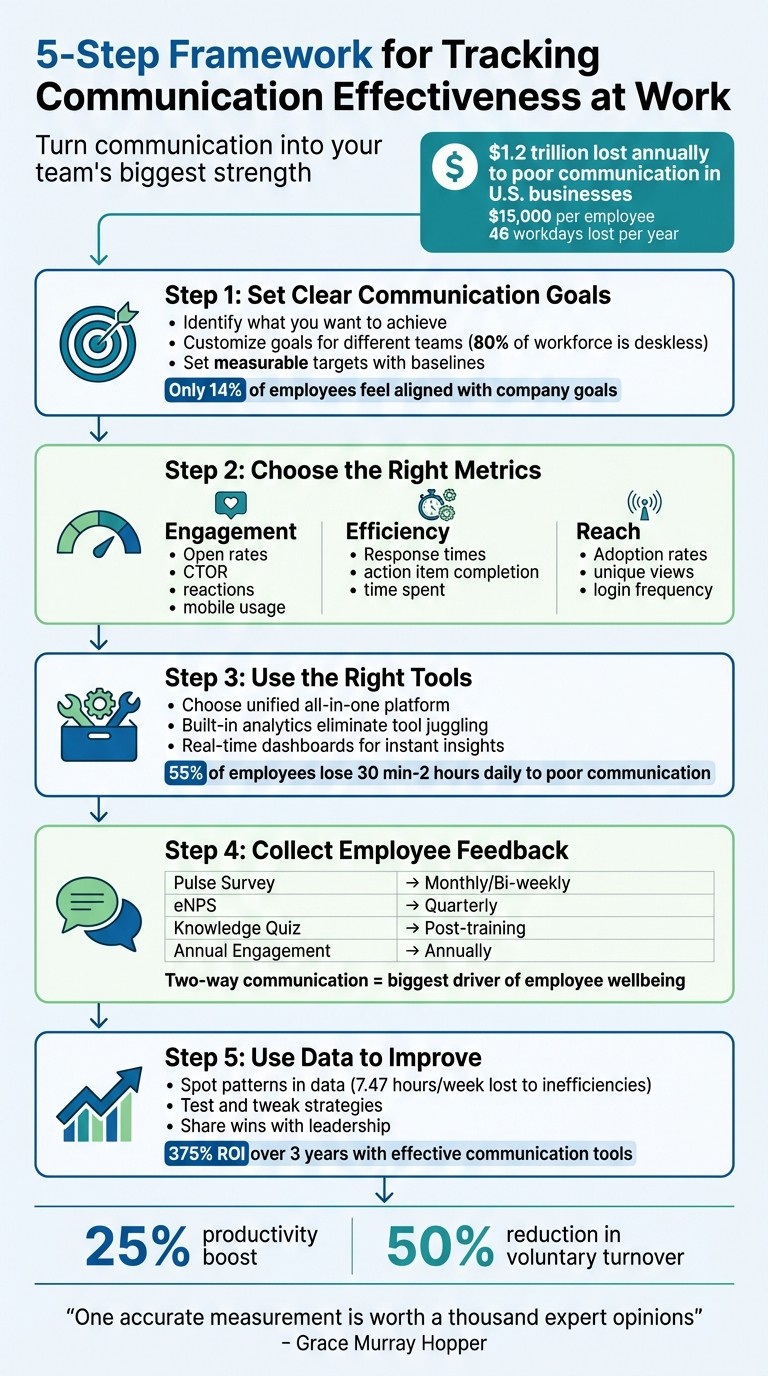
5-Step Framework for Tracking Communication Effectiveness at Work
Step 1: Set Clear Communication Goals
Before you even think about tracking metrics, take a step back and define what success looks like. Jumping into data without a clear purpose? That’s like trying to navigate a maze blindfolded - it wastes time and energy.
Let me walk you through how we approach this at Pebb.
Identify What You Want to Achieve
Think about the big picture. Do you want to improve collaboration between departments? Maybe reduce turnover by keeping your teams better informed? Or ensure that critical safety updates actually reach your frontline workers? Whatever it is, get specific.
Here’s a reality check: only 14% of employees feel fully aligned with their company’s goals. That’s a staggering disconnect, and it often starts with unclear communication objectives. From what we’ve seen, companies that thrive are the ones laser-focused on defining measurable outcomes tailored to their unique challenges.
"If you can't track and measure the performance of your communications you have no way of proving they're achieving business goals." - Tim Vaughan, Poppulo
Customize Goals for Different Teams

Here’s the thing: one-size-fits-all communication goals just don’t work. Your warehouse team and your marketing department? They’re operating in completely different worlds. And let’s not forget that 80% of the global workforce is deskless or constantly on the move, with 83% of non-desk employees lacking a corporate email address. If you’re treating them the same as your office staff, you’re setting yourself up for failure.
At Pebb, we’ve learned that tailoring communication to each team’s unique needs makes all the difference. For example, mobile-friendly updates work wonders for frontline teams, while office staff prefer more detailed reports. It’s all about meeting people where they are.
Once you’ve got those tailored goals in place, the next step is figuring out how to measure success.
Set Measurable Targets
Here’s the golden rule: vague goals like “improve communication” won’t get you anywhere. You need targets that are specific, measurable, and tied to actual behaviors. For instance, instead of saying “increase engagement,” aim for something concrete, like boosting email open rates or interaction levels within a set timeframe.
Start by establishing a baseline. Look at your current performance metrics to see where you stand, then set realistic targets for improvement. And here’s a pro tip: test new strategies on a small scale before rolling them out company-wide. That way, you’re working with real data, not just gut feelings.
Step 2: Choose the Right Metrics to Track
So, you've nailed down your goals - awesome! Now comes the next step: figuring out which metrics actually matter. Trust me, not every number on your dashboard deserves your attention. Some just add noise without offering real value.
At Pebb, we’ve learned to break communication metrics into three main buckets: engagement, efficiency, and reach. Think of it like piecing together a puzzle - each category gives you a unique part of the story. When you look at them together, you get a crystal-clear view of what’s working and where you might be falling short.
Engagement Metrics
Let’s start with the fun stuff - engagement. These metrics answer the big question: Are people actually paying attention to what you’re sharing? Here, we’re talking about things like open rates, click-through rates, reactions, comments, and survey participation.
But here’s the thing: open rates alone don’t cut it. Sure, they tell you if your subject line grabbed attention, but what happens after someone opens your message? That’s where the click-to-open rate (CTOR) comes into play. CTOR zooms in on the people who actually read your content and shows whether your message truly resonated. It’s like going from a blurry snapshot to a high-definition close-up.
Take the London Council of Tower Hamlets as an example. In 2024, they used Poppulo’s targeting and measurement tools during a major organizational shake-up. By focusing on engagement metrics, they could pinpoint which messages hit home and which ones didn’t.
"Poppulo has changed our lives. We can get the right information to the right people when they need it, we know what's working and what's not, and we have the analytics to derive really important insights into the behaviors and preferences of our colleagues."
– Sally Jackson, Senior Manager of Content and Channels, National Grid
And let’s not overlook mobile. With 80% of the global workforce being deskless, tracking mobile engagement - like app usage and push notification responses - is a must. If you’re only tracking email opens, you’re missing a huge slice of your audience.
Now that we’ve tackled engagement, let’s talk about how to measure whether communication is actually helping people get things done.
Efficiency Metrics
This is where we separate the productive from the time-wasters. Efficiency metrics look at things like response times, meeting productivity, and how much time people spend using communication tools. These numbers reveal whether your communication is moving work forward - or just adding more to-do lists.
One key metric here is the action item completion rate. This tracks how many tasks identified during meetings actually get checked off. If your team is generating a mountain of action items but barely crossing any off, that’s a clear sign something’s off in your communication flow.
Another useful metric? Time spent on communication apps. It’s not just about how often people log in - it’s about whether those tools are genuinely helping or just becoming another tab they ignore.
Finally, let’s make sure your messages are landing where they’re supposed to.
Reach Metrics
Here’s the deal: even the best-crafted messages are pointless if they don’t reach your audience. That’s why adoption rates, unique views, login frequency, and content accessibility are so important.
It’s also worth doing regular channel audits. Are people actually checking Slack? Is your company intranet being used effectively? At Pebb, we’ve built analytics right into the platform to track adoption rates and engagement patterns. Whether your team is in the office or out in the field, these insights help ensure your messages are reaching their mark. After all, without frontline logins, even the most brilliant message can fall flat.
Step 3: Use the Right Tools for Tracking
Alright, you've nailed down your goals and metrics. Now comes the part where many teams stumble - choosing the right tools to track them. Trust me, juggling multiple platforms is a recipe for wasted time and frustration. Every minute spent hopping between apps is a minute you could use to actually improve communication.
Here’s where a unified platform becomes your best friend. By consolidating everything into one space, you can ditch the messy tech stack and streamline your workplace communication and focus on what really matters.
Why an All-in-One Platform is a Game-Changer
When your tools are scattered, so is your data. Imagine this: your team chat is in one app, your news feed lives elsewhere, and your analytics are buried in some third-party tool. Suddenly, you're playing detective, piecing together a puzzle that shouldn’t even exist.
This is exactly why we created Pebb - to be your all-in-one employee app for communication and operations. Everything you need - work chat, news feed, shift scheduling, tasks, digital forms, calendar events, a knowledge library, and more - lives in one connected space. No more switching from Slack to Teams to yet another app just to figure out how your team is doing. It’s all right here, in one place.
Let’s compare: Slack is fantastic for chat, and their Workflow Builder can automate surveys, but if you want deep analytics? You’ll probably need to pay for extra third-party tools. Teams? Great for meetings and collaboration, but tracking communication effectiveness? Same story - more tools, more costs.
Here’s the kicker: Pebb is free for teams with up to 15 employees. And if you need our Premium plan? It’s just $4 per user per month. That’s a fraction of what you’d pay for enterprise versions of Slack or Teams, and you’re getting everything bundled together - communication, operations, engagement, and analytics.
Unlock the Power of Built-In Analytics
Once you’ve got the right platform, it’s time to put those built-in analytics to work. I know dashboards can feel overwhelming at first, but here’s the trick: start small. Focus on the metrics that tie directly to your goals (remember Step 1?) and build from there.
With Pebb’s real-time dashboards, you can slice and dice engagement data by department, location, or team with analytics in our Premium plan. For example, if your warehouse crew isn’t opening safety updates but your office team is, you’ll catch that pattern immediately - not months later when productivity has already taken a hit.
And here’s something I love: acknowledgment buttons for critical updates. It’s not just about knowing who opened an email. If you’re sending out a compliance update or a new safety protocol, you need confirmation that people actually read and understood it. With Pebb, employees can acknowledge messages, giving you accountability far beyond a simple “open rate.”
Plus, our mobile-first design ensures that tracking app usage, push notifications, and engagement patterns for frontline workers is seamless. Everything integrates smoothly into your overall analytics, so you’re never left guessing.
Here’s a stat that might surprise you: 55% of employees lose between 30 minutes and two hours of productivity every day because of poor communication. The right tools don’t just track communication - they help you spot and fix issues before they drain your team’s time and energy.
Step 4: Collect Employee Feedback
Tracking numbers is only part of the story. Sure, you can keep an eye on open rates and click-throughs all day long, but if you’re not tapping into your employees’ actual opinions, you’re missing out on the bigger picture. That feedback is the missing link between raw analytics and how your communication efforts are really landing with your team.
Let’s be honest - surveys can feel like just another task on an already packed to-do list. But without them, you’re basically guessing. You might think your weekly newsletter is a hit, but if your team finds it confusing or irrelevant, all those great metrics are just vanity numbers. Here’s a stat that hits home: 58% of internal communicators say their biggest obstacle to measuring communication is a lack of time and resources.
Make Surveys Count
If you’re going to ask for feedback, make it count. Keep your surveys short and to the point. Variety is your friend here - mix in Likert scale questions (you know, those 1–5 ratings) to spot trends and open-ended questions to get honest, unfiltered responses.
Here’s a framework that works like a charm: Start with an eNPS (Employee Net Promoter Score) question - “On a scale of 0–10, how likely are you to recommend working here to a friend?” Then, follow up with a few specific questions about communication clarity, frequency, and preferred channels. Wrap it up with one open-ended question, like, “What’s one thing we could improve about how we communicate?”
These surveys don’t just add context to your metrics - they give you a roadmap for what to tweak next.
Survey Type | Purpose | Frequency |
|---|---|---|
Pulse Survey | Quick feedback on specific topics | Monthly/Bi-weekly |
eNPS | Gauge employee loyalty | Quarterly |
Knowledge Quiz | Assess understanding of policies | Post-training |
Annual Engagement | In-depth look at workplace culture | Annually |
One thing to watch out for: participation bias. If only the most vocal employees respond, you’re not getting the full picture. Use random sampling to make sure everyone has a chance to weigh in. Also, establish baseline knowledge before rolling out new initiatives - it’s like gold when you’re trying to prove impact down the line.
Build Ongoing Feedback Loops
Here’s the thing - surveys are great, but they’re just snapshots. Real progress happens when you create ongoing feedback loops. These are channels where employees can share their thoughts in real time, instead of waiting for the next quarterly survey.
This is where Pebb really shines. Our platform includes comment sections on news posts, polls, and social reactions that make feedback quick and easy. When someone reacts to an announcement or leaves a comment on a company update, you’re collecting insights on the spot. It’s all part of our approach to integrate feedback seamlessly with analytics.
"It's one thing pushing out company communications, but is anyone reading your messages? That's what matters." - Ragan Communications
Two-way communication isn’t just a nice-to-have - it’s the single biggest driver of employee wellbeing and belonging. When your team feels heard and sees their feedback leading to action, engagement takes off. Set up spaces where employees can ask questions, share ideas, or raise concerns anytime - not just during survey season. And don’t just listen - track those conversations for patterns. For example, if multiple people mention confusion over a new PTO policy, you know it’s time to step in and clarify.
Finally, keep a close eye on how your channels are performing. If emails are being ignored but the group chat is buzzing, you’ve got your answer on where to focus your energy. Pay attention not just to what your team says, but how they’re engaging with your communication efforts. Their behavior speaks volumes.
Step 5: Use Data to Improve Communication
Having data is one thing, but using it to make communication better? That’s where the magic happens. You’ve got the metrics, the feedback, and the insights - now it’s time to transform all that information into meaningful action. This isn’t about getting lost in endless spreadsheets; it’s about spotting what works, ditching what doesn’t, and showing leadership why it all matters.
Spot the Patterns in Your Data
First, you need to uncover trends that keep popping up. For example, if your Monday morning announcements consistently see 30% lower open rates compared to Wednesday updates, that’s not a coincidence. It’s a clear signal. Maybe your team is swamped at the start of the week and needs breathing room before diving into company news.
Don’t stop at numbers - pair your quantitative data with employee feedback. For instance, if you notice a drop in engagement on a specific channel and employees mention in surveys that the channel feels "too noisy", you’ve got your answer. Dive deeper by comparing data across teams. If your warehouse crew is thriving with the mobile app while your office staff barely touches it, you know where to double down.
At Pebb, we regularly see data exposing inefficiencies that cost teams an average of 7.47 hours per week. That’s nearly a full workday lost! By spotting patterns - like missed updates buried in email - you can actually calculate the time you’re saving by improving communication.
Once you’ve identified these patterns, it’s time to adjust your internal communications strategy.
Tweak and Test Your Communication Strategy
Your data isn’t just there to look pretty - it’s a roadmap to fix what’s broken. Let’s say a critical policy update has a low open rate in the first few hours. Don’t just cross your fingers and hope it improves. Resend it with a more engaging subject line or push it through a different channel . With analytics in Pebb’s Premium plan, you can pivot instantly instead of waiting weeks to make adjustments.
Experimentation is key. If your team tends to ignore long newsletters but engages with short news feed updates, shift your approach. If video announcements spark more reactions than text posts, lean into that format. The data will tell you what your employees prefer - listen to it.
Share the Wins with Leadership
Once you’ve made changes and seen results, it’s time to loop in leadership. Here’s a reality check: 70% of communicators say leadership doesn’t actively ask for communication metrics. That means it’s on you to bring those insights to the table. But don’t just toss a bunch of numbers at them - connect the dots between communication improvements and business outcomes.
Here’s a formula that works:
(Engagement increase × 23% profit improvement) + (Retention improvement × average replacement cost) + (Productivity gains × average salary costs) - Communication platform costs.
When you show that effective communication tools can deliver a 375% ROI over three years, you’ll have their attention.
Focus on what leadership cares about most - metrics tied to the bottom line. Highlight how better communication reduces turnover, boosts productivity, and improves employee sentiment. For example, 86% of leaders believe greater transparency builds workforce trust. Use before-and-after comparisons, specific examples, and clear data to make your case.
Metric Category | Leadership Focus | Actionable Insight |
|---|---|---|
Engagement | Employee Net Promoter Score (eNPS) | Gauge how likely employees are to recommend the company |
Productivity | Time saved per employee | Show financial impact of smoother workflows |
Retention | Turnover correlation | Link communication quality to employee exits |
Sentiment | Feedback response rate | Demonstrate leadership’s responsiveness to employee input |
At Pebb, we’ve made this process simple with our analytics tools in Premium. It pulls the exact metrics leadership wants to see, shows real-time trends, and proves the impact of your communication strategy - all without hours of manual data crunching. And with our Premium plan priced at just $4 per user per month, the ROI practically speaks for itself.
Conclusion
Making sure your team truly hears and understands your message is the backbone of great performance. With the steps we've covered - setting meaningful goals, tracking the right metrics, using effective tools, listening to feedback, and acting on the data - you now have a solid plan to sharpen your communication game.
Here's the reality: sticking with outdated communication methods risks leaving employees in the dark. On the flip side, well-thought-out strategies can boost productivity by 25% and cut voluntary turnover by 50%. Those numbers are hard to ignore.
Grace Murray Hopper once said, "One accurate measurement is worth a thousand expert opinions", and I couldn’t agree more. That’s why conducting a communication audit is a must. Take a close look at your channels - keep what’s working, ditch what’s not, and fine-tune things like send times and message delivery. Small tweaks can make a big difference.
At Pebb, we’ve built our platform to tackle these exact challenges. From shift scheduling and PTO management to news feeds, chat, tasks, digital forms, calendar events, and analytics, everything you need is in one place. No more juggling tools or wondering if your message landed. Our Premium plan offers a powerful analytics dashboard for just $4 per user per month, making it one of the most cost-effective all-in-one solutions out there. And for smaller teams of up to 15 people, our Standard plan is completely free.
Why wait? Take the first step today. Your team - and your results - will thank you for it.
FAQs
How can I set clear and measurable communication goals for my team?
Setting clear communication goals for your team doesn’t have to feel overwhelming. The first step is to pinpoint what success means for your specific situation. Is it about smoother shift handovers? Cutting down on missed changes? Or maybe boosting engagement with company updates? Whatever it is, tie your goal to a concrete outcome - like reducing missed shift changes by 20% or getting 80% of your team to read updated policies.
From there, it’s all about tracking the right numbers. Think of metrics like email open rates, engagement levels (comments, reactions, etc.), survey response times, or even how effective meetings feel based on feedback. Once you’ve nailed down what to measure, compare your numbers to either industry benchmarks or your team’s past performance. That’ll give you a realistic starting point to aim for.
Now, here’s the secret sauce: make your goal SMART. That’s Specific, Measurable, Achievable, Relevant, and Time-bound. For example, you might say, “Let’s increase the weekly shift schedule read rate from 68% to 80% by September 30, 2026.” If you’re working with Pebb, tracking these metrics is super simple. Tools like news feeds, polls, and task completion trackers are built right in, and you can upgrade to the Premium plan for Analytics for just $4/user/month.
Once you’ve set your goal, don’t just leave it on the shelf. Check in monthly to see how things are going, and be ready to tweak your approach if needed. It’s all about staying flexible and focused!
What are the key metrics to measure communication effectiveness at work?
To truly understand how effective your team’s communication is, you’ll want to zero in on a few metrics that paint a clear picture of connection and collaboration. Start with reach - how many people are actually seeing your messages. Then, look at adoption - who’s actively using the communication tools you’ve provided. Finally, there’s engagement, which tells you how much employees are participating in discussions or activities.
Beyond that, keep an eye on message open rates, click-through rates, and feedback loops like meeting productivity or employee sentiment. These numbers don’t just show you what’s working; they highlight areas that might need a little extra attention. The best part? Tools like Pebb let you track all these metrics in one place, making it easier to keep your team aligned and involved.
Why is employee feedback essential for better workplace communication?
At Pebb, I’ve learned firsthand how a simple question like “What do you think?” can open doors to better understanding and collaboration. Numbers, like open rates, can only tell part of the story - how many people saw a message. But feedback? That’s where the real magic happens. It tells you whether your message hit home, made sense, and actually motivated people to act. That’s the kind of insight that transforms communication from just noise into genuine connection.
Here’s why this matters so much: Poor communication is a silent but massive drain on businesses in the U.S., costing a staggering $1.2 trillion annually - that’s about $15,000 per employee. On the flip side, companies that truly listen to their employees see tangible benefits: stronger profits, happier teams, and lower turnover rates. It’s a win-win.
At Pebb, we’ve made it our mission to make feedback a natural part of how teams communicate every day. Whether it’s quick emoji reactions in a chat, short pulse surveys, or reflections after a meeting, we’ve built tools that turn feedback into real, actionable steps. Because at the end of the day, communication isn’t just about making noise - it’s about making sure people feel heard and understood.
