
Author: Ron Daniel
Streamlining employee onboarding for hospitality teams in 2026
Digital onboarding for hospitality teams: role-based checklists, automated compliance, scheduling, and 0–90 day training to improve retention.
Here’s a question for you: How much time do you think hospitality teams spend onboarding new hires every year? If your guess is “too much,” you’re not far off. I’ve seen it firsthand. Between chasing down paperwork, juggling schedules, and trying to make sure every new hire feels prepared on day one, the process can feel like running a marathon without a finish line. And when you’re dealing with turnover rates pushing 70–80% annually, it’s not just frustrating - it’s expensive.
Let me give you some perspective. Replacing just one restaurant worker costs around $6,000, and for hotel employees, it’s even worse - up to 60% of their annual salary. That’s a tough pill to swallow, especially in an industry where every dollar counts. And it’s not just about the money; it’s about the chaos. I’ve seen teams rely on group texts, paper schedules pinned to a wall, and compliance forms buried in email threads. It’s messy, it’s stressful, and it’s not working.
That’s why we built Pebb. We wanted to create a system that doesn’t just help hospitality teams survive onboarding - it helps them thrive. From digital task checklists to real-time progress tracking, we’ve rethought everything to make it simpler, faster, and more effective. In this article, I’ll share how we’re tackling some of the biggest onboarding headaches in hospitality and turning them into opportunities for growth. Let’s dive in.
Setting Clear Onboarding Goals and Metrics
When it comes to hospitality, where every shift can feel like a high-stakes performance, setting clear and measurable onboarding goals is a game-changer. With high turnover rates and the need for flawless execution, having specific KPIs isn’t just helpful - it’s essential. These metrics give your team a solid framework to aim for and help you catch potential problems before they spiral out of control.
Key Metrics to Track Onboarding Success
In hospitality, the most impactful onboarding metrics fall into four main categories: compliance completion, time to productivity, new hire retention, and satisfaction scores. Let’s break these down:
Compliance completion: This one’s non-negotiable. For example, 100% of kitchen staff must have their food hygiene certification before they step onto the line.
Time to productivity: Measures how quickly a new hire can operate independently, whether it’s running a section or prepping meals.
Retention rates: Tracking 30-, 60-, and 90-day retention helps you gauge whether your onboarding process is keeping new hires engaged and committed.
Satisfaction scores: Gathering feedback through quick pulse polls tells you how new hires feel about their onboarding experience.
Here’s where Pebb steps in: digital task checklists ensure every training step is accounted for, built-in polls capture feedback at critical moments, and the news feed keeps everyone in the loop. Managers get a real-time view of each hire’s progress - all without needing a separate HR system.
But here’s the thing: onboarding isn’t one-size-fits-all. You’ve got to tailor these metrics for each role.
Adjusting Goals by Role
Let’s face it - what works for a server probably won’t cut it for a kitchen staffer or a manager. Each role has its own priorities, and your onboarding goals should reflect that:
Front-of-house staff (servers): Speed is the name of the game. The goal? Solo table service within two weeks.
Back-of-house staff (kitchen): Compliance is key. Food hygiene certification must be completed within the first five days.
Front desk or guest services: Mastery of systems like the PMS and check-in process should happen within a week.
Management roles: For managers, it’s about getting up to speed on operational systems - things like scheduling tools, PTO policies, and communication workflows - within 30 days.
With Pebb, you can create role-specific onboarding templates right from the start. A new line cook gets a checklist tailored to kitchen responsibilities, while a front desk associate sees tasks relevant to guest services. These customizable templates make it easy to hit those role-specific targets without missing a beat.
Take a look at how these goals translate into actionable targets:
Role | Goal | Key Metric | Target Timeline |
|---|---|---|---|
Front-of-House (Server) | Independent table service | Independent shift readiness | Within 2 weeks |
Back-of-House (Kitchen) | Compliance certification | 100% food hygiene completion | Within 5 days |
Front Desk / Guest Services | Systems and policy fluency | PMS and check-in process mastery | Within 1 week |
Management | Operational oversight | Scheduling and team comms mastery | Within 30 days |
Building a Digital Onboarding Process from Day 0 to Day 90
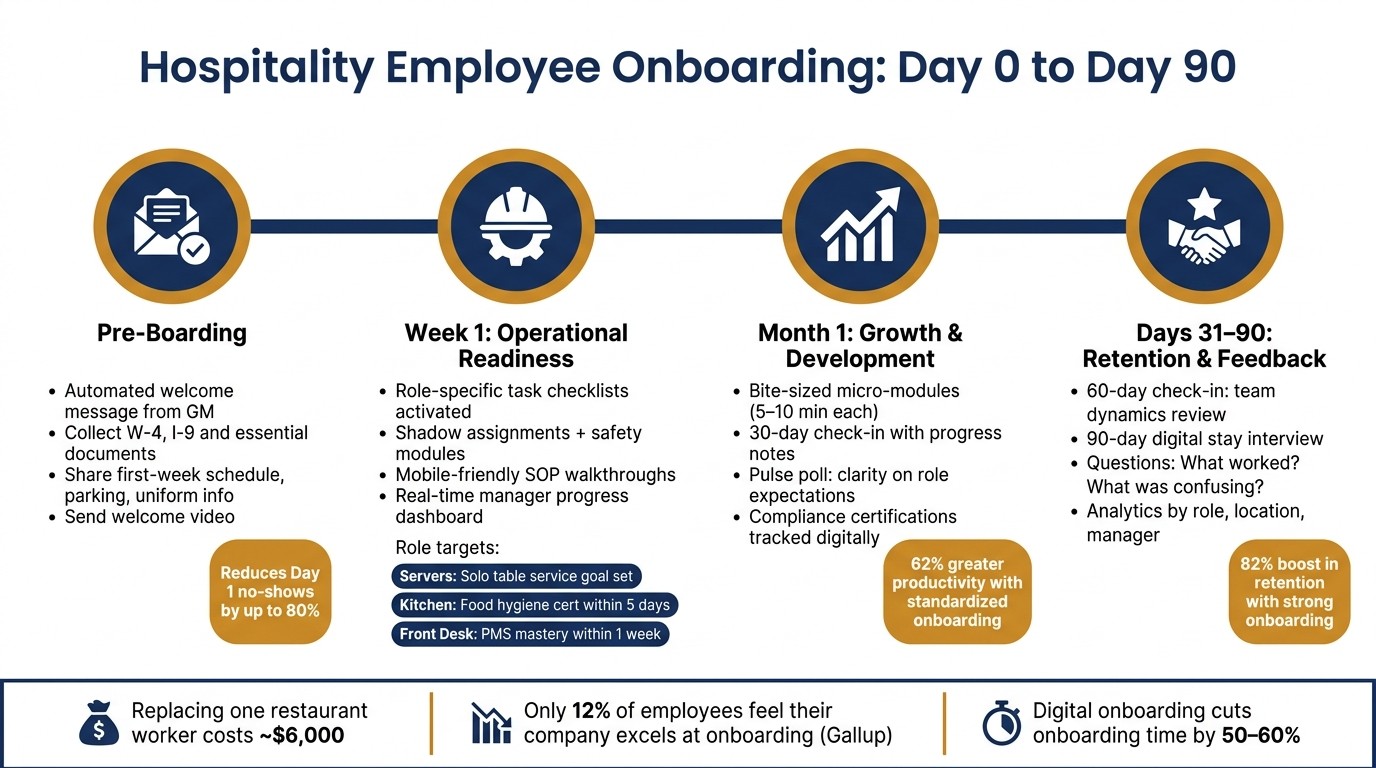
Hospitality Employee Onboarding Timeline: Day 0 to Day 90
When it comes to onboarding, having a clear and structured plan can make all the difference. Hospitality teams with a well-thought-out Day 0-to-Day 90 timeline often see stronger retention rates compared to those struggling with constant turnover. In fact, research from Brandon Hall Group shows that organizations with a frontline employee onboarding best practices experience 62% greater new-hire productivity and 50% higher retention. Those are some serious numbers, right?
Pre-Boarding: Setting the Stage Before Day 1
Here’s the thing: the time between when someone accepts an offer and their first day is often overlooked. And yet, it’s a critical window where hospitality teams can make or break the onboarding experience. This is where Pebb truly shines. Did you know that sending a personalized welcome message from the GM, sharing the first week’s schedule, and collecting essential documents like W-4s and I-9s ahead of time can cut Day 1 no-shows by up to 80%? That’s according to surveys from top talent platforms.
Here’s how we handle it at Pebb. The moment an offer is accepted, we send out an automated welcome message along with an essentials checklist. A few days before Day 1, employees receive details like their start time, parking instructions, uniform guidelines, and even a short welcome video from the GM. Each task comes with a time estimate, so employees know exactly what to expect and can complete everything without stress. No more chasing down paperwork or scrambling at the last minute. This smooth start helps set the tone for a confident and productive first week.
First Week: Building Confidence Through Operational Readiness
The first week is all about turning that initial paperwork into real-world readiness. Remember those role-specific checklists we talked about earlier? This is where they come into play. Tailored training sessions include shadow assignments, mandatory safety modules, and mobile-friendly SOP walkthroughs. Every task is clearly defined, with an owner, a deadline, and a simple way to mark it complete - whether it’s a trainer’s sign-off, a quick quiz, or an acknowledgment button.
Thanks to Pebb’s real-time dashboards, managers can track progress on the fly. For example, they can see who’s completed safety training versus POS training and tweak schedules as needed instead of discovering gaps after the fact. One of my favorite tools is the "Server – Week 1" template, which can be standardized across locations while still allowing for local customization. Teams can add tasks like learning neighborhood details, daily specials, or property-specific emergency exits. This balance of consistency and local relevance ensures every new hire gets off to a strong start.
Month 1 and Beyond: Growth Through Ongoing Support
After the first week, the focus shifts to continuous development. From Day 8 to Day 90, Pebb keeps the momentum going with bite-sized, mobile-friendly micro-modules - just 5 to 10 minutes each. These modules are assigned with due dates that align with the natural learning curve, making them easy to fit into a busy schedule. On top of that, we schedule 30/60/90-day check-ins to capture progress notes directly in the employee’s profile. These check-ins aren’t just about accountability - they’re a chance to celebrate wins, address challenges, and keep everyone aligned.
At the 90-day mark, we wrap things up with a quick digital stay interview. Questions like “What worked?” “What was confusing?” and “What would you change?” give us the insights we need to refine the process for future hires. Considering that only 12% of employees strongly agree their organization does a great job onboarding (thanks, Gallup, for that sobering stat), staying engaged through those first three months is a game-changer. It’s all about showing up consistently and making every new hire feel supported from the start.
Keeping Training and Communication Consistent Across Locations
When you're running just one or two locations, it's easy to keep things casual. But once you scale to five, ten, or twenty locations, that informal approach starts to fall apart. Here's the problem: inconsistency. A front desk agent at one property might handle guest complaints completely differently than someone at another location - and trust me, guests notice. Deloitte found that consistent guest experience across locations is a top strategic priority for hospitality brands. Why? Because inconsistency doesn’t just hurt your reputation; it directly impacts your Net Promoter Scores and loyalty, which means it’s hitting your bottom line. At Pebb, we tackle this head-on by unifying training and communication across all locations.
The solution isn’t about micromanaging every single detail. It’s about creating a system where consistency becomes second nature from the very beginning.
Building Role-Specific Training Templates
One of the quickest ways to ensure consistency is by standardizing role-based training. With Pebb's knowledge base and task templates, you can create a streamlined onboarding process for every role - housekeeping, front desk, kitchen, food and beverage (F&B) - and apply it across all locations with just one click.
Here’s how it works. Let’s take a housekeeping template as an example. It includes everything from room setup standards and inspection checklists to safety procedures. A front desk template walks new hires through check-in scripts, property management system (PMS) basics, and how to handle guest complaints. For the kitchen team, the template might cover food safety certifications, station prep, and shift handoff routines. Each template is broken into milestones - Day 1, Week 1, Day 30, Day 90 - complete with tasks, linked SOPs (Standard Operating Procedures), and an easy way for managers to confirm everything’s been completed.
The beauty of this approach? The core content stays consistent, but managers can add in local details, like property-specific emergency exits or current promotions. According to McKinsey, companies using standardized digital training tools saw 20–30% faster ramp-up times and fewer operational errors. That’s a game changer.
But training is just one piece of the puzzle. Building personal connections is just as important.
Connecting New Hires with Their Teams
Let’s face it: onboarding isn’t just about learning the ropes. It’s about making new hires feel like they belong. This is especially true in hospitality, where 80–90% of employees are hourly, frontline workers who don’t sit at desks and can easily feel overlooked during their first few weeks.
With Pebb, we make sure new hires feel welcome from day one. Managers can post a welcome message in the team news feed before the new hire even starts. It’s visible to the whole team, not just HR, which helps set a warm, inclusive tone. For day-to-day questions, new hires can use work chat with role-based group channels, so they can ask questions without worrying about interrupting anyone. And when it comes to introductions, voice and video calls make it easy to connect without the hassle of scheduling formal meetings.
This mix of asynchronous tools (like chat and news feeds) and real-time communication ensures that new hires stay informed and supported, no matter their shift or location. It’s all about making them feel seen and setting them up for success.
Cutting Down on Admin Work with Automation
Let me tell you, even the best training programs and team-building efforts can get completely derailed by one thing: paperwork. In hospitality, where turnover feels like a revolving door and seasonal hiring can mean onboarding dozens of people in just a few weeks, manual admin tasks can be a massive bottleneck. Think about this: HR teams spend up to 40–50% of their time on repetitive tasks like data entry, chasing down missing forms, and answering the same questions over and over. That’s time they could be using to actually support their teams.
Managing Compliance and Documentation Digitally
Here’s where Pebb steps in to save the day. With Pebb, the entire compliance process is handled digitally, starting from the moment a new hire is added to the system. It’s like having a digital compliance toolkit that kicks off automatically. For U.S. locations, this includes everything from I-9 and W-4 forms to handbook acknowledgments, safety policies, and tip-handling procedures. Each form comes with required fields, e-signatures, and automatic timestamps, so you always know exactly when something was completed.
For roles that need certifications - like a ServSafe Food Handler card or a state alcohol service permit - Pebb makes it simple. New hires get a prompt to either upload their existing certification or complete a training module, and everything is logged with a date and time stamp. If there’s OSHA-required safety training that must be done before someone can use specific equipment, Pebb ensures those tasks are locked until the training is completed. No more manual checks or chasing people down for proof.
And here’s the real game-changer: audits. Instead of rummaging through folders and stacks of paper, HR can pull up a single digital record for each employee, showing what’s been completed, when, and by whom. Companies that switch to digital onboarding processes have reported cutting their onboarding time by 50–60% - all thanks to eliminating paper forms, re-entering data, and endless follow-up emails.
Once compliance is in the bag, Pebb takes the rest of the onboarding process to the next level.
Scheduling and PTO Management for New Hires
Scheduling is one of those tricky pain points in hospitality. New hires often show up on payroll before they’re visible in the scheduling system, which creates all kinds of headaches. But with Pebb, that problem is solved before it even starts. During pre-boarding, new hires fill out a mobile-friendly availability form, and their scheduling profile is automatically updated. By the time they show up for their first shift, they’re already on the schedule and visible to the team.
Pebb also handles PTO rules without breaking a sweat. For example, a new hire in California will automatically get the correct meal and rest break acknowledgments assigned to them - no manual input needed. Managers can set blackout dates and minimum notice periods, and Pebb enforces those rules automatically. PTO requests? They go straight to the right manager for quick, one-tap approvals. Say goodbye to paper forms.
Here’s the kicker: restaurants using integrated scheduling and time-and-attendance tools have seen a 3–5% reduction in labor costs. Why? Fewer scheduling errors and better visibility across locations. That’s real money saved, all while making life easier for everyone involved.
Improving Retention by Building Connection During Onboarding
Let me tell you something I’ve learned firsthand: cutting down on admin tasks and automating schedules is great, but it doesn’t mean much if new hires don’t feel like they belong. In the hospitality world, where things move at lightning speed, creating those personal connections during onboarding is a game-changer for retention. According to Gallup, managers influence about 70% of the variance in team engagement. That’s huge. And when employees feel informed and connected, they’re far less likely to head for the door.
Making New Hires Feel Welcome from Day 1
Here’s what we do at Pebb to make sure new hires feel like part of the family from the start. As soon as someone’s start date is locked in, we post a welcome announcement on our news feed - ideally a day or two before their first shift. But we skip the boring “Please welcome John” messages. Instead, we highlight their role, what shift they’ll be working, or even a fun tidbit from the interview process. This not only gets everyone excited but encourages teammates to jump in with comments or tips, which creates an instant sense of community.
For those in roles where shifts rarely overlap, this is especially important. Direct messages also play a big role. We send out essential info - like what to bring or who to report to - before their first day. Then, we add them to role-specific group chats like “Front Desk – Evening Shift” or “Kitchen – Line Cooks.” These chats act as a built-in peer network, and assigning them a buddy within those groups makes the transition even smoother. It’s a simple step, but it goes a long way in reducing those first-day jitters.
Gathering Feedback to Improve the Process
Once those initial connections are in place, we turn our focus to feedback. This is where Pebb’s polls and forms come in handy. For example, we send out a Day 3 poll asking, “On a scale of 1–5, how clear are you on what’s expected this week?” It’s a quick way to catch any early confusion or concerns. By Day 30 and Day 90, the questions shift to bigger-picture topics like training, team dynamics, and whether they see a future with us.
The best part? Pebb’s analytics let us break down responses by location, role, or manager, so we can spot trends and areas for improvement. And we don’t just collect feedback - we act on it. Sharing a “You said, we did” update on the news feed shows employees that their voices matter. This kind of follow-through builds trust, which is crucial for keeping people around long-term.
At the end of the day, it’s all about creating an onboarding experience where every team member feels supported right from the start. And trust me, when people feel connected and valued, they’re much more likely to stick around.
Conclusion: Modernizing Hospitality Onboarding with Pebb
The fast-paced world of hospitality in 2026 demands smarter solutions, especially when it comes to onboarding. Here's the reality: fragmented processes burn through time, money, and - most importantly - talent. And with the industry constantly evolving, the pressure to hire, train, and keep top-notch employees has never been greater.
Let’s talk numbers. According to a Brandon Hall Group study, a well-executed onboarding process can boost new hire retention by 82% and productivity by over 70%. Yet, Gallup reports that only 12% of employees feel their company excels at onboarding. That gap? That’s where Pebb comes in.
Pebb simplifies everything by combining work chat, shift scheduling, PTO management, task checklists, digital forms, training tools, and team communication into one intuitive platform. No more jumping between apps or chasing paperwork. New hires know exactly what to do, managers save countless hours, and teams stay connected - whether they’re clocking in for breakfast service in Miami or closing the bar in Nevada. It’s all about creating a seamless experience from day one.
And here’s the kicker: effective onboarding doesn’t just save time - it saves money. Replacing employees is expensive, but a strong start keeps them around longer. With Pebb, you can get started at no cost for teams of up to 15 employees. This free plan includes essentials like checklists, messaging, and scheduling. Ready to expand? The premium plan is just $4 per user per month, offering advanced analytics and integrations at a price that’s hard to beat.
If you’re tired of juggling spreadsheets, group chats, and paper packets, now’s the time to upgrade. Pebb’s all-in-one platform gives your team the clear, connected experience they deserve. Start small - pilot it with one role or location - and see how it transforms your onboarding process. Let’s modernize together.
FAQs
What should I include in a Day 0–Day 90 onboarding plan for hourly hospitality roles?
When it comes to onboarding hourly hospitality employees, having a solid Day 0–90 plan can make all the difference. The goal? Cut down on admin overload and give new hires a clear path to success from the start.
Here’s how we approach it at Pebb. On Day 0, we use Pebb’s digital forms to knock out essentials like IDs, tax documents, and company policies. This frees up time for the fun stuff - like introducing new hires to our company culture and pairing them with a buddy for support.
Over the next 30–90 days, automation becomes our secret weapon. Pebb makes it easy to deliver compliance documents, safety protocols, and training materials right on schedule. Plus, with Pebb’s AI translation tools, everything is accessible in multiple languages, making sure no one feels left out. We also prioritize regular check-ins at the 30, 60, and 90-day marks to make sure everyone’s on track and feeling good about their role.
Which onboarding KPIs matter most for hospitality teams, and how do I track them easily?
When we talk about onboarding in the hospitality world, the key is to measure what really matters. For our teams, that means keeping a close eye on time-to-productivity, retention rates, and engagement scores. These metrics tell us if we're setting up our new hires for success - or if we're leaving them to sink or swim.
At Pebb, we’ve made it our mission to simplify this process. Our all-in-one platform takes the chaos out of tracking by pulling everything - task management, digital forms, and scheduling - into one centralized hub.
Here’s where it gets even better: features like automated checklists and a searchable Knowledge Library let you monitor training progress in real time. No more guessing if someone’s completed their onboarding or digging through emails to find out where they’re stuck. It’s all right there, easy to access.
And because integrated metrics are baked into the platform, you can effortlessly keep tabs on things like compliance, document completion, and role-specific training. The best part? You can ditch those fragmented tools that never seem to work together. Trust me, it’s a game-changer for saving time and staying organized.
How can I keep onboarding consistent across multiple locations without slowing managers down?
When it comes to onboarding, consistency is key - especially when you're managing multiple locations. That’s where Pebb’s centralized, digital-first platform comes in. It ensures every new hire, whether they’re in New York or Nebraska, gets the same training and policies. How? Through standardized forms and automated workflows that leave no room for guesswork.
Gone are the days of flipping through outdated binders. With Pebb, updates are applied instantly across all sites, keeping everyone on the same page. And here’s a bonus: the searchable knowledge library. New hires can look up answers on their own, cutting down on the endless stream of questions managers usually face. It’s a win-win for everyone.
