
Author: Ron Daniel
Why Pebb is the best free alternative to Connecteam for startups
Compare Pebb and Connecteam for startups: features, pricing limits, and why Pebb’s free plan supports up to 15 users.
Most startup teams don’t outgrow bad software all at once. They outgrow it one missed update, one buried PTO request, and one “which app do I use for this?” message at a time.
I see this from inside Pebb every week. Small teams often start with chat in one tool, scheduling in another, tasks in a spreadsheet, and company info buried in docs. That setup can hold for a bit. Then hiring starts, the team hits 10 to 15 people, and the stack starts slowing everyone down. Cost matters too. A jump from free to paid at the wrong time can hit a startup hard, especially when pricing stacks up across separate products or hubs.
That’s why this comparison matters. I’m going to break down where Pebb gives startups more room, where Connecteam still fits, and what I’d watch before picking either one. If you want one app that covers daily team work without pushing your budget too early, this will help you make the call.
Quick overview:
Pebb stays free for up to 15 users
Connecteam stays free for up to 10 users
Pebb Premium starts at $4/user/month
Connecteam paid plans start with monthly hub fees, then can add user-based costs
Connecteam is a fit for field teams that want GPS-heavy controls
Pebb is a fit for startups that want chat, updates, scheduling, tasks, forms, and a knowledge base in one place
What stood out to me most is simple: startups don’t just buy for today. They buy for the next 5 hires, the next location, and the next month when the budget gets tight. That’s where the gap between these two tools starts to show.
From my seat at Pebb, the short version is this:
If your team wants an all-in-one app with a free plan that lasts longer, Pebb is the stronger pick
If your team is very small and field-first, Connecteam can still work
If you expect headcount to grow soon, the 15-user free cap vs. 10-user free cap matters more than it looks
I also think startups make better software choices when they look past feature lists and ask harder questions:
What happens at 11 users?
What happens when managers need scheduling, chat, forms, and updates in one daily workflow?
What happens when new hires need one place to learn how the company works and follow frontline employee onboarding best practices?
My answer is shaped by what I’ve seen: fewer tools usually means fewer handoffs, fewer missed steps, and less time spent chasing basic info.
So in this piece, I’m not going to repeat every line item from each product page. I’m going to keep it simple: what each tool does well, where the limits show up, and why I believe Pebb is the best free Connecteam alternative for startups.
1. Pebb
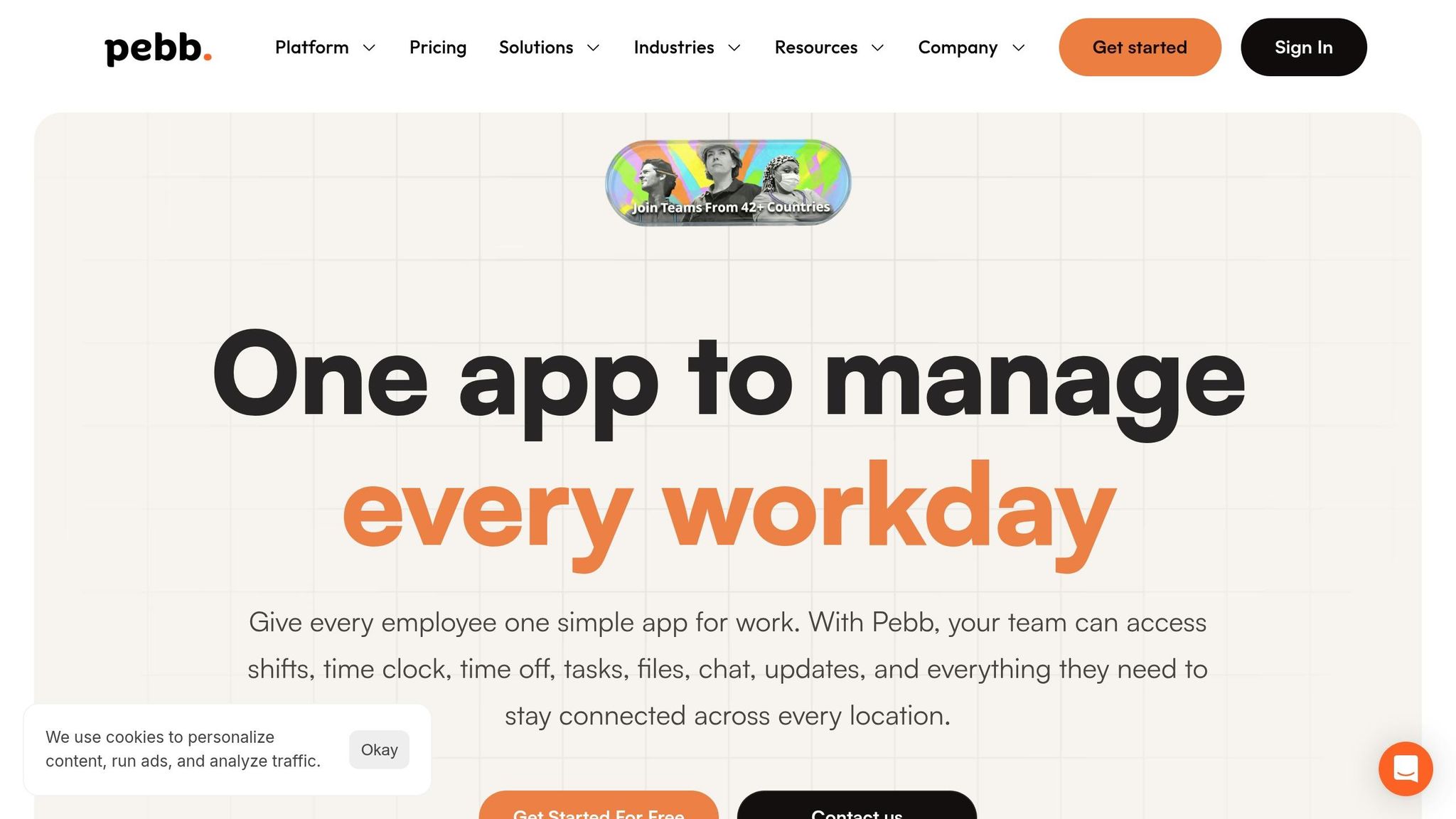
I’ve seen this play out a lot at Pebb.io: a small team hires fast, everyone’s moving at full speed, and then the messy part hits. New people don’t know where to find the handbook, managers are sending schedules in one tool, chat happens in another, and time-off requests get buried somewhere in email. It gets chaotic fast.
That’s the problem Pebb is built to fix.
Pebb brings work chat, news feed, shift scheduling, clock in, PTO management, digital forms, tasks, a knowledge base, and a people directory into one app. For a startup, that matters most when onboarding, scheduling, and day-to-day communication need to work right away.
Here’s what I like about the setup for small teams. The Standard plan is free for up to 15 users. It includes unlimited chat history, shift scheduling, time-off tracking, timesheets, digital forms, events, and up to 3 spaces for organizing teams or departments. In plain English, a new hire can join the right group, check their schedule, clock in from their phone, and pull up the company handbook without bouncing between five apps.
That kind of simplicity saves time. It also cuts down on the usual “Where do I find this?” messages that eat up a manager’s day.
Once a team starts growing, the next layer kicks in. The Premium plan is $4 per user/month, and that adds advanced permissions, analytics, voice and video calls, integrations, and enterprise SSO. I’ve found this is usually the point where startups want tighter control without turning their stack into a patchwork mess.
Outside reviews point to the same strengths. Gartner Peer Insights highlights Pebb's real-time chat, dynamic news feed, searchable profiles, knowledge library, and analytics, while SelectSoftwareReviews notes the free tier includes unlimited chat history, a knowledge library, and tasks.
Of course, it’s not magic. If deep third-party integrations are a must-have on day one, the free plan won’t do that. That’s a real limit, and it matters for teams already tied to a bunch of other systems.
Still, for startups that want core communication and operations tools without adding another software bill, Pebb makes a lot of sense. From where I sit, that’s the bar Connecteam has to clear: a free plan that stays useful even as the team gets bigger.
2. Connecteam
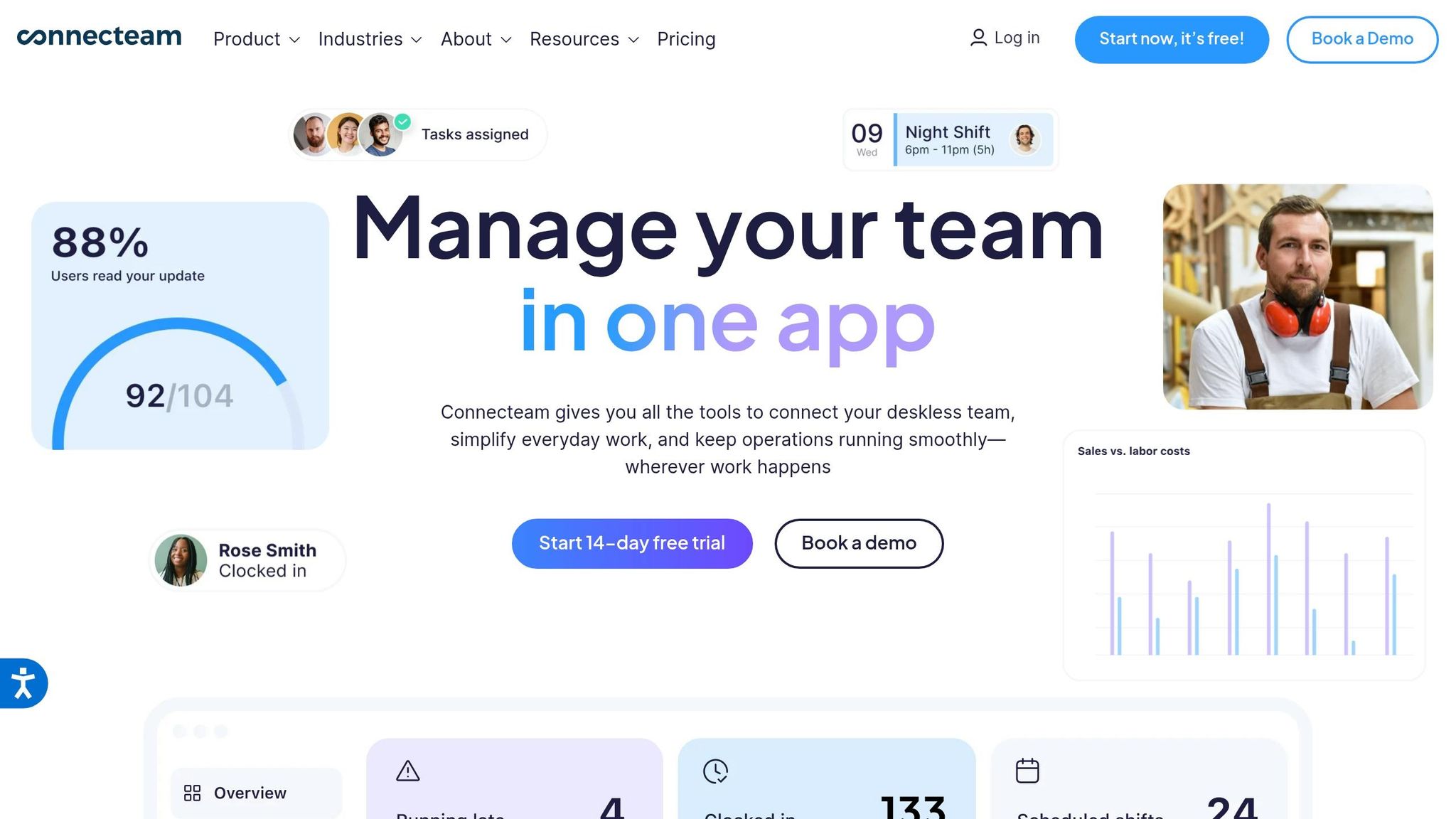
I’ve seen Connecteam come up a lot when startups compare tools with us at Pebb.io. And honestly, I get why.
For a tiny team that lives on phones and needs the basics in one place, Connecteam can feel like a neat starting point. Compared with Pebb's broader free all-in-one plan, Connecteam is a more limited mobile-first team management platform for small teams. If Pebb is the better free all-in-one option, Connecteam is the narrower alternative startups usually compare it against. Its free Small Business Plan includes all three core hubs - Operations, Communications, and HR & Skills - giving a team of up to 10 users access to GPS time tracking, shift scheduling, team chat, updates, forms, tasks, and onboarding tools at no cost.
Let me make that concrete.
A small startup team, for example, could clock in with GPS verification, check schedules, submit job-completion forms, and message a manager without leaving the app. When you’re moving fast and trying to get everyone set up by Friday instead of next month, that kind of simplicity helps. The 24/7 live customer support on the free plan is a useful perk when getting the team set up quickly.
Here’s the thing, though: I’ve watched this work nicely at the smallest scale, then start to pinch the moment hiring picks up.
The limit becomes a problem as the team grows. Once a startup hires past that ceiling, the free plan stops working - and the operational impact shows up before the billing does. A team that has cycled through even a few hires may hit the cap sooner than expected.
That’s usually where the mood changes. What looked cheap at first can get expensive once the team needs more room and more features. Costs rise quickly once a startup needs more than one hub. Using multiple paid hubs together can push monthly costs well beyond what a lean startup budgets for tooling.
I’ve also noticed that some of the tools teams want next just aren’t part of the free setup. The free plan also skips more advanced tools. Geofencing, breadcrumb GPS tracking, deeper automation, and SSO are reserved for higher paid tiers or enterprise pricing.
So yes, Connecteam can do the job for a very small crew, especially one that needs mobile scheduling, chat, and time tracking right away. But from my seat at Pebb.io, this is where the side-by-side comparison gets more serious: it’s useful for very early-stage teams, but less fit for startups that expect fast hiring and wider team rollout. Those tradeoffs are what matter most when startups compare the two side by side.
Pros and cons: Pebb vs. Connecteam for startups
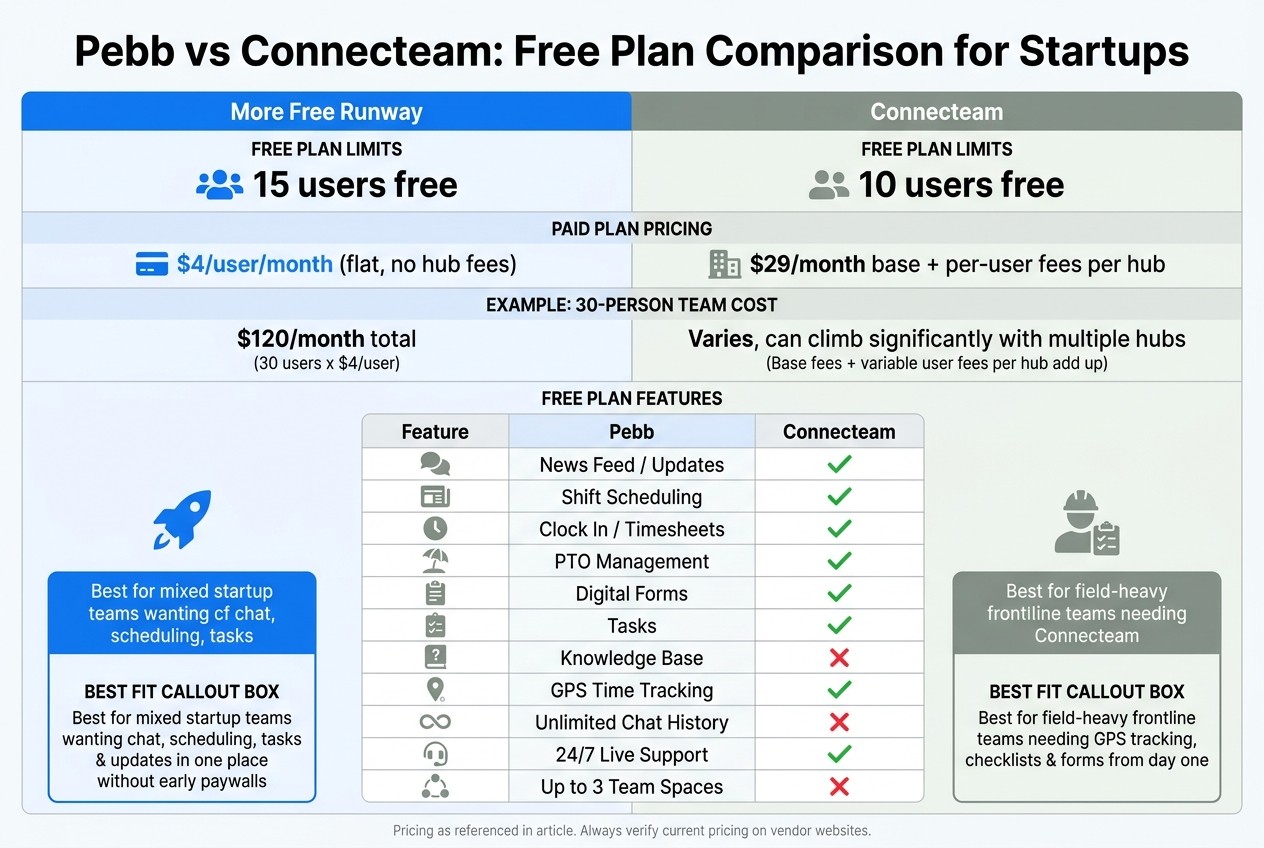
Pebb vs Connecteam: Free Plan Comparison for Startups
I’ve had this conversation more times than I can count with startup teams at Pebb.io. A founder gets on a call, shares their team size, then says something like, “We just need one tool that works now without turning into a budget problem three months from now.”
Here’s the thing: that’s usually where the split between Pebb and Connecteam becomes pretty clear.
Both platforms handle a lot of the same day-to-day needs. But from what I’ve seen, they fit different startup paths. If you’re hiring fast and want to keep your software costs under control, Pebb tends to give you more room before you hit that paywall. If you’re running a field-first operation and need tight process tools on day one, Connecteam can make sense.
Here’s the side-by-side view startup teams usually ask me for:
Platform | Pros | Cons | Best Fit |
|---|---|---|---|
Pebb | Free through 15 users. Premium is $4 per user/month - one price, no separate billing layers. | Advanced analytics, SSO, voice & video calls, and granular permissions require the Premium plan. | Startups that need chat, news feed, scheduling, PTO, and tasks in one place for both office and frontline staff. |
Connecteam | Free Small Business Plan covers up to 10 users with GPS time tracking, scheduling, chat, forms, and onboarding tools. Includes 24/7 live support on the free tier. | Free plan caps at 10 users. Paid tiers start at $29/month base plus per-user fees across multiple paid hubs. | Field-heavy startups running frontline shifts across locations where GPS tracking, checklists, forms, and training steps matter from day one. |
What I’ve learned is that startups rarely choose based on feature count alone. They choose based on what happens after the next 5 hires.
That’s where the math starts to matter.
Pebb stays free through 15 users. Connecteam pushes you into an upgrade at 11 users. That may not sound like a huge gap at first, but for a small team adding people month by month, it shows up fast. I’ve seen early-stage teams think they were picking a low-cost tool, only to hit a pricing wall right when they were trying to grow.
Let me tell you what happens next in most of those cases: the buyer stops asking, “Which tool has more stuff?” and starts asking, “Which one can we still afford when the team doubles?”
From my side at Pebb.io, I’d frame it pretty simply:
Connecteam works well for process-heavy frontline teams that need checklists, forms, GPS tracking, and training steps built in from the start.
Pebb works well for mixed startup teams that want chat, company updates, scheduling, and tasks in one place without seeing the software bill jump as hiring picks up.
That difference matters a lot when your team isn’t just office staff or just frontline staff, but a mix of both. I’ve seen that kind of setup create tool sprawl fast. One app for chat. Another for scheduling. Another for tasks. Another for updates. It gets messy.
Pebb is usually the better fit when a startup wants to keep those basics together in one place and avoid stacking extra monthly charges too early. Connecteam is usually the better fit when day-one field process control matters more than keeping the plan free for a longer stretch.
Final verdict: why Pebb is the top free Connecteam alternative for startups
I’ve seen this play out a lot at Pebb.io. A startup starts with one tool for chat, another for scheduling, something else for tasks, and then one more app for clock-ins. At first, it feels fine. Then the team hits 10 or 15 people, and suddenly simple stuff gets messy.
Here’s the thing: the choice usually comes down to runway and simplicity.
From what I’ve seen, Pebb gives startups more room before they have to spend money on workforce software. Our free tier covers up to 15 users with chat, news feed, scheduling, clock-in, PTO, tasks, forms, and a knowledge base. That means a small team can run a lot of its day-to-day work in one place instead of stitching together a pile of apps that slow everyone down.
And when it is time to move up, the math is still pretty straightforward. A 30-person team pays $120/month. That’s it. No hub bundles. No base fees piled on top of per-user charges.
Connecteam takes a hub-based pricing route. Its free plan caps at 10 users, and once teams start adding hubs, the bill can climb fast.
In my experience, though, the bigger issue isn’t just the monthly price. It’s tool sprawl. That’s the part that sneaks up on startups. When people have to bounce between chat, updates, scheduling, and clock-ins, work feels heavier than it should.
With Pebb, a new hire can read updates, find company policies, check the schedule, and clock in from one app. That cuts down on handoffs and confusion from day one. I’ve watched teams settle in faster when they don’t have to ask, “Wait, which app do I use for this?”
So if I were advising a startup team that wants one free app for communication and workforce management, I’d point them to Pebb. And if the goal is to start free and still keep costs under control as the team grows, I’d start with Pebb’s free tier.
FAQs
Is Pebb enough to replace multiple startup tools?
Yes - and I’ve seen this play out firsthand at Pebb.io.
When I first started talking to teams that were juggling five, six, sometimes even seven separate tools just to get through a normal workday, the pattern was always the same. One app for chat. Another for scheduling. A different one for clocking in and out. Then PTO lived somewhere else, tasks were buried in another system, and company info? Usually stuck in a doc no one could find when they needed it.
Here’s the thing: that setup wears people down fast.
That’s exactly why Pebb is built to replace fragmented tools with one platform for communication and workforce management. Instead of forcing startups to patch together a stack of disconnected apps, we bring the day-to-day work into one place.
Inside Pebb, teams can handle:
work group chat
shift scheduling
clock-in and clock-out
PTO management
digital forms
task tracking
a knowledge base
What I like most is how simple this feels in practice. A startup can manage team updates and daily operations in one app, without dealing with the cost or the mess of running multiple tools at once.
And from what I’ve seen, that’s often the turning point. Once everything lives in one place, people spend less time hunting for info and more time getting work done.
When should a startup move from free to Premium?
I’ve seen this shift happen a lot at Pebb.io. A team starts on the free Standard plan, keeps things lean, and moves fast. That works well early on.
Then growth kicks in.
Suddenly, the same startup that felt light and nimble now needs more control, better visibility, and a clearer read on how the team is doing day to day. That’s usually the moment I’d say it’s time to move from Standard to Premium.
Here’s what tends to trigger the upgrade:
You need voice and video calls in the same place your team already works
You want more granular permissions as more people join
You need SSO to make access and security easier to manage
You want advanced analytics to track engagement and spot burnout risks before they turn into a bigger problem
Here’s the thing... growth sounds fun until your old setup starts showing cracks. I’ve watched teams hit that wall. Communication gets scattered. Managers lose visibility. Admin work piles up. Let me tell you what happened next: the teams that upgraded usually got ahead of those issues before they became messy.
With Pebb, the move is seamless, and the price stays startup-friendly at $4.00 per user per month.
Is Pebb better for mixed office and frontline teams?
I’ve seen this firsthand at Pebb: one of the hardest parts of running a mixed workforce is keeping office teams and frontline staff on the same page without making everyone juggle five different apps.
That’s exactly why Pebb is built for teams with both office and frontline staff.
On the frontline side, we use mobile-first tools for the work people need in the moment, like shift scheduling, PTO tracking, and clock-ins. For office teams, we bring in the day-to-day collaboration pieces too, including task management, knowledge libraries, and voice and video calls.
Here’s the thing: when those tools live in separate systems, things get messy fast. I’ve watched teams lose time bouncing between apps, repeating updates, and trying to piece together what’s happening across the company.
With Pebb’s all-in-one setup, we keep both communication and daily operations in one place. That means fewer tool-switching headaches, less confusion, and a more steady experience across the organization.
Let me tell you what happened next when teams started using that setup: office staff had better visibility into frontline work, and frontline employees didn’t feel left out of the loop. Everyone worked from the same system, which made day-to-day coordination a lot smoother.
