
Author: Ron Daniel
5 Metrics for Remote Onboarding Success
Track five onboarding metrics—time-to-productivity, retention, training completion, engagement, and ROI—to improve remote hires' ramp-up and reduce early turnover.
It’s no secret that remote work has completely reshaped how companies bring new hires into the fold. But here’s a stat that stopped me in my tracks: 20% of employees leave within their first 45 days. That’s nearly one in five people walking out the door before they’ve even unpacked their virtual desks. And if you’re in a specialized industry, replacing them could cost up to 213% of their annual salary. Ouch, right?
I’ve seen this play out firsthand. A few years ago, we onboarded a talented developer remotely. On paper, everything looked fine - clear tasks, a welcome email, even a buddy system. But within six weeks, they were gone. Why? They felt disconnected, unsure of their role, and overwhelmed by scattered resources. That experience taught us a tough but valuable lesson: onboarding isn’t just a process; it’s a make-or-break moment for retention and productivity.
Here’s the kicker: companies that nail their onboarding see retention rates jump by 82% and new hire performance improve by 77%. At Pebb, we’ve spent years fine-tuning our approach, and I’m here to share what’s worked for us. From tracking Time to Productivity to measuring Program ROI, these five metrics have completely changed how we approach remote onboarding. Let’s dive in.
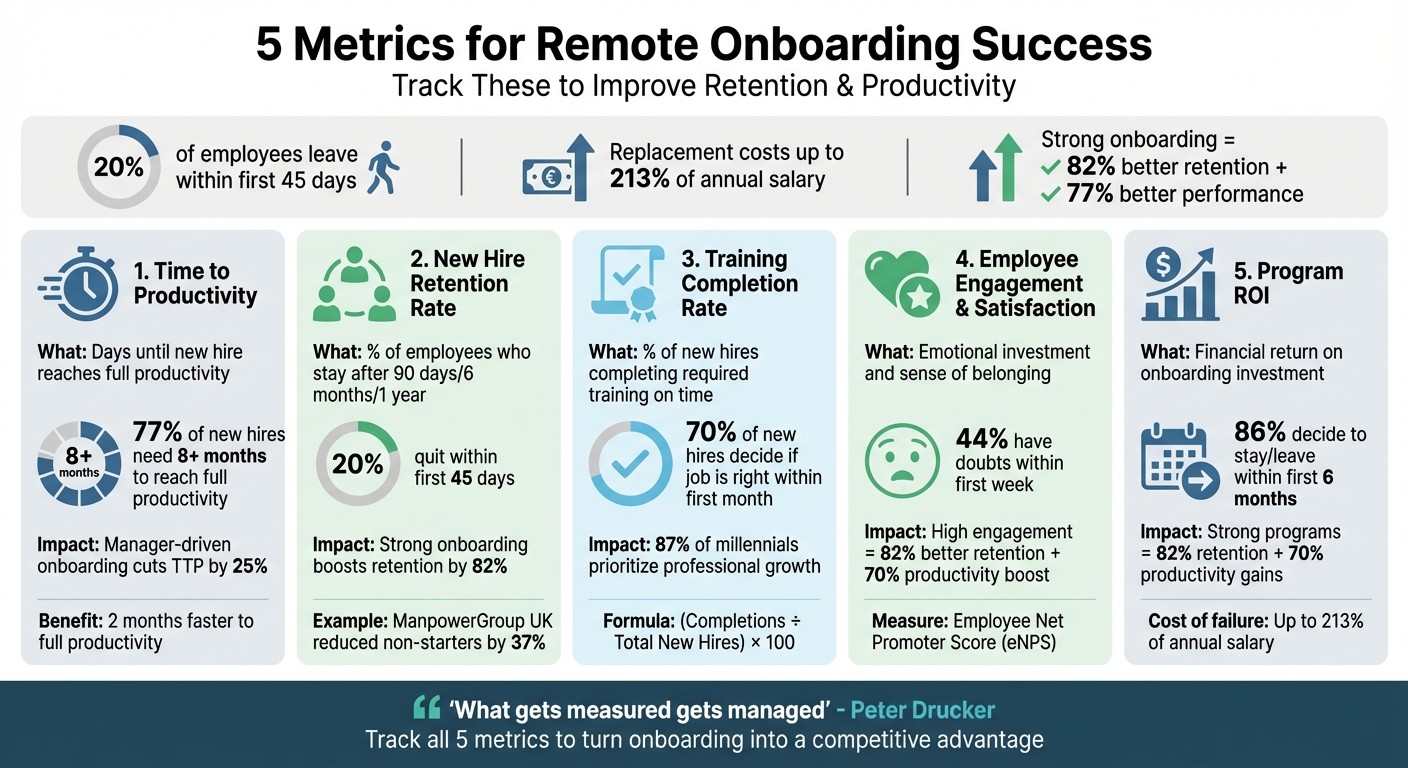
5 Key Metrics for Remote Onboarding Success with Statistics
1. Time to Productivity
What It Measures
Time to Productivity (TTP) is all about tracking how long it takes for a new hire to go from their start date to being fully productive. In other words, when they can handle their responsibilities independently, with little to no supervision.
Why It Matters for Remote Onboarding
Here’s a stat that might surprise you: 77% of new hires need eight months or more to reach full productivity. That’s a long runway, and it puts extra pressure on existing team members to pick up the slack. Now, in a remote work setup, this becomes an even bigger challenge. Managers can’t just swing by someone’s desk to check in, and new hires might hesitate to ask for help, leaving them stuck in silence. And let’s not forget the financial side - onboarding a single employee can cost over $10,000.
But here’s the good news: manager-driven onboarding can cut TTP by 25%, which means new hires can hit their stride up to two months faster. Since 82% of employees say that feeling happy and engaged boosts their productivity, crafting a supportive onboarding experience isn’t just a nice-to-have - it’s a must.
How to Calculate It
The formula for TTP is pretty straightforward. For an individual, you simply subtract their start date from the date they reach full productivity. For a group, add up the number of days it took all hires to become productive, then divide that by the total number of new hires.
One key tip: define role-specific KPIs. For example, set 30-, 60-, and 90-day goals. Keep in mind that "full productivity" will look different depending on the role. A sales rep might need to meet specific quotas, while a support specialist should be resolving tickets on their own.
Now, let me show you how we make this process smoother at Pebb.
How Pebb Can Help
At Pebb, we’ve seen firsthand how the right tools can trim weeks off the TTP timeline. Our platform simplifies tedious tasks like managing onboarding checklists, sharing resources, and keeping communication organized. This means new hires can dive into meaningful work almost immediately.
With Pebb’s Tasks feature, managers can create clear 30-, 60-, and 90-day goals, so everyone knows what success looks like from day one. Features like Work Chat and the Employee Directory make it easy for remote hires to connect with their team, while our Knowledge Library offers instant access to training materials tailored to their role. The result? A faster, smoother path to full productivity.
2. New Hire Retention Rate
What It Measures
Once you've tackled productivity, the next big question is: how well does your onboarding process keep new talent engaged? New hire retention is all about tracking the percentage of employees who stick around after they start - whether that’s 90 days, six months, or even a full year. It’s a two-part story. First, you’ve got preboarding retention, which measures your "no-show" rate - those who accept the job offer but never show up on day one. Then there’s integration retention, which looks at early departures - employees who leave within their first 90 days.
Why It Matters for Remote Onboarding
First impressions stick, and for new hires, those impressions form fast. In a remote setup, where casual in-person chats don’t happen, onboarding becomes your secret weapon to build those early connections. It’s not just about teaching the job - it’s about making new employees feel like they belong.
Here’s why it’s crucial: about 20% of employees quit within their first 45 days. But there’s good news too - companies with strong onboarding processes can boost retention by a whopping 82%. A great example? In 2023, ManpowerGroup UK overhauled their onboarding with better tech and managed to slash their "non-starter" rate by 37%.
How to Calculate It
The formula’s simple, but breaking it into steps makes it easier. Start with your new hire turnover rate: divide the number of new hires who left during a specific timeframe by the total number of new hires, then multiply by 100. Next, calculate preboarding retention: take the number of day-one arrivals and divide it by the number of accepted offers. Finally, figure out integration retention by dividing the number of hires who stayed 90 days by the number of day-one arrivals. You can even track retention by manager to see which leaders are doing an exceptional job.
How Pebb Can Help
At Pebb, we’ve learned that keeping new hires connected is the ultimate game-changer. Our News Feed keeps them in the loop with company updates from day one, while Work Chat ensures they always feel comfortable reaching out with questions. The Employee Directory helps them put faces to names instantly, and our Groups feature lets them join team spaces to build bonds beyond work tasks. When new hires feel supported and connected - instead of lost in endless Zoom calls - they’re far more likely to stick around well past that critical 90-day mark.
3. Training Completion Rate
What It Measures
Training completion rate tells us the percentage of new hires who successfully finish their required training - whether it’s onboarding modules, compliance courses, or orientation tasks - within a specific timeframe. The formula is pretty straightforward: take the number of completions, divide it by the total number of new hires, and multiply by 100. A high rate usually means things are clicking - engagement is strong, and the process is smooth. On the flip side, low rates often point to roadblocks like confusing content or an overwhelming workload.
Why It Matters for Remote Onboarding
Here’s the thing: in remote work, you can’t just pop by someone’s desk to see how they’re doing. That’s why training completion rates are so important - they act as a pulse check to make sure new hires are really absorbing what they need to thrive. And the stakes? They’re huge. Did you know that 70% of new hires decide whether a job feels right within their first month? Plus, for millennials - who make up a big chunk of the workforce - 87% say professional growth opportunities are a top priority. High completion rates don’t just mean tasks are getting done; they show we’re setting employees up for success from day one by following frontline employee onboarding best practices.
How to Calculate It
To calculate the training completion rate, divide the number of new hires who’ve completed their training by the total number of new hires, then multiply by 100. Want to get even more granular? You can track completion rates for individual tasks by dividing the number of completed tasks by the total assigned tasks. Here’s a tip we’ve learned: set role-specific benchmarks to make sure expectations align with the job.
How Pebb Can Help
We’ve been in the trenches and know how scattered training materials can sink completion rates fast. That’s why we built tools to simplify the process. Our Knowledge Library is like a one-stop shop for everything training-related - documents, videos, resources - all searchable and easy to find. No more digging through endless email threads or Slack messages.
Then there’s our Tasks feature, which lets managers assign specific training modules with clear deadlines, so everyone knows exactly what’s expected. Need to keep training front and center? Our News Feed does the trick with reminders and updates. And when new hires hit a snag, Work Chat makes it super easy for them to ask questions and get quick answers.
When training is easy to access and well-organized, completion rates naturally improve. Better yet, new hires actually retain what they’re learning, which sets them up for long-term success. That’s a win-win in my book.
4. Employee Engagement and Satisfaction
What It Measures
Employee engagement and satisfaction go beyond just checking off tasks or collecting a paycheck - they capture how emotionally invested a new hire is in our mission and whether they feel at home in our environment. While metrics like Time to Productivity and Retention Rate focus on performance and longevity, engagement dives into the heart of the matter: Does the new hire feel excited, supported, and like they belong? This is especially crucial in remote settings, where feeling connected can be a challenge.
Why It Matters for Remote Onboarding
First impressions stick. Did you know that 44% of new hires start having doubts about their decision within the first week? That’s a staggering number, and if those doubts linger, they can lead to early turnover - which, as we all know, comes with hefty replacement costs. But here’s the good news: when you focus on engagement during onboarding, you can flip the script. Companies that prioritize this see retention rates jump by 82% and productivity soar by over 70%. Plus, 82% of employees say their happiness and engagement are what truly fuel their productivity. This isn’t just fluff - engagement can make or break whether a new hire flourishes or starts looking elsewhere.
How to Calculate It
One of the most effective ways to gauge engagement is through the Employee Net Promoter Score (eNPS). We ask a simple but powerful question: "On a scale of 1–10, how likely are you to recommend this company as a great place to work?" From there, we subtract the percentage of detractors (those who score between 1–6) from the percentage of promoters (scores of 9–10).
For a deeper dive, calculate overall satisfaction by dividing the number of positive survey responses by the total number of new hires, then multiply by 100. Want more actionable feedback? Ask specific questions like, "Did the onboarding program clearly define your role?" These insights go a long way in identifying what’s working - and what’s not.
How Pebb Can Help
Engagement metrics don’t just tell you where things stand - they spotlight where extra support is needed. At Pebb, we’ve built tools that don’t just measure engagement; they help build it.
News Feed: Keeps new hires updated with company news and onboarding reminders, so they’re never left in the dark.
Work Chat: Makes it easy to reach out to colleagues or managers, bridging the gap that can sometimes feel vast in remote setups.
Groups: Here’s where the magic happens. These team spaces give new hires a chance to connect with coworkers on a personal level, beyond their daily tasks.
And if you’re looking to track engagement trends, our Analytics feature (available in the Premium plan for just $4 per user/month) gives you a clear window into how new hires are interacting with onboarding materials. It’s like having an early warning system to catch disengagement before it turns into a resignation.
5. Program ROI
What It Measures
Once you've tracked productivity, retention, training, and engagement, the next step is to evaluate the financial impact of your onboarding process. Program ROI is all about understanding the return on the time, effort, and money you've invested in recruiting, onboarding, training, and managing talent. Essentially, it measures when a new hire's contributions start to outweigh the resources spent on them. This includes factors like improved retention, quicker ramp-up times, and boosted morale, balanced against onboarding costs like administrative hours, equipment, training materials, and even lost revenue from unfilled positions.
Why It Matters for Remote Onboarding
Remote hires add an extra layer of complexity. They’re more vulnerable to challenges like isolation, which can lead to early departures or even "no-shows." Given that a whopping 86% of employees decide whether to stick with a company within their first six months, measuring ROI becomes a critical way to ensure your onboarding efforts are hitting the mark. Companies that invest in strong onboarding programs see an 82% retention rate and enjoy productivity gains exceeding 70%. Those numbers speak for themselves.
How to Calculate It
Here’s how you can crunch the numbers:
Start by calculating your turnover rate for new hires. Divide the number of new hires who leave within a specific period by the total number of new hires, then multiply by 100.
Next, assess your Revenue per Employee by dividing net sales by the average number of employees.
Compare these figures before and after implementing improvements to your onboarding process. This will give you a clear picture of how effective your program truly is.
How Pebb Can Help
At Pebb, we’ve designed our platform to make ROI tracking a breeze - and a strategic advantage. Our Analytics feature, included in the Premium plan at just $4/user/month, offers dashboards to monitor completion rates and engagement scores. This means you can spot potential issues before they snowball into bigger problems, like a new hire deciding to leave.
Our tools like Work Chat and the News Feed keep remote hires engaged and connected from day one, which significantly reduces the risk of "no-shows." (Fun fact: 44% of no-shows happen because candidates accept a better offer during the preboarding phase.) Plus, with features like Shift scheduling, PTO management, and our Knowledge Library all in one place, you’re not just organizing your onboarding process - you’re cutting down on the administrative chaos that can drain your budget.
Conclusion
Remote onboarding is more than just a checklist - it’s about understanding what’s working and what’s not. That’s why tracking the five key metrics - Time to Productivity, New Hire Retention Rate, Training Completion Rate, Employee Engagement and Satisfaction, and Program ROI - is critical. Together, these metrics paint a full picture of the new hire journey, from preboarding to full integration. And here’s the kicker: these insights are exactly what Pebb is designed to support at every step.
The stats don’t lie. Companies with robust onboarding processes see an 82% improvement in retention rates. And when you track engagement scores as leading indicators, you can spot potential turnover risks before they become a reality.
At Pebb, we’ve built tools like Analytics, Work Chat, News Feed, and our Knowledge Library to bring all these metrics into one seamless platform. I’ve seen how this approach simplifies onboarding, cutting through the noise and helping teams address challenges as they arise. It’s a game-changer for keeping remote hires connected while reducing the administrative headache.
Now, let’s talk about your process. Are you consistently tracking these five metrics across all departments? Are you digging into the data to identify bottlenecks by team or manager? Are you running pulse checks at critical milestones like Day 30 and Day 90? If not, you could be leaving serious money on the table. Consider this: the cost of failed onboarding can climb to 213% of an employee’s annual salary for C-suite roles. That’s not a small number.
Here’s where to start: establish your baseline. Gather data on all five metrics, figure out where the gaps are, and then put the right tools and processes in place to close them. This isn’t just about fixing problems - it’s about evolving your onboarding program to meet your team’s needs. As Peter Drucker famously said, “What gets measured gets managed”. And when it comes to remote onboarding, managing these metrics turns what might feel like a routine task into a serious competitive edge.
FAQs
What’s the best way to help remote new hires become productive quickly?
Helping remote hires get off to a great start isn’t rocket science, but it does take a solid plan and the right tools. Here’s how we do it at Pebb.
We kick things off by mapping out clear milestones for their first 30, 60, and 90 days. Think measurable goals that give both the new hire and their manager a way to track progress. Before their first day, we share onboarding resources through Pebb. This lets them dive into the company news feed, join relevant groups, and even set up their profile ahead of time. It’s like giving them a sneak peek of the office vibe - minus the office.
Pairing new hires with a buddy or mentor? Total game-changer. These quick connections, paired with short weekly check-ins (15 minutes tops), make sure they feel supported and can flag any roadblocks early on.
Now, let me tell you about organization - it’s a lifesaver. With Pebb’s tasks feature, we create role-specific onboarding checklists that keep everything on track. Plus, the built-in analytics give us updates on training completion and engagement. If there’s a slowdown, we catch it fast and fix it even faster. Combine all of this with regular manager feedback, and you’ve got a recipe for success. Not only does this approach speed up their time-to-productivity, but it also makes onboarding feel smooth, efficient, and dare I say, enjoyable.
How can I improve new hire retention in a remote work environment?
The secret to keeping remote new hires on board? It all starts with building a strong sense of connection and providing crystal-clear direction from day one. Here’s what we’ve learned at Pebb.io.
First, set clear goals right out of the gate - like time-to-productivity - and track progress from the very beginning. Use pulse surveys regularly to gather feedback and pinpoint any hiccups in your onboarding process. These quick check-ins are like early warning systems, helping you catch and fix problems before they snowball into disengagement.
Next, make communication a breeze. With Pebb’s all-in-one platform, new hires can jump right into group chats, join private groups, or explore a searchable knowledge library. Whether they need to ask a quick question, celebrate a win, or track down a resource, they’ll never feel stuck or buried in endless email threads. And here’s the kicker: with our free plan for up to 15 employees or $4/user/month Premium plan, you can create virtual coffee chats, mentorship channels, or team hangouts. These small but meaningful interactions go a long way in making remote employees feel like they truly belong.
Lastly, don’t underestimate the power of structured check-ins. Schedule them at the 30- and 90-day marks to review progress and gather feedback. Tools like Pebb’s task and event features make it easy to assign follow-ups or schedule additional training, ensuring new hires feel supported every step of the way.
By combining clear goals, effortless communication, and intentional touchpoints, you’ll create a remote onboarding process that not only welcomes new employees but keeps them engaged for the long haul.
How does Pebb help improve training completion rates during remote onboarding?
At Pebb, we’ve seen how remote onboarding can sometimes feel like wandering through a maze of emails, scattered files, and forgotten links. That’s why we created a platform to make training straightforward, accessible, and even enjoyable. With our Knowledge Library, all onboarding materials are neatly organized in one spot. Assigning and tracking tasks? A breeze. New hires can see their training checklist right alongside their chats and news feed, with real-time reminders to keep them moving forward.
Managers aren’t left out of the loop either. With our Analytics feature, they can easily track progress and jump in to help when needed - whether that’s through a quick video call or a group chat. And here’s the part I love: features like Groups bring people together. New hires can ask questions, share advice, and celebrate wins, turning what could feel like a solo grind into a team effort.
What really sets Pebb apart is how it brings communication, collaboration, and learning into one seamless platform. No more juggling tools like Slack or Teams - it’s all here. Plus, with a free Standard plan for up to 15 employees and a Premium plan costing $4/user/month, it’s an affordable way to speed up training, boost engagement, and create a happier, more connected team.
