

Author: Ron Daniel
5 Metrics for Measuring Communication During Change
Measure communication during change with five metrics: pulse surveys, engagement, satisfaction, adoption, and task completion to drive results.
Most companies think they’ve nailed communication during big changes - until the numbers tell a different story. Here’s a stat that stopped me in my tracks: 72% of employees don’t fully understand their company’s strategy. That’s not just a small hiccup; it’s a massive disconnect. And the kicker? Poor communication during transitions can cost businesses thousands per employee every year.
At Pebb, we’ve seen firsthand how easy it is to assume your internal communications strategy is landing, only to realize later that it’s been ignored, misunderstood, or lost in the noise. Trust me, I’ve been there - sending out updates, thinking I’ve covered all the bases, only to find out later that teams were confused or disengaged.
But here’s the good news: measuring communication doesn’t have to feel like a guessing game. Over time, we’ve fine-tuned five key metrics that help us figure out what’s working, what’s falling flat, and how to make real improvements. Ready to see how they can help you? Let’s dive in.
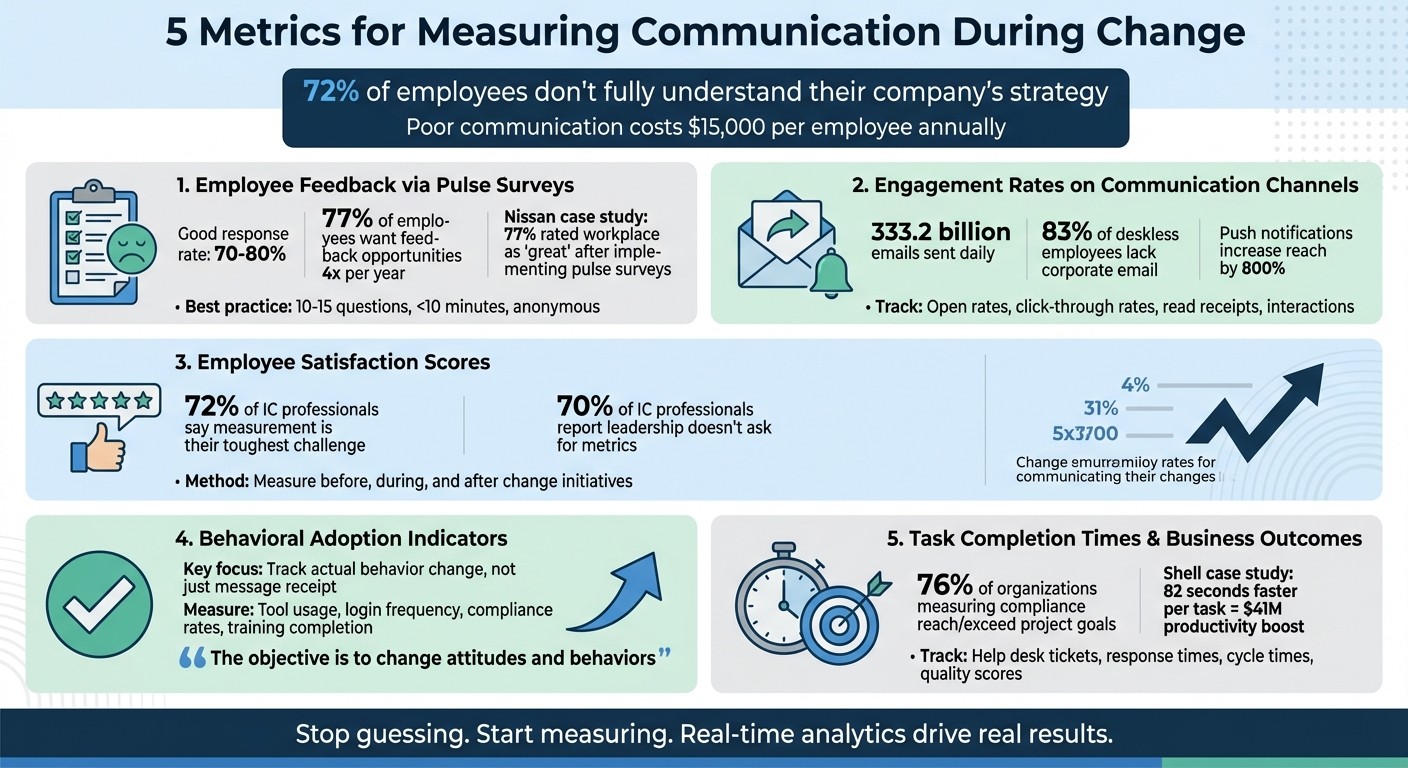
5 Key Metrics for Measuring Communication During Organizational Change
1. Employee Feedback via Pulse Surveys
Pulse surveys are like your team’s weather forecast - they help you spot storms before they hit. Whether you send them out weekly, monthly, or quarterly, these surveys give you a real-time snapshot of how your team feels and how well they’re understanding key messages. It’s all about catching potential issues early, before they snowball into bigger problems.
These surveys are especially effective at measuring both sentiment and how clearly your messages are landing. Take Nissan, for example. When they introduced a robust feedback system using pulse surveys, they broke down communication silos and saw a massive improvement in employee sentiment. In fact, 77% of their workforce eventually rated Nissan as a "great workplace". That’s the kind of transformation you can’t ignore.
Now, let’s talk numbers. A good response rate for these surveys usually falls between 70% and 80%, but even hitting above 50% can give you a solid read on your team. Here’s another eye-opener: 77% of employees say they want to give feedback more than once a year, and most prefer about four opportunities annually. That’s where tools like Pebb’s digital forms features come in handy.
At Pebb, we’ve designed our forms to be quick and easy - 10 to 15 questions that take less than 10 minutes to complete. They’re anonymous, use Likert scales for actionable insights, and are built to fit seamlessly into your workflow. A great example of this in action is Dixon Schwabl + Company. During a major transition, their pulse surveys revealed that 87% of employees didn’t want to return to the office full-time. This insight led them to adopt permanent workplace flexibility, a decision that resonated with their team.
But here’s the deal: don’t bother running surveys unless you’re ready to act on the results. Closing the loop is crucial. When your team sees that their feedback drives real change - like adapting communication strategies during tough transitions - pulse surveys become more than just a tool. They become a game-changer for navigating change successfully.
2. Engagement Rates on Communication Channels
Here’s the thing about communication: just because you hit "send" doesn’t mean your message is actually being read. That’s where engagement rates step in. Metrics like open rates, read receipts, click-through rates, and interaction data give us a clear picture of whether those critical change-related messages are hitting their mark or drowning in a sea of unread notifications.
But engagement goes deeper than just collecting feedback. It’s about knowing if employees are genuinely connecting with the message. At Pebb, we track reach through page views and open rates, while clicks, shares, comments, and reactions show us how people are interacting with the content. Because, let’s face it, opening an email doesn’t mean someone is actually engaging with it. As Ragan Communications succinctly puts it:
"Is anyone reading your messages? That's what matters."
Here’s a shocking stat: ineffective communication costs companies around $15,000 per employee every year. And with a staggering 333.2 billion emails flying around daily, your internal updates are competing for attention in an inbox war zone. That’s why we built read receipts and acknowledgment features into Pebb. These tools make it easy to see who’s staying informed and who’s missing out on critical updates.
Even better, the data helps you identify gaps before they spiral into bigger problems. For example, when you break down engagement by department, location, or role, you might notice something surprising - like your frontline workers skipping emails entirely. It’s not shocking when you consider that 83% of deskless employees don’t even have a corporate email address. With Pebb’s analytics, you can filter this data and pivot your strategy as needed. And if one channel isn’t cutting it, why not try another? Employee communication apps with push notifications, for instance, can increase reach by over 800%. It’s all about using these insights to fine-tune your approach.
So, what does healthy engagement look like? Think quick responses, strong adoption of tools, positive feedback, and active participation in polls or discussions. On the flip side, low interaction or radio silence from teams is a red flag. That’s when it’s time to experiment. Try A/B testing different subject lines, resend messages to non-openers, or time announcements for when employees are most likely to engage. It’s all about keeping the conversation alive and meaningful.
3. Employee Satisfaction Scores
Let me share something I’ve learned firsthand: employee satisfaction scores are like a window into how your team feels about your communication during times of change. If engagement rates tell you who’s paying attention, satisfaction scores tell you how they feel about what you’re saying. And trust me, during a transition, this insight is pure gold. By tracking satisfaction before, during, and after a change, you can figure out if your messages are hitting the mark - or if they’re leaving people scratching their heads.
Here’s how we approach it at Pebb. First, we set a baseline. Before any changes kick off, we measure where things stand. This helps us spot gaps in knowledge, attitudes, or communication preferences right out of the gate. Then, as the change unfolds, we send out quick pulse surveys. These are short and sweet, but they pack a punch, giving us real-time feedback to tweak our messaging as needed. Once the dust settles, we measure again to see if our core messages stuck - whether they were understood and, more importantly, acted upon. It’s fascinating to watch how communication evolves through this process.
But here’s the real magic: connecting satisfaction trends directly to specific communication efforts. High scores? That’s usually a sign of genuine, transparent leadership messaging. Low scores? They often point to issues like information overload, poor timing, or a lack of clarity. At Pebb, we’ve made it super simple to break down data by department, role, or even location. This way, we can zero in on the groups that might need extra support.
Now, here’s a stat that blew my mind: 72% of internal communications professionals say measurement is their toughest challenge. Even more surprising? 70% of internal communicators report that their leadership teams don’t even ask for communication metrics. That’s a huge missed opportunity. As David Grossman, Founder and CEO of The Grossman Group, explains:
"Measurement helps create credibility for communication among an organization's employees and leaders, and ensures that communication has a place at the table in any strategic business discussion."
The trick is to combine qualitative insights - like open-ended survey comments - with hard numbers, such as engagement rates. This way, you get the full picture: do employees’ feelings match their actions? Tools like the employee Net Promoter Score (eNPS) are great for tracking advocacy during a transition. And don’t forget - keeping surveys anonymous is key to getting honest feedback.
When you can show leadership how your communication efforts directly impact satisfaction - and, by extension, business results - you’re not just tracking change. You’re proving your worth. Up next, we’ll dive into behavior and outcome metrics that work hand-in-hand with satisfaction scores. Stay tuned!
4. Behavioral Adoption Indicators
Here’s the thing: you can send out all the emails, memos, and Slack messages you want, but if employees aren’t actually changing their behavior, all your effort is just noise. Engagement and satisfaction metrics might tell you how well your messages are received, but behavioral adoption is where the rubber meets the road. It’s the clearest sign that people are taking action - whether that’s using a new tool, following a new process, or completing mandatory training. As SnapComms puts it:
"The objective of most internal communication is to change the attitudes and behaviors of employees".
So, how do we measure that change?
Start by Measuring What’s Different
The first step is straightforward: figure out what’s changed. Are employees adopting a new habit or dropping an old one? What’s different now compared to before the communication went out? For instance, let’s say you’ve introduced a new platform. Don’t just track how many employees have access - dig deeper. How many have actually created an account? How often are they logging in? Daily? Weekly? Monthly?.
At Pebb, we know we’re onto something when we see employees not just trying out a tool but returning to it consistently. That’s when you know the change is sticking.
Control Groups Are Your Secret Weapon
Here’s a tip we swear by: use control groups. Select a specific team or location and withhold the communication from them. Then compare their behavior to those who received the message. This approach gives you a clear picture of how impactful your communication really is.
Another strategy? Segment your audience. Break them into cohorts, like new users versus long-term users, and track how their behavior evolves over time. This not only helps you identify who’s thriving but also pinpoints areas where people might be struggling.
Make Compliance Simple (and Trackable)
In industries where compliance is critical, acknowledgment features are a game-changer. Platforms that allow employees to confirm they’ve read and understood a policy update make it easy to track adoption. At Pebb, we’ve baked this right into our platform. With a single tap, employees can stay on top of updates, giving managers visibility into who’s on board and who might need a follow-up.
Want to take it a step further? Add quizzes to test whether employees actually understand the new procedures. Or, monitor traffic on training documents to see where people are getting stuck. These insights can help you refine your approach and make the process smoother for everyone.
Bottom Line: Actions Speak Louder Than Messages
If employees aren’t changing what they do after your communication, it’s time to rethink your approach. Track adoption rates, tool usage, and compliance metrics to see if your message is driving real change. When you can tie specific behaviors back to your communication efforts, you’re not just talking - you’re making an impact. And that’s when you can start connecting these changes to actual business results.
5. Task Completion Times and Business Outcomes
Here’s the thing: communication isn’t just about making people feel good - it’s about getting results. You could have off-the-charts engagement and satisfaction scores, but if tasks are dragging on and business outcomes aren’t improving, something’s missing. The real magic happens when communication directly impacts task completion times and measurable business goals.
At Pebb, we’ve learned this the hard way. When teams miss deadlines or struggle to complete tasks, it’s almost always because the "why" and "how" weren’t clearly laid out from the start. That’s why we focus on tracking speed of adoption - how quickly employees hit critical milestones after a change. If tasks are delayed, it’s a red flag that our communication needs work. And trust me, the numbers don’t lie.
Consider this: 76% of organizations that measure compliance and performance reach or exceed their project goals, compared to just 24% of those that don’t. And then there’s Shell. Their time-to-task testing showed employees completing routine tasks 82 seconds faster. That added up to over 3,500 hours saved daily and a jaw-dropping $41 million boost in productivity. That’s the kind of data that makes executives sit up and take notice.
So, how do you measure whether your communication is hitting the mark? Here are a few ways we do it:
Monitor help desk tickets: A surge in tickets often points to unclear instructions or messaging.
Track response times: How quickly are employees acting on calls-to-action?
Leverage real business metrics: Partner with Ops or IT to analyze cycle times, quality scores, and other key indicators.
Test execution: Monitor logins and run task execution tests to gauge adoption.
When you tie communication to faster task completion and operational efficiency, it stops being dismissed as a "soft skill." Instead, it becomes what it truly is - a driver of business success. And that’s when you start seeing real, tangible results.
Conclusion
Let me tell you, if you're not keeping tabs on how communication is landing during times of change, you're essentially navigating in the dark. Those five metrics - pulse surveys, engagement rates, satisfaction scores, behavioral adoption, and task completion times - aren’t just some fancy extras. They’re the difference between a change initiative that thrives and one that falls flat. And let’s be real, poor communication during these moments doesn’t just hurt morale - it hits the bottom line hard. Ineffective communication can cost companies a significant amount per employee, and that’s money you might as well be waving goodbye to.
Here’s something we’ve learned at Pebb: 72% of internal communications professionals admit that measuring their efforts is their biggest hurdle. It’s no wonder - manually juggling data across multiple tools is a nightmare, which is why many companies streamline their workplace communication with dedicated software. That’s exactly why we built communication and operations tools directly into our platform. Whether you’re rolling out a new shift schedule, announcing a policy change, or tackling a full-blown organizational overhaul, you need insights right now - not months later when the dust has already settled.
With Pebb, you get exactly that: one connected app that tells you how well your messages are landing. No more jumping between platforms or wrestling with spreadsheets. You’ll know who’s opening your announcements, how quickly teams are acting on the information, and what’s actually driving results. And when 58% of communicators say lack of time and resources is their biggest obstacle, having everything in one place isn’t just helpful - it’s a game-changer.
What we’ve realized is that success isn’t about bombarding people with more emails or updates. It’s about smarter communication. It’s about making sure the right people get the right message at the right time - and proving that it made a difference. When you can tie your communication efforts directly to business results, you’re no longer just a support function. You’re a strategic player. That’s when you earn the budget, the resources, and yes, the seat at the table you’ve been working toward.
FAQs
How do pulse surveys help improve communication during organizational change?
Pulse surveys have completely changed the way we handle organizational change. These quick, frequent questionnaires provide real-time insights into how employees are feeling and what’s actually working - or not - during transitions. Instead of relying on an annual engagement survey, which often feels like trying to steer a ship by looking at last year’s map, pulse surveys help you spot shifts in sentiment early. This means you can address concerns faster, adjust your strategies on the fly, and keep communication open and honest.
At Pebb, we’ve made digital forms an integral part of our free plan for up to 15 employees. With just a few clicks, you can create a survey, share the results, and spark meaningful conversations - all without leaving the platform. This simple feedback loop doesn’t just help leaders fine-tune their approach; it also builds trust and keeps employees engaged. The result? Smoother transitions, stronger teams, and a workplace where everyone feels heard.
Why are engagement rates important for measuring communication success during change?
Engagement rates are the pulse check for any communication strategy. They reveal whether your messages are truly resonating with your team or just collecting digital dust. When engagement is high, it’s not just about employees reading your updates - it’s about them interacting with the content, finding it meaningful, and, most importantly, taking action. It’s a clear signal that your communication is hitting the mark or if it’s time to tweak your approach.
For frontline teams, these rates carry even more weight. Unlike desk-based employees, frontline workers aren’t tied to email, so traditional metrics don’t always apply. Measuring engagement here helps you understand if your messages are prompting the right actions - whether it’s adopting a new system or simply staying in the loop. When engagement improves, you’ll often see tasks being completed faster, teams aligning better with objectives, and even a noticeable boost in morale. In essence, these rates act as your compass, helping you stay agile and ensure your change initiatives keep moving in the right direction.
Why are behavioral adoption metrics important for tracking the success of change initiatives?
Behavioral adoption metrics aren’t just numbers - they’re the heartbeat of any successful change. They tell you if employees are genuinely embracing new tools, processes, or ways of working, rather than just nodding along in meetings. And when people truly adopt these changes, the results speak for themselves: faster task completion, improved productivity, and fewer mistakes. Without adoption, even the most well-crafted communication strategies can fall flat.
At Pebb, we’ve made tracking these behaviors as seamless as possible. Want to see how often employees are engaging with a new policy update? Curious if they’re adjusting shift schedules or jumping into team chats more often? Our platform gives you real-time insights into all of this and more. With Pebb’s free solution for up to 15 employees - or our Premium plan at $4/user/month - you can spot trends, step in where support is needed, and make sure your efforts are driving real results. It’s about turning communication into action and action into measurable success.
