

Author: Ron Daniel
Improving employee engagement with a digital shout-out wall
Make recognition visible for deskless teams with a single digital shout-out wall: short, specific posts tied to daily routines.
More than 80% of the global workforce is deskless, yet most recognition programs still act like everyone sits at a laptop all day. I see that gap all the time at Pebb.io. Good work happens on the floor, on the road, behind the counter, and across late shifts, but the praise often gets stuck in email, group texts, or a meeting half the team never hears about.
That disconnect costs more than most teams think. Gallup data from 2022 to 2024 shows that employees who feel well recognized are 45% less likely to leave within two years. On frontline teams, where mixed shifts and low face time are common, public recognition in one shared digital space can keep wins visible instead of letting them disappear.
So I want to break down what I’ve seen work: why shout-out walls land better for deskless teams, where teams get stuck, and how we use short, public posts inside Pebb to make recognition part of the day instead of one more task on the list.
How a digital shout-out wall improves employee engagement
I’ve seen this play out up close at Pebb.io. When a team is moving fast, especially across shifts, good work can disappear in the shuffle. Someone handles a tough customer, covers a last-minute gap, or spots a safety issue early, and by the next shift, that moment is gone.
That’s where a digital shout-out wall helps. It gives us one shared feed for public recognition. For frontline teams, that matters because people need recognition they can see, share, and repeat.
Why public recognition helps teams notice good work
When recognition is public, it does two things at once. It helps the person being recognized feel seen, and it shows the rest of the team which actions matter.
I’ve noticed that when we post a shout-out for customer service, reliability, teamwork, or safety, people pay attention. Not in a stiff, corporate way. More like, got it, that’s what good work looks like here. A shared feed keeps those moments in view and reinforces the behaviors the team values every day.
A post that highlights customer service, reliability, teamwork, or safety signals what good work looks like.
Here’s the thing: private praise is nice, but public praise teaches. It turns one good moment into a signal the whole team can learn from.
Regular recognition builds momentum between shifts
This part is easy to miss until you’ve worked with shift-based teams. Recognition doesn’t just make people feel good in the moment. It helps carry energy from one shift to the next.
When recognition happens on a regular basis, morale stays steadier between shifts. Teams can see wins fast and start the next shift already knowing what went well in the last one. I’ve watched this reduce that disconnected feeling that often shows up when teams don’t overlap much.
But there’s a catch. It only works if posting is simple enough to happen during the workday. If people have to click through five steps or wait until they’re back at a desk, most of those shout-outs never get posted.
Peer-to-peer posts make recognition reach more people
One of the biggest upsides of a digital shout-out wall is that it works best when everyone can use it, not just managers. I’ve found that this changes the tone fast. Recognition becomes less top-down and more visible across the team.
That matters a lot for people who don’t always get face time with leadership.
Overnight workers
Part-time staff
Employees across multiple locations
These teams often miss in-person moments where praise would normally happen. A shared feed gives them the same view of recognition as everyone else, and the same recognition flow as day-shift teams.
Let me tell you what happened next when we looked at this kind of setup more closely: the big win wasn’t just more posts. It was making that shared space easy for every shift to use.
How to set up a shout-out wall your team will actually use
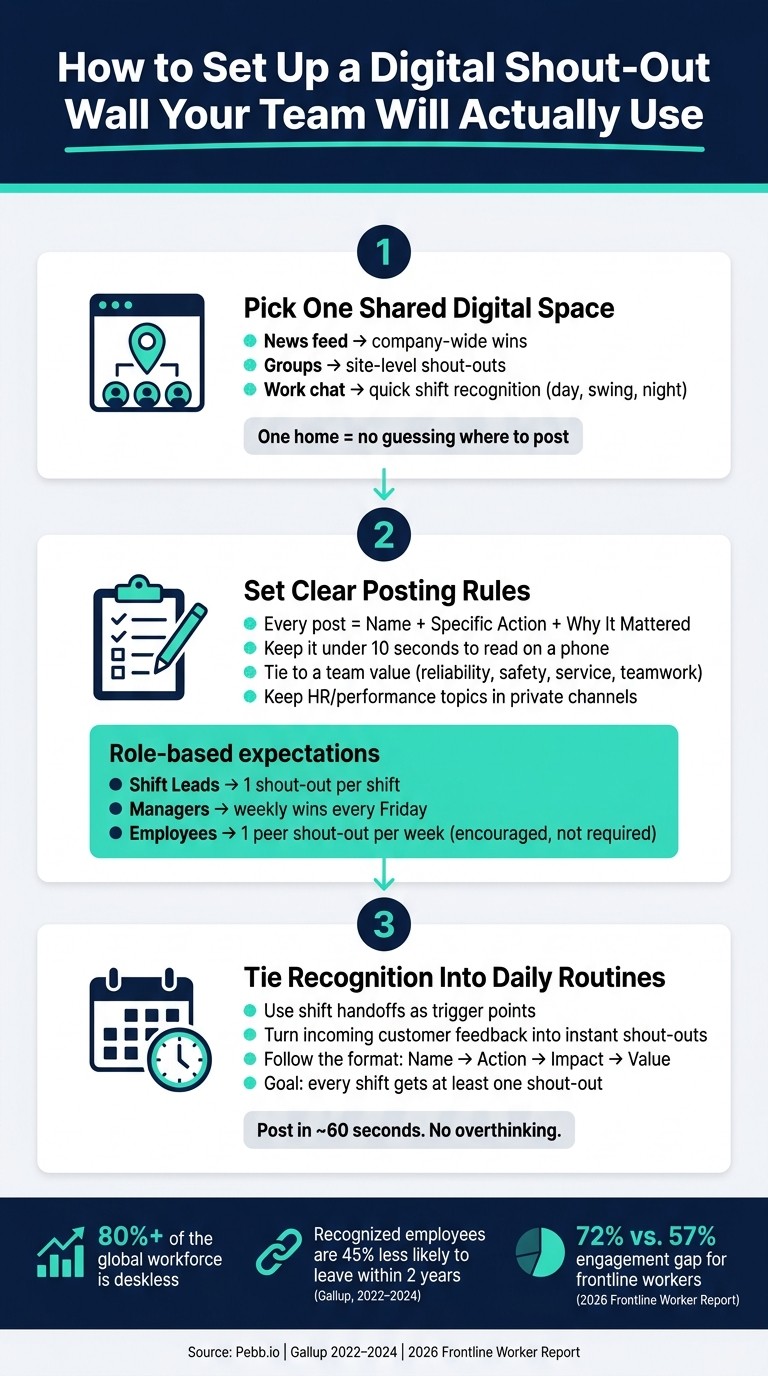
How to Set Up a Digital Shout-Out Wall That Sticks
I’ve seen this go wrong in the most predictable way.
At Pebb.io, we’ve worked with teams that had recognition living everywhere - one Slack channel here, a text thread there, a dusty HR portal nobody opened, and maybe a manager calling people out in a meeting half the team missed. The result? Good intent, weak follow-through.
Pick one shared digital space instead of scattered channels
The fastest way to weaken recognition is to spread it across too many channels. This is a common pitfall when choosing staff communication apps for your team. I’ve learned that if people have to guess where shout-outs belong, they usually stop posting them.
That’s why we push for one shared home for recognition. In Pebb, that usually means:
the news feed for company-wide wins
groups for site-level shout-outs
work chat for quick shift recognition across day, swing, and night shifts
Here’s the thing: when the home is clear, people don’t waste time deciding where to post. They just post. And that small bit of clarity makes a big difference.
Once the home is set, the next step is deciding what a good post looks like.
Set clear posting rules and participation expectations
Let me tell you what happened next when one team skipped this part.
Their wall started strong, then drifted. Posts got vague. The same three names kept showing up every week. Some messages felt so forced that people scrolled past them without a second thought.
So we tightened the rules.
The most important one is simple: every post should name a specific action and explain why it mattered. That changes the tone right away. “Thanks to Rosa for staying late to double-check the cash drawer - you prevented a discrepancy and made the morning opener’s job easier” means a lot more than “Great job, Rosa.”
It’s specific. It feels human. And it tells the rest of the team what good work looks like.
We also keep posts short enough to read in under 10 seconds on mobile apps for frontline communication. That matters more than people think. If a message feels like homework, busy teams won’t engage with it. We also tie the shout-out to a team value like reliability or service, so recognition doesn’t feel random.
Just as important, some things do not belong on the wall. Performance issues, HR topics, and anything sensitive should stay in private channels. I’ve found that spelling this out early saves a lot of awkward moments later.
For participation, I never like leaving it vague. Open-ended asks sound nice, but they usually lead nowhere. Role-based expectations work better:
Shift leads post at least one shout-out at the end of each shift.
Managers post weekly wins every Friday.
Employees are encouraged - not required - to post one peer shout-out per week.
That structure keeps the wall active without making it feel like a chore. And that’s the sweet spot.
After that, the goal is to make posting part of the workday, not some extra task hanging over people’s heads.
Tie recognition into existing daily routines
This is the part that separates walls people use for two weeks from walls people stick with.
The teams that keep shout-out walls alive don’t treat recognition like a side project. They tie it into routines they already have. At Pebb.io, I’ve seen end-of-shift handoffs and incoming customer feedback work best as trigger points.
So when a customer review or direct compliment comes in, turn it into a shout-out right away and tag the employees involved. If a review mentions friendly and fast service at the register, call out the evening front-end team for making that happen. Don’t wait for a monthly recap. Post it while it’s still fresh.
A simple habit like “every shift gets at least one shout-out” gives people a rhythm they can count on. That consistency matters. It turns recognition from a nice idea into part of how the team works.
We also like using a simple format: name, action, impact, value. That gives managers a fast way to post in about 60 seconds without overthinking it.
And once posting becomes routine, message format matters just as much.
What recognition messages work best on a digital shout-out wall
I learned this pretty fast at Pebb.io: getting a shout-out wall live is the easy part. Keeping it alive? That comes down to the posts people see every day.
We’ve seen it over and over. If the messages are vague, people stop paying attention. If they’re clear, short, and tied to something that mattered, the wall starts to feel like part of the workday instead of background noise.
Name the action and explain the impact
One mistake I see all the time is a post like, "Great work today, everyone!" It sounds nice, but it doesn’t tell anyone what went well. And if people can’t tell what good work looked like, the praise fades fast.
The messages that stick do three things: they name the person, spell out what they did, and show why it mattered to the team.
At Pebb.io, I like a simple formula for frontline teams: Name + Action + Impact.
Here’s what that looks like:
"Thanks to Jamal for stopping work to report a loose railing on the stairs - your attention to detail helped us avoid a potential injury and keep everyone safe."
"Appreciation for Alexis for covering a last-minute opening on the night shift - because of you, we stayed fully staffed and hit our production target."
That’s why these work. They’re specific. They’re easy to scan. And they make the result plain.
Let me tell you what happened next when teams started writing posts this way: the wall got more useful. People didn’t just see praise. They saw examples. They saw what good work looked like in a frontline setting, and that made the wall faster to use and easier to read.
Keep posts short, mobile-friendly, and tied to values
Here’s the thing: most frontline employees aren’t sitting at a desk all day reading long updates. They’re checking a phone between tasks, during a short break, or right before a shift starts.
That’s why I always push for one or two short sentences. Anything longer is easier to skip, especially on mobile. We usually post shout-outs in Pebb's news feed or group chat that fits the team, so people can catch them in the flow of work instead of hunting for them.
Length matters, but meaning matters too. When a post connects the praise to a company value, it feels less random and more grounded. A line like "your attention to detail protected our quality standards" or "that's real teamwork in action" only adds a few words, but it gives the recognition more weight.
Over time, those value callouts do something useful. They show employees which behaviors the team actually cares about, not just what’s printed on a poster in the break room.
Mix manager praise with coworker recognition
I’ve also learned that manager shout-outs can’t do the whole job on their own. They help set the tone, sure. But coworkers catch the moments managers never see.
Maybe it’s the person who quietly restocked during a rush. Maybe it’s the teammate who stayed calm when a customer got difficult. Those moments matter, and they’re easy to miss unless peers speak up.
A healthy wall needs both manager praise and coworker recognition. When both groups post, the coverage gets better across shifts, roles, and all the quiet contributors who keep operations moving. And in my experience at Pebb.io, that mix is what keeps recognition active across shifts.
Conclusion: turning recognition into a daily habit with Pebb
I’ve seen this happen more times than I can count at Pebb.io: a team has good intentions, people want to say thanks, and managers care about employee morale. But the praise ends up all over the place. One thank-you goes into a text thread. Another lands in email. A great moment gets mentioned in passing before a shift starts, then disappears.
That’s where recognition starts to fall apart.
When recognition is scattered, it loses steam. Messages get buried. Praise stays private. And deskless workers, who are already the most likely to miss company updates, never even see it. A digital shout-out wall fixes that by putting recognition where people can find it every day. It makes praise visible, repeatable, and part of the rhythm of work instead of a one-time message.
Here’s the thing: one shared feed does more than a bunch of random thank-yous spread across texts, email, and bulletin boards. I’ve learned that recognition sticks when it lives inside the same tools people already open during the workday. That’s why Pebb keeps shout-outs in the same place as team updates and conversations: inside the news feed, work chat, and groups. We built it that way because if recognition lives where work already happens, people are far more likely to use it.
Key points to carry forward
A lot of recognition programs were made for desk-based teams. You can feel it in the setup. They expect everyone to check email, sit at a laptop, and show up to the same meetings. Most deskless workers don’t work that way, and that gap matters.
A 2026 frontline worker report found a 72% vs. 57% engagement gap. When I read that, it hit me hard. That kind of difference is exactly why recognition can’t be hidden or occasional. It needs to be visible, frequent, and simple to reach.
What have I seen work best?
Posts that are short and specific
Recognition from both managers and peers
A habit tied to daily moments like shift handoffs or end-of-day check-ins
The good news is that this doesn’t take some huge launch plan. You don’t need a long rollout, a stack of posters, or another tool nobody wants to open. You need one shared space and the habit of using it.
Let me tell you what happened next when teams did that: once recognition had one home, it stopped feeling like extra work. It just became part of the day. Someone finished a tough shift, helped a coworker, solved a customer issue, or stepped in at the last minute, and the shout-out went into the feed right away.
That’s the shift I’d make first. Start with one of the best team communication apps. Post the first shout-out today. Keep it simple, keep it public, and keep it going. With Pebb’s free all-in-one communication app for up to 15 employees, or the premium plan at $4 per user per month, there’s no good reason to let recognition stay scattered across disconnected tools.
FAQs
How do I start a shout-out wall without adding extra work?
I learned this one the easy way at Pebb: if praise lives in five different places, people stop noticing it.
So we built the shout-out wall right into our team’s daily digital routine with Pebb. We use the built-in news feed or a dedicated group chat channel, which gives everyone one shared space to post kudos the moment something good happens.
Here’s the thing: this only works when it’s simple.
We keep one clear place for wins, and we encourage team members to tag the people they want to recognize. That small step makes praise easy to give, easy to see, and part of the workday instead of one more thing sitting on a to-do list.
What makes a shout-out post meaningful?
I learned this one the hard way at Pebb.io.
Early on, we gave plenty of praise, but some of it felt flat. A quick “great job” sounded nice in the moment, yet it didn’t stick. People smiled, then moved on. Let me tell you what happened next: the shout-outs that did land were the ones with detail behind them.
A shout-out means more when it’s specific, genuine, and steady. Instead of broad praise, I’ve seen the best recognition call out what someone did and why it mattered to the team or company. That small shift changes everything. It turns a nice comment into proof that the work was seen.
It also hits harder when it’s public, timely, and personal. If someone solves a messy issue before a deadline or helps a teammate get unstuck, I’ve found it’s better to say it right away and say it where others can see it. That gives the moment weight. It also shows the rest of the team what good work looks like in practice.
Here’s the thing: when we use Pebb to weave recognition into daily workflows, appreciation stops feeling random. It becomes visible. It becomes repeatable. And over time, it becomes part of how we work together every day.
How can I keep recognition fair across shifts and locations?
I learned this the hard way: if praise feels random, people stop trusting it.
At Pebb.io, we’ve seen that recognition works best when we set clear, objective criteria right from the start. We spell out which actions and behaviors deserve a shoutout, instead of leaning on fuzzy labels that mean different things to different people.
Here’s the thing: “great job” sounds nice, but it doesn’t help much if no one knows what great means. So we get specific. We tie recognition to visible behaviors people can point to, not gut feelings.
We also use Pebb to track recognition patterns and review them every quarter. That gives us a clean way to spot teams or people who may be getting missed, even when they’re doing strong work behind the scenes. Let me tell you what happened next when we started looking at those patterns more closely: it became a lot easier to catch blind spots before they turned into bigger morale issues.
Because recognition sits inside daily workflows, both frontline and desk-based employees can take part in the same way. It doesn’t matter if someone is on a store floor, in the field, at a desk, working early mornings, or covering a late shift. They all get the same mobile, real-time chance to give praise and receive it.
