
Author: Ron Daniel
How Gamification Boosts Knowledge Sharing
Game elements like points, badges, leaderboards and progress bars increase knowledge sharing, break silos, and boost team engagement.
Pebb is the all-in-one employee app for communication and operations, bringing chat, news, knowledge, tasks, forms, scheduling, clock in, PTO, and more into one simple place.
Common Barriers to Knowledge Sharing
Before diving into how gamification shakes things up, let me share two major hurdles we’ve seen when it comes to effective knowledge sharing. After working with teams across various industries, it’s clear these issues often feed into each other, creating a vicious cycle. Understanding them helps explain why gamification can make such a difference.
Low Engagement Leads to Information Silos
Here’s a scenario I’ve seen play out more times than I can count: a team spends weeks solving a problem, only to find out another department cracked the same issue months ago. Why didn’t they know? Because the solution was buried in some email thread or locked away in a tool only one team uses. This isn’t about people intentionally keeping secrets - it’s about systems that don’t encourage or reward sharing.
Think about it: when there’s no recognition for sharing knowledge, no incentives, and no visible impact from contributing, why would anyone go out of their way to do it? Research backs this up - employees are far less likely to share what they know if they don’t see a clear benefit or receive acknowledgment for their efforts.
This is especially tough for frontline workers. They’re already stretched thin, juggling tasks with barely enough time to grab a coffee, let alone check updates. If the process isn’t engaging or easy to use, any valuable insights they have stay locked in their heads instead of helping the team.
The Chaos of Too Many Tools
The second big issue? Tool overload. When your team has to juggle Slack for chats, Google Drive for files, Asana for tasks, and email for... well, everything else, knowledge sharing turns into a scavenger hunt. Important updates get lost in Slack channels no one checks. Key documents sit in someone’s Google Drive folder that only a handful of people can access. And let’s not forget the frontline workers - they’re often completely disconnected because these tools aren’t designed with mobile accessibility in mind.
We’ve seen teams waste hours every week just trying to track down information that should be readily available. It’s frustrating, inefficient, and a massive drain on productivity.
These barriers - low engagement and scattered tools - are the root of the problem. Addressing them is critical before we can talk about how gamification can transform the way teams share knowledge.
How Gamification Improves Knowledge Sharing
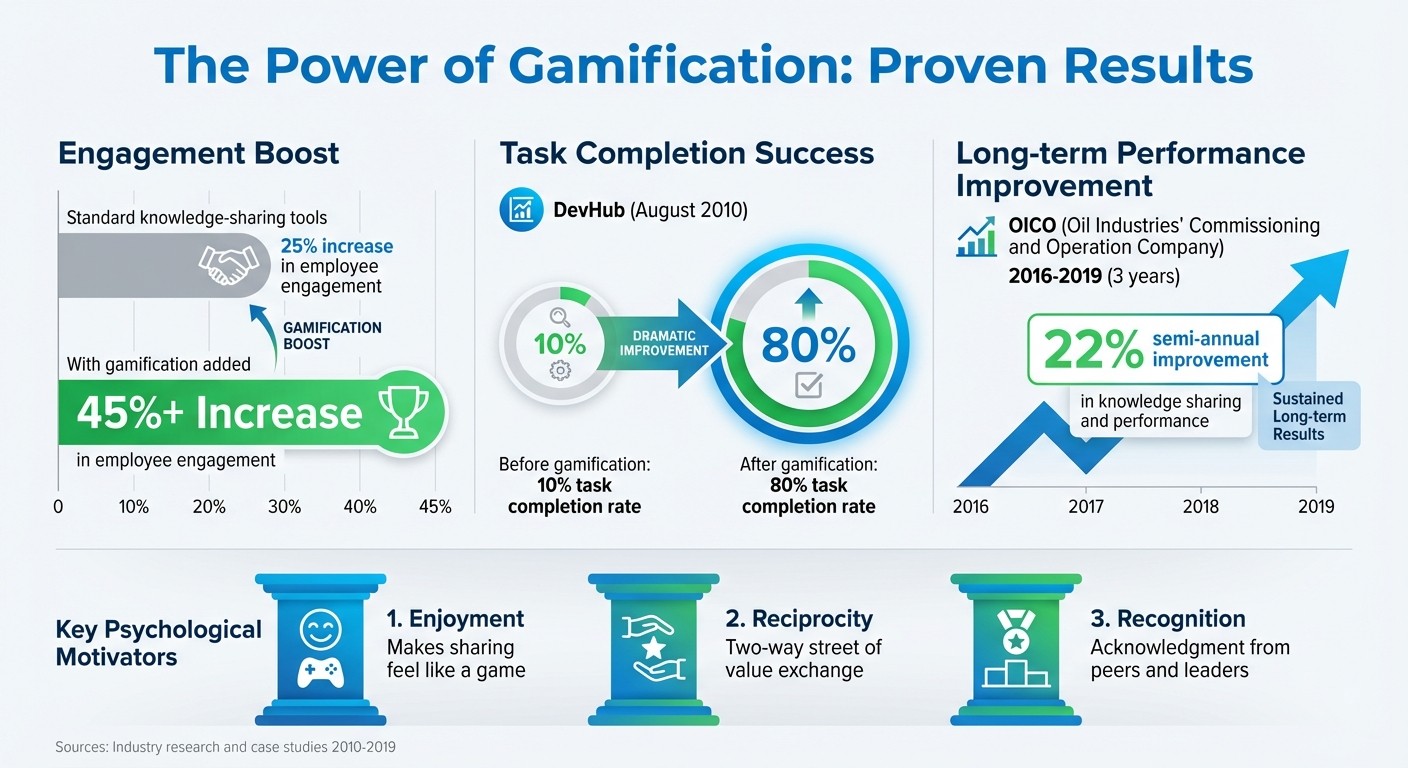
Gamification Impact on Employee Engagement and Knowledge Sharing Statistics
Let’s face it - getting people excited about sharing knowledge at work can feel like pulling teeth. Between low engagement and the overload of tools everyone’s already juggling, it’s no wonder this task often ends up at the bottom of the to-do list. But here’s the twist: gamification flips that script. It turns knowledge sharing into something people want to do, not just another checkbox to tick.
What Gamification Brings to the Table
At its core, gamification is all about bringing game-inspired elements - like points, badges, leaderboards, and progress bars - into everyday tasks. When applied to knowledge sharing, it transforms routine actions, like adding to a knowledge library or answering a coworker’s question, into achievements that feel rewarding and tangible.
Take DevHub, for example. Back in August 2010, this website builder added gamification features to its platform. The result? Task completion rates skyrocketed from 10% to 80%. That’s not just an improvement - it’s a game-changer.
We’ve seen similar success at Pebb. When teams dive into our platform’s gamification tools - earning recognition for sharing useful resources or receiving kudos for sparking meaningful discussions - engagement levels soar. It’s not just about completing tasks; it’s about creating a culture where participation becomes second nature.
Why Gamification Works So Well
So, what makes gamification such a powerful driver of participation? It taps into three psychological motivators: enjoyment, reciprocity, and recognition.
Enjoyment: When knowledge sharing feels like a game, it stops being a chore. This ties into Flow Theory, where you’re so immersed in an activity that time flies by. As Mihaly Csikszentmihalyi puts it:
"Flow is being completely involved in an activity for its own sake. The ego falls away. Time flies. Every action, movement and thought follows inevitably from the previous one."
Reciprocity: Sharing knowledge becomes a two-way street. When employees see tangible rewards - like points or badges - they feel their efforts matter. And when they know they’ll get valuable insights in return, participation becomes a no-brainer.
Recognition: Let’s be honest - who doesn’t love a little acknowledgment? Whether it’s a badge, a spot on the leaderboard, or a shoutout from a manager, being recognized by peers is a huge motivator. A study even found that gamification elements like "bravo" points significantly boosted both work engagement and performance expectancy.
The stats back this up. Simply introducing knowledge-sharing tech can increase employee engagement by 25%. But when you layer in gamification? Engagement shoots up to over 45%. And it’s not just about short-term gains. The Oil Industries' Commissioning and Operation Company (OICO) saw a 22% semi-annual improvement in knowledge sharing and performance after combining gamification with nudge theory over three years.
So, whether it’s through badges, leaderboards, or kudos, gamification doesn’t just make knowledge sharing easier - it makes it irresistible.
Gamification Features That Work
Let me share what we’ve learned at Pebb about gamification and how it can motivate teams to share knowledge. The secret? Tapping into what drives people: recognition, a bit of friendly competition, and seeing their progress in real time.
Reward Systems That Truly Motivate
Here’s what works: mixing virtual rewards like points, badges, and levels with real-world incentives like gift cards, bonuses, or even small prizes. At Pebb, we’ve noticed a clear spike in engagement when someone gets recognized for sharing a helpful document in our Knowledge Library, completing a task, submitting a digital form, or answering a tough question in a group chat. It’s like a ripple effect - one small acknowledgment can spark a chain reaction.
The key is tying rewards to specific actions. For example, you could award points for uploading a resource, participating in a discussion, or sharing a success story about how a piece of content was used. And don’t underestimate the power of a heartfelt thank-you from a senior leader or a shout-out during something like our "Thankful Thursday" sessions. Sometimes, that personal touch can mean more than any monetary reward.
Stan Garfield, a well-known voice in knowledge management, summed it up perfectly:
"When they saw that the chief executive was backing up this program financially they said, 'This must be important. Therefore, I probably should be doing it.'"
Of course, you’ve got to keep things fair. To avoid people gaming the system, we’ve implemented quality checks and rules, like limiting recognition to one win per year. This keeps the rewards meaningful and ensures everyone has a fair shot.
The Power of Leaderboards and Friendly Rivalry
Leaderboards can turn knowledge sharing from a chore into something people actually want to do. Seeing your name as a "Top Document Contributor" or watching your team climb the ranks sparks a sense of pride - and a little healthy competition. Interestingly, we’ve found that team-based competitions (like department vs. department) are even more effective than individual contests.
At Pebb, we’ve built spaces for teams that let them compete to see who shares the most useful resources, completes the most tasks, or starts the liveliest discussions. And here’s the cool part: public leaderboards act as a self-policing system. If someone tries to boost their rank with low-quality content, the community usually calls it out. To keep things fair, we’ve added rules like limiting each winner to one leaderboard victory per year.
Progress Tracking That Keeps Momentum Going
You know that feeling when you see a progress bar almost filled, and you just have to complete it? That’s the magic of visual tracking. Whether it’s a progress bar, a completion percentage, or milestone markers, these tools make contributions feel tangible and rewarding.
Stan Garfield points out that this strategy works even without competition:
"The competition does not have to be with other people – it can be against a target such as profile completion percentage. Some people obsess over achieving 100% completion as reflected in a visible badge."
We’ve seen this firsthand. When team members can track their impact - like through a dashboard showing their contributions or a badge celebrating a milestone - it creates a sense of accomplishment. It’s like they enter a state of “Flow,” where they’re so focused and engaged that time just flies.
The trick is to tie every milestone to something that matters for the team or the company. For example, if someone hits a milestone for sharing ten high-quality resources, make sure that’s celebrated publicly. Leadership recognition goes a long way in reinforcing that knowledge sharing isn’t just nice to have - it’s a priority.
Examples of Gamification in Practice
Let me share some real-world examples of how gamification can deliver tangible results. By weaving in these proven strategies, gamification has transformed the way teams engage and perform.
How We Use Gamification at Pebb
At Pebb, we’ve made gamification an integral part of our platform - not as a flashy add-on, but as a meaningful tool that encourages collaboration and sharing. For instance, when someone uploads a helpful guide to our Knowledge Library or sparks a lively conversation in a Club, they earn badges. And it doesn’t stop there - we highlight top contributors on our News Feed, giving them well-earned recognition in front of the entire team.
What makes it work? Everything is seamlessly integrated into one all-in-one employee app for communication and operations. Features like group chats, tasks, digital forms, calendar events, and the news feed are right at your fingertips, making it simple for frontline workers to dive in and participate. Whether you’re starting with our free plan for up to 15 employees or upgrading to Premium at just $4 per user per month, you get a complete gamification toolkit without stretching your budget.
Gamification in Action on Other Platforms
While we’ve built gamification directly into Pebb, other platforms have also found success by taking unique approaches. Take Stack Overflow, for example. Their entire reputation system revolves around earning points and badges. By answering questions, users unlock privileges and even moderator tools. It’s a system that’s kept their knowledge base vibrant and active for years.
Another standout is DevHub, which saw task completion rates soar from 10% to an impressive 80% back in August 2010 after introducing points and badges. It’s clear that gamification isn’t just a buzzword - it’s a game-changer when done right.
But not every platform makes it easy. Slack and Microsoft Teams, for instance, often rely on expensive third-party integrations to add gamification features, which can complicate things and drive up costs. Similarly, platforms like Workvivo and Staffbase offer social feeds and kudos, but they’re designed with larger enterprises in mind, making them less accessible for smaller teams. That’s where Pebb shines - offering built-in gamification tools at a fraction of the cost.
And let’s not forget the results. Consider the Oil Industries' Commissioning and Operation Company (OICO), which implemented gamification and nudge theory over a three-year period ending in 2019. By using emoticons and rewards to show project managers how their teams were performing, they boosted knowledge sharing and performance by an impressive 22% every six months. That’s the kind of measurable improvement we’re aiming for - not just engagement for the sake of it, but real progress that drives momentum and results.
How to Set Up Gamification with Pebb
Getting gamification up and running with Pebb is refreshingly simple - no need to juggle third-party tools or complex integrations. Whether you're using our free plan for up to 15 employees or our Premium plan at $4 per user per month, everything you need is already baked into the platform. The idea is to turn everyday tasks into engaging, rewarding experiences. Let me walk you through how it works.
Creating Knowledge Libraries and Groups
The first step is to build a central hub where your team can easily access essential information. Pebb's Knowledge Library is perfect for this, alongside Tasks, Digital forms, and Calendar events that keep work organized in one place. It's where you can store all your training materials, SOPs, best practices, and how-to guides. Everything is searchable, neatly organized, and accessible to everyone - whether they're at their desk or out in the field.
But here’s where it gets even better: pair your Knowledge Library with groups and spaces for focused team collaboration. You can create spaces around specific topics like "Sales Tips", "Customer Service Wins", or "Tech Troubleshooting." These spaces encourage team members to share insights, ask questions, and even upload their own guides. For example, someone might post a quick tip that solves a common issue, and just like that, they’re helping the whole team. And since Pebb is mobile-first, your team can tap into this knowledge anytime, anywhere.
Once you’ve set up these foundational hubs, it’s time to make participation exciting with rewards and recognition.
Setting Up Rewards and Recognition
Here’s where gamification really shines. After your Knowledge Library, tasks, digital forms, and team spaces are up and running, you can start recognizing and rewarding contributions. Pebb lets you spotlight top contributors right on the News Feed, giving public shout-outs to employees who’ve shared valuable insights or helped solve a tricky problem. Trust me, this kind of recognition isn’t just about handing out badges - it’s about making people feel appreciated.
You can also track milestones and celebrate them. For instance, feature someone as "Contributor of the Month" for uploading their 10th guide, completing key tasks, submitting helpful forms, or answering 50 questions from teammates. All of this happens seamlessly within Pebb, so there’s no need to pay for extra tools to make it work.
Measuring Results with Analytics
Of course, gamification isn’t just about fun - it’s about making a real impact. That’s where Pebb’s Analytics feature in the Premium plan comes in. You can track who’s contributing to the Knowledge Library, see which spaces are buzzing with activity, and monitor engagement trends over time. For example, are some teams more active than others? Is participation growing month by month?
These insights are a game-changer. Research shows that gamification can boost employee engagement from 25% to over 45%. With Pebb’s analytics, you’re not just hoping for results - you’re tracking them. This data helps you refine your approach, focus on what’s working, and keep the momentum alive. It’s all about making informed decisions that drive real progress.
Wrapping It All Up
Gamification has proven to be a game-changer when it comes to breaking down information silos and giving knowledge sharing a much-needed spark. By weaving in elements like recognition, leaderboards, and rewards, it turns what could be mundane routines into something engaging and collaborative.
And the stats? They don’t lie. While standard knowledge-sharing tools can bump up engagement by 25%, adding gamification takes it to over 45%. Take OICO (Oil Industries' Commissioning and Operation Company) as an example - they implemented gamification strategies between 2016 and 2019 and saw their organizational knowledge sharing and performance improve by 22% semi-annually. That’s not just a small boost; that’s a leap forward.
Here’s what I’ve seen: combining fun with functionality really does work. At Pebb, we’ve built an all-in-one platform that makes this transformation easy for teams of any size. Whether you’re a small group or managing thousands of employees, we’ve got you covered. Our free plan supports up to 15 employees, while the Premium plan - only $4 per user per month - offers even more tools like Knowledge Libraries, Tasks, Digital forms, Calendar events, News Feeds, Analytics, Voice & Video calls, Integrations, and more.
The real hurdle isn’t the technology; it’s getting people to actually use it. Gamification tackles that head-on by making participation something people want to do. And with Pebb, you can get this all set up in a way that’s simple, cost-effective, and tailored for everyone - from desk workers to frontline teams.
So, why wait? Dive into Pebb today and turn knowledge sharing into something your team looks forward to.
FAQs
How can gamification make knowledge sharing more engaging?
Gamification has this knack for turning knowledge sharing into something people actually want to do. By weaving in elements like leaderboards, points, and achievement badges, it taps into that universal craving for recognition and a touch of friendly competition. Imagine seeing your name climb a leaderboard or snagging a badge like "Knowledge Pro" - suddenly, sharing insights isn’t just a task; it’s a game you want to win.
And here’s the kicker - it’s not just fun; it’s effective. Research backs up that gamified systems can significantly boost engagement and make folks more eager to share what they know. At Pebb, we’ve made these features a core part of our platform. Whether it’s a post, a chat, or a shared document, every contribution has the potential to earn rewards. Oh, and guess what? You don’t need a massive budget to get started. These features are included in our free plan for up to 15 employees or available for just $4 per user per month with our Premium plan. It’s a straightforward way to keep your team energized and connected.
How can gamification make knowledge sharing more engaging?
Gamification turns the often mundane task of knowledge sharing into something exciting and rewarding. Think about it - earning points for sharing insights, unlocking badges for milestones like "Top Contributor", and climbing leaderboards through some friendly competition. These elements not only make employees feel recognized but also encourage them to actively participate. Add in features like progress bars and level-ups, and suddenly, learning feels more like an adventure than a checkbox on your to-do list.
At Pebb, we’ve dialed this up a notch. We’ve added tools like tasks, digital forms, and knowledge sharing features where team members tackle real-world problems and level up their skills. It’s these little details that tap into our innate desire to achieve and keep the momentum alive. And the best part? All of this is seamlessly integrated into Pebb’s all-in-one employee app for communication and operations. With tools like chat, news feeds, tasks, digital forms, calendar events, and video calls, we’ve made sharing knowledge both rewarding and effortless - for just $4 per user per month. The outcome? A workplace buzzing with energy, collaboration, and fresh ideas!
How can small teams use gamification to encourage knowledge sharing without spending a lot?
Small teams can make a big splash with gamification, and you don't need a massive budget to pull it off. Start with the basics: set clear, bite-sized goals. For example, encourage teammates to share one helpful tip every week or respond to a colleague’s question within 24 hours. Then, tie those actions to simple rewards - think points, badges, or shout-outs in your team feed. These little incentives can make participation feel more like a game and less like a chore.
If you’re already using Pebb, you’ve got everything you need to encourage knowledge sharing without spending a dime. You can create spaces, run polls, assign tasks, use digital forms, and track activity effortlessly. The analytics dashboard in Premium even lets you monitor engagement and spotlight top contributors. Want to sweeten the deal? Offer small rewards like a $5 coffee card or a custom digital badge. It’s amazing how these small gestures can fire up motivation.
When it’s time to take things up a notch, Pebb’s Premium plan is just $4 per user per month. This unlocks features like analytics, unlimited admins, permissions control, advanced work chat, voice & video calls, integrations, and enterprise SSO - powerful tools at a fraction of the cost of other platforms. By starting with the free tools and upgrading only when it feels right, small teams can build a lively, knowledge-sharing culture that’s affordable and fun.
