
Author: Ron Daniel
The Ultimate Checklist: Every Employee Onboarding Form You Need for 2026
Complete digital checklist of onboarding forms - W-4, I-9, tax, NDAs, benefits and 30/60/90 reviews to ensure compliance and improve retention.
Have you ever felt like onboarding a new hire is more like juggling flaming torches than welcoming someone to the team? I’ve been there. A few years ago, we had a new hire show up on their first day, only to find out we didn’t have their W-4, their I-9 was incomplete, and their direct deposit details were missing. It was a nightmare. They spent hours filling out forms, HR scrambled to fix the mess, and let’s just say their first impression of us wasn’t exactly stellar.
Here’s the thing: onboarding isn’t just about paperwork - it’s about setting the tone for someone’s entire experience with your company. And in 2026, with remote work, multi-state tax rules, and compliance standards constantly evolving, it’s gotten even trickier. If you’re still relying on scattered emails and paper forms, you’re making it harder than it needs to be - for you and your new hires.
That’s why we at Pebb took a hard look at our own onboarding process and built a system that simplifies everything. From preboarding to Day 1 and beyond, we’ve created a digital checklist that ensures nothing gets missed, no one feels lost, and everyone starts off on the right foot. In this guide, I’ll walk you through the exact steps we use, the forms you absolutely need, and how we’ve turned onboarding from a headache into a smooth, stress-free experience. Let’s dive in.
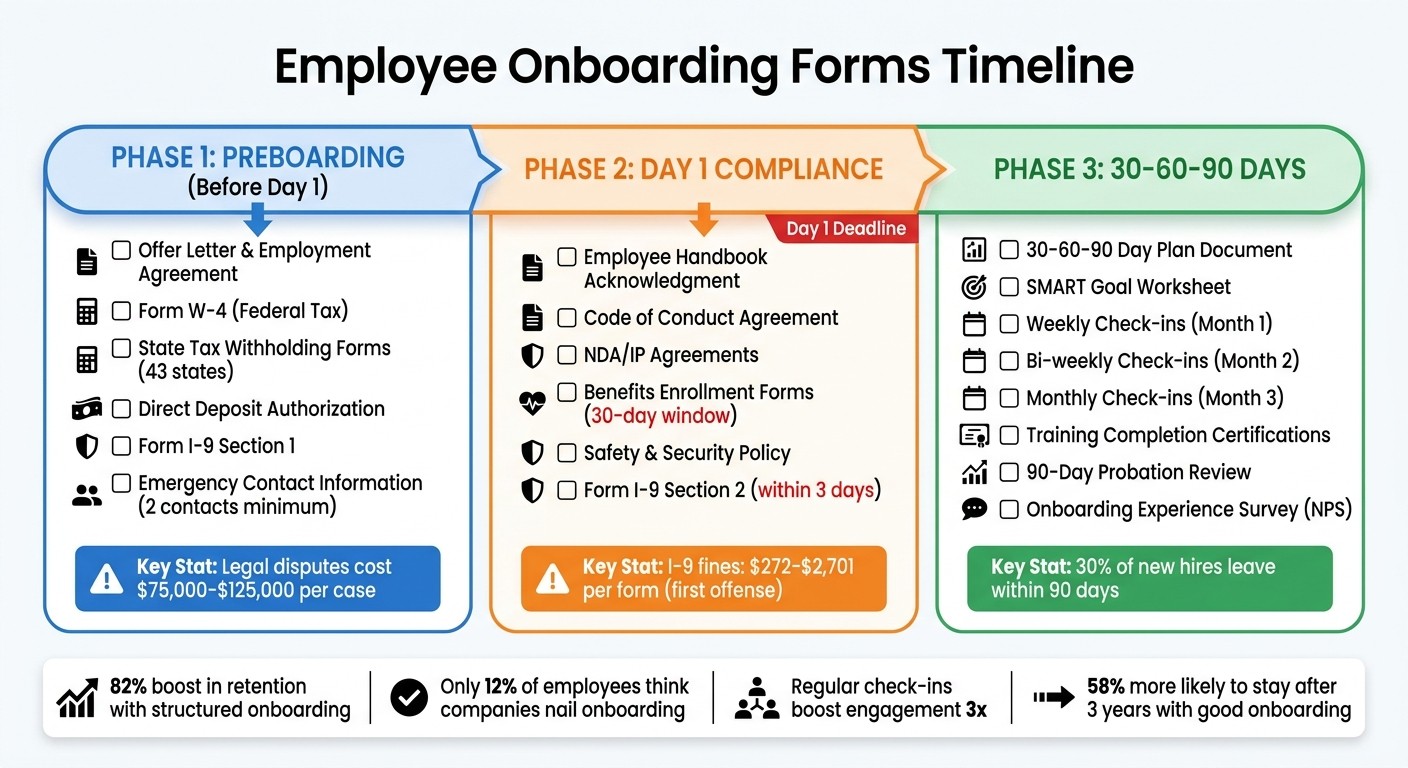
Complete Employee Onboarding Forms Timeline: Preboarding to 90 Days
Preboarding Forms Checklist
Preboarding is the period between offer acceptance and Day 1. It’s often overlooked, but let me tell you - this time is gold for getting all the paperwork out of the way. When done right, it transforms Day 1 from a frantic shuffle of forms into a warm, seamless welcome. Trust me, a little upfront effort here goes a long way in avoiding surprises later.
Offer Letter and Employment Agreement
Think of the offer letter as the formal handshake that seals the deal. It spells out the big stuff: job title, salary (yes, the dollar signs), start date, and employment type. While it’s not legally binding, it sets expectations on both sides. We use tools like Pebb to digitize and simplify the process, making it quick and hassle-free.
The employment agreement, on the other hand, dives deeper. This document covers the nitty-gritty - intellectual property rights, confidentiality, non-compete clauses, and exclusivity provisions. Skipping this step? That’s a gamble you don’t want to take. Legal disputes over these omissions can cost anywhere between $75,000 and $125,000 per case. Ouch.
Tax and Payroll Forms
Getting tax details sorted before Day 1 is a game-changer. Start with Form W-4, which determines how much federal income tax gets withheld from paychecks. If this isn’t completed, the default rate kicks in (single filer, no adjustments), and that can lead to headaches for your new hire later.
Don’t forget state tax withholding forms. Most states - 43, to be exact - have their own versions separate from the W-4. Here’s a pro tip: if your new hire is remote and working from another state, make sure to follow their state’s tax rules, not your office’s. And for those lucky enough to live in states with no income tax (hello, Texas and Florida), state forms aren’t required.
Another must-have? Direct deposit authorization. By collecting bank routing and account numbers early, you’ll ensure payroll runs like clockwork from the very first paycheck.
Once these details are locked in, it’s time to tackle employment eligibility with the I-9 form.
I-9 Employment Eligibility Verification
Here’s the deal: Form I-9 is non-negotiable. Federal law requires employers to verify that every new hire is legally authorized to work in the U.S. Section 1 must be completed by Day 1, and Section 2 within three days. Missing these deadlines can lead to fines ranging from $272 to $2,701 per form for first offenses, with penalties skyrocketing to $27,018 per violation for unauthorized hires.
"Section 1 [of the I-9] must be done on or before Day 1. No exceptions. Starting work before this step is a federal violation regardless of intent." - FirstHR
To stay on the safe side, store I-9 forms separately from general personnel files, either in a dedicated binder or a secure digital folder. This makes them easy to access during audits. With compliance squared away, the next step is gathering emergency contact info.
Emergency Contact Information
Safety comes first. Before Day 1, make sure you’ve got at least two emergency contacts on file for every employee. Each entry should include a name, phone number, and relationship. In case of an accident, medical emergency, or something unexpected like a natural disaster, having this information handy is not just good HR practice - it’s essential.
At Pebb, we store these details in our secure Knowledge Library alongside tax documents and I-9s. This way, everything is organized and accessible, even from a smartphone, ensuring we’re prepared for anything.
Day 1 Compliance Forms Checklist
Day 1 matters - a lot. It’s the foundation for legal compliance and workplace security. By now, you’ve tackled the preboarding paperwork, so this is the moment to focus on the forms that protect both your company and your new hire. These documents aren’t just formalities; they’re what help you avoid costly legal headaches. Did you know the average litigation cost for businesses runs between $75,000 and $125,000 per case? That’s a price tag no one wants to pay.
Employee Handbook Acknowledgment
The employee handbook acknowledgment is a game-changer. It’s your proof that the employee has received, read, and understood your company’s policies - everything from PTO rules to disciplinary procedures. Without this signed document, disputes can turn into messy "he said, she said" situations.
"A signed acknowledgment proving the employee received, read, and understood your policies is critical if you ever need to discipline or terminate someone for a policy violation." - FirstHR
Here’s a surprising stat: only 12% of employees think their company nails onboarding. Overwhelming your new hires with a massive handbook on Day 1 isn’t the way to fix that. Instead, tools like Pebb’s Digital Forms can make this process smooth. With e-signatures and timestamped tracking, you’ll have an airtight record - no more "I didn’t know about that policy" excuses.
But there’s more to Day 1 than just the handbook. Let’s talk about the other forms that set clear expectations from the start.
Code of Conduct and Policy Agreements
The code of conduct form lays out the rules of the road for workplace behavior. This includes at-will employment clauses, social media guidelines, and acceptable use policies for IT systems like email, VPNs, and company devices. If your new hire is remote, make sure these policies align with the laws of their state.
Benefits Enrollment and NDA/IP Agreements
After setting behavioral expectations, it’s time to address two key areas: employee benefits and protecting your company’s sensitive information.
Benefits Enrollment Forms: These typically go out on Day 1, though employees usually have up to 30 days to finalize their choices. Walk them through options like health insurance, dental plans, and 401(k) contributions. The goal? Help them make confident, informed decisions without feeling rushed.
NDAs and IP Agreements: These are crucial for roles that involve access to proprietary data, trade secrets, or customer information. They spell out what’s confidential and ensure that any work created on the job belongs to the company. With Pebb’s platform, these forms can be handled digitally, saving everyone time.
Safety and Security Policy Acknowledgment
Safety and security policies aren’t just for office workers - they apply to everyone, whether they’re remote, on-site, or frontline employees. These policies cover everything from emergency protocols to cybersecurity rules like VPN usage and password management. And let’s face it, in a world where a single data breach can cost more than a physical workplace injury, these acknowledgments are non-negotiable. Collect them on Day 1 to set the tone for accountability and preparedness.
Form Type | Purpose | Deadline |
|---|---|---|
Employee Handbook Acknowledgment | Confirms receipt and understanding of all company policies. | Day 1 |
Code of Conduct | Establishes behavioral standards and ethical expectations. | Day 1 |
NDA / IP Agreements | Protects proprietary information and intellectual property. | Day 1 |
Safety & Security Policy | Outlines emergency procedures and data security protocols. | Day 1 |
30-60-90 Day Forms Checklist
Onboarding doesn’t stop after Day 1. In fact, those first 90 days are make-or-break. Let this sink in: 30% of new hires leave within their first 90 days. But here’s the good news - structured onboarding can boost retention by an impressive 82%. The secret? Having the right forms at the right time.
At Pebb, we’ve designed a digital system that handles these forms seamlessly, making the onboarding process smooth and effective. Once the Day 1 compliance forms are out of the way, the next 90 days are all about building performance and gathering meaningful feedback.
Performance Feedback and Progress Review Forms
The 30-60-90 Day Plan Document is your starting point. Think of it as a roadmap tailored to each role, laying out learning milestones, relationship-building goals, and performance targets for each month. Pair this with a SMART Goal Worksheet to set objectives that are specific, measurable, and achievable.
But here’s the thing - setting goals is just the beginning. To make them stick, you need regular check-ins. That’s where Check-in Agenda Templates come in handy. These templates help you stay consistent with feedback: weekly check-ins during the first month, bi-weekly in the second, and monthly in the third. Why does this matter? Regular manager check-ins can boost employee engagement nearly threefold. Wrap it all up at the 90-day mark with a 90-Day Probation Review Form, which helps formally evaluate performance and finalize the decision on permanent employment.
Training Certifications
For roles that involve compliance, Training Completion & Certification Forms are a must. These forms confirm that required training has been completed, which is critical for audits. Pebb’s Digital Forms make this process painless by automatically timestamping and securely storing these records, so you’re always covered.
Onboarding Experience Survey
Now, let’s talk feedback. Around the 90-day mark, send out an Onboarding Experience Survey to gather insights from your new hires. This is your chance to find out what worked, what didn’t, and how you can improve. Be sure to include a Net Promoter Score (NPS) question to measure how likely they are to recommend your company. Why is this important? Because only 12% of employees feel their company nails onboarding.
The insights you gather here aren’t just nice-to-have - they’re essential. Use them to fine-tune your onboarding process for the next hire. After all, onboarding isn’t a one-time event. It’s an evolving system that grows better with every round of feedback, helping you turn new hires into long-term, engaged team members.
How to Digitize Employee Onboarding Forms with Pebb
Let’s face it - paper-based onboarding is outdated. If you're still printing out W-4s, chasing signatures, or losing I-9 forms in filing cabinets, you're not just wasting time - you’re throwing money away. That’s exactly why we created Pebb’s Digital Forms, and let me tell you, it’s been a game-changer.
Here’s what we’ve seen: Pebb cuts onboarding time by 65%, dropping it from 10 days to just 3.5 days. On top of that, each hire saves an average of $1,200, and paper costs are slashed by 80%. Those numbers speak for themselves, don’t they?
Why Pebb's Digital Forms Are a Better Fit
Our secret sauce? A mobile-first design that’s perfect for the 92% of frontline workers in industries like retail and hospitality who don’t sit behind a desk all day. With Pebb, new hires can handle everything - W-4s, I-9 verification, emergency contact info, and even benefits enrollment - straight from their phones. No desktops, no hassle. Features like voice-to-text and photo uploads make I-9 document verification a breeze.
But here’s the real kicker: real-time compliance updates. When the IRS makes changes to tax forms or E-Verify rules get updated (remember the remote verification changes in 2026?), Pebb instantly updates your forms. You’ll get alerts on your dashboard for expiring forms, and everything stays formatted correctly in MM/DD/YYYY to meet audit requirements. This proactive approach can save you from compliance fines, which average around $2,000 per violation. That’s peace of mind right there.
We’ve also streamlined the follow-up process. Automated workflows remind employees to complete their forms, pushing completion rates to a whopping 98%, compared to just 60% with paper forms. One of our customers, a U.S. retailer with 1,000 employees, hit 95% form completion before Day 1, shaving 15 hours of admin time per hire. That’s the kind of efficiency that makes a difference.
Replace the Clutter with Pebb
Tired of juggling tools like Google Forms, DocuSign, and BambooHR? With Pebb, you don’t have to. Our platform covers everything - form creation, e-signatures, storage, and analytics - and integrates seamlessly with payroll systems like ADP. And here’s the kicker: at just $4 per user per month, our customers report saving anywhere from $5,000 to $10,000 annually by ditching the extra tools and consolidating everything into Pebb.
"Digital forms replace messy paperwork with fast, flexible, and trackable forms your team can actually use." - Pebb Digital Forms
But Pebb isn’t just about forms. It’s an all-in-one platform where new hires can check shift schedules, chat with teammates, request PTO, and even access the employee handbook. Everything they need is in one place, simplifying the onboarding process and cutting out confusion.
With Pebb, digitizing your onboarding process isn’t just about ditching paper - it’s about creating a system that’s efficient, compliant, and ready to engage new hires from Day 1.
Wrapping It All Up
Let’s face it - onboarding is so much more than just ticking off boxes or filing paperwork. It’s the cornerstone of retention, productivity, and setting the tone for your new hires’ journey. A solid checklist doesn’t just ensure compliance with essentials like tax forms, I-9s, and policy sign-offs - it lays the groundwork for success right from Day 1. And here’s the kicker: structured onboarding makes employees 58% more likely to stick around after three years. On the flip side, poor onboarding can spike voluntary turnover by 25%, costing you a whopping $15,000–$20,000 per replacement. Ouch.
But here’s the thing: having the right forms is only half the story. The way you handle onboarding - your how - is just as crucial as your what. Traditional paper systems? They’re riddled with 40–50% error rates. Compare that to Pebb’s automated checks and audit trails, which slash errors down to under 5%. That’s not just a stat; it’s the difference between panicking during an audit and confidently breezing through it.
"The real goal of a great new employee onboarding checklist isn't just efficiency. The real goal is to build a foundation of psychological safety and trust." - Dan Robin, Pebb.io
And here’s where Pebb truly shines. For just $4 per user per month, you get more than digitized forms. Pebb brings everything - digital forms, scheduling, chat, PTO management - into one seamless platform. No more juggling fragmented tools or chasing down lost paperwork. It’s a streamlined, all-in-one solution that backs up every point we’ve covered in this checklist.
Still stuck in the paper-signature era? It’s time for a change. Your new hires will feel more supported, and your HR team will finally breathe a sigh of relief. Trust me, they’ll thank you.
FAQs
What forms are required before Day 1 vs on Day 1?
Before Day 1, new hires usually handle a few key tasks to get the ball rolling. These include completing the Form W-4 for federal tax withholding, Section 1 of Form I-9 (if applicable), and any necessary state withholding forms.
Then comes Day 1, when it’s time to wrap up the essentials. Employees finalize Section 2 of Form I-9 to confirm their employment eligibility and tackle any remaining paperwork, like NDAs or company policy acknowledgments.
The key here? Make sure everything is submitted on time to meet compliance requirements. Trust me, staying ahead of deadlines makes life easier for everyone involved.
How do I handle I-9 verification for remote hires in 2026?
To manage I-9 verification for remote hires in 2026, you'll need to stick to the updated federal rules. Employers are required to confirm both identity and work authorization for every new hire. For remote employees, the permanent E-Verify remote verification process is now the go-to method, especially since the COVID-era flexibilities will officially end on March 31, 2026.
Here’s the timeline you’ll need to follow:
Section 1: Get this completed by the employee no later than their first day of work.
Document Verification: Review the required documents within 3 business days of their start date.
Storage: Ensure the completed forms are securely stored to meet compliance regulations.
Staying on top of these steps not only keeps you compliant but also helps streamline the onboarding process for your remote team.
What’s the simplest way to digitize onboarding forms in Pebb?
The quickest way to streamline onboarding with Pebb is by using the Digital Forms feature. This tool allows you to create custom forms without needing any coding skills. New hires can fill out and submit these forms right from their phones or desktops. Some standout features include the ability to attach files and photos, role-based access controls to ensure proper permissions, and instant notifications for managers. It’s a simple way to make onboarding smoother and more efficient.
