
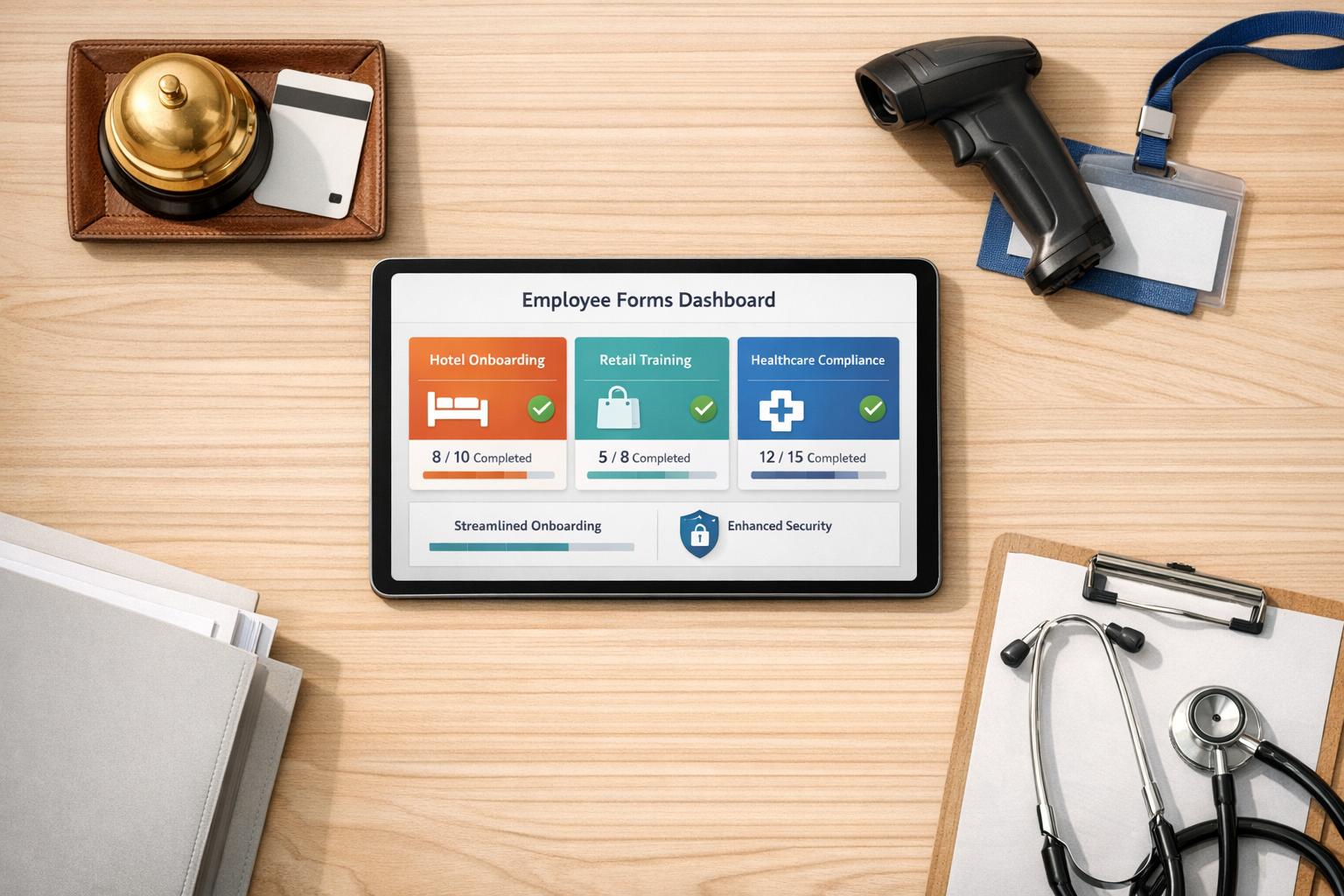
Author: Ron Daniel
Employee Forms Software for Hotels, Retail & Healthcare
Digital forms that cut onboarding time, reduce compliance risk, and save labor for hotels, retail, and healthcare frontline teams.
Have you ever seen a manager flipping through a stack of papers, trying to find a missing incident report, or watched a new hire fill out the same form three times because the originals vanished? It’s frustrating, right? I’ve been there too, and I can tell you - it’s not just an inconvenience, it’s a massive time drain. A 2023 report showed that 68% of frontline workers in industries like hospitality, retail, and healthcare waste 2–3 hours every week wrestling with paperwork. That’s time they could spend helping guests, assisting customers, or caring for patients.
Here’s the kicker: those inefficiencies aren’t just annoying - they’re expensive. Paper processes lead to lost forms, compliance risks, and hours of wasted labor. But there’s a better way. At Pebb, we’ve seen firsthand how digital forms can transform these industries. From cutting onboarding times in half at a Las Vegas hotel to saving healthcare providers millions in compliance costs, the results are undeniable.
In this article, I’ll share how Pebb’s digital forms are solving these challenges. We’ll dive into real-world examples from hotels, retail, and healthcare, explore the hidden costs of paper forms, and show how switching to digital saves time, money, and headaches. Let’s get into it.
Why Hotels, Retail, and Healthcare Need Digital Forms
Working in industries like hospitality, retail, or healthcare, I’ve seen firsthand how the constant churn of employees, strict compliance rules, and fragmented communication can create chaos. Let’s take the hospitality industry as an example - annual turnover rates hover between 72% and 75%, nearly double the average of 41% across other industries. Retail isn’t far behind, with turnover averaging 60% and frontline roles sometimes exceeding 80%. Healthcare faces its own challenges, with 19% turnover for nursing staff and 25% for support roles. And here’s the kicker: onboarding each new hire can cost a business anywhere from $3,500 to $5,000.
Now, toss paper forms into the mix, and you’ve got a recipe for inefficiency. When you’re training new hires at this pace, consistency is everything. But paper checklists? They vary by manager, get lost, and lack accountability. I’ve seen retail managers waste hours just trying to figure out if a new cashier completed their POS training or if the form simply vanished. And in healthcare, where compliance is non-negotiable, you can’t afford any ambiguity - HIPAA certification needs instant, verifiable proof. Digital forms solve these headaches by standardizing processes across shifts and locations.
The Compliance Challenge
Compliance is where things get even trickier. Healthcare organizations alone can spend $1.2 million annually on administrative labor and storage for paper records. And let’s not forget the errors - manual processing mistakes happen in 15–20% of paper submissions, which can lead to violations. The penalties? Anywhere from $100 to over $50,000 per incident. Hotels juggle OSHA standards, labor laws, and health codes, while retail chains are constantly proving wage-and-hour compliance across multiple locations.
And then, there’s the communication gap. In hotels, a misplaced note could mean housekeeping misses a guest’s special request. In retail, inventory issues might slip through the cracks during shift handoffs. And in healthcare, poor communication during shift changes contributes to up to 40% of workplace accidents in retail and hospitality. A maintenance issue scribbled on paper might go unnoticed until it turns into a bigger (and costlier) problem.
Here’s where digital forms shine. They cut compliance errors from 15–20% down to under 2% and make retrieving records a breeze. At Pebb, we designed our Digital Forms feature with frontline teams in mind - whether it’s a housekeeper, store associate, or nurse, they can access what they need right from their phone.
Faster Onboarding and Training
Let’s talk about onboarding. High turnover means businesses are constantly training new hires. In hotels, for example, new employees need to quickly learn property-specific procedures, safety protocols, and guest service standards. Retail stores face similar challenges, with fragmented training materials for POS systems, loss prevention, and customer service. And in healthcare, compliance training and HIPAA certification are mandatory before new team members can even interact with patients.
With paper-based onboarding, this process can drag on for 2–3 weeks. Digital forms? They cut that down to just 3–5 days. Automated tracking and notifications ensure no step is missed. Standardized templates mean every new hire gets the same training, no matter where they’re located or who their manager is. And when procedures change, updates can be pushed instantly across all sites - no more swapping out outdated binders.
Better Compliance and Record-Keeping
Once onboarding is streamlined, digital record-keeping takes compliance to the next level. Lost documentation during an audit can be a nightmare, with fines ranging from $100 to over $50,000. Paper forms are risky - they can be lost, misfiled, or inconsistent across locations. Plus, proving timely completion of required training is nearly impossible with paper, and there’s no encryption to protect sensitive data.
Digital forms eliminate these risks. They create immutable audit trails where every entry is timestamped and every access is logged. Role-based access controls ensure that only authorized personnel can view specific forms. For instance, a healthcare facility can instantly verify that all 200 staff members completed their annual HIPAA training, while a retail chain can generate a single report to prove wage-and-hour compliance across multiple locations. As Dan Robin from Pebb.io puts it:
"The problem with paper is that it has no brain. It can't tell you if a field is missing, it can't route itself to the right person, and it certainly can't update your other systems."
With digital systems, sensitive information stays secure, and only the right people see what they need to.
Improved Daily Operations and Communication
Day-to-day operations get a major boost with digital tools. Poor communication between shifts can lead to operational failures and even safety risks. Imagine a guest’s request for extra towels getting lost in a hotel’s housekeeping notes. Or a malfunctioning checkout terminal in a retail store going unreported because the closing shift didn’t properly hand it off to the opening team. In healthcare, missing updates on medication allergies or care plan changes can have serious consequences.
Digital forms fix this by enabling real-time task assignments and instant notifications. If a hotel guest reports a maintenance issue, the form goes straight to the maintenance team’s mobile devices - often with photos attached - while managers can track all pending tasks on a centralized dashboard. In retail, managers can review incident reports from multiple locations in real time to spot recurring problems. With instant alerts, managers can act proactively, preventing issues from escalating. No more waiting 24–72 hours to find out what went wrong.
Digital forms aren’t just about replacing paper - they’re about transforming how industries like hotels, retail, and healthcare operate. From faster onboarding to airtight compliance and smoother daily operations, they’re making life easier for teams on the ground. And trust me, once you switch, there’s no looking back.
Key Features of Pebb's Digital Forms
At Pebb, we’ve designed our digital forms to tackle real-world challenges head-on, making them practical and efficient for industries like hospitality, retail, and healthcare.
Customizable Templates for Different Industries
Let’s face it - housekeeping, retail, and healthcare all have their own unique needs when it comes to forms. That’s why we offer pre-built templates for tasks like shift feedback, safety inspections, incident logs, and compliance audits. The best part? They’re fully customizable with our drag-and-drop editor - no coding skills required. Want to add photo uploads or signature boxes for HIPAA consent? No problem.
Our templates save serious time, cutting form creation by up to 70%. Here’s a real-world example: a mid-sized U.S. hotel chain adopted our shift feedback template and slashed paperwork time from 30 minutes to just 5 minutes per employee. Not only that, but their response rates jumped by 40%. Over in retail, a 50-store operator standardized performance reviews using our templates, cutting admin time by 60% and boosting employee satisfaction scores in the process.
Mobile-First Design for Frontline Workers
Did you know that 85% of frontline workers rely on their smartphones daily? We designed Pebb’s digital forms to fit seamlessly into their day-to-day. Our mobile apps for iOS and Android are built to pass the "one-thumb test", meaning they’re easy to use even when multitasking. Features like large tap targets, clear layouts, and offline mode make filling out forms a breeze - submissions automatically sync once the user is back online.
We’ve also added GPS stamping for location verification and push notifications for urgent tasks. In our field tests, these features reduced submission errors by 50% and pushed completion rates to an impressive 95%. It’s all about making things easier for the people on the ground.
Secure Data Storage and Easy Access
Data security is non-negotiable, especially in industries like healthcare where a single HIPAA violation could cost thousands. That’s why we use AES-256 encryption for data both at rest and in transit. On top of that, we’re SOC 2 Type II compliant and offer role-based access controls to ensure sensitive information stays in the right hands. Every submission includes a timestamped, tamper-proof audit trail, so you’re always covered.
Need to find something fast? Our centralized dashboard lets you search submissions by date, employee, form type, or even keywords. You can export records to PDF, Excel, or CSV in seconds. For instance, a hotel using Pebb cut audit prep time from 4 hours to just 15 minutes.
We also store data on U.S.-based AWS servers with 99.99% uptime, and features like two-factor authentication and auto-expiring access links keep everything locked down. Plus, our system integrates seamlessly with tools like Workday and BambooHR, so form data syncs automatically. One retail chain cut manual data entry by 80% thanks to these integrations.
These features aren’t just about convenience - they’re about giving industries like hospitality, retail, and healthcare the tools they need to run smoothly. Up next, we’ll dive into how these benefits play out in daily operations. Stay tuned!
Use Cases for Hotels, Retail, and Healthcare
Let me walk you through some real-world examples of how Pebb's digital forms are transforming operations in hotels, retail, and healthcare. By swapping out clunky paper processes for streamlined digital workflows, these industries are seeing faster results, happier teams, and significant cost savings.
Hotels: Managing Guest and Employee Tasks
Hotels juggle a mountain of tasks daily - guest requests, housekeeping checklists, maintenance issues, and incident reports. In early 2024, Hilton Hotels introduced digital housekeeping checklists across 50 properties under the leadership of Operations VP Maria Lopez. The results? Room turnaround times dropped from 45 to 28 minutes, compliance rates hit 92%, and labor savings topped $1.2 million annually. That’s a game-changer.
Here’s how it works: housekeeping staff can snap photos of maintenance issues and submit them instantly through their phones. This triggers automatic alerts to the right team, cutting out the usual back-and-forth. Even guest feedback is now collected digitally, slashing complaint response times from 24–48 hours to under 2 hours. The payoff? Happier guests and better reviews. And it’s not just hotels - retail and healthcare are feeling the impact too.
Retail: Supporting Store Operations and Employee Feedback
In mid-2023, Walmart tested digital shift reports in 200 stores, spearheaded by Retail Ops Director Tom Reilly. The platform included anonymous surveys and real-time dashboards, and the numbers speak for themselves: feedback collection time shrank from 15 minutes to just 3 per shift, issue resolution improved by 45%, and employee engagement scores shot up by 30%.
Retail managers now have a consistent way to handle inventory tracking, shift reports, and employee feedback. Daily sales data, inventory updates, and incident reports are all wrapped up within 30 minutes of closing. Plus, anonymous surveys encourage honesty, with response rates jumping by 60–70%. The shorter completion times (3–5 minutes compared to the old 10–15) make participation a breeze.
Healthcare: Improving Patient Care and Compliance
Back in 2022, Cleveland Clinic rolled out digital incident reporting forms across the board under Dr. Emily Carter. The system brought in e-signatures and automatic routing, and the improvements were striking: filing time dropped from 20 minutes to 5, compliance audit scores soared from 85% to 98%, and over 150 potential violations were avoided.
Nurses now document patient care and safety concerns in real-time, right at the bedside. This has boosted accuracy by 35–45% compared to paper-based delays. Critical issues are flagged and escalated within 15–30 minutes, a massive improvement over the previous 24-hour lag. Plus, near-miss reporting has jumped by 40–50%, signaling a stronger safety culture. With required fields and standardized formats, documentation is always complete, and audit prep time has been slashed from 40–60 hours to just 2–4 hours.
These examples show how Pebb’s digital forms are more than just convenient - they’re transforming the way frontline teams work, saving time, reducing stress, and creating better outcomes across the board.
Pebb vs. Paper Forms
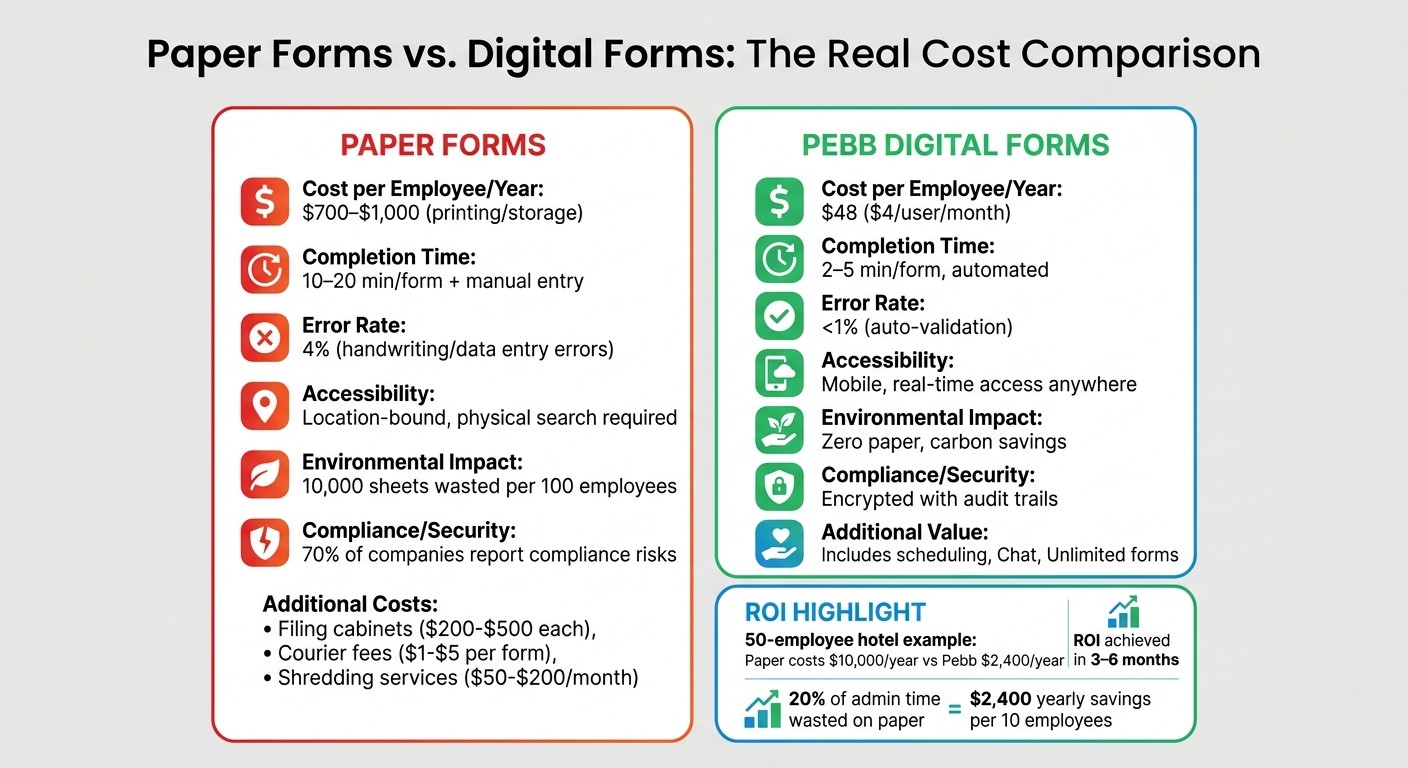
Paper Forms vs Digital Forms Cost and Efficiency Comparison
The Hidden Costs of Paper Forms
Let me tell you a little secret about paper forms - they seem cheap at first glance, but the hidden costs can quietly drain your budget. Gartner’s 2023 research shows U.S. businesses spend $700–$1,000 per employee every year just on printing and paper. And that’s just scratching the surface. Add filing cabinets (priced between $200 and $500 each), storage space, courier fees ($1–$5 per form), and monthly shredding services ($50–$200), and the expenses start piling up.
Then there’s the productivity loss. Let’s break it down: at $15 per hour, wasted time on paper processes can cost mid-sized businesses over $10,000 annually. Think about it - retail employees spend 10–15 minutes filling out a single shift feedback form on paper, compared to just 1 minute digitally. In hotels, managers lose 20 minutes daily on guest task logs. Healthcare workers? They’re stuck doing compliance checks that take 45 minutes per shift. Deloitte even found that 20% of admin time is wasted on paper processes, which translates to about $2,400 in yearly savings for every 10 employees when switching to digital.
And let’s not forget human error. According to Forrester Research, manual data entry from paper forms has a 4% error rate, compared to less than 1% for digital forms. Plus, 70% of companies report compliance risks due to lost or damaged paper records. It’s a recipe for inefficiency and risk.
Aspect | Paper Forms | Pebb Digital Forms |
|---|---|---|
Cost per Employee/Year | $700–$1,000 (printing/storage) | $48 ($4/user/month) |
Completion Time per Form | 10–20 min/form + manual entry | 2–5 min/form, automated |
Error Rate | 4% (handwriting/data entry) | <1% (auto-validation) |
Accessibility | Location-bound, physical hunt | Mobile, real-time anywhere |
Environmental Impact | 10,000 sheets waste/100 employees | Zero paper, carbon savings |
Compliance/Security | High loss risk (70% issues) | Encrypted, audit trails |
When you add it all up, the inefficiencies of paper forms make a strong case for embracing a digital solution like Pebb.
What Makes Pebb Different
Now, here’s where Pebb shines. We’ve built an affordable, all-in-one platform designed to tackle the hidden costs of paper forms head-on. For just $4 per user per month, Pebb gives you unlimited digital forms, secure cloud storage, mobile access, and seamless integrations. Plus, it includes extras like scheduling and chat - features that other tools often charge a premium for.
Let’s do the math. In a 50-employee hotel, paper-based processes cost over $10,000 annually. Switching to Pebb? Just $2,400 per year. Even fragmented digital tools can cost $4,800 or more annually. With Pebb, you’re looking at a return on investment in just 3–6 months, all without setup fees.
Our mobile-first design is a game-changer for frontline teams. Employees can fill out forms in seconds on their phones - even without an internet connection. Once they’re back online, everything syncs automatically. No more misplaced documents or manual follow-ups, thanks to automated routing and cloud storage.
And here’s the kicker: we offer a free all-in-one platform for teams of up to 15 employees. Need more? Our premium plan still beats the competition on price while delivering features that tools like Slack or Teams often charge extra for. Pebb doesn’t just replace paper - it transforms the way your team works, turning inefficiencies into real productivity gains.
How to Implement Pebb Digital Forms
Review Your Current Processes
When we first considered implementing digital forms, we took a hard look at our existing workflows. Over the course of 1–2 weeks, we mapped out every process to pinpoint inefficiencies. Let me give you a few examples. In hotels, new hire paperwork can eat up 2–3 hours per employee. In retail, we've seen error rates climb to 15% just because of illegible handwriting on inventory sheets. And in healthcare, missing HIPAA documentation can lead to compliance nightmares.
To get started, we grouped forms by how often they’re used - daily forms like shift feedback, weekly ones like task reports, and one-time forms like onboarding paperwork. Then we scored each form on a 1–10 scale, looking at how much time we could save, how many errors we could eliminate, and how much they impacted compliance. For instance, if your retail team spends 10–15 minutes every day filling out stock count forms, that’s a no-brainer for digitization. Instead of trying to overhaul everything at once, we focused on 2–3 high-impact forms to start. Once we knew which forms to tackle, we got ready to bring the team on board.
Training Your Team
We found that training doesn’t have to be complicated or time-consuming. In fact, 15–30 minute hands-on sessions worked perfectly for us. For example, we showed housekeeping staff how to submit task reports straight from their phones. For retail managers, we walked them through the approval process and how to view analytics. And for healthcare teams, we practiced compliance audits using the offline mode.
One thing that made a huge difference was identifying 2–3 well-respected employees in each department to act as peer champions. When their coworkers saw them using Pebb with ease, adoption rates shot up. After just two training sessions, most teams reached 90% proficiency, and support tickets were cut in half. We also addressed common concerns right away - like how the app works offline, how data syncs automatically, and how intuitive the mobile interface is. To keep things on track, we scheduled quick check-ins at the 1-week and 1-month marks to answer any lingering questions. Once the training wrapped up, we used Pebb’s analytics dashboard to measure the results.
Tracking Results with Pebb
Here’s where the magic happens: tracking the results. We set clear goals upfront, like cutting form completion time by 50–80%, reducing error rates to under 5%, and hitting 90% adoption within 30 days. Pebb’s built-in analytics dashboard made it easy to monitor metrics like submission volume, completion time, and cost savings (usually $2–$5 per form when you factor in labor and materials).
For example, a 50-employee hotel that switched from paper forms saw onboarding time drop from 3 days to just 4 hours. At a $15/hour wage, that’s a savings of over $500 per new hire. Healthcare clinics typically report 30% faster compliance tracking and 99% accuracy on required forms. We ran monthly reviews to compare these results to our baseline numbers. Plus, the ability to export reports in standard U.S. formats - complete with visual charts - made it easy to show stakeholders exactly how Pebb was delivering. Most teams we’ve worked with see their investment pay off in just 3–6 months.
Wrapping Up
After diving into the world of digital forms, one thing is clear: they leave traditional paper processes in the dust. Just look at the numbers - hotels speed up onboarding by 30%, retail cuts compliance errors by 35%, and healthcare slashes audit time from 20 hours to just 4. That’s not just efficiency; it’s a game-changer.
Here’s where Pebb steps in. It’s more than just a tool for forms - it’s a complete platform designed for frontline teams. For just $4 per user per month, you get digital forms, work chat, shift scheduling, PTO management, and so much more. Whether it’s housekeeping staff, retail managers, or healthcare workers, they can submit reports, approve feedback, and stay connected - even offline. Compare that to other communication and HR tools like BambooHR, which range from $6 to $12 per user, or expensive custom setups, and it’s easy to see why Pebb stands out.
Still clinging to paper forms? Think about the headaches - illegible handwriting, misplaced documents, wasted time. It’s time to make the switch. Start your free 14-day trial at pebb.com, turn your high-use forms digital, and see the difference in time savings and team productivity. With Pebb, you don’t just work - you work smarter and faster.
FAQs
Which paper forms should we digitize first?
Digitizing the forms your team relies on every day is a game changer. Start with the ones that are crucial for compliance, safety, and efficiency - think daily safety checks, employee onboarding forms, and incident reports. These are the backbone of maintaining standards while cutting down on manual processes.
Next, turn your attention to forms that make workforce management smoother, like shift schedules, time-off requests, and onboarding checklists. By prioritizing these high-impact forms, you'll see immediate improvements in communication and organization, setting the stage for an easier path to broader digital transformation.
Can Pebb forms work without Wi‑Fi or cell service?
Yes, Pebb forms can work offline, but there's a catch - you need to download or save them locally in advance. While this is great for filling out forms without an internet connection, you'll still need to be online for submitting them and tracking responses in real time.
How does Pebb keep employee and patient data secure?
Pebb takes protecting employee and patient data seriously, implementing strong safeguards to block any unauthorized access. By adhering to healthcare regulations like HIPAA, we ensure that sensitive information stays secure. For example, during a recent security incident involving Navia, Pebb's systems remained untouched - there was no data breach or modification. This highlights our dedication to keeping data privacy and security at the forefront of everything we do.
