

Author: Ron Daniel
5 Common Collaboration Challenges and Solutions
Practical solutions to five collaboration issues: onboarding gaps, information silos, app fatigue, remote trust shortfalls, and notification overload.
Have you ever felt like your team is juggling a dozen tools but still missing the mark on communication? I’ve been there. A few years back, I watched a manager at a retail chain spend half her day digging through emails, Slack messages, and a scheduling app just to find one update. By the time she shared it with her team, the information was outdated. Frustrating, right? Turns out, she isn’t alone - 86% of employees blame poor collaboration for workplace failures.
Here’s the kicker: the tools meant to make collaboration easier often end up creating more chaos. I’ve seen frontline workers miss critical updates buried in apps they barely know how to use. And when you add remote teams, different shifts, and scattered locations into the mix, it’s a recipe for confusion. But it doesn’t have to be that way.
At Pebb, we’ve spent years tackling these challenges head-on. In this article, I’ll share the five biggest collaboration hurdles I’ve seen - and how we’ve helped teams overcome them. Whether it’s simplifying onboarding, breaking down silos, or cutting through app fatigue, these solutions are practical, actionable, and proven to work. Let’s dive in.
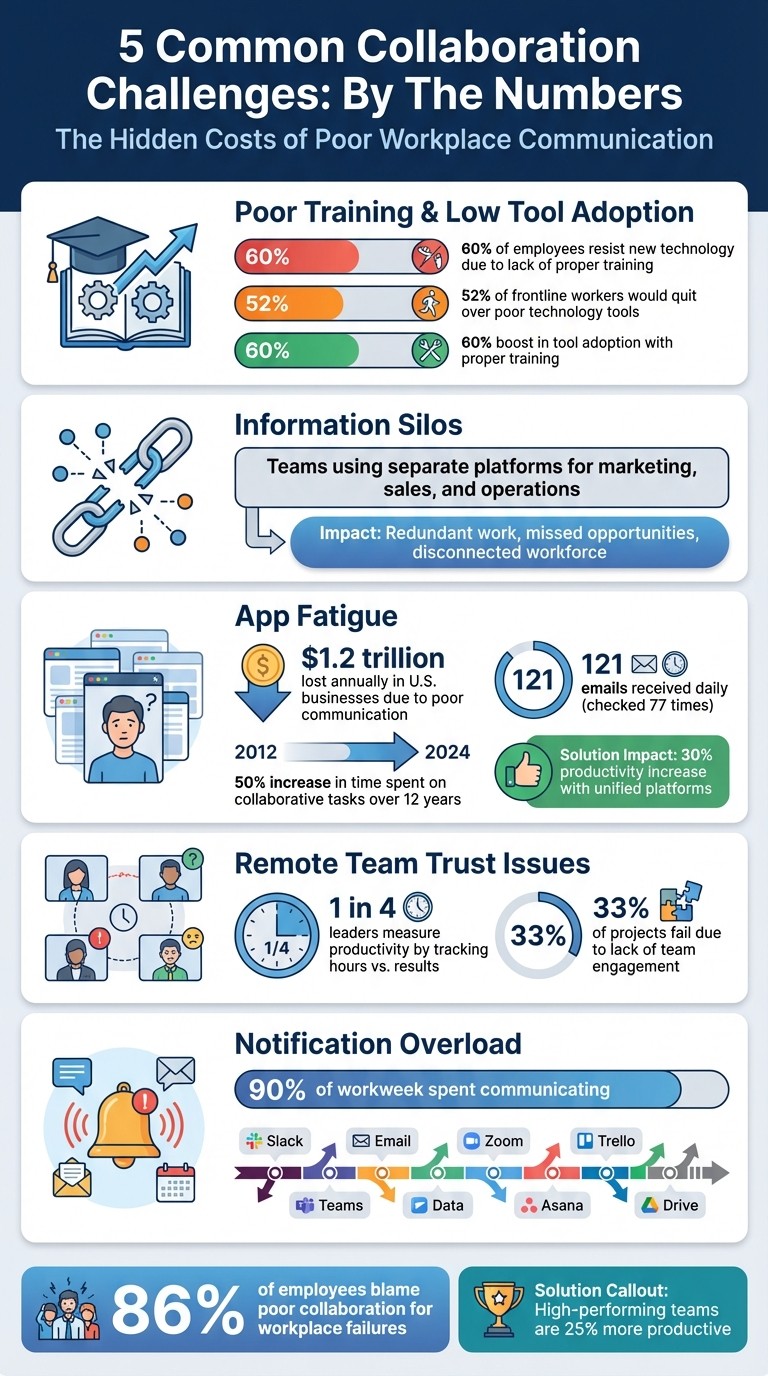
5 Collaboration Challenges: Key Statistics and Impact on Workplace Productivity
Challenge 1: Poor Training and Low Tool Adoption
Let’s be honest - how many times have you seen a shiny new tool rolled out at work, only to watch it gather digital dust? It’s not usually because the tool is bad. It’s because 60% of employees resist adopting new technology simply due to a lack of proper training and familiarity. I’ve seen it happen: a manager introduces a new platform with one email saying, “Here’s your login,” and then expects magic to happen. Spoiler alert - it doesn’t. Instead, people stick to what they know: email chains, sticky notes, or even group texts. Why? Because learning something new feels like extra work when their plates are already overflowing.
Here’s where it gets serious: 52% of frontline workers would consider quitting their jobs over poor technology tools. This isn’t just about frustration - it’s about retention. When retail associates or restaurant staff can’t access their schedules or company updates easily, it sends a clear message: “You’re not a priority.” And let’s face it, no one wants to feel undervalued.
The real issue lies in the gap between rolling out the tool and getting people to actually use it. It boils down to three things: the tool has to be easy to use, training must show immediate value, and ongoing support is non-negotiable. Companies that prioritize training see a 60% boost in tool adoption rates. That’s why we made a point to rethink our onboarding strategy at Pebb, focusing on creating quick wins right out of the gate.
Solution: Make Onboarding Simple and Show Quick Results
At Pebb, we knew we had to tackle this problem head-on. Our goal? Make onboarding so simple and intuitive that employees could start seeing the benefits almost instantly. No thick manuals. No confusing setup. Just straightforward, user-friendly design.
Here’s an example: imagine your warehouse worker opens the app and, in seconds, sees their shift schedule, catches up on company updates, and messages their team lead - all without digging through endless menus. That’s exactly how we built Pebb. Features like group chats and the news feed are front and center, right where they should be.
Take Elara Caring, for instance. They rolled out the Blink employee app in 2024 to connect 32,000 carers who didn’t even have company email before. Their annual staff turnover rate was a staggering 65%. But after introducing a mobile-first platform for schedules, paystubs, and peer recognition, 96% of employees said they’d recommend the tool. That’s what happens when onboarding is done right.
Here’s what works:
Pair new users with a "buddy" who already knows the platform.
Build a simple knowledge library with quick how-to guides (we include this in Pebb).
Show how the tool solves their specific pain points on day one.
When someone realizes they can swap shifts with two taps or pull up updated safety protocols in seconds, they’re sold. It’s that simple.
At Pebb, we’ve made it a point to keep everything in one place: shift scheduling, PTO management, work chat, tasks, calendar, and more. No app-switching headaches. And for smaller teams, our Standard plan is completely free for up to 15 employees - a no-risk way to test-drive the platform. For larger teams, our Premium plan is just $4 per user per month, offering advanced features like voice and video calls, analytics, and enterprise SSO, all while keeping the onboarding experience seamless.
"Proper training can enhance tool adoption and ease frustrations associated with new technologies." - Kara Goldin, Founder of Hint Water
The takeaway? If your team needs a manual to figure out your collaboration tool, you’ve already lost. Keep it simple, deliver quick wins, and watch your adoption rates skyrocket.
Challenge 2: Information Silos Between Teams
Picture this: marketing is managing campaigns on Google Drive, sales is tracking leads in a separate CRM, and frontline staff are getting updates from a bulletin board in the breakroom. It’s chaos. No one knows what the other is doing, and important information slips through the cracks. That’s the reality of information silos, and it’s costing companies more than just headaches. Redundant work piles up, opportunities are missed, and confusion reigns supreme.
This issue becomes even more glaring for teams that rely on mobile access. Imagine a retail associate trying to check product specs or a warehouse worker looking for updated safety protocols. They shouldn’t have to dig through five apps or wait until they’re at a desktop to find what they need. But that’s often the case when information is scattered across disconnected platforms. Each team sticks to its own system, leading to duplicated efforts and missed updates.
The worst part? These silos don’t just slow down work - they disconnect people from the bigger picture. When technicians miss a critical announcement or restaurant staff skip over training updates buried in emails, it creates a two-tier workforce. And let’s be real: in 2026, employees expect their work tools to feel as seamless as the apps they use in their personal lives. Anything less won’t cut it.
The root cause? Too many tools that don’t talk to each other. HR, operations, leadership - each department uses its own platform, and before you know it, silos form. The connections between teams weaken, and collaboration takes a back seat.
Solution: Put Everything in One Place
Once we saw the damage silos were causing, the answer became obvious: consolidation. When we built Pebb, we made it our mission to bring everything teams need into one easy-to-access hub. No more app-hopping to find a document, check a schedule, or catch company updates. It’s all there - knowledge libraries, people directories, task management, news feeds, and group chats - living side by side.
Here’s how it works in real life. Say your operations manager updates a safety procedure. In a siloed setup, they might email it to some people, post it in Slack for others, and maybe even print it out for the warehouse crew. Half the team sees it; the other half doesn’t. With Pebb’s knowledge library, updates are centralized and instantly accessible on any device.
Our news feed breaks down barriers by making company-wide updates visible to everyone. If leadership shares a big win or announces a new initiative, it doesn’t get stuck in management meetings - it reaches every employee in real time. And with groups, teams like marketing, sales, and product can collaborate on specific projects without losing information in endless email chains.
What really sets Pebb apart is how it connects communication with action. Need to assign a task? It’s linked directly to the conversation about it. Looking for someone who knows the ins and outs of a project? The people directory puts their contact info and role at your fingertips. Everything flows together seamlessly, instead of living in isolated systems.
And here’s the kicker: our Standard plan is free for up to 15 employees, giving you access to chat, knowledge, task, and scheduling features. The Premium plan, at just $4 per user per month, adds analytics that track engagement patterns across departments. You can see which teams are falling into silos and address the issue before it snowballs into a bigger problem.
When everything is in one place, information silos become a thing of the past, and your team can finally work as one. That’s the power of consolidation.
Challenge 3: Too Many Tools and App Fatigue
Let me paint a picture you might recognize: you start your day hopping between Slack for messages, Microsoft Teams for video calls, Asana for task tracking, and Google Drive for documents. Meanwhile, your inbox is lighting up with 121 emails, and you're checking it an average of 77 times a day. Sound familiar? This constant back-and-forth between apps isn’t just annoying - it’s exhausting. It’s what we call app fatigue, and it’s a silent productivity killer.
Here’s the kicker: this chaos comes with a hefty price tag. U.S. businesses lose a jaw-dropping $1.2 trillion annually due to poor communication practices. And over the past 12 years, the time we spend on collaborative tasks like instant messaging and meetings has skyrocketed by 50%. Instead of streamlining our work, these disconnected tools often create a fragmented mess, where important information slips through the cracks. It’s like trying to run a marathon while carrying a suitcase in each hand - inefficient and downright draining.
Solution: Use One Platform Instead of Many
This is exactly why we built Pebb - to take the chaos out of your workday. With Pebb, everything you need lives in one place: chat, scheduling, PTO management, tasks, knowledge libraries, news feeds, and even people directories. No more toggling between apps, no more missed messages, no more wasted energy.
The numbers back it up. Digital platforms that unify communication can increase employee productivity by about 30%. And high-performing teams? They’re up to 25% more productive than teams that aren’t as connected. By cutting out the constant context switching, Pebb gives your team the focus they need to thrive.
Here’s how it works in real life: your operations manager can post a shift update, assign tasks, and share documents - all without leaving Pebb. No more jumping between Slack, Google Calendar, and email. And for teams ready to go all-in, our Premium plan is just $4 per user per month. It includes voice and video calls, analytics, and integrations. The best part? It simplifies your workflow instead of complicating it.
Not ready to commit? No problem. Our Standard plan is completely free for teams of up to 15 employees. You’ll get access to work chat, scheduling, tasks, and more - no hidden fees, no credit card required.
Challenge 4: Building Trust in Remote and Hybrid Teams
Let’s face it - trust doesn’t just magically appear when your team is spread across cities, time zones, or even continents. Remote and hybrid setups strip away those casual, watercooler moments where trust usually grows. And here’s a sobering stat: 1 in 4 leaders still measure productivity by tracking hours and online status instead of focusing on actual results. That’s not trust - it’s surveillance, and it doesn’t sit well with most employees.
But there’s an even bigger issue lurking: proximity bias. It’s human nature for managers to favor the folks they see in the office, often giving them first dibs on opportunities or sharing critical updates with them first. Meanwhile, remote team members can feel sidelined, and that’s a recipe for disaster. In fact, 33% of projects fail because team members aren’t fully engaged or involved. Think about it - when people feel excluded or micromanaged, psychological safety takes a nosedive. And without that safety net, collaboration doesn’t just suffer - it collapses.
Solution: Build Everyday Connections with Pebb
When we noticed these trust gaps, we knew we had to rethink how remote teams connect. Trust isn’t built through one-off team-building exercises; it’s built through consistent, meaningful interactions. That’s why we designed Pebb with features that make everyday connection easy, whether it’s for work or just for fun.
Take our groups, for example. These spaces let employees bond over shared interests - whether it’s a book club, swapping pet photos, or planning a weekend hiking trip. These little pockets of connection go a long way in creating genuine relationships. Then there’s our news feed, where public recognition takes center stage. A simple peer-to-peer shout-out can make someone’s remote contributions visible to the entire team, helping them feel valued and appreciated.
And for those moments when typed words just don’t cut it, we’ve got integrated voice and video calls. These tools capture the nuance and non-verbal cues that text alone can’t deliver, making sensitive or complex conversations feel more human.
Here’s the kicker: strong collaboration can boost team productivity by up to 25%. For just $4 per user per month, our Premium plan offers voice/video calls, analytics, and integrations to keep your team firing on all cylinders. Smaller teams? No problem. Our free Standard plan supports up to 15 employees, giving you access to work chat, news feeds, and groups - all the essentials to start building trust today.
Challenge 5: Too Many Notifications and Competing Priorities
Did you know the average worker checks their email 77 times a day and receives a staggering 121 new emails?. Now toss in Slack pings, Teams alerts, texts, and calendar reminders, and you've got a recipe for chaos. It’s no wonder professionals spend about 90% of their workweek communicating. With constant notifications pulling us in every direction, deep, focused work feels like a distant dream.
But here’s the kicker - the issue isn’t just the sheer number of notifications. It’s the fact that they’re scattered across so many platforms. Updates pop up in email, project management tools, group chats - you name it. This fragmented system doesn’t just waste time; it chips away at focus. When every ping screams for attention, nothing feels genuinely urgent. The result? We end up reacting to everything instead of prioritizing what truly matters.
Solution: Organize and Prioritize Updates
When we built Pebb, this was one of the first problems we set out to tackle. We knew teams needed a better way to manage updates without drowning in notifications. That’s why we designed our news feed to serve as a central hub for everything - company announcements, project milestones, team updates - you name it. Instead of bouncing between five different apps, your team can check one streamlined space. Post an update once, and everyone can catch up on their own schedule. Goodbye, unnecessary check-in meetings!
We didn’t stop there. With customizable permissions, employees only see updates that actually matter to their role. For example, if you’re in marketing, you won’t be bogged down by notifications about warehouse inventory. And our tasks feature helps teams manage deliverables asynchronously, so those daily status meetings can become a thing of the past. By encouraging your team to batch their communication - checking messages at set times instead of reacting to every ping - you’ll notice a big boost in productivity.
Here’s the best part: for just $4 per user per month, our Premium plan offers advanced permissions, analytics, and integrations to keep everything organized without the noise. If you’re part of a smaller team, our free Standard plan supports up to 15 employees and includes essentials like work chat, news feeds, and tasks. It’s all designed to help you cut through the clutter and focus on the work that actually matters.
Conclusion
Here’s a number that hits hard: 86% of employees and executives blame poor collaboration and communication for workplace failures. It’s a stark reminder of how critical it is to get teamwork right. Challenges like onboarding gaps, information silos, app overload, trust issues in remote setups, and endless notifications may seem overwhelming, but the good news? They’re problems we can solve.
The key to fixing them lies in one word: simplicity. By bringing everything together - onboarding, communication, task management, and updates - into a single platform, you cut out the clutter and streamline the way teams work. In fact, studies show that this kind of unified approach can boost productivity by as much as 25%. That’s exactly the kind of transformation we had in mind when we created Pebb.
We built Pebb because we saw firsthand how teams were struggling - drowning in tools, buried under notifications, and tangled in disconnected workflows. With Pebb, we’ve brought all the essential collaboration and communication tools into one easy-to-use platform.
Want to see the difference for yourself? Start with Pebb for free if you’re a small team, or unlock advanced features with an upgrade. Either way, it’s a step toward smoother, more productive teamwork. Trust me, your future self will be glad you did.
FAQs
How does Pebb make onboarding easier and encourage employees to adopt the platform?
When a new team member logs into Pebb for the first time, it’s like walking into a space where everything just makes sense. There’s no fumbling around or feeling lost. Admins can get teams set up quickly and easily - no need to start fresh or waste time transferring data. It’s all there, ready to go, making onboarding a breeze for everyone involved.
What truly sets Pebb apart is its all-in-one design. Instead of hopping between Slack for messaging, Teams for meetings, or separate tools for scheduling and HR, Pebb brings it all together. Group chats, shift schedules, video calls - everything your team needs is housed in one place. This setup not only simplifies life for new hires but also eliminates the headache of managing multiple apps. It’s straightforward, intuitive, and designed to help your team get up to speed quickly and efficiently.
How does Pebb help prevent information silos within teams?
At Pebb, we've made it our mission to tackle one of the biggest productivity killers: information silos. You know the drill - jumping between tools to find that one policy document or scrambling through apps to track down a project update. It’s frustrating, right? That’s why we’ve centralized everything into one platform. Group chats, voice and video calls, tasks, shift schedules, even the knowledge library - it’s all in one place. No more tool-hopping. Need the latest policy? It’s there. Collaborating on a project? It’s all streamlined.
What makes Pebb stand out is how we’ve built it to encourage effortless teamwork. Take our Groups feature, for example. Whether your team’s on the frontline or working from the office, Groups help everyone stay aligned around shared goals or initiatives. Updates, ideas, and progress flow naturally, so nobody’s left out of the loop.
And here’s the kicker: Pebb’s Standard plan is free for up to 15 employees. Yep, free. If you’re looking for a little extra, our Premium plan is just $4/user/month. So, budget constraints? Not an issue. You won’t have to cobble together disconnected tools that create silos all over again. With Pebb, we turn scattered information into a single, transparent workspace - and honestly, it’s a game-changer.
How does Pebb reduce app fatigue and help teams work more efficiently?
We get it - too many apps can make work feel like a never-ending scavenger hunt. That’s exactly why we built Pebb: an all-in-one platform designed to simplify your workday. With Pebb, you can handle everything in one spot - chat with your team, post updates, schedule shifts, request PTO, find colleagues, and even jump on voice or video calls. No more bouncing between apps or endlessly searching through tabs!
Pebb was made with frontline workers in mind, especially those who depend on their mobile devices. By bringing all the tools you need into one easy-to-use hub, we help cut down the hours wasted switching between platforms. And it doesn’t stop there - features like analytics, a news feed, and a knowledge library make sure the info you need is always at your fingertips. The result? A boost in productivity and a stronger sense of connection across your team. Best of all, we’ve kept it affordable. There’s a free plan for up to 15 employees, and our premium option is just $4/user/month - a small price for a big upgrade in how your team works together!
