

Author: Ron Daniel
How to build a sense of community for remote-first companies
Practical habits for remote-first teams: one shared hub, clear communication rules, repeatable rituals, manager check-ins, and visible feedback.
Most remote teams don’t have a communication problem. They have a belonging problem.
I’ve seen this at Pebb.io. We had chats flying, meetings stacked on the calendar, and updates posted all day long. From the outside, it looked like we were connected. But some people still felt alone, new hires took too long to feel part of the team, and cross-team work slipped because too much lived in too many places.
The data lines up with what I saw. Fully remote employees often report strong engagement, yet 25% say they feel lonely daily, and knowledge workers can lose close to 4 hours per week just from switching between apps. That gap matters. When people feel disconnected, work gets slower, trust gets thinner, and teams start acting like separate islands.
So I want to keep this simple. I’m going to walk through the few habits that made the biggest difference for us: clear communication rules, one shared home for work, repeatable team rituals, including virtual team building activities, manager-led check-ins, and feedback loops that people can actually see.
If your remote company feels busy but not close, this is where I’d start.
Set clear communication rules and one shared digital home
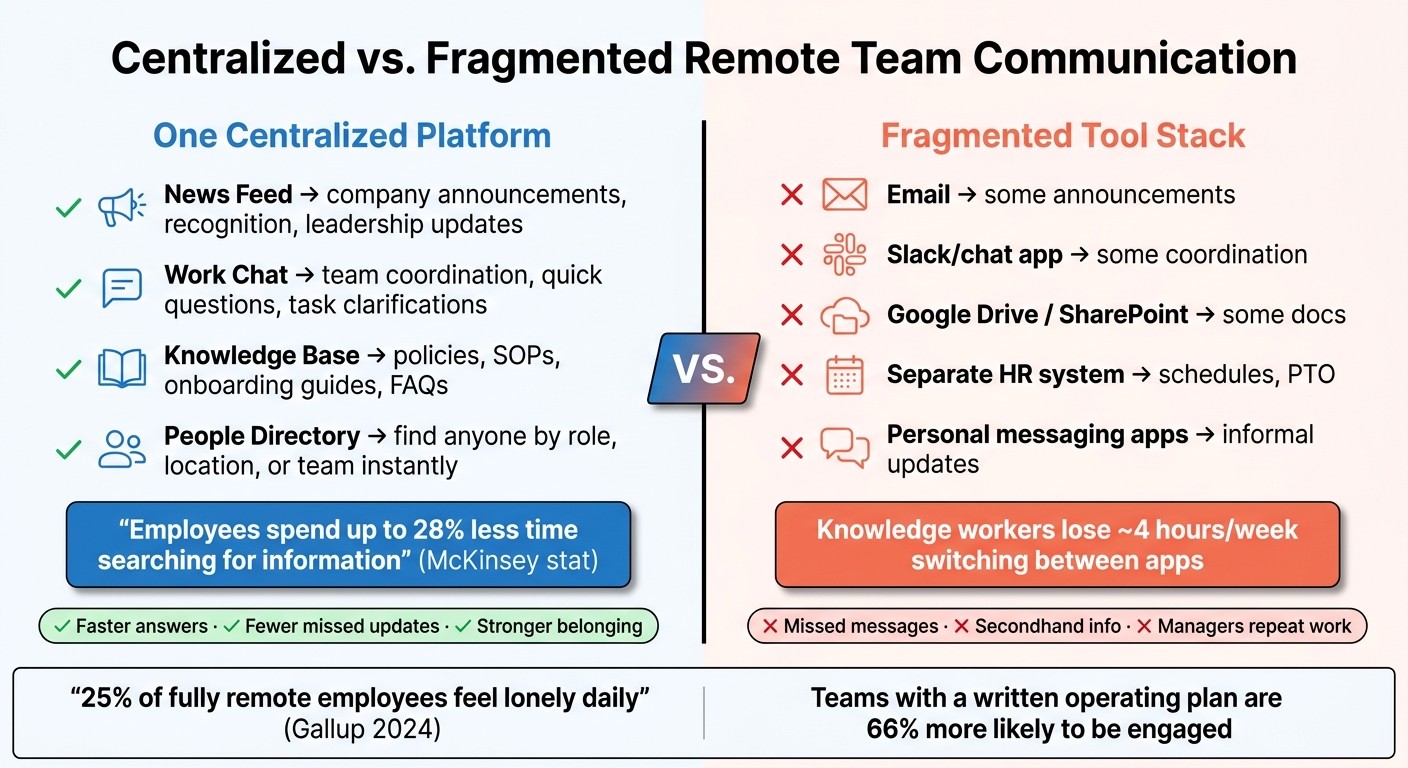
Remote Team Community: Centralized vs. Fragmented Communication
A while back at Pebb.io, I watched a simple update turn into a mini scavenger hunt.
A manager posted a policy note in one tool, followed up in chat, and then someone asked for the latest version in a totally different place. By the end of the day, three people were working from old info. Nobody meant to make a mess of it. But that’s what happens when teams don’t have one clear system.
After we got the basics of community in place, the next move was simple: give people one clear place to communicate. If rules are fuzzy, updates get buried and urgent questions vanish into the noise. The fix isn’t fancy. We just had to write it down. Once people know where to post, it gets a whole lot easier to give them one place to find everything else.
Write simple channel rules for updates, chat, and documentation
We learned not to overcomplicate this. A short guide works best. It should tell employees exactly where each message belongs across three places:
News feed → company-wide announcements, policy changes, leadership updates, recognition, and major initiatives
Work group chats → day-to-day team coordination, quick questions, shift updates, task clarifications, and informal check-ins
Knowledge base → policies, SOPs, onboarding guides, FAQs, and repeatable workflows
Here’s the thing: channel rules fall apart if nobody knows when to reply.
So we set simple response-time expectations for urgent chat, routine questions, and announcements. We also defined shared core hours for live work. Outside of that, we keep async as the default. And if a thread starts going in circles or passes three back-and-forth replies, we move it to a call.
That one habit saved us a lot of drag. Fewer long chat spirals. Fewer “Did you see my message?” pings. More forward motion.
And this part goes deeper than logistics. When people know where to look and what to expect, they spend less energy guessing and more energy contributing. Clear rules build trust. Trust helps people feel part of the team.
Build a central hub with chat, news, directory, and knowledge base
At Pebb.io, we found that rules only stick when the same platform holds the news, chat, and docs those rules point to.
Inside Pebb, work chat handles team coordination in dedicated channels, like a project space or a cross-functional group. The news feed acts as the main board for leadership updates, recognition, and links to docs. The people directory helps anyone find a coworker by role, location, or team in seconds, which matters a lot when people rarely meet face to face. Then the knowledge base serves as the single source of truth for policies, onboarding materials, and repeatable workflows.
Let me tell you what happened next when we leaned into that setup.
People stopped asking where things lived. New hires ramped with less hand-holding. Managers spent less time repeating the same update in three places.
For frontline and mobile employees, this matters even more. When chat, news, directory, and docs live in one app, people don’t have to bounce between disconnected systems just to do basic work. McKinsey found employees can spend up to 28% of their workweek searching for information across those systems. One shared hub cuts that waste directly and gives everyone the same context at the same time.
Centralized communication vs. fragmented tools
I’ve seen the same communication rule play out in two very different ways.
In one platform, it works.
Across five tools, it starts to crack.
With Pebb, leaders can post in the news feed, send people to the knowledge base, and keep day-to-day coordination in work chat, all in one place. In a fragmented stack, that same update gets repeated across email, personal messaging apps, and separate tools. That’s where missed messages creep in. That’s where secondhand info spreads. That’s where managers end up doing the same work twice.
What I like about centralization is that it helps on both sides of the equation. It’s practical, because people get faster answers and miss fewer updates. And it’s human, because everyone has a clearer sense of where they belong and how to stay in sync.
Create shared rituals that make remote work feel social and predictable
When we started paying closer attention to remote team habits at Pebb.io, one thing hit me fast: people don’t feel part of a company because of one big event. They feel part of it because of the little things that keep showing up every week.
That’s the part a lot of teams miss.
Once your shared digital home is set up, community comes from what happens inside it again and again. I’m talking about repeated habits that make remote work feel social and predictable. And in my experience, those habits work best when they live in the same place people already use for updates, chat, and recognition.
Office life used to come with a built-in rhythm. You had hallway chats, lunch breaks, and Friday recaps without even trying. Remote work strips a lot of that away. Big events don’t fix it. What does help is small, repeating touchpoints people can count on.
The need for that rhythm is pretty clear in the data. According to Gallup's 2024 State of the Global Workplace, 25% of fully remote employees report daily loneliness, compared with 16% of fully on-site workers. I’ve seen that gap shrink when teams build consistent, low-friction rituals into the week instead of treating connection like a once-a-quarter project.
Use weekly and monthly rituals to reduce isolation
Here’s the thing: rituals help because they give remote teams a predictable way to see each other’s work. Not in a forced, awkward way. Just enough to remind people, “I’m not doing this alone.”
The rituals that last are usually the simplest ones.
Weekly written standups are the easiest place to start. We’ve seen this work well when each person drops three short bullets into a shared channel:
what they finished
what they’re working on
any blockers
Short is the whole point. Standardized helps too. If every update follows the same format, people don’t have to think hard about how to post.
Friday wins posts are another ritual I’d push almost any team to try. At Pebb.io, we’ve found that a manager or rotating team member can share 3 to 5 team wins, tag people by name, and link to the actual work. That post can live in a dedicated Team Wins channel or right in the company news feed. Simple move, big difference.
If the team needs something lighter, I like rotating small groups into 20- to 30-minute virtual coffee chats. No agenda. Low pressure. Cameras optional. That last part matters more than people think.
On the monthly side, all-hands should cover updates, priorities, recognition, and Q&A. If your team spans multiple U.S. time zones, don’t make attendance the price of staying informed. Record the session, share a written summary, and add an async Q&A thread so people can respond later.
We’ve also learned that async retrospectives help round out the month without adding meeting fatigue. Keep the template plain: what worked, what didn’t, what to change. Then give people 2 to 3 days to respond in writing. And yes, write the format down. New hires settle in much faster when they can see the rhythm instead of guessing it.
Make recognition visible in daily team spaces
I’ve seen teams overcomplicate recognition. They build a separate program, launch it with energy, then forget about it two weeks later.
What works better is folding recognition into the weekly rhythm.
In an office, someone can say “great job” in the hallway and it feels natural. In remote teams, that moment doesn’t just happen. You have to design it into the day-to-day flow. A #shoutouts or #kudos channel works well when the praise is tied to actual work. On Pebb, managers can post shoutouts directly in the news feed, where the whole company sees them next to regular updates.
That visibility matters, but the bigger point is this: praise has to be specific.
“Great work this week” is fine, but it doesn’t hit like, “Alex coordinated three teams to launch the new onboarding flow ahead of schedule.”
That kind of praise tells people what mattered. It shows the behavior you want repeated. It also reminds remote employees that they’re seen, not just needed.
We’ve found the same thing with birthdays and work anniversaries. Those are worth automating. If the platform surfaces a reminder or drafts the message, managers are much more likely to follow through, and the employee feels seen in a way that might not happen otherwise.
Async rituals vs. live rituals: how to choose
Let me tell you what happened next when we looked at our own habits: like a lot of teams, we realized we were defaulting to meetings for almost everything.
That gets expensive fast, especially when people are spread across the country.
My rule of thumb is pretty simple:
Use async for repeatable work like updates, recognition, and retrospectives.
Use live time for relationship-building, complex discussion, and open Q&A.
That split saves energy and makes live sessions feel more worth showing up for.
And when you do hold a live session, document it every time. Share a written summary, post the recording, and open an async thread for follow-up questions. That way the outcome belongs to everyone, not just the people who could make that exact time slot.
I’ve come to see async-first habits as more than a time-saving move. They help distributed teams include people across time zones in a real way, instead of treating them like an afterthought.
Make managers responsible for community-building habits
I’ve seen this play out up close at Pebb.io: you can set up all the right rituals, write clean communication rules, and build a solid system, but if managers don’t keep it alive week after week, the whole thing starts to feel hollow.
That’s the part people miss.
In remote-first teams, community can’t be treated like a side project. It has to live inside the weekly rhythm of work. The platform gives us the structure. Managers are the ones who make it feel human.
And the numbers back that up. Managers drive most team engagement, yet weekly 1:1s are still rare. Employees who never meet one-on-one with their manager are more than three times as likely to be highly disengaged. From what I’ve seen, the issue usually isn’t that leaders don’t know what to do. It’s that they don’t do it often enough.
Here’s the thing: the habits that help aren’t fancy. They just need to happen on a steady basis.
Run check-ins that cover workload, mood, and blockers
One mistake I used to see all the time was managers overthinking the weekly 1:1.
It doesn’t need to be a huge meeting. In most cases, 20 to 30 minutes does the job just fine if the structure is clear. At Pebb.io, we keep coming back to three prompts:
Workload
Mood
Blockers
That’s it.
But those three prompts open up more than you’d expect. A teammate might say their workload is “fine,” then admit they’re mentally drained. Someone else might look okay on paper but mention they’re stuck waiting on another team. That’s usually where the early signs show up: isolation, burnout, and confusion tend to surface quietly before they turn into visible problems.
I’ve learned that if you wait until the problem is obvious, you’re already late.
That’s why a short biweekly pulse check helps so much. It gives managers a way to spot patterns early instead of guessing. On Pebb, managers can build recurring check-in forms and track responses over time, which makes those trends a lot easier to see.
What happens next matters too. Those conversations shouldn’t vanish into thin air. They should lead to visible recognition and tighter follow-up.
Turn recognition and feedback into a regular routine
Let me tell you what happened next when we made recognition more routine instead of random: people started noticing each other’s work more often, and not just managers.
Recognition works best when it’s predictable, public, and specific. A short “wins of the week” post every Friday in a team channel, with names and actual impact, keeps good work from getting lost in the shuffle. On Pebb, that can go straight into the news feed or a dedicated #kudos channel.
That public piece matters. When praise is vague, late, or only shared in private, people can feel invisible even when they’re doing solid work.
Feedback is a different kind of conversation. I’ve found it works better in private, usually during 1:1s. We keep it simple:
what went well
what could improve
what support is needed
That structure keeps the conversation moving forward instead of turning into a blame session.
After big milestones, a short form with “What should we keep, stop, or start next time?” gives employees a fast way to share input. It’s simple, but simple tends to win when people are busy.
Manager office hours help too. A recurring open slot, like Fridays from 2–3 p.m. local time, announced on a steady basis, gives people a known place to bring questions or concerns. When that time stays on the calendar, it becomes a real resource instead of a nice idea no one uses.
These habits hit harder when they show up not just in feedback moments, but also in onboarding and daily workflows.
Manager habits that build community vs. habits that weaken it
I like to gut-check manager habits by looking at the contrast, because the gap is usually pretty obvious once you see it.
Check-ins: Keeping weekly 1:1s at the same time builds trust over time. Canceling them often, or moving them around every week, sends a message too, and it’s not a good one. It tells people the team isn’t high on the list.
Recognition: Posting specific public wins each week shows the team what good work looks like. Generic praise, delayed praise, or praise shared only in private doesn’t carry the same weight.
Expectations: Writing down roles, priorities, and workflows where everyone can find them keeps people aligned. Changing priorities without clear ownership creates confusion fast, and confusion chips away at belonging.
I’ve seen written team plans make a bigger difference than most people expect. Teams with a written team operating plan are 66% more likely to be engaged and 29% less likely to burn out than teams without one.
Connect belonging to onboarding, feedback, and daily workflows
I’ve seen this play out over and over at Pebb.io: team habits stick when onboarding, feedback, and day-to-day work live in the same flow.
Here’s the thing - when people have to bounce between apps just to find a schedule, ask a question, or give feedback, small tasks start to feel weirdly hard. That friction adds up fast. But when everything sits in one place, community stops feeling abstract. People can actually see it and use it.
Build remote onboarding with early social touchpoints
The first two weeks shape a lot more than most teams think. In my experience, the tone starts before day one.
We like to send a personal welcome message from the manager 3–5 days before the start date, along with a link to the team space. It’s a small move, but it changes the first impression. Instead of showing up cold, the new hire already knows where to go and feels expected.
On day one, we make the intro public in the company news feed. We share the person’s name, role, location, and a simple icebreaker - maybe their favorite weekend activity or go-to lunch. That gives teammates an easy opening to jump in and say hello, instead of typing the usual stiff “welcome aboard” and moving on.
We also assign a culture buddy for two chat check-ins during the first month. Let me tell you what happened next when we started doing this more on purpose: new hires stopped leaning only on their manager for every little thing. They had someone close by to ask the awkward stuff, like where to find updates, how people usually communicate, or what actually matters in the first few weeks.
On day one, people should also be able to find the basics without hunting:
the people directory
the shift schedule
the PTO flow
the top role-specific knowledge base articles
For frontline workers with limited computer access, this has to work well on a phone. If it doesn’t, onboarding breaks right at the start. That kind of clarity helps people feel settled faster.
Once people know where they are and how things work, the next step is simple: keep listening.
Use feedback loops to keep community measurable
I’ve learned that if we don’t measure community, we’re mostly going on vibes.
A simple way to do it is with monthly or quarterly pulse surveys using 3 to 5 questions, a 1–5 scale, and one open field. We run them in the same app people already use, because no one wants “one more platform” just to answer a few questions.
The patterns matter. If people keep mentioning confusion around PTO, schedules, or late company news, that usually points to a trust gap - not just a process problem.
And this part matters just as much as the survey itself: when feedback comes in, we close the loop in public. We post a short You said, we did update in the news feed with two or three actions we took. That visible follow-through builds trust because people can see their input didn’t disappear into a form somewhere.
That’s the loop I’ve come to trust most: show people how to get started, then keep tuning how work happens.
Conclusion: build community with consistent habits and one platform
From what I’ve seen at Pebb.io, remote-first community doesn’t come from one big campaign. It comes from steady habits, clear structure, and one shared home for work.
That’s the thread running through every tactic here. When tools are scattered, the system gets weaker. People miss updates, feedback gets lost, and belonging starts to feel patched together.
That’s why we built Pebb: a free, all-in-one employee communication platform with work chat, news feed, people directory, shift scheduling, PTO management, knowledge base, digital forms, and voice and video calls on premium. Premium starts at $4 per user per month.
FAQs
How do you build community without adding more meetings?
I learned this the hard way: more live calls didn’t make our team feel closer. They just made people tired.
At Pebb.io, we started seeing the same pattern again and again. Calendars were packed, messages were scattered, and people still felt out of sync. Let me tell you what happened next: we stopped treating every update like it needed a meeting.
We leaned into asynchronous communication so employees could connect on their own schedules. That shift gave people more breathing room, and it helped community grow in a way that felt natural instead of forced. And when we kept those conversations in one place with Pebb, we cut down on the fatigue that comes from jumping between fragmented apps all day.
Build community by shifting to asynchronous communication
Here’s the thing: people don’t bond just because they’re online at the same time. They bond when it’s easy to share, respond, celebrate, and stay in the loop without stress.
That’s why we use a central news feed for updates, wins, and polls. It gives everyone one clear place to check what’s happening, react to team moments, and join the conversation when it works for them.
We also create dedicated spaces for things like:
hobbies
resources
project collaboration
Those digital hubs do a lot of quiet heavy lifting. They support connection, peer recognition, and relationship-building without pulling everyone into live calls. In my experience, that’s when community starts to feel less like a company initiative and more like something people want to be part of.
What should managers own in a remote-first culture?
At Pebb.io, I’ve seen this play out up close: when managers set clear goals, keep direction steady, and check in on a regular basis, teams don’t drift.
They move.
That sounds simple, but it’s easy to miss when everyone’s busy, messages are flying, and half the team is working from different places. I’ve watched managers think one quick update was enough, only to find out later that people were pulling in slightly different directions. Not wildly off track - just off enough to slow everything down.
Here’s the thing: managers need to own the basics.
Clear, measurable goals
Steady direction
Regular check-ins
When those three pieces are in place, alignment gets a whole lot easier.
I’ve also learned that tools matter more than people like to admit. We use tools like Pebb to make communication simpler and cut down on that isolated, “am I working alone here?” feeling that can creep in fast. A good digital workspace doesn’t fix weak leadership, but it does make strong leadership easier to show every day.
And that daily presence matters. When managers stay active in digital spaces - posting updates, replying to questions, joining conversations, and not disappearing after meetings - they set the tone for engagement. People notice. I know I do.
Then there’s the other side of it: data. When managers use analytics to catch roadblocks early, they can step in before small issues turn into team-wide frustration. I’ve seen how much smoother things go when a manager spots a dip in activity or a breakdown in communication early and deals with it right away.
That kind of steady involvement helps teams stay connected, and it helps build a stronger sense of belonging.
How can we tell if remote employees feel connected?
I’ve learned not to guess when a teammate is drifting. We look at what people do, and we listen to what they say.
Inside Pebb, I use our analytics dashboard to watch response times, group participation, and day-to-day activity levels. That’s usually where the first clue shows up. If interaction drops off, it can point to isolation.
But I never stop at the numbers.
Here’s the thing: a quiet dashboard tells me something changed, not why it changed. So we pair that data with pulse surveys and regular informal one-on-one check-ins. I’ll ask simple questions, like whether employees feel their contributions are valued.
That mix matters. Data gives us patterns. Conversations give us context.
On our team, steady engagement in Pebb’s groups and news feed is one of the clearest signs that people feel connected, seen, and part of something bigger than their task list.
