
Author: Ron Daniel
Team Communication Beyond WhatsApp: Top Picks for 2026
Explore top team communication platforms that replace WhatsApp, offering scheduling, security, and built-in operations.
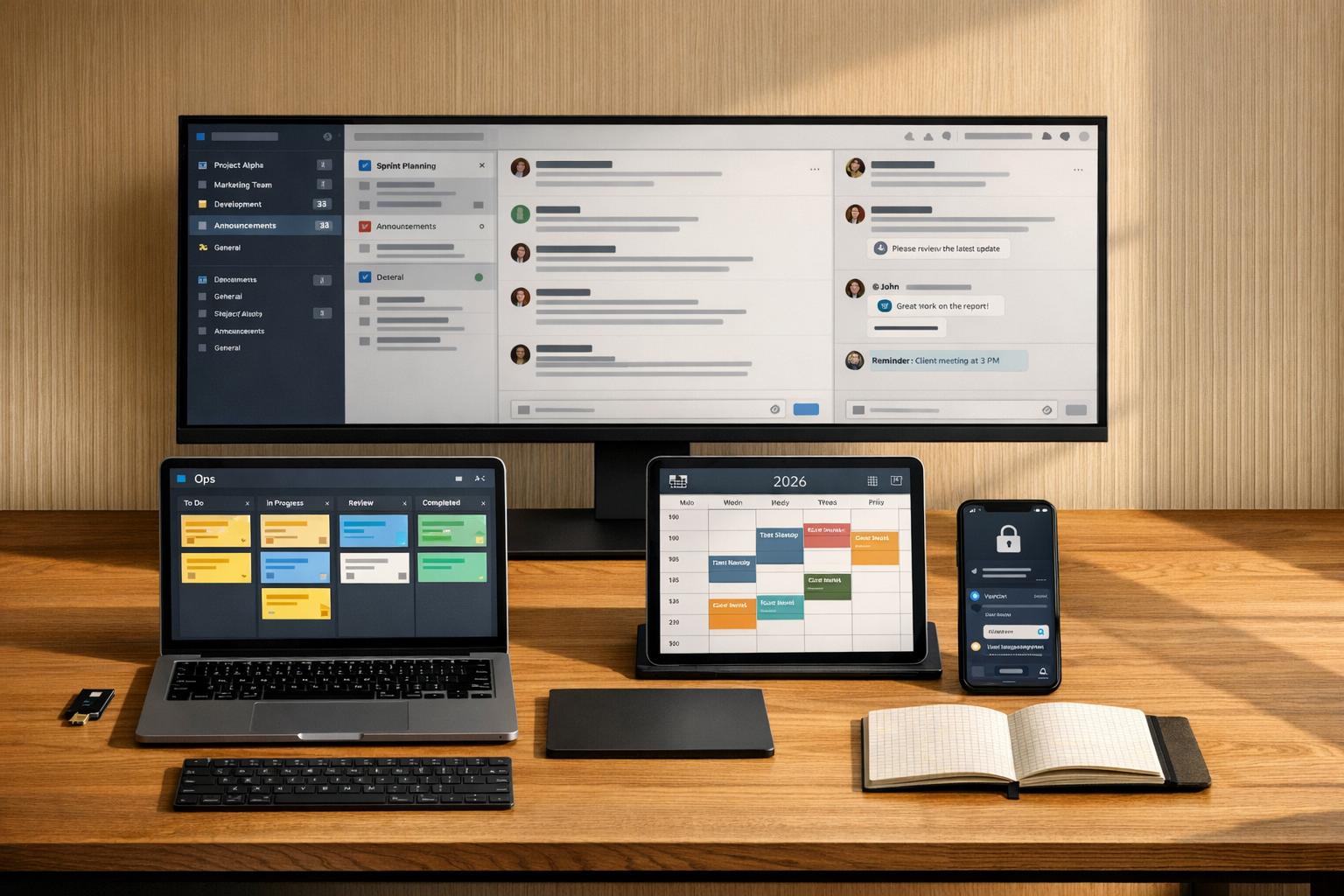
You know that feeling when your work chat turns into a meme dump, and finding an important update feels like digging for treasure? Been there. A few years ago, my team relied on WhatsApp for everything - quick messages, group chats, even scheduling shifts. At first, it worked. But as the team grew, so did the chaos. Important notes got buried, scheduling became a guessing game, and don’t even get me started on trying to track PTO in a group chat. It wasn’t sustainable.
Here’s the kicker: we’re not alone. A 2023 Gartner report showed that 68% of teams using consumer apps like WhatsApp faced data risks, compared to just 12% for those on purpose-built platforms. And by 2026, 75% of enterprises are stepping away from consumer apps altogether. Why? Because they’re not built for work. No task management, no compliance features, no real way to stay organized. It’s like trying to run a marathon in flip-flops - not impossible, but definitely not ideal.
That’s why we built Pebb. It’s not just another tool - it’s a complete workspace designed to simplify communication, scheduling, and team engagement. And we’re not the only ones in this game. Platforms like Slack, Microsoft Teams, and Zoom each bring something different to the table. So, if you’re ready to move beyond WhatsApp, let me walk you through the best options out there, what makes them tick, and why Pebb might just be the solution you didn’t know you needed. Let’s dive in.
1. Pebb
At Pebb, we’ve taken a hard look at the chaos that platforms like WhatsApp can bring to workplace communication. Then, we built something better - a single digital hub where communication, operations, and engagement come together seamlessly.
Communication Features
Let’s face it: WhatsApp group chats can get messy fast. That’s why Pebb organizes conversations into Spaces - dedicated areas for specific departments or projects. Everything stays tidy, searchable, and accessible with unlimited message history. Whether it’s one-on-one chats, group discussions, or integrated voice and video calls, Pebb keeps it all in one place - no need to juggle separate conferencing tools.
Our Heartbeat news feed makes sure company announcements don’t get buried under a flood of messages. Think of it as a social media-style timeline for your workplace. And with the People Directory, connecting with teammates is a breeze - it’s like having everyone’s contact info at your fingertips.
But we didn’t stop at communication. Pebb is packed with tools to streamline operations, too.
Operational Tools
Running a team’s day-to-day operations can be a headache, but Pebb simplifies it. We’ve got shift scheduling that syncs with employee availability and integrates directly with your calendar (formatted for US dates, like 04/15/2026). Need to track working hours? Our real-time clock-in feature has you covered. Managing PTO? Pebb makes it easy with leave tracking and approval workflows, plus digital forms for collecting data.
Here’s a real-world example: In 2026, a US healthcare provider with 200 employees cut scheduling errors by 40% using Pebb’s tools. And since we integrate with Google Workspace, Outlook, and payroll systems like ADP, everything works together smoothly.
Of course, productivity isn’t just about logistics - it’s also about keeping your team engaged.
Engagement Capabilities
Pebb goes beyond just getting the work done. We’ve built features to keep employees connected and invested. You’ll find polls and surveys right in the news feed, calendar events for celebrating team milestones, and a knowledge base to store important resources.
In fact, G2 reviews from 2026 show that small and mid-sized businesses (SMBs) in the US saw a 92% adoption rate with Pebb. Even better, users reported a 35% boost in productivity by having everything they need in one place.
Pricing
Here’s the kicker: Pebb is affordable. We offer a free plan for up to 15 users, which includes chat, shift scheduling, PTO management, and tasks. Need more? Our Premium plan is just $4 per user per month (billed annually). That unlocks voice and video calls, analytics, unlimited admins, and over 50 integrations. For a team of 50, you’re looking at less than $2,400 a year. And if you’re not ready to commit, there’s a 14-day free trial to test out all the Premium features - no strings attached.
Whether you’re managing a small team or scaling up, Pebb keeps everything running smoothly.
2. Slack
Slack has been a go-to for workplace communication for years, and as of 2026, it’s still a strong contender for teams looking to step up from WhatsApp. Unlike WhatsApp, which feels more like a personal messaging app, Slack was built with professional environments in mind, offering tools to keep conversations tidy and easy to access. That said, don’t forget that Pebb provides a free, all-in-one solution that covers communication, operations, and engagement for just $4 per user.
Communication Features
Slack’s standout feature is its channels, which can be public or private, making it easy to organize chats by projects or departments. And here’s the game-changer: threaded messaging. Instead of endless scrolling through group chats, Slack lets you group replies under a single thread - so much easier to follow. Plus, you can search through over a decade of message history.
In 2024, Slack introduced Slack AI, which can summarize threads and even answer questions. According to Forrester, this bumped up productivity for enterprise users by 30%. Then there’s huddles, which are quick audio or video calls for up to 50 people, all without leaving the app. And if you work with external partners, Slack Connect lets you create shared channels with up to 250 organizations - goodbye, messy email chains.
Operational Tools
Slack also excels at integrating with tools like Asana, Trello, Google Calendar, and Shiftboard. Need to remind the team about tomorrow’s meeting? Just type a command like "/remind @team meeting tomorrow 9:00 AM PT." Their Workflow Builder is a no-code solution that automates repetitive tasks like approval processes. And let’s not forget Slack Canvases, a shared space for documents and media inside channels. According to a 2025 G2 review, this feature alone cuts down context-switching by 25%.
Engagement Capabilities
To keep things lively, Slack offers reactions, emojis, and polls through integrated apps. Features like Do Not Disturb scheduling and custom status updates (like "Out of office until 01/05/2026") help maintain boundaries between work and personal life. And here’s a neat trick: Slack’s AI-driven highlights notify you about key mentions, which, according to internal benchmarks, improve response rates by 40% compared to WhatsApp’s basic notifications. These features aren’t just bells and whistles - they’re designed to help teams stay connected and on-task.
Pricing
Slack’s Free plan gives you a 90-day message history and 10 app integrations, which is a decent start. If you need more, the Pro plan costs $7.25 per user per month (billed annually) and includes unlimited search history, 50-person video calls, and unlimited integrations. The Business+ plan, priced at $12.50 per user per month, adds security features like SAML SSO and a 99.99% uptime guarantee. And for larger organizations, there’s Enterprise Grid, which offers custom pricing and advanced compliance tools. To give you an idea, a 50-person team on the Pro plan would cost around $4,350 annually.
3. Microsoft Teams
Microsoft Teams is a powerhouse in workplace communication, especially for companies already invested in Microsoft 365. With a staggering 320 million daily active users as of 2026, it’s impossible to ignore its reach. But here's the kicker: while Teams is bundled into Microsoft 365, Pebb offers a complete solution for just $4 per user, no hidden costs.
Communication Features
What makes Teams shine is its seamless integration with Microsoft 365. You can co-edit Word, Excel, and PowerPoint documents directly in chat channels - no need to download, tweak, and re-upload. It’s a time-saver, no doubt. Teams Phone adds calling capabilities, and Town Halls can host up to 50,000 attendees. For video meetings, the platform supports up to 300 participants on Business plans and up to 1,000 on Enterprise plans.
"If your team lives in Outlook, Word, and SharePoint, Teams is the connective tissue that holds it all together." – Dan Robin, Pebb Insights
Microsoft has also rolled out Copilot, an AI assistant designed to summarize meetings and organize tasks. And for frontline workers, Teams offers tools like Walkie Talkie for instant voice chats and Shifts for scheduling. While Pebb includes shift scheduling at no extra charge, Teams’ version often requires additional subscriptions.
Operational Tools
Teams integrates tightly with SharePoint and OneDrive, making document management a breeze. On top of that, it boasts advanced security features like SOC 2/ISO 27001 compliance and Data Loss Prevention (DLP), which are critical for industries like healthcare and finance. These tools make Teams a solid choice for companies needing secure and efficient operations.
Engagement Capabilities
To keep employees engaged and connected, Teams includes the Viva Suite - designed for communication and community-building. Users can react with emojis, set custom statuses, and keep the conversation lively. However, without strict IT oversight, Teams’ flexibility can lead to cluttered channels, which can be a headache to manage.
Pricing
Here’s where things get interesting. While Teams offers a robust feature set, its pricing structure can quickly add up. The standalone Teams Essentials plan is $4.00 per user per month, but for the full Microsoft 365 experience, costs escalate. Business Basic jumps from $6.00 to $7.00 per user per month, while Business Standard increases from $12.50 to $14.00. And if you want Copilot? That’s an extra $21 per user monthly.
Let’s break it down: a 50-person team using Microsoft 365 Business Basic plus Copilot would cost about $14,400 annually at promotional rates. Compare that to Pebb’s $2,400 annual cost for the same team, and the difference is hard to ignore.
4. Zoom
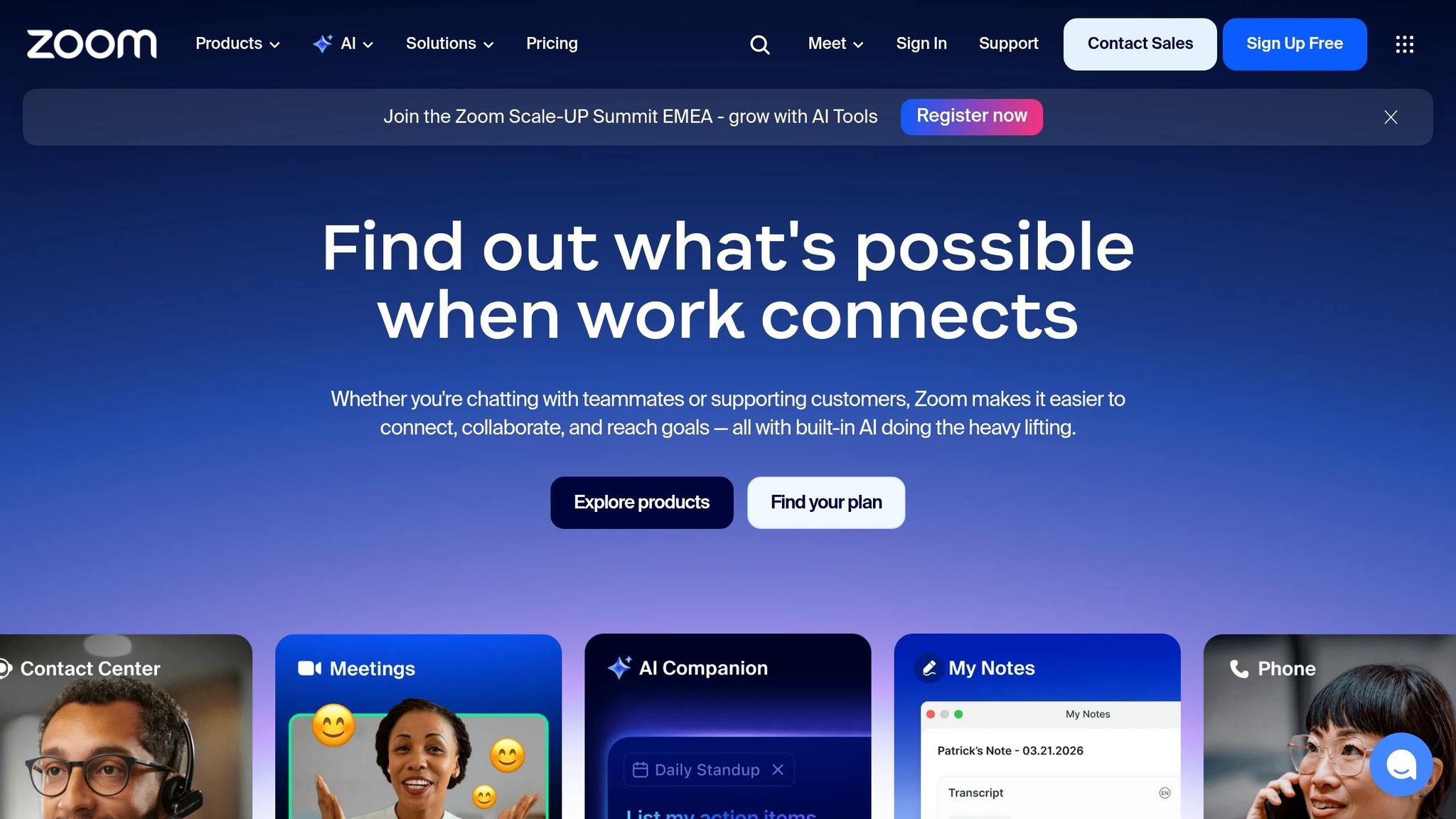
Zoom has transformed into Zoom Workplace, a suite that combines tools like Team Chat, Phone, Whiteboard, and Docs. By 2026, 78% of US enterprises are expected to use Zoom. While Zoom dominates in video conferencing, it doesn't fully cater to the operational needs of frontline teams.
Communication Features
Zoom’s bread and butter is its high-quality video conferencing, accommodating up to 1,000 participants and enhanced with AI features. It also offers Clips for asynchronous updates and Team Chat for ongoing conversations. Add to that Zoom Phone, which integrates VoIP calling and SMS. However, where Pebb seamlessly blends operations with communication, Zoom stays heavily focused on video.
Operational Tools
Zoom does include tools like a Whiteboard for brainstorming and integrates with platforms like Asana and Trello through Zapier. But here’s the catch: it lacks native features for shift scheduling. While its AI Companion can summarize meetings and generate action items, managers still have to rely on external tools for tasks like time tracking and shift management. In contrast, Pebb offers built-in features like shift scheduling, clock-in/out functionality, and task management, making it a one-stop shop for operational and communication needs. Zoom’s integrations fill some gaps, but its strength lies in video - not in delivering a fully integrated solution.
Pricing
Zoom’s pricing reflects its focus on video capabilities. The Pro plan starts at $15.99 per user per month (billed annually), offering 30-hour meetings and unlimited participants. The Business plan costs $21.99 per user per month, adding admin controls and a 500-participant limit. For a team of 50, the annual cost comes to $13,194, which is a staggering 5.5 times more than Pebb’s annual rate of $2,400. And while Zoom Pro includes 5 GB of storage, Pebb Premium offers unlimited storage.
Zoom shines in video meetings and webinars, but if you’re looking for a solution that balances both communication and operations without draining your budget, Pebb stands out. Next, let’s take a closer look at Workvivo and its approach to employee engagement and communication.
5. Workvivo
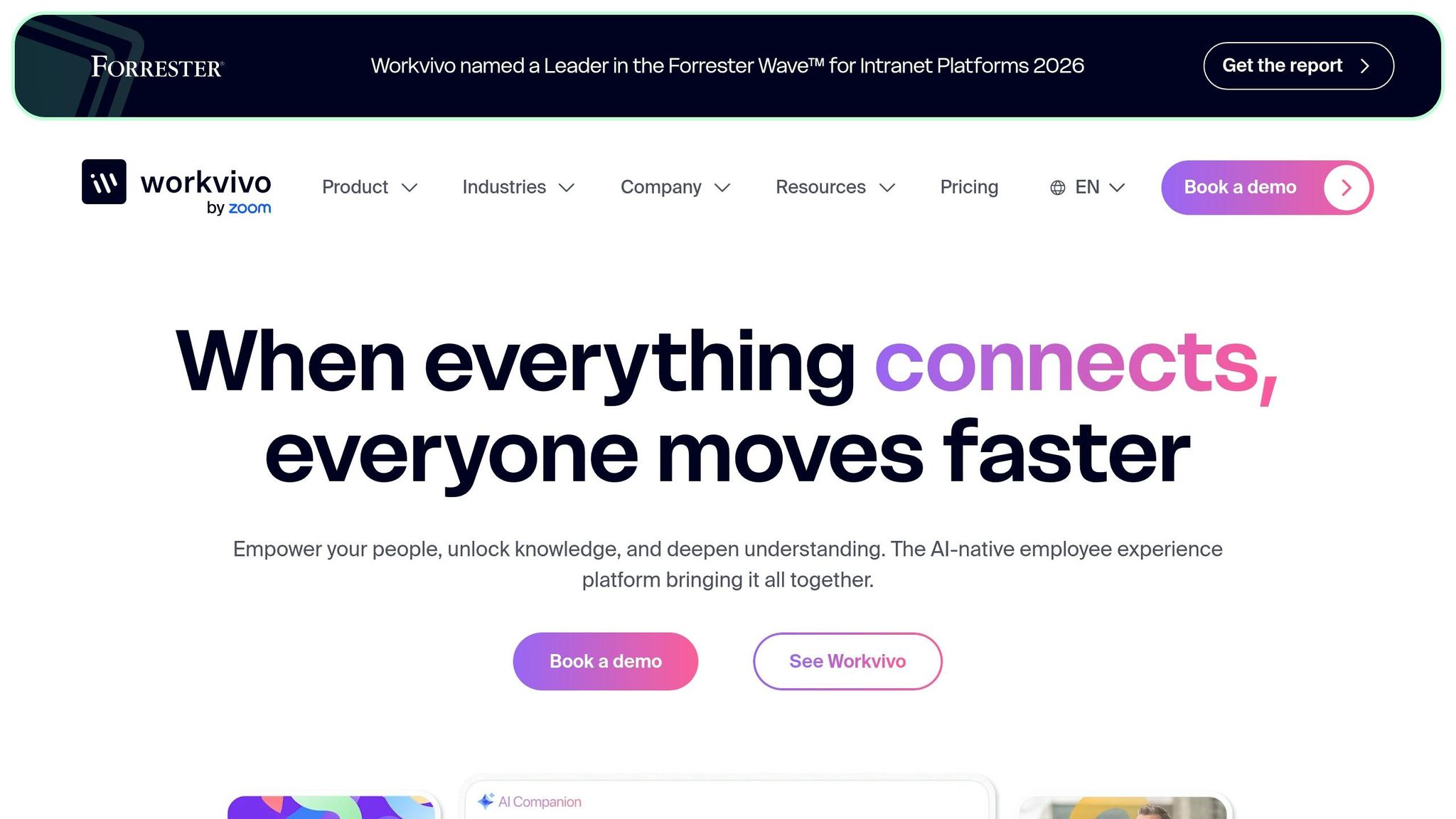
Workvivo is a mobile-first platform tailored for enterprises, combining internal communications, social networking, and intranet features. Since Zoom acquired it in April 2023, the platform has become part of the Zoom Workplace ecosystem. While it’s a great fit for large organizations focused on fostering a connected work culture, its audience differs significantly from Pebb's.
Communication Features
Workvivo offers a news feed that feels like a social media platform, enabling employees to share updates, celebrate wins, and engage with company-wide announcements. It also includes live-streaming and podcasting as part of its base Business plan. However, instant messaging isn’t included as a core feature - it’s an add-on that comes with extra costs. That’s a big contrast to Pebb, where features like work chat, voice, and video calls are included from the start, with no hidden fees.
Operational Tools
While Workvivo aims to simplify workflows by consolidating communication and engagement tools, it doesn’t include workforce management features. Things like shift scheduling, time tracking, and PTO management are missing, which means managers need separate tools to handle these tasks. Pebb, on the other hand, offers a unified solution with built-in scheduling, clock-in/out functionality, task management, and PTO tracking. This makes Pebb a go-to option for teams that need both operational and communication tools in one place.
Engagement Capabilities
When it comes to employee engagement, Workvivo stands out for mid-sized to large enterprises. It offers advanced analytics (as a paid add-on) and digital signage through Workvivo TV. These features are ideal for companies with 250+ employees looking to strengthen their culture and keep distributed teams connected. For smaller teams or those looking for a more balanced solution, Pebb provides a robust news feed, groups, and a people directory - all included without the hefty enterprise price tag.
Pricing
Workvivo’s pricing starts at $20,000 per year, making it clear that the platform is designed for organizations with at least 250 employees. While it bundles many premium features, the steep cost makes it less approachable for smaller teams. By comparison, a 50-person team can choose Pebb for just $2,400 annually, gaining a comprehensive suite of communication and operational tools at a fraction of the cost. Workvivo caters to enterprise budgets, but Pebb is built for teams that want powerful features without overspending.
6. Staffbase and Firstup
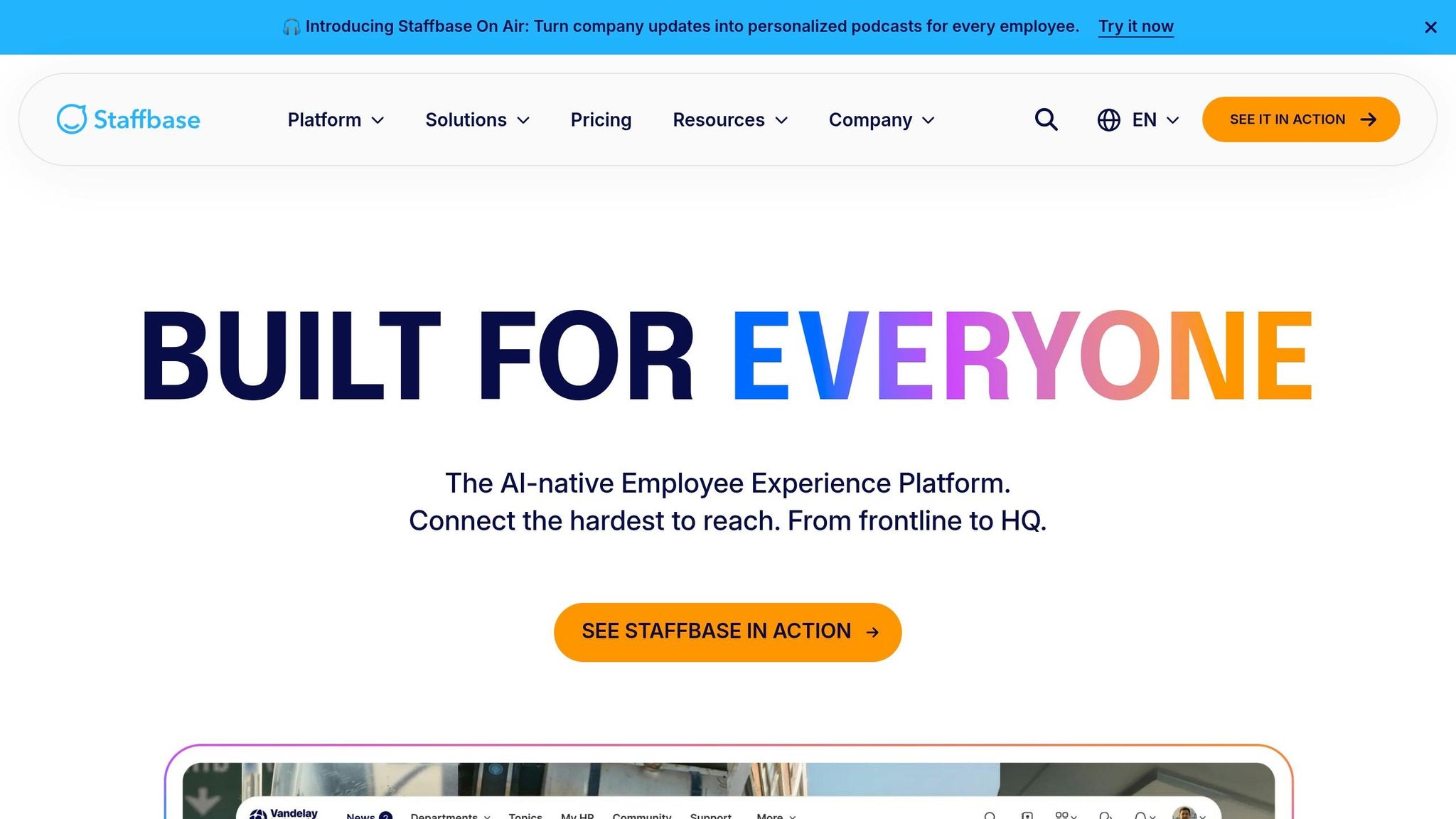
When it comes to enterprise-level solutions, Staffbase and Firstup stand out as go-to platforms for massive organizations. They’re designed to bring order to the chaos of scattered WhatsApp chats by offering structured, branded systems that integrate seamlessly with corporate tools like HRIS and payroll. That said, they cater to a very different audience than we do at Pebb.
Communication Features
Both platforms tackle the challenge of information overload. They use editorial calendars and automated employee journeys to streamline communication. Staffbase, for instance, supports multi-language publishing with translation options for 110 languages, while Firstup offers machine translation in about 75 languages. Impressive, right? But here’s the catch - they don’t include built-in instant messaging, voice, or video calls. That’s a big difference compared to Pebb, where those tools are baked right in.
Operational Tools
Staffbase positions itself as a "unified front door" to your digital workplace. It includes operational tools like shift scheduling, tasks, and payroll widgets. Firstup, on the other hand, focuses more on content distribution and linking to external systems rather than handling operations directly. But here’s the thing - both platforms require heavy integration with existing enterprise systems, which can drive up complexity and costs. At Pebb, we’ve taken a different approach. Everything you need - work chat, shift scheduling, PTO management, task coordination - is bundled into one platform. No extra integrations, no extra headaches.
Engagement Capabilities
Staffbase and Firstup also bring some AI-powered tools to the table. Staffbase has "Navigator", a chatbot that pulls verified answers from internal policies, while Firstup’s "Optimizer" uses AI to time message delivery for maximum engagement. Staffbase even offers full white-label branding, so your company name appears in the App Store, which can boost trust and reduce phishing concerns.
Lisa Mühsig, Storytelling Strategist at Staffbase, sums it up well:
"Choose Staffbase if your priority is high adoption and operational efficiency, especially for frontline teams. Choose Firstup if your goal is a standalone distribution layer focused primarily on push-driven communication".
For smaller teams that don’t need enterprise-level campaign orchestration, Pebb’s features - like news feeds, groups, and a people directory - are more than enough. And for teams that want comprehensive communication tools alongside those engagement features, Pebb is the clear winner.
Pricing
Here’s where things get tricky. Unlike Pebb’s straightforward pricing - $2,400 annually for a 50-person team - neither Staffbase nor Firstup offers transparent costs. Their total cost of ownership often balloons with implementation and integration expenses. While they’re great for massive organizations with complex needs, smaller teams looking for simple, effective communication and operations management often find the price-to-value ratio doesn’t stack up. That’s where Pebb shines, delivering powerful tools without the enterprise-level complexity or cost.
Platform Comparison: Strengths and Weaknesses
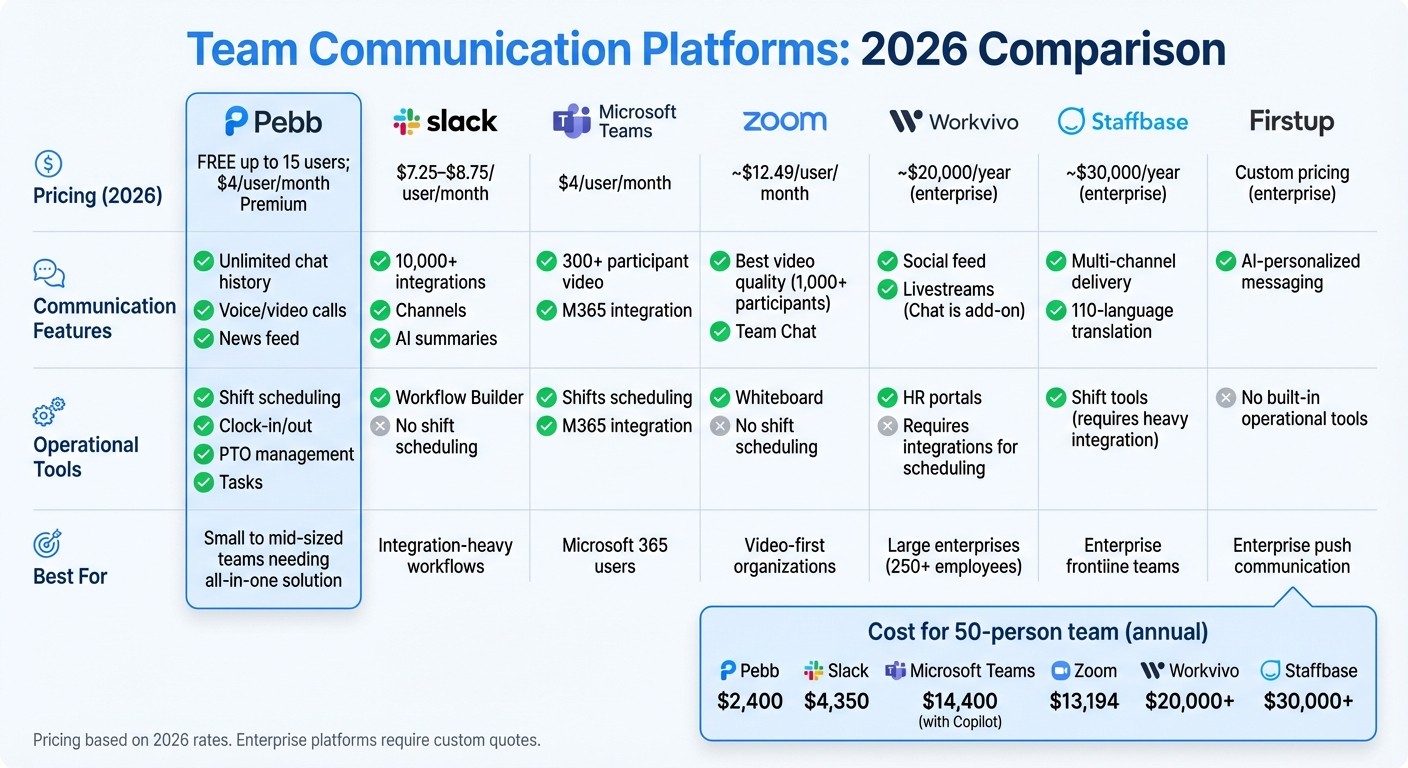
Team Communication Platforms Comparison 2026: Features and Pricing
Let’s break down how Pebb stacks up against the competition in Communication Features, Operational Tools, Engagement Capabilities, and Pricing. Here’s a quick look at the numbers and features:
Platform | Communication Features | Operational Tools | Engagement Capabilities | Pricing (2026) |
|---|---|---|---|---|
Pebb | Strengths: Unlimited chat history, integrated voice/video calls, news feed | Strengths: Built-in shift scheduling, clock-in, PTO management, tasks, digital forms | Strengths: Employee directory, clubs, polls, analytics | Free up to 15 users; $4/user/month for Premium |
Slack | Strengths: 10,000+ integrations, channels, Huddles, AI summaries | Strengths: Workflow Builder, Lists, Canvas | Strengths: Emoji reactions, integrated apps | $7.25–$8.75/user/month |
Microsoft Teams | Strengths: 300+ participant video, Walkie Talkie, deep M365 integration | Strengths: Shifts (scheduling), seamless M365 integration | Strengths: Town halls, news feed via Viva | $4/user/month |
Zoom | Strengths: Best-in-class video (1,000+ participants), Team Chat, Phone | Strengths: Tasks, Whiteboard, Scheduler, Docs | Strengths: AI Companion, Webinars, Surveys | ~$12.49/user/month |
Workvivo | Strengths: Social feed, podcasts, livestreams | Strengths: HR portals, event management | Strengths: Shout-outs, badges, community spaces | ~$20,000/year (enterprise pricing) |
Staffbase | Strengths: Multi-channel delivery (SMS, Email, App), 110-language translation | Strengths: Shift tools, automated employee journeys | Strengths: Branded app, surveys, Smart Impact analytics | ~$30,000/year (enterprise pricing) |
Firstup | Strengths: AI-personalized messaging, multi-channel delivery | Strengths: Links to third-party systems (ADP, Workday) | Strengths: Pulse surveys, real-time engagement analytics | Custom pricing (enterprise only) |
Each platform has its strengths. Slack and Microsoft Teams thrive in chat-heavy environments, Zoom leads the pack in video conferencing, and Workvivo is ideal for social engagement. But here’s the thing: if your team needs an all-in-one solution that handles shift scheduling, PTO management, and communication without breaking the bank, Pebb is the standout choice. At just $4 per user per month, it’s designed to simplify team collaboration without the headaches of juggling multiple tools.
Conclusion
Picking the right communication platform boils down to what works best for your team’s unique needs. For teams already embedded in the Microsoft Office 365 ecosystem, Microsoft Teams is a natural choice, even if there’s a bit of a learning curve. On the other hand, if your team thrives on integrations, Slack’s catalog of over 2,600 app connections makes it a strong contender.
From what we’ve seen at Pebb, many teams don’t need the extra layers of complexity. If you’re managing a mix of in-office and remote workers and need tools like shift scheduling, PTO tracking, and streamlined communication, Pebb keeps it simple and efficient. At just $4 per user per month (and free for teams of up to 15), it’s a game-changer for anyone tired of juggling WhatsApp chats and scattered spreadsheets.
For larger organizations focused on fostering company culture, Workvivo might be the way to go, though it comes with a price tag of about $20,000 annually. And if your team’s priority is top-notch video conferencing, Zoom continues to stand out for its quality and reliability.
FAQs
How hard is it to migrate from WhatsApp to Pebb?
Migrating from WhatsApp to Pebb is easier than you might think. Pebb streamlines the process by offering tools to import contacts, transfer messages, and set up groups and channels in no time. What makes it even better? It’s not just a messaging app - it’s an all-in-one platform that combines messaging, scheduling, and operational tools. This eliminates unnecessary steps and keeps things simple, ensuring your team experiences minimal disruption while gaining a more powerful solution.
Can Pebb replace separate scheduling and PTO tools?
Pebb isn’t just a scheduling tool - it’s your all-in-one solution for managing shifts, PTO, time tracking, and team communication. With everything integrated into one platform, you can say goodbye to juggling multiple apps and hello to a more streamlined workflow. It’s like having all your workplace management tools rolled into one neat package.
What security and admin controls does Pebb offer for work chat?
When it comes to workplace communication, security is non-negotiable. At Pebb, we’ve built a system that keeps your work chats safe with advanced encryption and secure cloud storage. But we didn’t stop there - admins have the tools to take control.
Admins can manage who gets access, set retention policies, and fine-tune permissions to ensure everything stays locked down and compliant with regulations. These features work together to safeguard sensitive conversations, giving teams a solution they can trust for protecting workplace communication.
