
Author: Ron Daniel
Best Practices for Role-Based Onboarding Communication
Role-based onboarding communication turns overwhelmed new hires into productive, retained employees with short, mobile-ready, role-specific training and clear checklists.
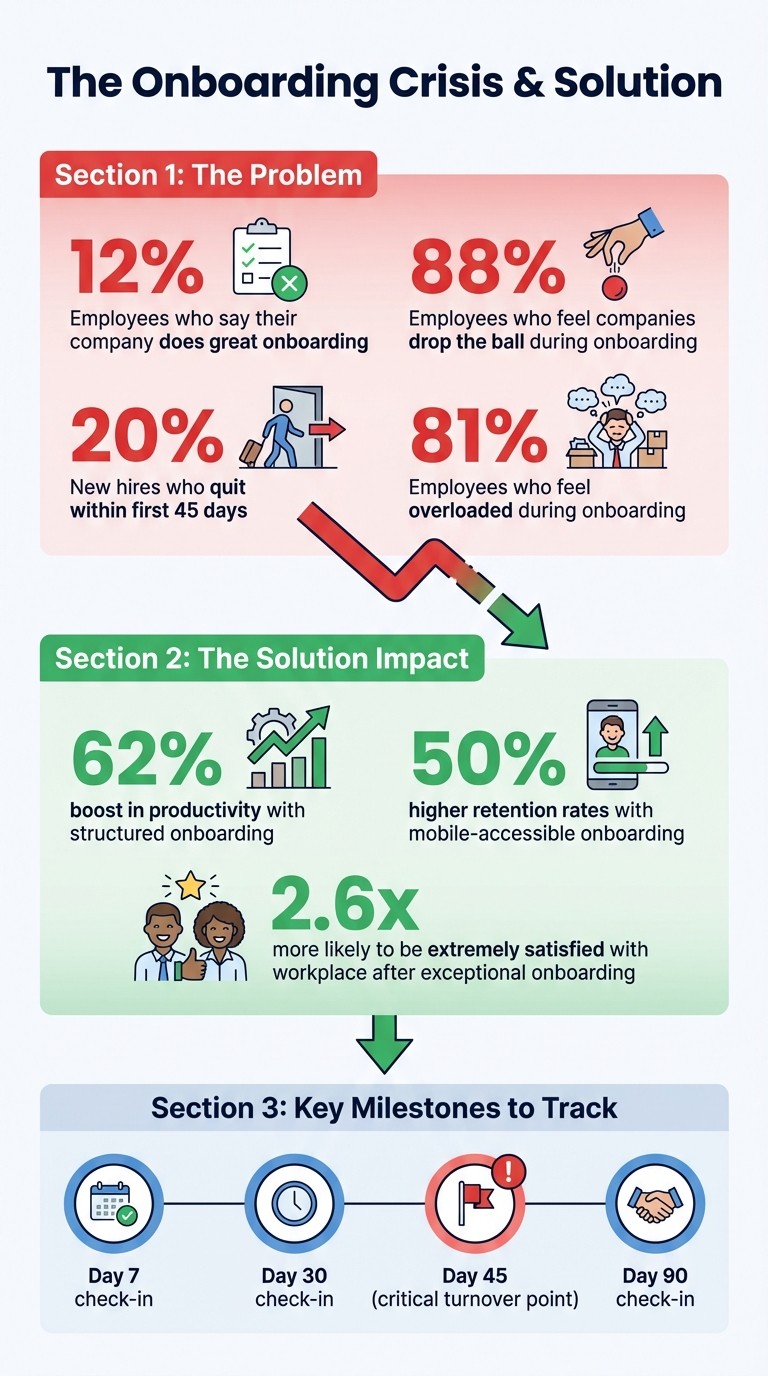
Most onboarding programs fail. Harsh, I know - but let me explain. Only 12% of employees say their company does a great job onboarding new hires. That’s a jaw-dropper when you consider how critical those early days are. And here’s the kicker: up to 20% of new hires quit within their first 45 days. Why? Because most companies treat onboarding like a one-size-fits-all checklist, drowning people in irrelevant information instead of setting them up for success.
I’ve seen this firsthand. At Pebb, we used to struggle with the same problem - generic onboarding that left new hires overwhelmed and disengaged. It wasn’t until we shifted to role-specific onboarding that things changed. Now, our new hires not only feel supported from day one, but they’re also hitting their stride faster and sticking around longer.
In this article, I’m sharing exactly how we approach role-based onboarding at Pebb. From pinpointing what each role needs to leveraging tech that simplifies the process, I’ll walk you through the steps we’ve taken to turn onboarding into a game-changer for retention and productivity. Let’s dive in.
Role-Based Onboarding Statistics and Impact on Employee Retention
Best Practices for Role-Based Onboarding Communication
When it comes to role-based onboarding, clarity and practicality are the name of the game. Let me walk you through how we make it work.
Pinpoint What Each Role Truly Needs
First, you’ve got to dig into what success looks like for each role. At Pebb, we start by chatting with department heads to map out what success should look like at the 30-, 60-, and 90-day milestones. For instance:
A sales rep needs to get comfortable with the CRM and learn the product lineup inside out.
An engineer requires access to system architecture documents and a ready-to-go development environment.
A warehouse associate benefits more from learning safety protocols and understanding shift schedules than a deep dive into company history.
It’s also important to consider seniority. Executives need strategic alignment and stakeholder context, while entry-level hires thrive with foundational training and clear, step-by-step instructions. Pre-boarding skills assessments can be a game-changer here, helping you tailor learning paths to fit each role.
I love the example of BJC Healthcare. With a workforce of 33,000 spread across 15 hospitals, they created a program called "GPS" (Guiding People to Success). This initiative equipped managers with role-specific resources, whether they were onboarding food service workers or neuroscience specialists. It’s a perfect example of how defining role-specific needs can make onboarding seamless and impactful.
Once you’ve nailed down the needs, the next move is to bring in technology to make communication targeted and efficient.
Leverage Tech to Simplify and Personalize
Here’s the thing: relying on spreadsheets and email chains for onboarding is like trying to sail with a leaky boat - it’s messy and inconsistent. Technology steps in to patch those leaks and streamline the process.
Take centralized knowledge libraries, for example. These allow new hires to access everything they need - role-specific guides, FAQs, policies - whenever they need it. At Pebb, we’ve integrated these libraries directly into our platform. Whether it’s shift schedules or training materials, it’s all in one place, accessible from any device. Unlike tools like Slack or Teams, which are great for chat but not for structured onboarding, Pebb provides dedicated spaces for each department. Think targeted announcements, group chats, and content tailored to each role.
Ziggy’s Home Improvement provides another great example. They ditched their old-school, “tie your boots and get to work” approach in favor of structured digital onboarding. As Jordan Worthington, their Training Manager, put it:
"The days of 'tie your boots and get to work' are long gone. Potential hires and new employees are expecting to receive a certain level of care, attention, and structure."
By automating compliance training and setting clear expectations from day one, they saw better retention rates and became more competitive in attracting talent. That’s the power of tech done right.
Keep It Short, Clear, and Mobile-Ready
Now, let’s talk about how you deliver the message. Bombarding new hires with long PDFs? That’s a fast track to overwhelming them - especially when 81% of employees already feel overloaded during onboarding.
For roles like retail associates, warehouse workers, or delivery drivers, mobile-first communication is non-negotiable. At Pebb, we focus on delivering concise, mobile-friendly content through:
Short videos that explain key concepts quickly
Digital checklists to keep tasks manageable
Real-time alerts for schedule changes or updates
Our mobile app doesn’t require a corporate email or desk setup. It’s built for teams on the go, with push notifications, digital forms that fit into daily workflows, and a news feed to keep everyone connected to HQ.
The results speak for themselves. Companies that adopt structured, mobile-accessible onboarding see retention rates jump by 50%. When people can access the information they need, exactly when they need it, they feel supported - and they’re more likely to stay.
How Pebb Simplifies Role-Based Onboarding
At Pebb, we’ve made it our mission to turn onboarding headaches into smooth, role-specific solutions. Our platform was built with one goal in mind: to simplify the process by consolidating all the tools you need into a single, mobile-friendly hub. Why? Because we understand that every role comes with its own unique demands, and a one-size-fits-all approach just doesn’t cut it.
What Sets Pebb Apart from Slack and Teams
Here’s the deal - while Slack and Teams are great for chat, they weren’t designed with onboarding in mind. Pebb, on the other hand, is a true all-in-one employee app for communication and operations. We go beyond just communication by integrating features like work chat, knowledge libraries, shift scheduling, PTO management, tasks, calendar events, and digital forms - all in one place. There’s no need for extra configurations or IT tickets to get started.
And the cherry on top? Our free plan supports teams of up to 15 employees, and our premium plan is just $4/user/month. It’s a solution that combines value with functionality, making it accessible for teams of all sizes.
Features That Make Role-Based Onboarding a Breeze
Let me walk you through how Pebb makes onboarding a tailored experience:
Knowledge Library: Training materials are organized by department, so sales reps can dive into CRM guides while warehouse associates find safety protocols - all accessible from their phones.
Work Chat: Instant check-ins during those critical first weeks are just a message away, helping new hires feel supported from day one.
Operational Tools: Frontline workers can view shift schedules, request time off, and access the employee directory without needing a corporate email or desktop computer. For teams on the go, this is a game changer.
Tasks: From system access to initial project goals, onboarding tasks are tailored to each role. For example, an engineer’s task list might focus on tools and systems, while a sales task list emphasizes client engagement.
These features aren’t just theoretical - they’re already making a real difference for teams across industries.
Real Stories of Pebb Transforming Onboarding
We’ve seen firsthand how Pebb has revolutionized onboarding for teams in retail and manufacturing. The setup is so quick and intuitive that you can have your entire organization up and running in less than a day.
HR managers using Pebb have told us they’ve shifted from a "checklist mindset" to a "connection mindset". Instead of just tracking tasks, they’re using our chat for meaningful check-ins and setting up buddy systems through our groups feature, utilizing modern team directory tools to enhance connection. And when you consider that only 12% of employees believe their company does a great job with onboarding, while 88% feel their companies drop the ball during this critical phase, having a platform that balances structure with human connection is a game changer.
The results speak for themselves. Teams using Pebb report better retention and productivity, proving that personalized, role-specific onboarding isn’t just nice to have - it’s essential for success.
How to Measure Your Onboarding Success
Let me tell you something we’ve learned at Pebb: you can’t just cross your fingers and hope your onboarding program works. Too many companies launch role-based onboarding and then leave it to chance. That’s not how we operate. If you want to see real results, you need data - solid, actionable data - to figure out if your communication strategy is clicking or if new hires are just smiling politely while feeling completely lost.
Metrics to Track
There are a few key metrics we swear by to measure onboarding success. The big one? Time-to-productivity. This metric tells you how quickly a new hire is hitting their role-specific KPIs. For instance, if you’re onboarding a customer support rep, you might track how long it takes them to resolve five tickets independently - ideally by Day 30. For a warehouse associate, it could mean reaching picking accuracy goals within the first two weeks.
Another critical metric is retention rates. Did you know that nearly 20% of employee turnover happens within the first 45 days? That’s why we track retention at 90 days, six months, and one year, broken down by "graduating class." It’s an eye-opener. If you notice engineers leaving around Day 45 but retail associates dropping off closer to Day 90, that’s a clear signal to dig into what’s working - or not - within each role’s onboarding process.
Then there’s engagement metrics, which are just as important. One of our go-to tools is the Net Promoter Score (NPS) for onboarding. It’s as simple as asking new hires, “On a scale of 0-10, how likely are you to recommend this onboarding experience to a colleague?” That one number can reveal a lot. Pair it with training module completion rates to pinpoint exactly where people are dropping off.
At Pebb, we also keep a close eye on communication analytics, like how often messages are read and how quickly people engage with them. These insights help us catch potential issues before they snowball. And here’s the kicker: structured onboarding has been proven to boost long-term retention, and we’ve seen it firsthand through our tracking efforts.
Collect Feedback from New Hires
Here’s the thing: numbers are only part of the story. To really understand what’s happening, you’ve got to talk to your new hires. We’ve found that checking in at key milestones - Day 7, Day 30, and Day 90 - works wonders. Use a mix of quantitative questions, like “On a scale of 1-5, do you have the tools you need?” and open-ended ones, such as “What’s one thing we could have done better?” This combo gives you both the data and the context behind it.
"The 90-day check-in is your chance to actually do something. It should serve as an alignment check and an opportunity for feedback." - Elisa DiMauro, Director of Talent Development, Rent the Runway
At Pebb, we’ve made this process seamless by building polls right into our platform. This way, HR teams can collect feedback automatically without adding extra work to their plates. But here’s the golden rule: close the loop. When you gather feedback, don’t just let it sit in a spreadsheet. Share what you’ve learned with managers and, more importantly, let your team know what changes you’re making based on their input. When employees see their feedback driving real improvements, they’re 2.6 times more likely to feel extremely satisfied with their workplace.
And if someone leaves within those first 90 days? Don’t let that exit interview go to waste. Focus on whether the role expectations communicated during onboarding matched reality. This is where you uncover the gaps between what you promised and what you delivered - and trust me, those insights are pure gold for improving your next round of onboarding.
Conclusion
Let me spell it out: role-based onboarding isn't optional anymore - it’s a must-have. When only 12% of employees feel their company nails onboarding, there’s a huge opportunity to do better. And the payoff? Companies with structured onboarding enjoy a 62% boost in productivity and 50% higher retention rates. That’s not just saving money - it’s keeping top talent from walking out the door within 45 days.
At Pebb, we saw how many organizations were drowning in a sea of disconnected tools, trying to make onboarding work. Juggling Slack, Teams, email, and whatever else is out there often leads to chaos, not connection. That’s why we built an all-in-one employee app for communication and operations that simplifies everything: shift scheduling, news feeds, tasks, calendar events, and digital forms - all starting at just $4 per user. Oh, and for teams of up to 15 people? There’s a free plan.
"The first few weeks aren't a prelude. They're the foundation for everything that follows - an employee's productivity, their connection to the team, and whether they decide to stick around." - Dan Robin, Pebb
Here’s the kicker: employees who go through exceptional onboarding are 2.6 times more likely to be extremely satisfied with their workplace. That kind of satisfaction doesn’t just stop at smiles - it fuels loyalty, stronger productivity, and a workplace culture that draws in top talent. If you’re serious about creating an effective internal communications strategy, tailoring your onboarding process isn’t just smart - it’s the first step in building something great.
FAQs
How does role-based onboarding help retain employees?
Role-based onboarding isn’t just about ticking off boxes or creating a flashy first-day experience. It’s about laying the groundwork for success that lasts. By tailoring the onboarding process to fit the unique needs of each role, you’re giving new hires the tools and insights they need to thrive from the start. Whether it’s learning the right processes, understanding team workflows, or mastering the tools they’ll use daily, this approach helps build confidence, eases early jitters, and fosters a sense of belonging right away.
And here’s the kicker: companies that invest in role-specific onboarding see measurable benefits. Employees not only stick around longer but also excel in their positions. At Pebb, we’ve made it ridiculously simple to make this kind of onboarding a reality. With our all-in-one employee app, you can deliver custom news feeds tailored to specific roles, organize function-focused resources in the knowledge library, assign tasks, and create private groups for effortless collaboration - all without juggling multiple tools. The result? New hires feel supported, connected, and ready to grow, which translates to stronger retention and a more cohesive team.
What are the best tools to improve the onboarding process?
The right tools can transform what might feel like a chaotic onboarding process into something seamless and even enjoyable. At Pebb, we’ve built an all-in-one platform designed to make life easier for both new hires and their teams. Imagine having everything you need in one place - work chats, news feeds, shift scheduling, PTO management, voice and video calls, and even a knowledge library. No juggling multiple tools, no unnecessary headaches. And here’s the kicker: our core solution is free for up to 15 employees, with a premium plan priced at just $4/user/month. That’s about as budget-friendly as it gets for a full-stack solution.
For teams looking for even more support, there are options like learning management systems (LMS) to deliver role-specific training or onboarding software that offers checklists and automated progress tracking. If you’re already using chat-focused tools like Slack, you can enhance onboarding with dedicated channels and real-time Q&A sessions. But here’s the thing - Pebb combines all the essential communication and collaboration features in one streamlined platform. That means your new hires can hit the ground running, feeling confident, connected, and ready to contribute from day one.
Why is it important to make onboarding communication mobile-friendly?
Making onboarding communication accessible on mobile devices is a game-changer, especially for remote or frontline workers who depend on their smartphones. When new hires can easily access key information anytime and anywhere, they feel more connected, supported, and ready to hit the ground running. It sets the stage for a smoother, more engaging onboarding experience.
At Pebb, we’ve made it our mission to meet employees where they are. Our platform is built to ensure seamless communication across all devices, so your team can stay informed and collaborate without a hitch - no matter where they are or what tools they’re using.
