
Author: Ron Daniel
Keep Frontline Employees Engaged - With Better Scheduling & Leave Visibility
Give frontline workers predictable schedules, clear PTO balances, and mobile self-service for shift swaps to cut burnout and reduce turnover.
Let me ask you something: what would your life look like if you never knew your schedule more than a week in advance? For millions of frontline workers, that’s not a hypothetical - it’s their daily reality. I remember when I worked my first retail job, and every Sunday night was a guessing game. Would I have Tuesday off to take my mom to her doctor’s appointment? Could I make it to my best friend’s birthday dinner on Friday? The uncertainty wasn’t just stressful - it was exhausting.
Here’s the kicker: 60% of service-sector workers get less than two weeks’ notice for their schedules, and two-thirds feel like they have to keep their personal lives “open and available” just in case. That kind of unpredictability doesn’t just wear people down; it drives them out the door. And when replacing a single frontline worker costs an average of $4,700, high turnover becomes a business problem, too.
But here’s what I’ve learned at Pebb: when you give employees more control - like letting them check schedules ahead of time, swap shifts easily, or track their PTO without hassle - you’re not just reducing stress. You’re building trust, improving morale, and even boosting productivity. I’ll walk you through the common scheduling pitfalls that hold businesses back and show you how to fix them in ways that benefit both your team and your bottom line. Let’s dive in.
Common Problems with Frontline Scheduling and Leave Management
Frontline scheduling and leave management often feel like a relic of the past, relying on outdated systems that frustrate employees and create chaos for managers. These inefficiencies don’t just hurt morale - they chip away at productivity and trust. Let me walk you through some of the most common issues we’ve seen.
Last-Minute Schedules Lead to Employee Burnout
Imagine trying to plan a family dinner or a doctor’s visit, only to have your work schedule drop in your lap at the last minute. For many frontline employees, this is their reality. Late scheduling forces them to put their lives on hold, always waiting for work to dictate their plans. Doctor’s appointments? Childcare? Forget it - they’re left scrambling.
And while businesses might see just-in-time scheduling as a way to align labor with demand, it’s employees who bear the brunt of the uncertainty. Constantly being on-call or dealing with rotating shifts that mess with sleep patterns can take a serious toll on well-being. Over time, this erodes trust. Employees stop feeling like valued team members and start feeling like cogs in a machine.
"The schedule is more than a list of times. It's the framework upon which your team builds their lives. When that framework is constantly shifting, everything else feels unstable, too."
– Dan Robin, Pebb
Here’s the kicker: poor scheduling doesn’t just hurt employees - it hits productivity, too. In warehouse environments, it can lead to a 15% drop in output. And let this sink in: 82% of shift workers say having control over their schedule is a top priority, with 40% willing to take a pay cut for more predictable hours. That’s how much stability matters.
Unclear PTO Balances and Leave Policies
Now, toss unclear PTO policies into the mix, and you’ve got a recipe for even more frustration. When employees don’t know how much time off they’ve earned or worry that taking a day off might make them look uncommitted, trust takes another hit. Even policies like “unlimited PTO,” which sound great on paper, can backfire. Without clear guidelines, many workers actually take less time off because they fear being judged.
And the burnout numbers don’t lie: 41% of U.S. workers report being burned out, compared to just 27% in countries with more structured leave policies, like Japan. That’s a stark difference.
Manual systems only add fuel to the fire. Sticky notes, texts, and spreadsheets make it way too easy for leave requests to get lost. But here’s something to think about: companies that offer paid time off see a 35% drop in voluntary turnover. That’s loyalty you can’t buy.
"A fair, transparent, and compassionate process tells employees they are supported as whole individuals, not just as workers. This builds psychological safety and deepens loyalty."
– HRcertification.com
And it’s not just about morale - unused PTO costs employers an average of $512 per employee in accrued liability and lost productivity. Those numbers add up fast.
Manual Processes Waste Manager Time
Let’s talk about managers for a second. When scheduling relies on spreadsheets, managers end up spending hours juggling availability, labor laws, and last-minute changes. If someone calls in sick or needs a shift swap, the manager is stuck making phone calls one by one. It’s a time sink that pulls them away from leading their teams or focusing on customer service.
"The most expensive part of bad scheduling isn't the direct cost, but the opportunity cost. It's the leadership, growth, and customer service that never happens because your managers are trapped in administrative quicksand."
– Dan Robin, Pebb
The numbers tell the story: the global market for employee scheduling software is expected to grow from $485.32 million in 2026 to $1,369.44 million by 2035, while workforce management software could hit $12.04 billion by 2031. That’s a lot of businesses realizing they need a better way.
Manual systems also come with compliance risks. Without automated alerts, it’s easy to accidentally schedule overtime or violate fair workweek laws - mistakes that can lead to hefty fines. Spreadsheets just can’t keep up with real-time availability or complex regulations, forcing managers to wear too many hats: accountant, lawyer, and scheduler all rolled into one.
So, what’s the takeaway? Outdated scheduling and leave systems don’t just frustrate employees - they drag down productivity, morale, and even compliance. It’s a lose-lose situation, and it’s clear something has to change.
How to Fix Scheduling and Leave Management Issues
Manual vs Self-Service PTO Management Comparison
Let’s talk about a challenge almost every workplace faces: scheduling and leave management. It doesn’t have to be a constant headache. With thoughtful planning, clear communication, and the right tools, these issues can be addressed effectively - no massive overhaul required.
Scheduling Methods That Reduce Employee Stress
One of the simplest ways to reduce employee stress is by offering fixed shifts. When people know their workdays and hours won’t change week to week, it’s easier for them to plan their lives. Whether it’s arranging childcare, scheduling appointments, or just maintaining some balance, this stability makes a big difference.
Another game-changer? Availability-based planning. Instead of guessing when someone can work, why not ask them directly? Gathering real-time availability and building schedules around it not only reduces last-minute changes but also shows your team you value their time and commitments.
"A schedule built on accurate availability is the foundation of trust. It shows your team you see them as people, not just resources to be managed." – Dan Robin, Pebb
Then there’s advance notice. Posting schedules at least 14 days in advance isn’t just considerate - it’s becoming a legal requirement in many areas. And here’s a small but powerful tip: build in a 15-minute overlap between shifts. This allows outgoing and incoming staff to share important updates, ensuring smoother transitions and fewer hiccups.
While better scheduling eases stress, making time-off requests simple and transparent is just as important.
Self-Service PTO Systems for Clear Leave Tracking
Let’s be honest - sticky notes and spreadsheets are no way to manage PTO. They’re messy, prone to errors, and leave employees frustrated. That’s why self-service PTO systems are a game-changer. These tools give employees control over their leave, letting them check balances, submit requests, and get real-time updates - all from their phones.
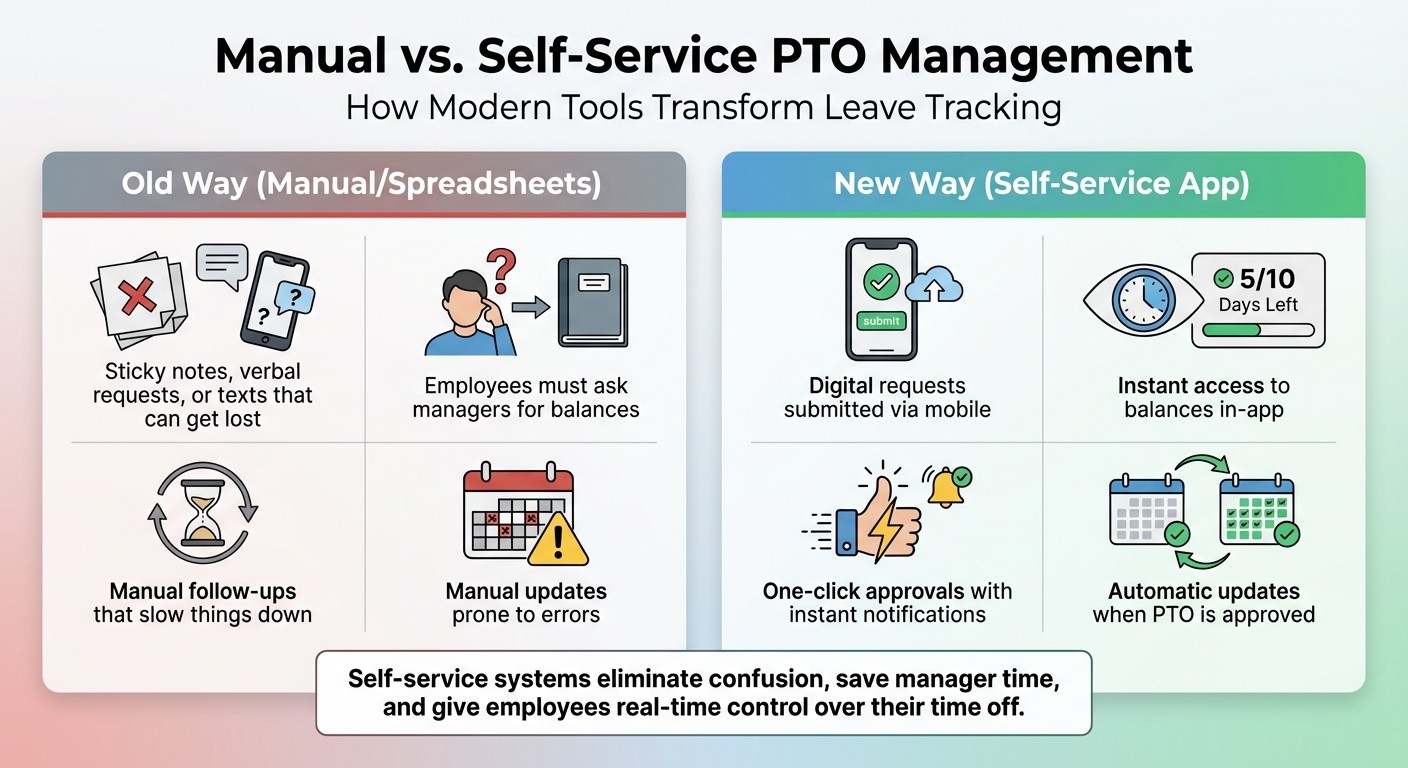
Here’s how the old way stacks up against the new:
Feature | Old Way (Manual/Spreadsheets) | New Way (Self-Service App) |
|---|---|---|
Request Method | Sticky notes, verbal requests, or texts that can get lost | Digital requests submitted via mobile |
Visibility | Employees must ask managers for balances | Instant access to balances in-app |
Approval Process | Manual follow-ups that slow things down | One-click approvals with instant notifications |
Schedule Sync | Manual updates prone to errors | Automatic updates when PTO is approved |
With a system like this, employees no longer have to chase down managers for answers, and managers get to skip the hassle of manual updates. It’s a win-win. Plus, when PTO requests sync directly with schedules, double-booking becomes a thing of the past. That kind of transparency fosters trust and keeps everyone on the same page.
Using Technology to Simplify Scheduling and Leave
Let’s face it - spreadsheets just don’t cut it anymore. They can’t handle real-time availability, flag potential overtime issues, or send push notifications. That’s where mobile-first platforms step in.
Here’s a stat that says it all: frontline employees are 50% more likely to feel equipped for their jobs when their tools are mobile-friendly. Many of these workers don’t have access to company email or desks, so tools that work on their phones are essential.
At Pebb, we’ve taken this to heart. Our platform combines scheduling and PTO management in one place. Managers can drag and drop shifts, employees can trade shifts with a single tap, and everyone gets instant notifications about changes. It’s not just about convenience - it’s about creating a smoother, more engaging workplace.
And the market is moving in this direction. The global employee scheduling software market is expected to grow from $485.32 million in 2026 to $1,369.44 million by 2035. Investing in a mobile-first solution designed for frontline teams isn’t just smart - it’s necessary for building trust and boosting productivity.
Why Pebb Works Best for Frontline Teams
When it comes to keeping frontline teams organized and connected, Pebb was built to tackle the exact challenges they face - especially when it comes to scheduling and managing time off. It's designed to make life easier for teams who are constantly on the move.
Pebb's All-in-One Platform Features
Let me walk you through what makes Pebb such a game-changer. It’s not just a scheduling tool or a messaging app - it's an all-in-one platform that keeps everything in one place. Here’s what you get:
Shift scheduling: Drag-and-drop simplicity makes organizing shifts painless.
PTO management: Employees can check balances and submit time-off requests right from their phones.
News feed: Keep everyone in the loop with company updates.
Work chat: Perfect for quick questions or team discussions.
Voice and video calls: Seamless communication, no extra apps required.
Tasks and digital forms: Stay on top of daily responsibilities.
Clock in/out functionality: Easy tracking for hours worked.
Here’s the thing: over 75% of frontline employees prefer tools that are mobile-first. Pebb creates a single hub where workers can find schedules, pay info, and policies without jumping between apps or systems. And when nearly half of frontline workers feel disconnected from their office-based peers, having a tool that combines communication and operations helps bridge that divide.
Pebb's Pricing: Free and $4 per User/Month Plans
Now, let’s talk cost. Pebb offers two plans that are straightforward and budget-friendly:
Standard Plan: Free for teams of up to 15 employees. It includes work chat, scheduling, PTO management, a news feed, tasks, digital forms, clock in, apps, unlimited spaces, teams & branches, and a calendar - everything you need to get started.
Premium Plan: Just $4/user/month. This adds analytics, unlimited admins, permissions control, advanced work chat, advanced posts, voice and video calls, premium SLA support, integrations, and enterprise SSO to the mix.
When you compare this to other tools, it’s clear Pebb delivers serious value at a fraction of the cost.
How Pebb Compares to Slack, Firstup, and Workvivo
Pebb shines when it comes to frontline-focused features, and it’s far more affordable than many of the big names in the industry. Here’s how it stacks up:
Feature | Pebb (Premium) | Slack (Pro) | Workvivo | Firstup |
|---|---|---|---|---|
Monthly Cost | $4/user | $7.25/user | Custom ($20k min) | $10–$100/user |
Scheduling | Native Included | Third-party only | Integrated | Limited |
Frontline Focus | High (Mobile-first) | Low (Desk-centric) | High | High |
Integrated Voice/Video | Included | Included | Zoom-powered | Limited |
Slack works well for desk jobs but doesn’t cater to frontline needs and relies on third-party apps for scheduling. Firstup excels at communication campaigns but comes with a hefty price tag - anywhere from $10 to $100 per user. Workvivo offers solid social features, but custom pricing often starts at $20,000.
Pebb, on the other hand, is designed with frontline teams in mind. You don’t need a company email or even a desktop. Everything - schedules, time-off requests, team updates - is accessible right from your phone. It’s simple, efficient, and built to keep your team connected, no matter where they are.
Wrapping Up
Frontline employees often face the frustration of unpredictable schedules and confusing time-off policies. It’s no surprise that 82% of shift workers rank control over their schedules as a top priority, and 40% would even accept a pay cut for more flexibility in their working hours. This makes clear and accessible scheduling tools a game-changer for both engagement and retention.
The solution? Give teams the tools to take control. With self-service access to PTO balances, shift swaps, and schedules - all in one mobile-friendly platform - you’re not just solving a scheduling headache; you’re empowering your team. Companies that nail this approach report up to 40% lower turnover and a 200% increase in engagement.
That’s exactly where Pebb shines. We’ve built an app that puts everything your frontline team needs right at their fingertips. From managing shifts to checking time-off balances, it’s all in one place, designed to simplify their work lives.
And here’s the best part: it’s affordable. Our free plan covers teams of up to 15, and Premium is just $4 per user per month. Why wait? Start with Pebb’s free plan today and see how it can transform your scheduling process, boost team engagement, and reduce turnover.
FAQs
How far ahead should we post schedules?
Schedules are the backbone of any smooth operation, and posting them early can make all the difference. Most businesses try to release schedules at least a week ahead. Why? It gives employees the breathing room to review, make requests, or flag availability issues without scrambling at the last minute. With Pebb’s platform, this process gets a whole lot easier. Teams can access and update schedules in real-time, cutting down on miscommunication and avoiding those last-minute headaches. Plus, it’s a simple way to keep frontline teams more in sync and engaged.
What’s the simplest way to make PTO balances visible?
The simplest way to make PTO balances accessible is by using a platform like Pebb. With Pebb’s real-time tracking, both employees and managers can view and manage PTO balances directly within the app. This eliminates the hassle of outdated methods like spreadsheets, making communication smoother, planning easier, and ensuring everyone stays on the same page.
How can we allow shift swaps without losing control?
Pebb’s shift swap tool is a game-changer for managing schedules. Employees can request swaps directly within the platform, and managers have the final say with built-in approval functionality. The best part? Everything happens in real-time, so nothing slips through the cracks. Managers can review, approve, or deny requests with just a few clicks, and the updated schedules appear instantly.
This setup keeps everyone on the same page. It’s transparent, avoids scheduling headaches, and gives employees the flexibility to manage their availability - all while ensuring managers stay in control. It’s a win-win for the whole team.
