
Author: Ron Daniel
Why Factory Workers Need a Mobile Communication Platform
Mobile communication delivers real-time safety alerts, simplifies shift scheduling and PTO, and connects frontline factory workers to improve productivity and collaboration.
Why Factory Workers Need a Mobile Communication Platform
Let me take you back to a conversation I had with a factory supervisor last year. She told me, “We’re running a 24/7 operation, but getting a message to my team feels like playing telephone in a hurricane.” That stuck with me. She wasn’t exaggerating - between the deafening machinery, rotating shifts, and limited access to traditional office tools, her team was missing critical updates. And it wasn’t just her. Across the industry, this communication gap is costing time, safety, and morale.
Here’s the deal: factory floors are a completely different world from office settings. Workers don’t have desks or easy access to email. They’re constantly on the move. And when information doesn’t flow seamlessly - whether it’s a safety alert, a shift change, or a production update - it can lead to delays, frustration, and even accidents. But the good news? There’s a way to fix this.
At Pebb, we’ve seen how mobile platforms can change the game for factory teams. I’m not just talking about convenience - I’m talking about real, measurable improvements. In this article, I’ll share the challenges factory workers face, how mobile tools solve them, and why Pebb is built to meet these needs. Let’s dive in.
Communication Problems Factory Workers Face
When I think about factory workers, I picture people who are constantly on the move - assembling products, operating machinery, and keeping everything running smoothly. But here's the thing: most of them don’t have access to the same communication tools that office employees take for granted. This creates a huge information gap between management and the folks on the production floor who are actually getting things done. Let me walk you through some of the biggest communication challenges they face.
No Access to Desktops or Office Tools
Imagine working in a warehouse or on an assembly line all day. There’s no desk, no computer, and definitely no time to check email or log into a company portal. That’s the reality for most factory workers. Their personal smartphones are often the only device they have, and if the company doesn’t offer mobile-friendly communication tools, they’re left in the dark. No updates, no announcements, no easy way to access policies - it’s like they’re cut off from the rest of the organization. And relying on personal devices? That’s a patchwork solution at best.
Noisy Work Environments
Factories are loud. Between the hum of machinery and the constant movement, it’s nearly impossible to rely on traditional communication methods like PA systems or verbal instructions. And bulletin boards near break rooms? Let’s be honest - how often do workers even get a chance to stop and read those during a busy shift? Important messages often get lost in the noise, literally. What’s needed is a way to break through the chaos and deliver information directly to workers where they are.
Delayed Safety Alerts and Updates
In manufacturing, time is everything - especially when safety is on the line. If there’s a machine breakdown, a hazardous spill, or a sudden change in emergency protocols, workers need to know right away. Delayed notifications can put lives at risk and disrupt operations. Real-time communication isn’t just a nice-to-have; it’s a must-have to keep everyone safe and informed.
Disorganized Shift Scheduling and PTO Management
Scheduling can be a nightmare when systems aren’t connected. Workers often don’t know their shifts, PTO requests get misplaced, and managers scramble to fill gaps in coverage. Want to swap a shift or check your vacation balance? Good luck if the system is manual. This disorganization leads to wasted time and frustration for both workers and supervisors. A mobile-friendly solution could take the headache out of scheduling by making everything accessible instantly.
Poor Team Collaboration
Here’s another challenge: when communication tools don’t connect workers, collaboration falls apart. Think about it - how does the day shift let the night shift know about a production issue or a machine that needs repairs? Without a streamlined way to share updates, teams end up working in silos, which leads to inefficiencies and missed opportunities. A mobile platform could make all the difference, enabling smooth communication across shifts and keeping everyone on the same page.
How Mobile Platforms Solve Factory Communication Problems
Let me share something we’ve learned firsthand: factory communication is no walk in the park. The constant noise, the fast pace, and the sheer size of the floor make it a challenge to keep everyone informed. But here’s where mobile platforms truly shine - they meet workers where they already are: on their phones, in the thick of their shifts. These tools tackle factory-floor communication problems head-on, and the results speak for themselves.
Real-Time Updates with Push Notifications
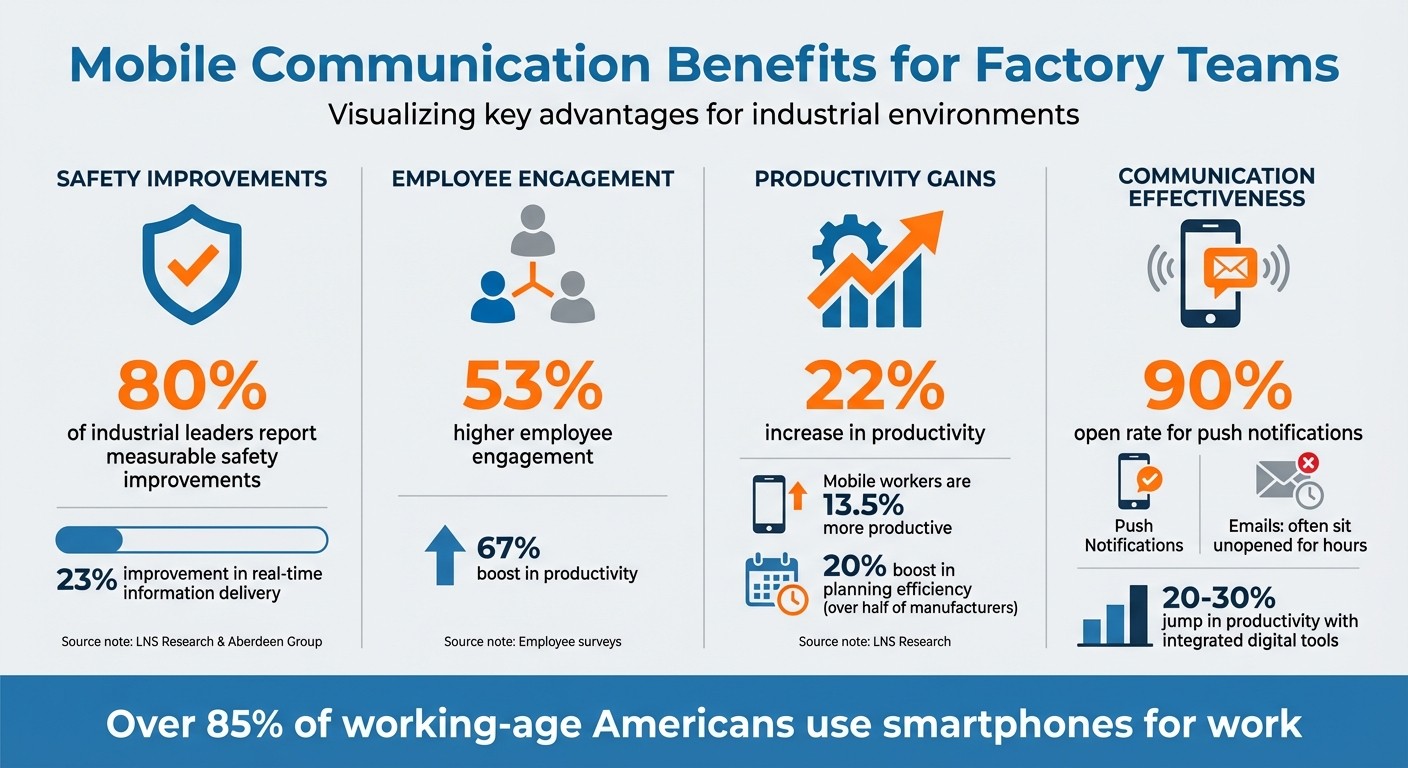
Imagine this: a machine breaks down, and within seconds, every relevant worker knows. That’s the power of push notifications. They cut through the noise - literally - and deliver critical updates instantly. Whether it’s a safety alert, a schedule change, or a production issue, workers get the message right when they need it. Emails? Forget it. They often sit unopened for hours. Push notifications, on the other hand, boast a 90% open rate and ensure urgent updates don’t go unnoticed. Some companies using mobile communication tools report a 23% boost in their ability to share real-time information. That’s a game-changer for staying ahead of issues.
Access from Personal Smartphones
Here’s the beauty of mobile platforms: they don’t require fancy hardware. Workers can use their own smartphones, which are already in their pockets. This BYOD (Bring Your Own Device) approach is not just cost-effective for companies but also incredibly convenient for employees. Workers can check updates during a coffee break, review safety protocols before clocking in, or even get shift reminders while relaxing at home. It’s seamless and ensures that even those without desks or computers stay in the loop. By breaking down communication barriers, personal smartphones keep every worker connected to what matters most.
All Tools in One Platform
Now, let’s talk about simplicity - because no one wants to juggle multiple apps or systems. Mobile platforms that consolidate everything into one app are a breath of fresh air. Shift schedules, PTO requests, task management, instant messaging, and company updates all live in one place. No more confusion, no more wasted time hunting for information. Research backs this up: companies that adopt integrated digital tools see a 20-30% jump in productivity. Workers can focus on their tasks instead of chasing down details, and that efficiency adds up fast.
Benefits of Mobile Communication for Factory Teams
Mobile Communication Impact on Factory Productivity and Safety Statistics
Mobile platforms are game-changers when it comes to improving safety, scheduling, teamwork, and overall productivity on the factory floor. By addressing delays and disorganized workflows, they pave the way for smoother operations and better outcomes.
Better Safety with Instant Alerts
Safety is the backbone of any factory operation, and mobile platforms make it easier to protect workers. Alerts sent straight to smartphones ensure that critical information gets to the right people in seconds. According to LNS Research, 80% of industrial leaders report measurable safety improvements thanks to connected worker tools that provide real-time alerts and troubleshooting capabilities. Imagine starting a shift with instant quality alerts or receiving sensor notifications during production - these tools reduce delays, prevent defects, and enhance safety. In fact, the Aberdeen Group found that manufacturers using mobile tools improved real-time information delivery by 23%. Faster access to information means faster responses, especially in high-stakes safety scenarios.
Easier Shift Scheduling and PTO Management
Managing shifts and PTO requests doesn’t have to be a headache. Mobile platforms centralize these processes, letting workers check schedules, swap shifts, and submit requests directly from their phones. Notifications keep everyone in the loop, cutting down on confusion and giving employees more autonomy over their schedules. This is a big win for workers managing irregular hours or balancing personal responsibilities. Plus, when scheduling runs smoothly, collaboration across shifts becomes far more effective.
Better Team Collaboration and Engagement
Mobile platforms foster collaboration in ways that traditional systems simply can’t match. Need a part or have a problem to solve? Group chats make it easy to connect instantly. Want to share updates or celebrate wins? News feeds with text, videos, and infographics keep everyone informed and engaged. Video calls even allow operators to troubleshoot directly with engineers without leaving their stations. The results speak for themselves: employee surveys show 53% higher engagement and a 67% boost in productivity among workers using mobile-first communication tools. These platforms ensure that everyone, from tech-savvy newcomers to seasoned veterans, feels included and valued.
Higher Productivity and Efficiency
When communication flows seamlessly, productivity skyrockets. Mobile platforms simplify workflows with real-time updates, digital checklists, and instant troubleshooting. This translates into a 22% increase in productivity and shows that mobile workers are 13.5% more productive than those who aren’t using such tools. Onboarding is faster, issues are resolved on the spot, and defects are minimized. According to LNS Research, over half of manufacturers using connected solutions report a 20% boost in planning efficiency, which drives productivity even further. These gains underscore the importance of a unified solution like Pebb, designed to bring all essential tools together for factory teams.
Why Pebb Works Best for Factory Teams
Let me share why Pebb has become such a game-changer for factory teams. Designed with the realities of factory floors in mind - think noisy environments, constant movement, and packed schedules - Pebb puts everything workers need right in their pockets. It’s not just another platform; it’s a mobile-first solution built for teams that don’t sit at desks all day.
All Communication and Operations Tools in One App
Here’s the thing: factory workers don’t have time to switch between multiple apps to keep things running. That’s why Pebb combines work chat, shift scheduling, PTO management, tasks, digital forms, calendar events, clock in, news feeds, and more into one app. Imagine being able to check your schedule, request time off, or send a quick message - all without leaving a single platform. It’s seamless, efficient, and keeps everyone on the same page, no matter how hectic the day gets.
Affordable Pricing for All Teams
Budget constraints are a reality for most factory managers, and that’s where Pebb really shines. We offer a free Standard plan for up to 15 employees, while our Premium plan costs just $4 per user per month. Compare that to competitors like Slack, which charges $7.25–$8.75 per user, or Workvivo, which starts at a jaw-dropping $20,000 annually. Even Microsoft Teams, at $4 per user, requires you to already pay for Microsoft 365. With Pebb, you’re getting an all-in-one solution that won’t break the bank - a lifesaver when you’re outfitting an entire frontline team.
Built for Frontline and Deskless Workers
We built Pebb with one goal in mind: make it so easy to use that anyone can pick it up and get started. The mobile-first design means workers can quickly check their schedules, send messages, or even receive safety alerts - all without slowing down. Considering that 70% of US workers are mobile or deskless, platforms like Pebb aren’t just convenient - they’re absolutely essential for keeping factory teams connected and productive.
Wrapping It Up: Why Mobile Communication Matters
Factory floors are noisy, chaotic, and unpredictable - trust me, I’ve seen it firsthand. That’s where mobile platforms come in, cutting through the noise (literally) to make communication faster and easier. Whether it’s delivering instant safety alerts, organizing shift schedules, or encouraging real-time collaboration, mobile tools are changing the way factories operate. And the results? Clear productivity gains that show just how powerful digital tools can be for manufacturing.
Here’s the thing: mobile communication isn’t just a nice-to-have anymore - it’s a must. With over 85% of working-age Americans already using smartphones for work, the numbers speak for themselves. Companies leveraging mobile communication report 53% higher employee engagement and 67% productivity gains. That’s not just a little boost - it’s a game-changer.
At Pebb, we’ve built an all-in-one employee app specifically for teams like yours. Our app brings everything together in one place: schedules, safety updates, work chats, tasks, digital forms, calendar events, even PTO management. And it’s designed with frontline workers in mind - those who don’t have the luxury of sitting at a desk all day but still need instant access to critical tools. Best of all? It’s affordable. For just $4 per user per month, or completely free for teams of up to 15, you can get everything your team needs without breaking the bank.
So, what’s next? Equip your factory team with Pebb today. Improve safety, simplify scheduling, and keep everyone connected - all without needing a desktop. Start with our free plan and see how mobile-first communication can transform your operations. Let’s make it happen!
FAQs
How can mobile communication platforms make factory floors safer?
Mobile communication platforms play a key role in improving safety on the factory floor. They provide real-time updates, instant safety alerts, and enable smooth communication between workers and teams. This means potential risks can be addressed swiftly, helping to minimize accidents and avoid unnecessary downtime.
These tools also simplify safety procedures. For instance, they can alert workers to nearby hazards, coordinate emergency responses, and ensure compliance with safety regulations. By keeping everyone connected and informed, mobile platforms help create a workplace that’s not only safer but also more efficient - perfect for the fast-moving demands of factory environments.
How does Pebb save money for factory teams?
Pebb is designed to help factory teams cut costs while staying connected with an all-in-one employee app for communication and operations priced at just $4 per user per month. What's great is that there are no surprise fees - everything your team needs is included, from work chat and shift scheduling to PTO management, tasks, and digital forms.
By combining multiple tools into one streamlined solution, Pebb eliminates the hassle and expense of juggling separate subscriptions. This not only saves money but also boosts team collaboration and productivity in the process.
Why is instant communication crucial for factory workers?
Instant communication is a game-changer for factory workers. It ensures they get real-time updates that directly impact safety, productivity, and the smooth flow of operations. Think about it: in a fast-moving manufacturing environment, where employees often don’t have access to computers or email, how else can you keep everyone in the loop? This is where a mobile communication platform steps in.
With tools like Pebb, teams can receive immediate alerts, coordinate shifts effortlessly, and collaborate more effectively. The result? Quicker problem-solving, a safer work environment, and a more organized team - all without breaking the bank. It’s the kind of solution that keeps the factory floor running like a well-oiled machine.
