
Author: Ron Daniel
Ditch Spreadsheets for Good: Smarter Shift + PTO Management
Replace spreadsheets with a single app for shift scheduling and PTO: drag-and-drop schedules, real-time alerts, mobile access, and payroll exports.
Have you ever tried managing a team’s schedule with spreadsheets? I have, and let me tell you - it’s a nightmare. I remember one week when back-to-back shift swaps, missed PTO requests, and outdated files had me scrambling to keep things on track. By Friday, I was knee-deep in emails, group texts, and sticky notes, trying to figure out who was working when. It felt like I was solving a puzzle, except half the pieces were missing. Sound familiar?
Here’s a reality check: spreadsheets weren’t built for managing people. Sure, they’re great for crunching numbers, but when it comes to handling dynamic schedules, overtime rules, or last-minute changes, they fall apart. And the stats back it up - 94% of spreadsheets used in businesses contain errors, and those mistakes cost companies hundreds of dollars per payroll cycle. Worse, they waste hours of time that managers like us could be using to actually lead our teams.
That’s why we built Pebb. It’s an all-in-one employee app for communication and operations that eliminates the chaos of spreadsheets, keeps your team on the same page, and saves you time (and headaches). Today, I’ll walk you through how it works, why it’s a game-changer, and how you can finally ditch the spreadsheet chaos for good.
Why Spreadsheets Fail for Shift and PTO Management
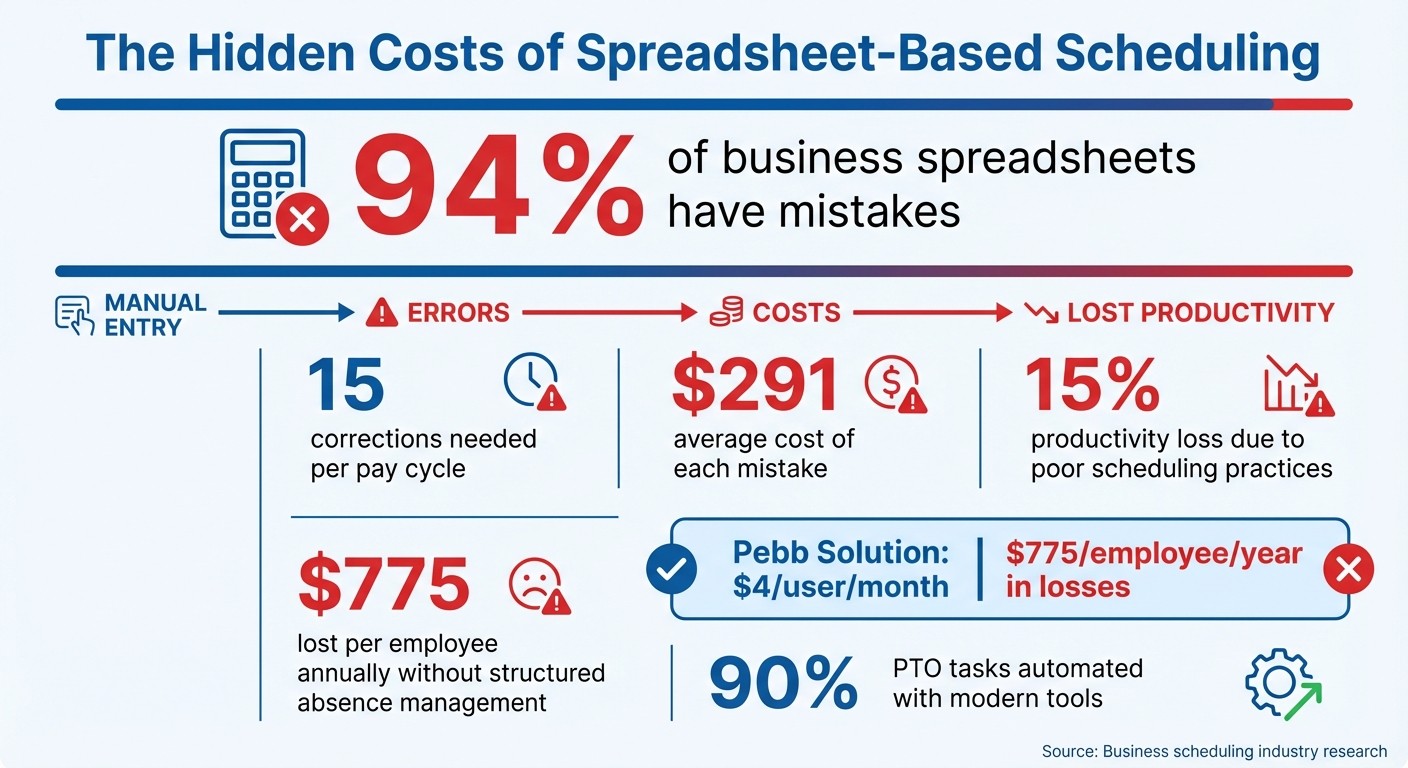
The True Cost of Spreadsheet Scheduling: Errors, Time Loss & Financial Impact
Let me share a hard truth: 94% of spreadsheets used in business decision-making contain errors. That’s staggering, right? If you’re managing your team’s schedule or PTO using spreadsheets, chances are, there’s a mistake lurking in there, just waiting to cause problems.
Manual Entry: A Recipe for Mistakes
Here’s the thing - every time you manually enter data, you’re opening the door to errors. Maybe it’s a typo in the hours worked, a miscalculation in pay rates, or a formula that goes haywire. It happens more often than you’d think. On average, employers make 15 payroll corrections per pay period, and each mistake costs about $291. Now, that’s just the financial hit. Add in the time managers spend fixing those errors and the frustration employees feel when their paycheck is wrong, and you’ve got an even bigger issue.
And let’s not forget about formula creep - you know, when you copy and paste a “quick fix,” and suddenly your overtime or holiday pay calculations are all over the place. Things get even messier when you’re manually transferring data from your scheduling spreadsheet to payroll. If you’re dealing with PTO accruals that depend on tenure or irregular hours, spreadsheets simply can’t handle that level of complexity.
But the problems don’t stop with errors. Spreadsheets also fall short when it comes to keeping everyone on the same page.
Static Grids in a Dynamic World
"A spreadsheet is just a static grid. Scheduling is a living, breathing process. It can't tell you who's about to hit overtime, who is actually free to cover a sick call, or if a team member has even seen the latest version."
Dan Robin, Pebb
Dan hit the nail on the head. Spreadsheets are stuck in time. Let’s say someone calls in sick - suddenly, that neat little grid is outdated. There are no automatic alerts to warn you about overtime limits or incoming PTO requests. Instead, you’re left scrambling to manually update the file and praying everyone is working off the latest version. Is it the one you emailed? The printed copy in the break room? Or the version saved on someone’s desktop? Good luck figuring that out.
And even if you manage to keep the file updated, getting it into the hands of your team is another story.
Accessibility: The Missing Link
Think about your team members on the ground - the ones who don’t have a desk or a company laptop. They’re not sitting around refreshing their email to check for an updated schedule. More often than not, they’ll shoot a quick text asking about their shift. That’s not just inconvenient; it’s inefficient.
Then there’s the issue of sharing. Traditional spreadsheets often lock out multiple users. If your assistant manager needs to make a change, they might have to wait for the file to become available. Meanwhile, the delay could mean someone misses an updated shift, leading to confusion and frustration.
Spreadsheets might have been a go-to tool in the past, but when it comes to managing dynamic schedules and PTO, they’re falling behind - big time.
How Pebb Simplifies Shift and PTO Management
At Pebb, we’ve made it our mission to take the headaches out of communication, scheduling, and time-off management. By combining these functions with tasks, digital forms, events, and real-time communication, we’ve created a one-stop solution that works from any device. No more juggling spreadsheets, emails, and sticky notes - everything your team needs is in one place.
Effortless Shift Scheduling
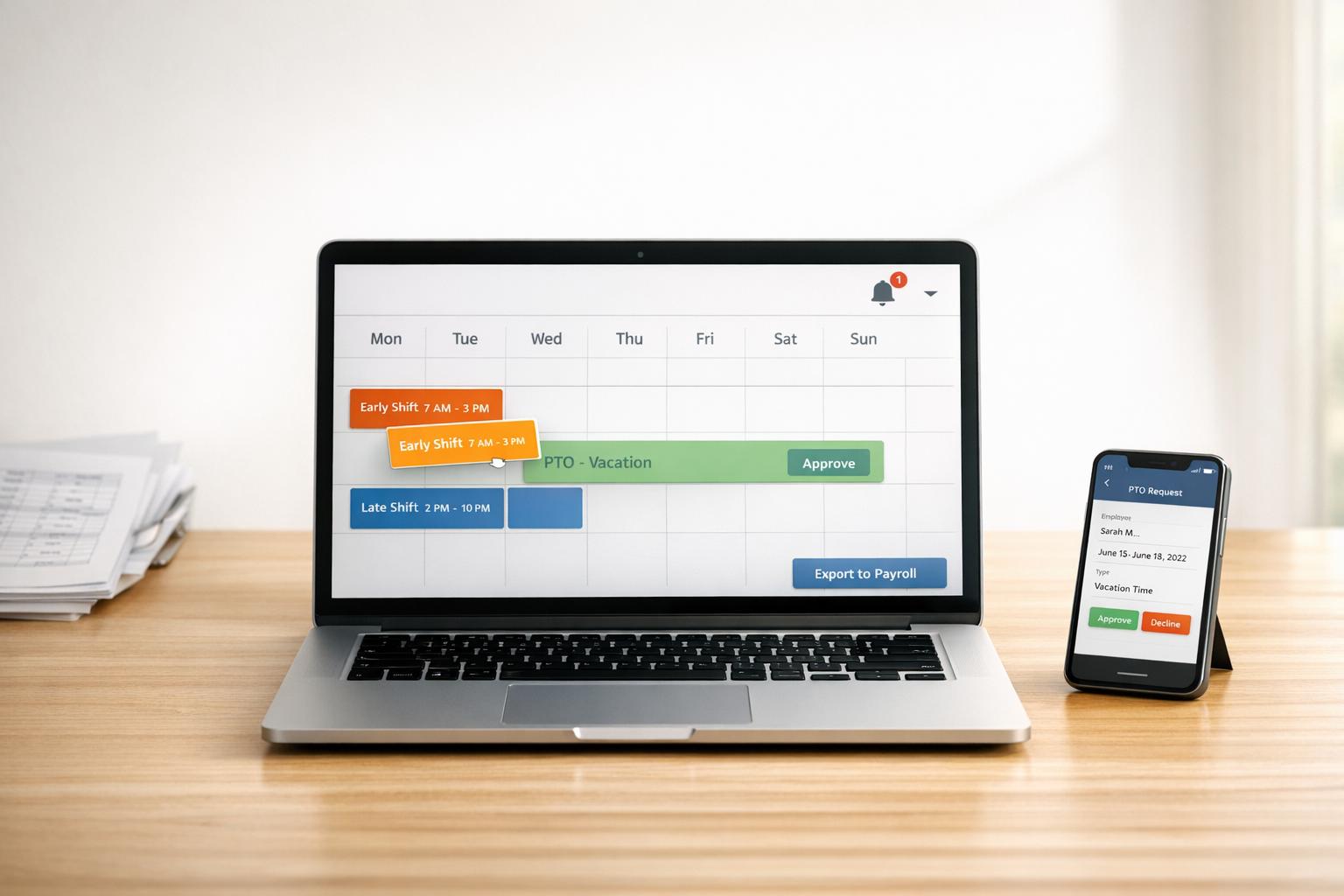
Scheduling shifts in Pebb is as straightforward as it gets. With our drag-and-drop interface, you can build weekly or monthly schedules in just minutes. Got a last-minute change? Drag the shift to a new slot, and you’re done. Want to save time by reusing last week’s schedule? Just copy it with a single click.
Here’s where Pebb really shines: real-time updates. The moment you publish a schedule, every team member gets an instant push notification on their phone. No more missed emails or outdated bulletin boards. Plus, if there’s an issue - like double-booking or someone nearing overtime - Pebb flags it immediately, so you can fix it before it becomes a problem.
We’ve also added a Shift Swaps channel, where employees can handle coverage changes themselves. They coordinate, you approve it with one tap. It’s that simple.
Streamlined PTO Management
Handling PTO has never been easier. Employees can submit their time-off requests directly from their phones, and the requests pop up on your dashboard for quick approval. Once approved, the time-off is automatically blocked on the schedule - no manual updates required.
Everyone on the team can see who’s off and when, thanks to real-time visibility. This integration keeps your scheduling accurate and eliminates the miscommunication that often comes with spreadsheets. And when payroll time rolls around, all the PTO data is ready to go - no manual entry or extra steps.
Communication in Real Time
Pebb’s built-in Work Chat and News Feed make sure everyone stays in the loop. Announce a shift change on the News Feed, and your team sees it instantly. Need to check coverage or answer a quick question? Use Work Chat for direct messaging.
For your frontline workers - those without desks or company laptops - everything is accessible through frontline worker solutions on their phones. They get real-time notifications, can respond to updates, and even swap shifts without picking up the phone. It’s all connected and easy to use.
And here’s the kicker: all of this is available for just $4 per user per month with our Premium plan. If you’re a smaller team, our Standard plan is free for up to 15 employees. That includes shift scheduling, PTO management, tasks, digital forms, calendar events, and all the communication tools you need to finally say goodbye to spreadsheets.
With Pebb, managing schedules and PTO doesn’t just get easier - it becomes something you don’t have to think twice about.
Getting Started with Shift and PTO Management in Pebb
We designed Pebb to make your life easier - no IT headaches, no complicated setup. Let me walk you through how to get your team onboarded and managing shifts and PTO with ease.
Adding Your Team to Pebb
The first step is setting up your workspace and organizing your team by departments. This keeps everything streamlined, from communication to scheduling.
Here’s what I love about Pebb: it’s built for frontline teams who rely on their phones, not email or desktop setups. You can send unique mobile invite links to your team, and they’ll be able to join in seconds from any mobile device. Quick and simple.
While setting up, you’ll define department structures, outline PTO policies (like how much notice is required), and decide who gets administrative permissions for things like approving shifts. Once that’s done, you’re ready to roll. To keep everyone on the same page, post schedules consistently and share them in both the News Feed and dedicated scheduling channels. I recommend creating specific channels like “Weekly Schedules,” “Shift Swaps,” and “Time-Off Requests” to keep everything organized. Pin a message in the time-off channel with your company’s policies - something like “two weeks’ notice required for PTO” - so there’s no confusion.
Setting Up Shift and PTO Rules
Now that your team is onboard, it’s time to configure your scheduling rules to match how your business operates. For recurring schedules, like regular lunch or dinner rushes, you can create reusable shift templates. Trust me, this will save you a ton of time every week.
For PTO, you can set up workflows that make sense for your team. Decide how much notice employees need to give, who approves requests, and how time off is tracked. Once these rules are in place, Pebb takes care of the rest. Time-off requests will show up on your dashboard for quick approval - no more juggling spreadsheets or worrying about double-booking shifts.
"The goal isn't just to fill empty slots. It's to build a predictable, fair, and transparent system that respects everyone's time - both the business's and the employee's." - Dan Robin, Pebb
With your shift and PTO rules locked in, the next step is connecting everything to your payroll system.
Connecting with Payroll Systems
One of the best parts of using an all-in-one employee app like Pebb is how it simplifies payroll. With the Premium plan, Pebb offers integrations, automatically syncing shift and PTO data. That means overtime calculations, PTO payouts, and timecards are handled without you lifting a finger.
If your payroll system doesn’t integrate directly, don’t worry. Pebb offers export options that are easy to use - no complicated reformatting needed. Just download your data and upload it to your payroll software. To keep things running smoothly, make sure to sync timecards regularly and approve all shift swaps and PTO requests before the payroll period ends. You can also use Pebb’s Knowledge Library to build a knowledge base for payroll policies and step-by-step guides so employees always know how their pay is calculated.
The Financial Benefits of Better Shift and PTO Tools
Switching from spreadsheets to Pebb isn’t just about convenience - it’s about saving money and improving efficiency in ways that directly impact your bottom line.
Save Time and Work More Efficiently
Here’s something to think about: companies without a structured absence management plan lose an average of $775 per employee, per year. Add to that the fact that poor scheduling eats up about one in every seven hours of work, cutting productivity by as much as 15% in operational environments. That’s a lot of wasted potential.
With Pebb, about 90% of PTO tracking tasks are automated. This means managers no longer have to waste hours updating spreadsheets, chasing down approval emails, or manually crunching overtime numbers. Instead, they can put their energy where it really matters - leading teams, serving customers, and driving growth.
Fewer Errors and Lower Risk
Let’s face it: manual tracking is a ticking time bomb when it comes to compliance. Did you know that at least 20 U.S. states - including California, Colorado, and Illinois - require companies to pay out the full value of unused PTO when an employee leaves? In Colorado, failing to do so within 14 days could mean paying double the owed wages. That’s a costly mistake no one wants to make.
Pebb steps in where spreadsheets fall short, automatically flagging potential overtime risks and compliance issues. Whether it’s approving a shift swap or a PTO request, the system instantly checks for conflicts, overtime violations, and coverage gaps. No more payday surprises or compliance headaches. This not only protects your business but also helps create a more stable and engaged workforce.
Better Team Morale and Satisfaction
Unpredictable schedules are a recipe for burnout and high turnover, especially for frontline staff. And let’s not forget the price tag of replacing a trained employee - it’s far more expensive than Pebb’s $4 per user per month. Think about recruitment costs, training time, and the dip in productivity while a new hire gets up to speed.
With Pebb, your team gets the tools they need to thrive. They can easily view schedules, request time off with a click, and stay updated in real-time. This kind of control over their hours makes a huge difference. In fact, 40% of shift workers say they’d even consider a pay cut for more scheduling flexibility. By using Pebb, you’re not just cutting admin costs - you’re investing in happier, more loyal employees who stick around longer. That’s a win-win for everyone.
Wrapping It Up: Why Spreadsheets Just Don’t Cut It
Let’s be honest - spreadsheets were never meant to handle the chaos of scheduling. They falter when availability changes, swaps happen at the last minute, or PTO requests come flooding in from a mobile team. And yet, so many managers are stuck wrestling with them, drowning in manual updates, approval chains, and overtime calculations. That’s exactly why we created Pebb.
Here’s the thing: scheduling isn’t just about plugging holes in a calendar. As Dan Robin wisely said, "The goal isn't just to fill empty slots. It's to build a predictable, fair, and transparent system that respects everyone's time". Pebb makes that vision a reality - for just $4 per user per month.
With the employee scheduling software market set to grow from $485.32 million in 2026 to a whopping $1,369.44 million by 2035, it’s clear businesses are moving on from outdated tools. The real question is: how much longer can you afford to lose time, money, and good employees to clunky spreadsheets?
Pebb simplifies everything. Drag-and-drop scheduling, automated PTO tracking, tasks, digital forms, calendar events, real-time updates, and unified team communication - all in one platform. It eliminates the headaches of scattered tools, version mix-ups, and compliance worries. Whether you’re on your phone or desktop, it just works.
This isn’t just about saving time. It’s about creating a workplace where your team feels supported, shifts run smoothly, and everyone can focus on what really matters. So, if you’re ready to ditch the spreadsheet chaos, Pebb is here to help you build a better, more efficient system - one shift at a time.
FAQs
How hard is it to switch from spreadsheets to Pebb?
Switching from spreadsheets to Pebb feels like upgrading from a flip phone to a smartphone - everything just works better. With Pebb's all-in-one platform, managing shifts and PTO becomes a breeze. Features like drag-and-drop scheduling, real-time updates, and mobile access make the process faster and far less frustrating.
Let me tell you, the difference is night and day. No more dealing with outdated data or scrambling to fix manual errors that spreadsheets are infamous for. Pebb is designed with both frontline and office employees in mind, so everyone benefits from the simplicity. The best part? The transition is quick and painless, cutting down on administrative headaches and saving you time from the very start. It’s a game-changer for efficiency.
Can employees swap shifts and request PTO from their phones?
Managing schedules on the fly has never been easier. With tools like Pebb, employees can swap shifts or request PTO directly from their phones. The platform is designed with mobile users in mind, offering features like shift scheduling, PTO management, and team communication all in one place. It’s a game-changer for anyone who needs to handle their work schedule while on the move.
Will Pebb work with my payroll system?
Pebb works seamlessly with your existing payroll system, simplifying HR tasks like payroll processing. This integration helps cut down on administrative work and reduces the chances of mistakes, ensuring your operations run more smoothly.
